
ALLENCOMM BLOG | Insights
A Tale of Two Flights
August 26, 2010
While traveling during two recent international flights, I had time to ponder the definitions of some of the training objectives we encounter working with our clients, and how those objectives are mapped to the actions needed by the learners to fulfill their jobs. The following two stories from a training perspective seem very simple.
On the first 13 hour flight, I observed that the flight crew was not able to supply ice or start playing movies for the economy cabin. During the return flight I observed that the flight crew was refusing to serve meals to an infant on a mother’s lap.
Curious at this odd behavior on the different flights, I asked to speak to the Purser. The explanation for the lack of movies and ice incident was that the crew was new to that type of aircraft, due to a merger, and they had no idea how to work the ice machine or the movie system. On the return flight, the hungry 2-year-old wasn’t being unfairly persecuted, the attendant was simply following the no seat-no meal rule of the airline. In both situations, my discussion with the Purser made it clear that reaction to the situation taken by the attendants did not reflect the best desired action that should have been taken by the attendant.
The proliferation of online and self-paced content has the potential of blurring the line between the content and its intended consequence. It would be obvious to most of us that the value of training is only as good and the decisions and actions undertaken as a result of the training. While any decisions we make can be mediated by the experience and context of any given situation, the right design can influence more optimal actions by learners. Design leads at Allen have faced this dilemma for years and follow approaches based on Cathy Moore’s Action Based Mapping model (http://blog.cathy-moore.com/2008/05/be-an-elearning-action-hero/) as a feasible way to avoid the pitfalls of dissonance between the content and the actions they should trigger.
To quote some of the guidelines we provide to our designers:
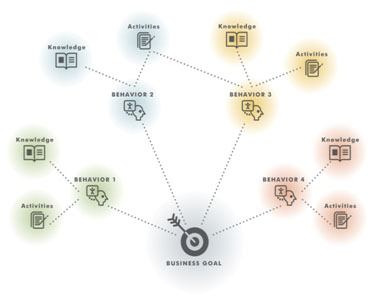 To create value, corporate training needs to be more than a presentation of information; instead, it should help learners perform the real-world behaviors that will allow your organization to meet its business needs. In our training designs, we put action over knowledge: we emphasize what learners need to do to support a business goal, rather than what they need to know. This process is called action mapping.”
Our use of the “to do” is not isolated to a physical action such as which button to press but as in our tale ….. relates to actions that combine rules, customer service and some level of creativity.
In the case of our two flights, the Purser was able to find the one crew members with knowledge to work the movies (alas no ice for us this flight). In the case of the toddler a few passengers offered to provide their own meals until the attendant found an extra meal to serve the toddler.
No custom training intervention is ever perfect, but we should not shortchange our employees either. Given the focus on the desired actions, optimal outcomes will follow suit.
Find out more about our custom training solutions.
Resources For L&D Leaders

free guide
free guide
insights | on the blog

ALLENCOMM Press Releases
AllenComm Earns Spot on Best Mobile Learning Content Providers 2026 List
eLearning Industry honors AllenComm for its custom mobile learning solutions for enterprise, built to improve performance outcomes at scale. SALT LAKE CITY, [July 29, 2026] — AllenComm has been named to eLearning Industry’s...
ALLENCOMM Press Releases
AllenComm Named a Top Employee Engagement Training Provider by eLearning Industry
AllenComm has been recognized by eLearning Industry as a 2026 top provider for employee engagement, cited for scalable, personalized L&D that drives measurable results. SALT LAKE CITY, [June 24, 2026]...
ALLENCOMM Press Releases