
ALLENCOMM BLOG | Insights
Adding Virtual Collaboration to Interactive eLearning
October 3, 2012
As a well-known fact, one of the advantages of classroom instruction compared to self-paced corporate training is that the learners can share their own stories, problems, and solutions with their peers. By doing so, they feel “comforted” that they are not facing similar challenges alone. Often, by telling their stories out loud, learners see things more clearly and from different perspectives. This type of collaboration is an effective strategy for teaching learners how to apply abstract concepts and principles to real-life situations. People learn from each other by discussing a variety of relevant, real-life situations that they can easily relate to and by sharing their best practices, successes, and mistakes.
So, what can we do to include a similar strategy in an interactive eLearning course?
When considering a social learning component in our design, we are often faced with the following questions:
• How can we formalize informal learning?
• How can our clients monitor/moderate learner-generated content? Do they need to?
• Are our clients ready to “trust” the learners to be responsible for their own learning or for “modifying” the content?
• Do our clients have the right tools and infrastructure?
This list can go on and on. But, instead of trying to find answers to the complex questions, we should start looking for simple solutions— at least, as a starting point. Here is an example.
In most cases, a web-based training course provides one or two representative examples or scenarios for each concept, process, and principle. Some learners may not relate to those examples since they may not be specific for their role, situation, etc.

Consider including virtual collaboration that can help meet the unique needs of individual learners. First, the learners work independently in the tutorial part of each lesson. Then, they submit personal example(s) for each category and review a variety of examples from other learners. Similar to a classroom environment, they learn from each other’s stories and experiences.
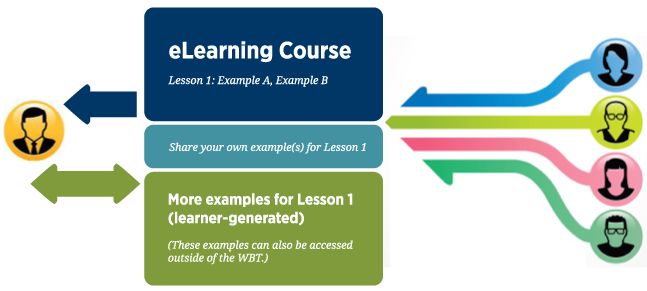
In this example, learners have a choice of connecting with like-minded people with whom they can “communicate” and share ideas, resources, and experience. They not only collaborate but they also co-create content and learn together. By combining personal and social learning environments, learners more actively participate in the learning process.
What’s your approach? Have you introduced “social” components in your interactive eLearning courses? What advantages have you observed?
Resources For L&D Leaders

free guide

free guide
insights | on the blog
ALLENCOMM Press Releases
AllenComm Earns Spot on Best Mobile Learning Content Providers 2026 List
eLearning Industry honors AllenComm for its custom mobile learning solutions for enterprise, built to improve performance outcomes at scale. SALT LAKE CITY, [July 29, 2026] — AllenComm has been named to eLearning Industry’s...
ALLENCOMM Press Releases
AllenComm Named a Top Employee Engagement Training Provider by eLearning Industry
AllenComm has been recognized by eLearning Industry as a 2026 top provider for employee engagement, cited for scalable, personalized L&D that drives measurable results. SALT LAKE CITY, [June 24, 2026]...
ALLENCOMM Press Releases