

ALLENCOMM BLOG | Insights
Tips for Instructional Designers- Avoiding Scope Creep
December 18, 2012
Whether you’re a beginning instructional designer or a seasoned veteran in the business, you are most likely familiar with the term “scope creep.” Like most of us, you have probably even been guilty of allowing scope creep to enter a project—to some degree. Christopher Butler says the following about scope creep: “It is the kind of thing that accumulates so slowly and subtly that you don’t realize it’s happening until it’s too late, like when you’ve already promised it or, worse, when you’re already building it.” Scope creep is dangerous because it upsets the balance of the project management triangle.
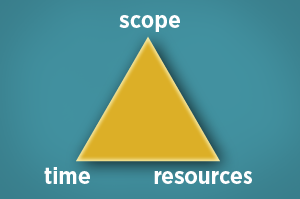
Scope creep is generally seen as something a project manager controls, but what responsibility do instructional designers have to keep scope creep in check? (Oftentimes it’s the instructional designer who introduces scope creep into the project— not the project manager.) What can we, as instructional designers, do to avoid letting it negatively affect our projects? Here are a few suggestions that may help:
1) Thoroughly understand the project’s goals and vision. Know the project’s scope in its entirety during your design phase of the project and before engaging in the develop phase. This will eliminate the need to keep adding features and/or updates to the project that are unplanned. Here at AllenComm the bulk of our training as instructional designers is based on thoroughly understanding the project’s overall goals and vision. This has helped us to better utilize the design phase of the project and foresee the assets and resources that will be needed for the project to be successful.
Your role as an instructional designer is to lead and direct the client into helping you.
2) Don’t get stuck taking orders. If you are merely meeting the requests of the client, you can easily lose control of the scope of the project. Your role as an instructional designer is to lead and direct the client into helping you develop the content of the project within the constraints established during the design phase of the project. I have found that when I merely agreed to a client’s request the scope of the project consistently increased. However, when I created a relationship of trust with the client and established myself as the design expert I was better able to consult with the client about any proposed changes and make my recommendations.
3) Be able to let go of the project. You have to be able to let go of the project after you’ve designed it. It’s easy to justify making some “final tweaks” to the project after seeing it being developed, but this leads to scope creep. A former project manager of mine would meet with the team at the end of the design phase of a project, and we would go over the project to make sure everyone was ready to “let go” of the design and move the project into the development phase. This collaborative transition was very helpful for me as the instructional designer.
We welcome your comments and feedback. How have you been able to minimalize or eliminate scope creep from your projects?
Resources For L&D Leaders


free guide

free guide
insights | on the blog

ALLENCOMM Press Releases
AllenComm Earns Spot on Best Mobile Learning Content Providers 2026 List
eLearning Industry honors AllenComm for its custom mobile learning solutions for enterprise, built to improve performance outcomes at scale. SALT LAKE CITY, [July 29, 2026] — AllenComm has been named to eLearning Industry’s...
ALLENCOMM Press Releases
AllenComm Named a Top Employee Engagement Training Provider by eLearning Industry
AllenComm has been recognized by eLearning Industry as a 2026 top provider for employee engagement, cited for scalable, personalized L&D that drives measurable results. SALT LAKE CITY, [June 24, 2026]...
ALLENCOMM Press Releases