
ALLENCOMM BLOG | Insights
Pay Attention! Adult Learners Need Engaging Course Design
August 3, 2017
Maintaining focus in the workplace has been a constant hotbed of discussion over the last decade across all professions. Each year, more and more research is released proclaiming the rapid decline of our attention span throughout the workday.
While the jury is still out on whether goldfish maintain better focus than adult humans, one thing is quite clear, the way we pay attention and process information has undergone a major shift. This shift can be primarily attributed to the advancements made in technology, from social media to digital devices, items commonly accessible to the average adult in the workplace.
With the everyday tasks of most career professionals lasting well beyond a few seconds, companies must now find ways to not only keep their workforce engaged, but cater to this changing landscape of short attention spans.
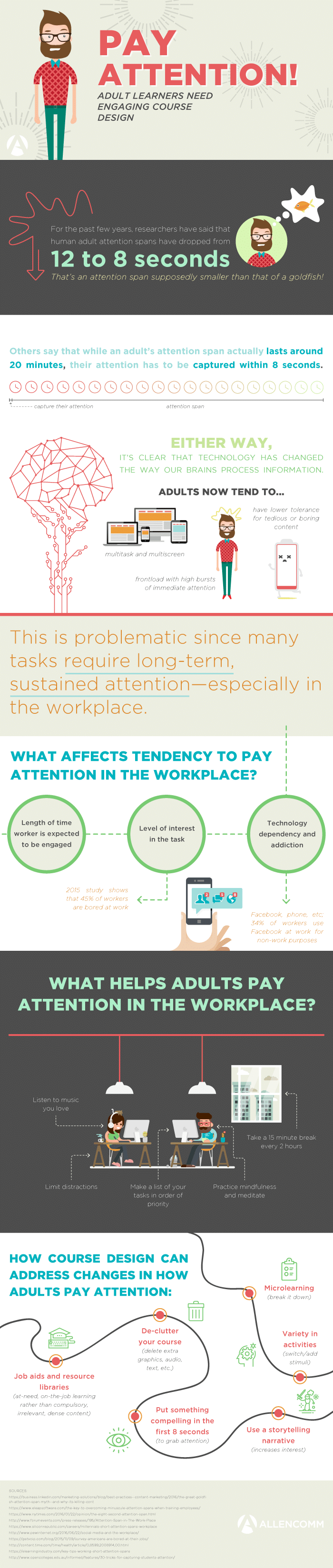
This informative infographic shares what affects the attention span of adult learners and how thoughtful course design can be a powerful tool in meeting the needs of how today’s learners focus best.
How is your company helping its adult learners to stay focused in the workplace?
For the past few years, researchers have said that human adult attention spans have dropped from 12 to 8 seconds. That’s an attention span supposedly smaller than that of a goldfish! Others say that while an adult’s attention span actually lasts around 20 minutes, their attention has to captured within 8 seconds. Either way, it’s clear that technology has changed the way our brains process information.
Adults now tend to…
- Multitask and multiscreen
- Frontload with high bursts of immediate attention
- Have lower tolerance for tedious or boring content
This is problematic since many tasks require long-term sustained attention – especially in the workplace.
What affects the tendency to pay attention in the workplace?
- Lengths of time worker are expected to be engaged
- Level of interest in the task
- 2015 study shows that 45% of workers are bored at work
- Technology dependency and addiction
- Facebook, phones, etc: 34% of workers use Facebook for non-work purposes
What helps adults pay attention in the workplace?
- Listen to music you love
- Limit distractions
- Make a list of your tasks in order of priority
- Practice mindfulness and meditate
- Take a 15-minute break every 2 hours
How course design can address changes in how adults pay attention:
- Job aids and resource libraries (at-need, on-the-job learning rather than compulsory irrelevant, dense content)
- De-clutter your course (delete extra graphics, audio, text, etc.)
- Put something compelling in the first 8 seconds (to grab attention)
- Use a storytelling narrative (increases interest)
- Variety in activities (switch/add stimuli)
- Microlearning (break it down)
Sources
(1) The great goldfish attention span myth – and why it’s killing content marketing
(2) The Key to Overcoming Minuscule Attention Spans When Training Employees
(3) The Eight-Second Attention Span
(4) Attention Span in The Work Place
(5) Are millennials’ short attention spans the best thing ever?
(6) Pew Research Center – Social Media and the Workplace
(7) GetVoip – Survey: Almost Half of the US Workforce is Bored At Their Jobs
(8) Time – Losing Focus? Studies Say Meditation May Help
(9) Key Tips for Working with Short Attention Spans
(10) informED – The Science of Attention
Resources For L&D Leaders
free guide
free guide
insights | on the blog

ALLENCOMM Press Releases
AllenComm Earns Spot on Best Mobile Learning Content Providers 2026 List
eLearning Industry honors AllenComm for its custom mobile learning solutions for enterprise, built to improve performance outcomes at scale. SALT LAKE CITY, [July 29, 2026] — AllenComm has been named to eLearning Industry’s...
ALLENCOMM Press Releases
AllenComm Named a Top Employee Engagement Training Provider by eLearning Industry
AllenComm has been recognized by eLearning Industry as a 2026 top provider for employee engagement, cited for scalable, personalized L&D that drives measurable results. SALT LAKE CITY, [June 24, 2026]...
ALLENCOMM Press Releases