

ALLENCOMM BLOG | Podcast
EPISODE 1: INTRO TO THE LEARNER EXPERIENCE PODCAST
July 31, 2024
In this inaugural episode, Michael Noble, VP of Marketing at AllenComm interviews Ron Zamir CEO about the rationale and aspirations for a new podcast series for organizational learning leaders. They discuss the nature of change in organizational learning, and Ron touches on his experiences as a learning expert in the Israel Defense Forces and as a consultant in South Africa. He also shares practical advice for managing change in your own organization.
This podcast, hosted by AllenComm, focuses on change in corporate learning and development. We will discuss changing needs, changing roles, and changing technologies across onboarding, leadership development, skills development, sales enablement, and compliance.

Ron Zamir, CEO, AllenComm | AllenComm.com
Ron Zamir has been the AllenComm CEO since 2003, but his expertise in leading global learning and business organizations begins as early as 1991. With over 22 years of experience, he’s achieved a mastery of marketing, sales, and education methodologies within the corporate training realm, and he’s been featured in multiple magazines, digital publications, and conferences across the globe. He holds Honors in multiple academic degrees and certifications, and he is the recipient of the Raoul Wallenberg Fellowship for Leadership and Democracy. In his free time, he volunteers in his community to assist economic development and support local charter schools.
Michael Noble
Welcome to the first podcast in a new series hosted by AllenComm. We’re calling it Learner Experience Evolution and our focus is going to be change in corporate learning, specifically targeted for learning leaders. And what we want to do is be able to talk about changing technologies, changing roles, changing expectations of learners.
We’ll do this by looking really practically at challenges you’re facing every day, like sales, leadership, onboarding. Our plan is to host experts in all those areas. Today I’ve got a first expert for us to talk to. He’s the CEO of AllenComm. He’s been our CEO for 20 years. I’ll let him do a little introduction and then we’ll get started with our interview.
Ron Zamir
Sure. Well, thank you, Michael. And we are excited. There’s a lot of podcasts out there and I think this one will be very tactical, very direct, and hopefully help people like us in our industry. Not just vendors, of course, but the actual people that are running L&D teams across the country and across the world.
So I’ve been here a little over 20 years now, more actually. I think for me being here now is not with my AllenComm hat, but as a practitioner. As you know, I started my career too long ago as a designer, spent many years as a designer, learned things, made a lot of mistakes, and then slowly moved into a role that I am in today. So hopefully this podcast and the really important guests after me will be able to give everybody some really good tactical ideas that they can implement as quickly as possible in their L&D practice.
Michael Noble
Thank you. You and I have talked a lot about what should be the focus and where do we think we can bring the most value? That theme of change came up again and again, whether it was change readiness, change management, we want to do this specifically in the context of corporate L&D. How would you define change in that context?
Ron Zamir
Well, I think in our context as L&D professionals, change is a boon, but it can also be a curse. You know, we are receivers of change. We’re inundated by technology that’s changing rapidly around us. We’re in organizations, if it’s a large corporation, where things are changing rapidly. If it’s from the IT side, the marketing side, HR is adopting new systems.
Frankly, the curse of change for us is that we’re never really the ones to initiate it, right? The big things, right? Our company picks a new LMS. They decide to invest in an LXP. A new leader comes on and says, well, I want everything now to be shorter and faster. And that’s kind of the curse.
The boon is, and I think we’ll get into this, is we know our boundaries and there are ways that when change is defined as a way that we could deliver our services better, when we look at change from the eyes of the learner, not just the organization, we can identify areas where we can shift our priorities, where we can use technology differently, where we could design in a way that is more appropriate and matching the needs of our learner population.
So change for us is movement towards our boundaries and pushing those boundaries and not being afraid to try things in the appropriate manner in the appropriate way.
Michael Noble
I mean, that kind of takes us to the name of our podcast, which is Learner Experience Evolution, right? We didn’t call it revolution. I think transformation is everywhere. Everyone’s talking about digital business transformation and everything’s transformational. So why evolution? Why is that a good place to start?
Ron Zamir
I think it’s a better way to accept change into the reactive way we have to function. No matter how much technology would change, we all hear about AI. We’re hearing about new approaches to talent management, new systems that integrate with the other parts of our organization. We have to accept that a lot. Part of the ways we change is to react. And that reactive time takes a lot of our attention.
So I think if we get carried away and try to look for a silver bullet, which is often, I see that in IT sometimes where somebody is told, okay, I can shorten. I can gain more capacity. Our world is not like that. Yet we’re changing all the time. It doesn’t take a person like me who’s been doing ID for over 25 years to say, well, I’ve seen things change over time. No. So if I look at our partners today, they are changing continuously, but they’re doing it in a much more incremental fashion.
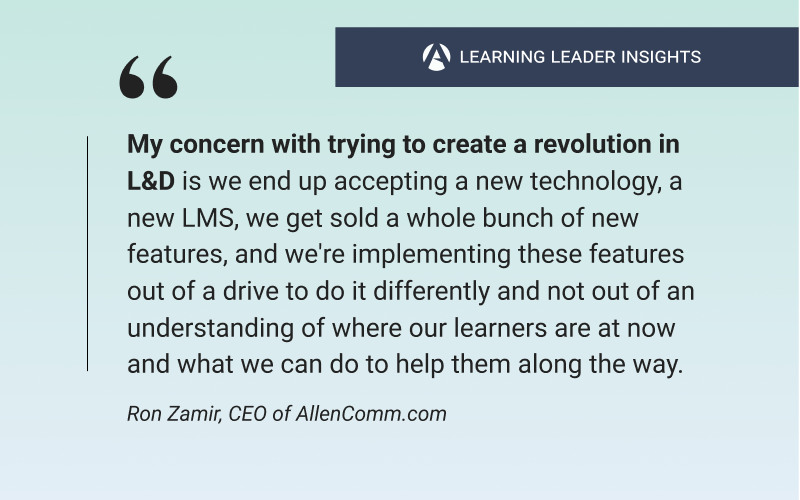
My concern with trying to create a revolution is we end up accepting a new technology, a new LMS, we get sold a whole bunch of new features, and we’re implementing these features out of a drive to do it differently and not out of an understanding of where our learners are at now and what we can do to help them along the way.
So incremental change has always been most successful when we look at our customers. And I think some of the people we will bring on these podcasts will answer that question better than me.
Michael Noble
Yeah. I mean, in some ways we let the tail wag the dog when it comes to learning technology, right? It’s like, well, I need this technology. This is the technology everybody’s using. We were in a session with an analyst a couple of weeks ago where he said by far the biggest expense they’re making is on their learning management system. And yet they struggle to do things like create a learning experience that is actually going to change things for learners.
Ron Zamir
Look, I started my career in a company that had an amazing technology for two-way video. And we sold these systems to the outback in Australia, to villages in South Africa, to the US Postal Service. And I was in charge to look at the implementation. I wasn’t the sales guy. I was more marketing. I was more human experience design even then.
And I would go visit these places. And I didn’t go to Australia, sadly. But I did go to Kansas City, right? Postal service had their big headquarters there. I did go to PeopleSoft in California. And we had sold this technology and companies were adopting this technology. Everything was great except for one thing.
The companies we sold it to couldn’t get the rights to the roofs of their buildings to have the satellite light dishes. So they spent all this money on technology and it never really reached the learners because they were trying to emulate the idea that with video, two-way communication would be better, but nobody really tested that. And I think the learning organizations, they were told, here, we have this technology, they were buying it because of the POS systems that the organizations had that needed twoway communication, and this video technology was fostered on them.
I really think we can do better, and we are doing better, when we look at change as an incremental process of impacting the learner experience versus adopting a technology that may not be the right thing for our learners.
Michael Noble
So that’s one category of change. Definitely emerging technology. We have been, you know, either it’s been a boon or a challenge. But if we look more generally at learning leaders in the types of clients that we work with, what other categories of change do you see our client partners facing?
Ron Zamir
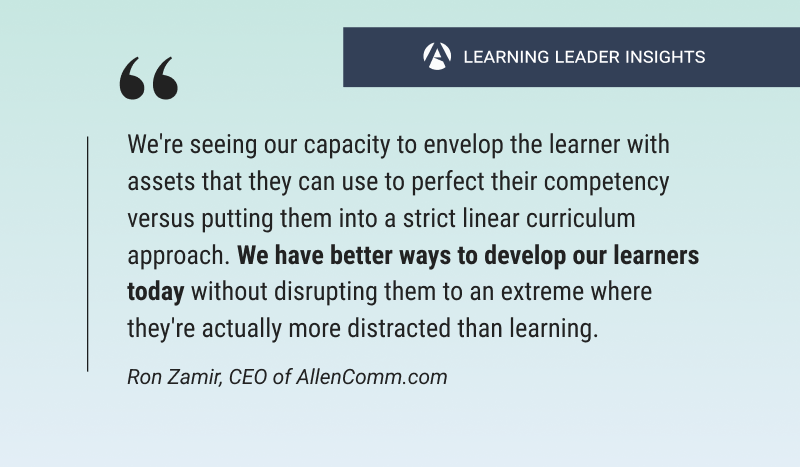
Yeah, well first of all, technology is a change agent. I don’t want to minimize that. I think the other one is really how we’re looking at how we intervene with the learner. I think one of the biggest changes that kind of incrementally happened, and this is related to COVID also, but also related to our early adoption of micro learning and stuff like that, is we’re seeing our capacity to envelop the learner with assets that they can use to perfect their competency versus putting them into a strict linear curriculum approach.
Now, I’m sure that most of the people on this podcast had started somehow designing curriculum, making it very linear, right? You teach a skill, then you combine a bunch of skills to develop a competency, then you contextualize that competency to create more stickiness or more transfer. I really believe that we have better ways to develop our learners today without disrupting them to an extreme where they’re actually more distracted than learning.
Because we can take change from both ends. So, one technology, two breaking out of the curriculum design paradigm, right? And I think the third one is that we are trying to encourage our learners to be more involved in the process. Again, that reactive nature is, we can break those boundaries now. A lot has been said about the power of coaching, the power of learning, learners interacting with each other. I think when we look at the context of how change will impact the learner, we could find those change engines, so to speak, everywhere in technology and curriculum and in how we encompass different components of the employee job or the learner job to bring learning to the learner when they need it.
Michael Noble
I really like that point about how kind of interconnected it is that we get a little bit of a step forward with the technology that teaches us that we can do more instructionally. And suddenly, it’s not just doing the old stuff on a new platform. We can actually do new strategies that we weren’t doing before, whether that’s more social, more project-based learning, more skill-based focus, and actually create the change.
Some of those instructional theories have been around for decades, of course, but we can now do them in a way or at scale in a way that we couldn’t do. Right. The whole, you know, Bloom of Bloom’s taxonomy, and his research about one-on-one coaching is the best way to learn. That doesn’t scale very well, but we can take a lot of those elements now with technology and create those kinds of experiences for learners that will be transformative.
Ron Zamir
Yeah, that whole idea of learning experience design is to unshackle yourself from the adherence to this or that technology.
We learn from our clients and hopefully we’re going to bring some of these to talk to our audience because we’ve seen amazing stuff being done with SharePoint. We see amazing stuff being done with virtual classrooms that incorporate in them a self-paced element versus the opposite that self-paced elements introduce virtual classrooms. We’re seeing people use their LMSs not just as systems of record, but a way to encourage interaction between learners. LXP implementations all over, but I don’t want to just focus on technology.
I want to focus on those lessons that we learn from our clients on how they’re able to draw in so many different environments within their company to impact learning to change behavior, right? I think there’s a lot of things, and I know we’re going to ask our audience to talk about the things I wish I would have known 25 years ago, because they were as relevant today, we know them, but they were as relevant 25 years ago as well.
Michael Noble
What are some of those things? Give us maybe five reasons, five things you would change, or things you wish you had known over the 20 years that you know now.
Ron Zamir
If I look at the first six, seven years of my career, and this was when technology was vastly different, I was using pen and paper. I had just been starting to design an Apple IIe, which I would have kept it. I could have sold it on eBay, my first training computer I used. We were very reactive. I would be sitting in my cubicle or office and I would get manuals dumped on my desk and said, “turn this into a learning activities” for, in this case it wasn’t the military.
Or later on when I was working with students studying entrepreneurial studies and I had to develop soft skill training or business skill training, I was told you can only use this. And so I was reacting as opposed to thinking, how can I change the context?
There’s a story I still take with me. And I only understood the significance of it years later when I was trying to run a class and the classroom just wasn’t working. And I took the class outside. Now that seems, that’s very low tech, right? But the impact on the learners was vastly different. It was the same lesson plan, but in a different context. And I fight against that reactive nature. Today, when I look at learning design, when I review a design we’ve done for a company, I always try to contextualize and say, we’re not order takers because we have a lot more empowerment to make things more contextual. So that’s something I wish I would have known many, many years ago.
The second relates to learning objectives. I’m sorry to geek out with our listeners, but to me, a learning objective for years was something I could string together in five words. I started by writing it on a board. At the end of this course, you will know this. X, Y, and Z. The learner will be able to. The learner will learn. Now we look at learning objectives totally differently. They’re a narrative, they’re a behavior, they’re stringing together so many things that we know when a learner has achieved that level of competency or behavioral change. And we should never be shackled by the need to summarize it in a very simple sense. When I sit in front of young designers today, that’s something I bring up to them.
The other thing is that, and how many of us when we started this career used the teaching metaphor as a way to train? We took that experience we had in the classroom and in the university and we tried to replicate it in our careers. And we’re not teachers. We’re not even just educators. We are builders of experiences that help an adult encompass go from point A to point B. And that relates to that structural curriculum design.
And I wish when I was creating those lesson plans, when I was designing the first, one of the first computer-based classes I did, and again, this was on an Apple IIe in the late 80s, I wish it wasn’t in the late 80s, it wasn’t in 88, 89. I wish I would have known what I know today that I need to communicate, I need to create interactivity, I need to be an informal teacher. I think a lot of what, if we look at today, what we are practicing, it’s what informal educators are doing. One of the best lessons I took with me was working with youth and running youth camps. And that taught me a lot about instructional design. So that’s something that I take with me.
The last thing and I’ll admit it, AllenComm makes a lot of money from this, is helping organizations get ready for change, get ready to launch the project. You can tell a project and how it’s going to end by what you observe in the first few days. And years ago, I would have patience. I would sit in front of subject matter experts, three subject matter experts, four opinions. It would be all over the place. And I would say, we’ll work it out.
And today we’re so much stricter in helping our clients make early decisions, align around learning, align around job descriptions, align around behaviors, align around the constraints you have in your technical environment of what you can do, and don’t just try to fix it along the way. Years ago, that’s what we would do. And today I’m so proud of our AllenComm team, because we ask the hard questions and I think our clients are getting better at doing that. So I am definitely in awe of the young designers we have today, because they’re a lot better on doing the things that I wish I would have known 25 years ago.
Michael Noble
You’ve kind of reminded me of why I love working in this field, right? It’s that we’re on a learning journey ourselves, right? And the experiences in that journey. These are the kinds of stories that I’m hoping we will get from our guests, right? And this is where I’ll just put a plug in for some of the episodes we have coming up the rest of this year. We’re going to be talking to some of our Fortune 1000 clientele.
We’re going to have some learning leaders from those organizations join us. We’ve got some industry experts that are going to join us. We’ve got just some independent thought leaders that are willing to, just kind of friends of the house that will join us on our podcast. So I’m wanting that we can just curate some of that because there’s wisdom in it that I think actually hits to your point about practical change.
Ron Zamir
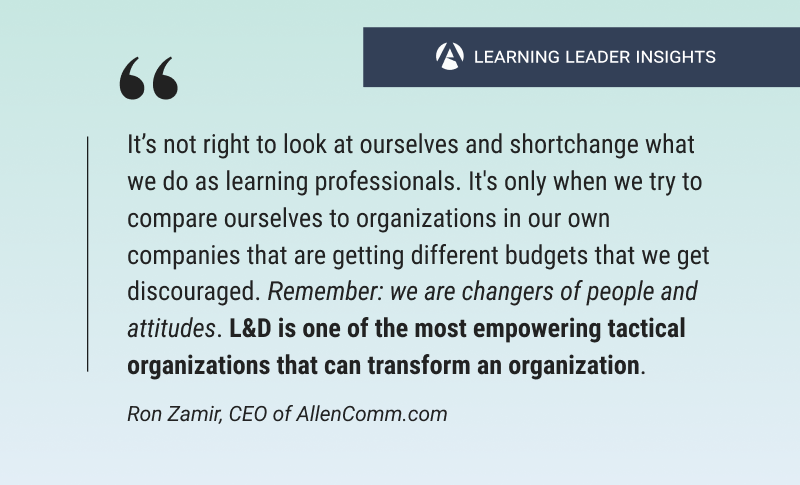
And we should never stress that, more and more stress that. It is not right to look at ourselves and shortchange what we do as learning professionals. It’s only when we try to compare ourselves to organizations in our own companies that are getting different budgets, that are driven more by technology.
We are changers of people and attitudes, right? We can do better in internal marketing through learning than I believe internal marketers can do. But that only comes with, I think, a very tactical approach.
L&D is one of the most empowering tactical organizations that can transform an organization, and strategy will always take second fiddle to the execution of tactics, and that’s what I hope we can do in this series of podcasts
Michael Noble
Yeah, I’m hoping the pendulum is swinging a little bit more to thought prior to action.
Ron Zamir
Well, that readiness, we’re going to talk a lot about readiness as we talk in other instances and how critical that is to our success of any initiative. But I think if we just listen to each other, bring in those leaders that are leading L&D teams and give them the spotlight, I can’t wait to be a spectator in our future podcasts.
Michael Noble
I can’t wait either. And we’re going to have some great guest hosts. We’re going to have some great guests. They’ll all kind of be this interview format. So we hope you’ll join us on this journey and subscribe to our podcast. But that’s all for today. And we look forward to speaking with you again soon. Thanks.
Ron Zamir
Thank you.
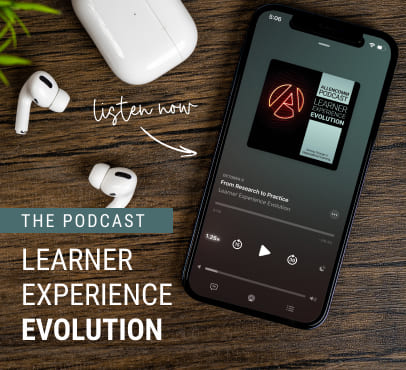
The Learner Experience Evolution is a weekly podcast for L&D learning leaders to stay inspired and gain valuable insights from other industry leaders. Subscribe now to never miss an episode wherever you listen to your podcasts




Resources For L&D Leaders
free guide
free guide
insights | on the blog
ALLENCOMM Press Releases
AllenComm Earns Spot on Best Mobile Learning Content Providers 2026 List
eLearning Industry honors AllenComm for its custom mobile learning solutions for enterprise, built to improve performance outcomes at scale. SALT LAKE CITY, [July 29, 2026] — AllenComm has been named to eLearning Industry’s...
ALLENCOMM Press Releases
AllenComm Named a Top Employee Engagement Training Provider by eLearning Industry
AllenComm has been recognized by eLearning Industry as a 2026 top provider for employee engagement, cited for scalable, personalized L&D that drives measurable results. SALT LAKE CITY, [June 24, 2026]...
ALLENCOMM Press Releases