
What Is Custom eLearning?
For maximum access and scalability, clients often rely on custom eLearning development as a key delivery strategy. eLearning is flexible and much more cost-effective to deploy than traditional instructor-led training (ILT). What’s more, when designed well, eLearning can enable engaging learner experiences (LX) using video, simulation, and practice to make learning more effective.
When we think of eLearning, we tend to think of online self-tutorials that are presentational.
The truth is that today’s eLearning can be much more, including virtual instructor-led training, hybrid solutions, AI-enabled coaching or simulations, social learning, and experiential learning.
At AllenComm, we design custom eLearning development services to meet both organizational and learner needs.
- We focus on performance outcomes and prioritize the learner experiences that will have a real impact.
- Our solutions situate learning within the context of the organization and the specific use cases of teams or roles.
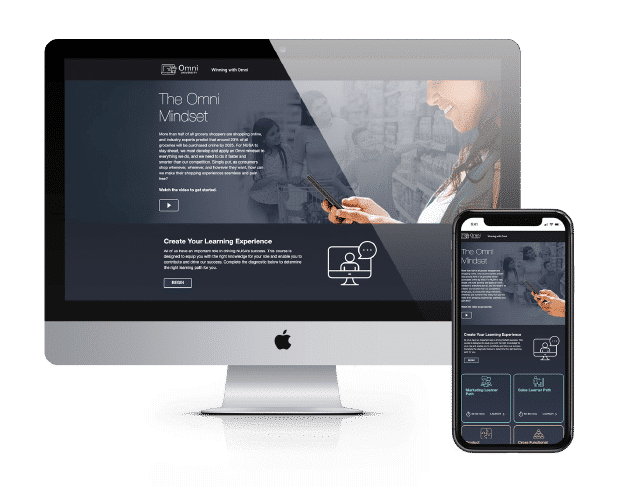
- We use menus, dashboards, and portals that orient learners on their journey.
- Our simulations and practice scenarios mimic real-world situations that engage the learner’s curiosity and critical thinking.
An immersive digital learning experience, from our perspective, is one whose relevance is immediately understood by learners.
What Experience Has Taught Us
At AllenComm, our award-winning instructional designers employ a systematic approach we call performance mapping to create impactful eLearning experiences tailored to your learners’ needs.
-
All eLearning Is Not the Same
eLearning is a broad category that includes tutorials, microlearning, online assessment, AI-enabled learning, and more. There isn’t one recipe to meet all needs. Templated solutions can be very efficient, but using the right template to meet the learning need is essential. Through AI in eLearning, we can now analyze learner data to determine which modality (microlearning, simulation, or assessment) will drive the most effective behavior change.
-
Focus on Performance
Through careful analysis, we identify performance gaps and design solutions using a mix of custom eLearning development services and other strategies to map out the learner journey. Our approach to learner experience design (LXD) focuses on scaffolding learners from learning to success on the job. We leverage AI-powered eLearning analytics to connect learner performance data with business outcomes, helping organizations make data-driven training decisions.
-
Leverage What Works
Rather than starting from scratch, we want to take advantage of what your team and organization have already been doing. We look for opportunities to upgrade, elevate, and convert your existing learning. We’re experts at evaluating your existing program to recommend a rapid content revision or redesign. Using artificial intelligence tools such as ChatGPT and adaptive learning engines, we streamline updates and enable rapid content generation that keeps your training relevant and scalable.
What Does Our Custom eLearning Development Process Look Like?
Every project starts with the performance problem, not the course. We use an approach we call performance mapping to connect what the business needs to change with what learners actually do on the job, then design backwards from there.
- Needs analysis. We identify the performance gap, who it affects, and what is getting in the way. This is also where we decide whether eLearning is the right answer at all.
- Performance mapping. We map the behaviours that close the gap and turn them into learning objectives, so every part of the course exists for a reason.
- Design. Our instructional designers choose the modality mix — scenario work, simulation, microlearning, video, or a blend — based on what those objectives require.
- Development. We build the course, integrate it with your platforms, and test it in the environment your learners will actually use.
- Measurement. We track learner data against the business metrics agreed at the start, so you can see whether behaviour changed, not just whether people finished.
Custom eLearning Services We Provide
Custom eLearning is not one format. These are the builds we deliver, and most programs combine several of them.
- Digital learning — self-paced web-based courses, the format most people mean by eLearning.
- On-demand learning — short modules learners pull up at the point of need rather than working through in one sitting.
- ILT and VILT — instructor-led and virtual instructor-led sessions, including converting existing classroom material.
- Blended and hybrid — programs mixing self-paced work with live sessions and on-the-job practice.
- Video — produced video built into the learning rather than bolted on afterwards.
- Simulations and scenario practice — safe environments to rehearse the decisions the job actually requires.
- Articulate Storyline and Rise — custom builds in the authoring tools your team already knows, so you can maintain them after launch.
- Adaptive learning and AI — content that adjusts to what each learner already knows.
- Platform integration — deployment into your LMS, learning portal, or wider learning tech stack.
Not sure which mix you need? That’s what the needs analysis is for.
Featured Work
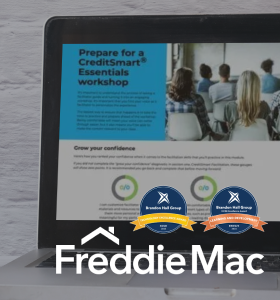
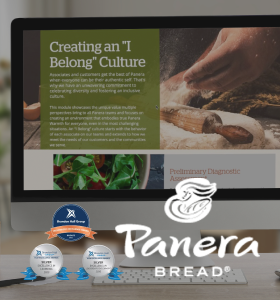
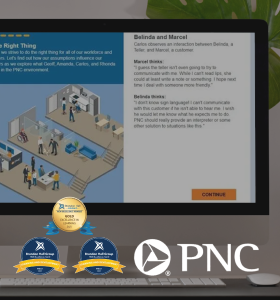
See how we partnered with other clients to design and develop award-winning eLearning solutions that generated positive results.
Use Cases
- An entire curriculum delivered through asynchronous web-based activities, complete with assessments and integrated media as necessary.
- Digital learning as pre- and post-work for synchronous workshops or social learning activities, setting the stage with foundational understanding.
- Digital toolkits that organize supplementary resources, documents, and links, or transform reference information into interactive activities.
Outcomes
- Digital learning slots seamlessly into any curriculum to maximize engagement and retention, before, during, or after the main training event.
- Self-paced exploration that flexes to meet individual needs and preferences, honoring where each learner is starting from.
- Micro and nano modules keep learning laser-focused, memorable, and easy to revisit, enabling just-in-time reference on the job.
eLearning FAQ
Why do organizations use eLearning?
Organizations choose eLearning for its scalability, flexibility, and cost efficiency. As an eLearning company, AllenComm uses eLearning artificial intelligence to personalize learning and measure performance impact.
How do you define eLearning?
eLearning is digital learning delivered through computers or mobile devices. Modern eLearning solutions now use AI-powered tools to adapt and optimize the learner experience.
What tools are used to create eLearning?
Our eLearning company uses platforms like Captivate, Articulate Storyline, or Rise, along with eLearning artificial intelligence to automate design, create adaptive content, and enhance interactivity.
How do you deploy or host eLearning?
Most eLearning solutions are hosted on an LMS or LXP. AI-driven insights help eLearning companies track engagement, recommend courses, and improve learner outcomes.
How long does it take to develop a custom eLearning course?
Development time varies by complexity and interactivity. With eLearning artificial intelligence, content creation can be accelerated without sacrificing quality.
What is rapid content development?
Rapid content development uses templates and agile methods to build training fast. As an eLearning company, we use AI tools to create and refine content efficiently while maintaining instructional excellence.
How much does custom eLearning development cost?
Custom eLearning is usually priced per finished hour of learning, and the range depends on how much interactivity, video, and simulation the program needs. A course built on an existing template costs considerably less than an immersive scenario-based program with custom video and practice environments. We scope against your performance goals first, then recommend the modality mix that reaches them without paying for production you do not need.
What is the ROI of custom eLearning?
The return on custom eLearning comes from the performance change it produces, not from how many people finish the course. Because we design against a specific performance gap and connect learner data to business outcomes, you can measure improvement in the behaviors that actually move results. Off-the-shelf content rarely allows that connection, which is why generic training is harder to justify to a finance team.
Can custom eLearning integrate with our LMS?
Yes. Everything we build is designed to deploy in your existing LMS, and when an LMS alone is not enough we also build learning portals and platform integrations. If your ecosystem spans several systems, our learning tech team maps the integration before development starts, so tracking and reporting work from the first day the course goes live.
How do you measure custom eLearning effectiveness?
We measure against the performance gap the program was built to close, using a measurement plan agreed before development starts. That usually combines in-course assessment and practice data with business metrics your team already tracks, so results are expressed as outcomes rather than completion rates. Our measurement and evaluation team builds that plan as part of the engagement.
How do I choose a custom eLearning development company?
Look for a partner who starts with your performance problem rather than a course catalogue, and ask to see how they measured results on work like yours. The questions worth asking are who does the instructional design, whether they can work with the content and platforms you already have, and how they will prove the program worked. A company that answers those with specifics rather than a portfolio is the one to shortlist.
What is the difference between custom eLearning and off-the-shelf training?
Off-the-shelf training is pre-built and sold to many organizations, so it covers general topics at a lower upfront cost. Custom eLearning is built around your business, your processes, and the specific behaviors you need to change. It uses your brand, your scenarios, and your data, which drives higher engagement and measurable performance results. Off-the-shelf works well for broad compliance or software basics. Custom is the better fit when training needs to reflect how your organization actually works.