

ALLENCOMM BLOG | Podcast
EPISODE 2: MAKING THE CASE FOR CHANGE IN L&D
September 10, 2024
Effective leaders use change as a catalyst to drive sustainable results. In this next episode of the Learner Experience Evolution podcast, Michael Noble interviews Shana Storey, Learning and HR Leader for Progyny. They dive deeper into what it means to embrace the discomfort of change, build empathy, model a passion for innovation, and sow the seeds of growth that prepare an organization for the future—even if it means negotiating the way processes are handled today.
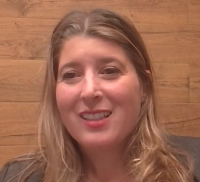
Michael Noble
Welcome to episode two of the Learner Experience Evolution. I’m Michael Noble, VP of AllenComm Advisory, and I’m your host for this episode. Today our guest is Shana Storey. I’m excited to have Shana with us. Shana and I have been acquainted for several years, and she has built an impressive career as a learning leader.
We’re going to begin by asking her to share a little bit of her experience, just a little bit of her journey as a learning leader. Shana welcome. Could you give us a quick recap of your experience in learning?
Shana Storey
Hi everyone, it’s nice to be here today. Thank you so much for inviting me to be part of your podcast, Michael.
I am Senior Director of Learning and Development at Progeny. And Progeny is a benefits company primarily focused in women’s health and fertility and reproductive care. I can’t believe, Michael, how long we’ve known each other. And so Michael’s actually seen a lot of my career transition.
I am very fortunate that I started my career doing a part-time job when I was very young. I was still in my second year of undergraduate. And I took a part-time internship focused on editing courses when they were still on CD-ROMs. I feel really fortunate that I landed in learning. I went to school for multimedia. I’m an artist outside of work. I paint. I hold an MFA in painting, which is things that people don’t really know about me. But landing in a place where I could be creative as a young person, but I also saw a business opportunity and career growth.
I met a number of mentors in my early career that I’m actually still in touch with and who helped shape my career across the last few decades. Across my career, I’ve held roles from everything from development to facilitation to program management to account management. But over the last 10 to 15 years, I primarily focused in leading learning teams, leading learning functions at high growth, high change organizations.
Michael Noble
Well, I am very excited to learn from you today, Shana. Our podcast focuses on change in organizational learning and development. That’s a really broad umbrella, but it is something that most of us face continuously. We’re kind of at the front lines of change in our role. I’d love to start a little just general and hear about your approach to change in learning and development. Maybe how you manage change at a high level, and then we’ll get into some specific examples.
Shana Storey
Yeah, that sounds great. Awesome. So kind of my philosophy is change is constant. We live in the fastest pace of change is the change we’re going to feel tomorrow and then tomorrow the day after. And it’s nonstop. And so from my perspective, especially in learning and development, it’s about the balancing act between understanding what is happening in the business and understanding your constants.
Michael Noble
That is the irony of change, right? That it’s always in front of us. And as much as we would like to have a consistent approach to change, it changes. Maybe you could share a narrative of like, maybe it was a transformational change, maybe it was technological change, some kind of change that you were faced with as a learning leader. That was maybe a learning experience for you or that maybe helped you kind of sharpen your change management skills.
Shana Storey
Yeah, absolutely. One of them that comes to mind is, like most learning leaders when we come into a new organization, we’re often faced with thinking about how to redefine learning at a company. There’s often a desire for consolidation to bring learning under one umbrella or into one generalized consistent experience for the learners and the employees. There’s often a reframing of what learning is, a reshape of what it becomes to learn at scale to execute what they’ve been doing, but for maybe several hundred or thousand more people. And then also a refresh on how learners and employees interact with learning.
And so I can think about an experience I had a handful of years ago that I think a lot of us faced during the pandemic. I had just started a new role and I spent my first eight weeks with leaders across the organization, learners across the organization, trying to understand what learning was for them, what learning meant, what they wanted it to be. And part of my thinking was we were going to move towards a much more digital experience so we could start to bring together our learners who are across the globe into one format. A lot of virtual opportunities blended with in-person. And then the pandemic hit.
Part of my case for change, going digital, using a lot more virtual tools to interact kind of that case for change was built for itself very quickly, probably in about the first two weeks. And I think most of us remember that feeling of, wow, we have new hires starting in April, and what are we going to do with them?
So we started to rapidly find tools, rapidly transition almost all of our content into a seamless—I’m still incredibly proud of the team I worked with then, to bring it into this environment so quickly and to make it a meaningful experience for people who are going through it. You know, we continued implementing new learning experience platforms, thinking about what our learners’ interactions were, learning lessons from our live instructor-led training at the time, and finding ways and new ideas to pass forward. And over the course of two years, we had an amazing run.
Then suddenly, we’re kind of in this return to work, this return to office. And there was such a shift. It was so incredible. I remember having conversations around people wanting to go back to the experience they had in 2019. And I didn’t anticipate that. I thought, wow, we have this amazing thing here. It’s been so successful. People are so engaged in it. Wait a second, we have to roll backwards to what we’re doing, what happened to moving forwards.
And so from a change perspective, I was blindsided by this sudden idea shift. I thought I had a pulse on my learners. I thought I understood what was driving them and what they wanted to do. And suddenly it was different. From a leadership perspective, I felt a little blindsided. I didn’t expect to work through that change again.
I felt like I maybe didn’t do the right thing. Digital learning wasn’t the right answer. In fact, what it was is it was an opportunity to move forward. It wasn’t an opportunity to roll back. And it was about thinking through those blind spots of what does next look like where we maintain a piece of this being digital and at scale while we still kind of think about what it looks like to learn face to face with each other in an inperson environment again.
Michael Noble
There’s several interesting things about what you just said. Two of them that I want to talk about a little bit. One of them is about, you were talking about how the changing, the role of learning in the organization and how that changes, right? And as you said that, I’m like, that is constantly being renegotiated. What is the role of learning in the organization?
Just this morning I read some analyst was talking about the changing role of learning in the organization again. And it just never occurred to me that that’s a constant theme of, and I think it’s more that we, it’s such a unique negotiation. It’s not, we can’t really do it at the industry level. Any thoughts on that negotiation as you’ve had to just carve out a space for learning?
Shana Storey
Yeah, think lessons I learned at this the previous company and the companies before is it is a constant negotiation. What is on the business forefronts minds and what they need to think about to drive forward learning as part of a support function, but also part of a partnership function that enables these changes.
So these enable the company to move forward, and what it might look like in 2024 might look completely different in 2025 due to sales, due to change in industry, due to product introduction, due to a lot of colleagues not here, but people I’ve kept in touch with over the years from aviation. There’s a huge pivot for people and it still changes all the time. Back in the early 2000s, there was fuel crisis and so it was constant change on how learning supports this, how learning can be part of making change easier on employees.
That negotiation is a critical piece and I think from a learning leader perspective and even a learning partner perspective, understanding what the business cares about, understanding what is driving from the CEO, if you’re in public company, what the board is looking for. It helps us be able to provide a better partnership and helps us be able to find the solutions that kind of meet what the learning might need to support it, but also understand where there is ability to play and introduce new things.
Michael Noble
The other idea that I had was about kind of future readiness. You were talking about the pivot that had to be made suddenly due to COVID. But thinking back on my own experience, I had a learning center with live instruction. I had our digital solution. We had virtual, but we also had a lot of tutorials.
Of course, immediately we lost our learning center big part of like, I think change management is probably, you can’t just have one strategy. Part of the resilience, part of future readiness is that you are exploring whether it’s other channels in that very obvious example. But I’m wondering if you have any thoughts on just kind of future readiness and how to increase the agility of the learning team through looking ahead and being innovative.
Shana Storey
Understanding business as a whole is a gap that a lot of L &D teams don’t dig into. And I think that’s really important because that helps build empathy for what the business is looking for. But it also teaches you to think about how to work strategically, how to champion the things that you think are going to be needed in a year or two years from now, and helps you start to build and plant seeds with people around how you can make those changes come to life, how it will benefit the operation, or how it will benefit the leaders of the organization.
So I really encourage teams I work with and for myself to spend time developing yourself. You need to change and grow. Because if you’re not changing and growing, your ideas aren’t changing and growing. You’re not adding perspective. Part of that is understanding what’s coming in technology, understanding even where things are today and may not be ready for you, or your organization may not be ready to receive that type of technology.
You can still understand it, test it out on your own time, not at work, on your own laptop, try new things, see how it works. Because if you don’t understand what’s coming or what’s possible, it makes it really hard to be able to think about new and innovative things and it makes it harder to ask for what you’re looking for from your team.
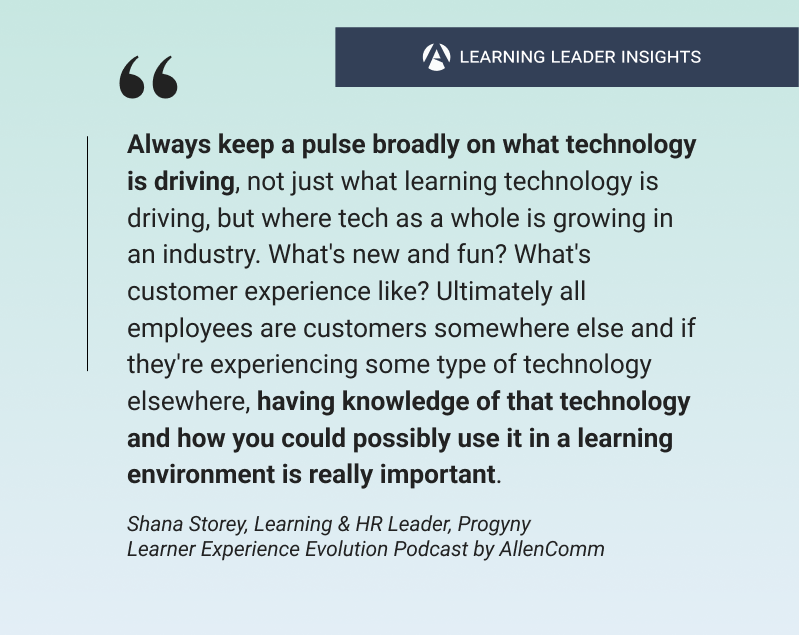
And so just always keeping a pulse on broadly what technology is driving, not just what learning technology is driving, but where tech as a whole is growing in an industry, what’s new and fun, what customer experience is like, because ultimately all employees are customers somewhere else. And if they’re experiencing some type of technology elsewhere, having that knowledge of that technology and how you could possibly use it in a learning environment is really important.
I hope that answers your question. I think I went down the rabbit hole there.
Michael Noble
No, think it does. It does, and it also gets us to some tactical considerations, right? I mean, let’s say you’re mentoring a new learning leader, and you’re trying to share some past insights or just what is, you know, hindsight’s 2020 but… What would you pass on as some go-to strategies for handling change?
Shana Storey
I think three.
One: understand FP&A, so understand corporate finance. So many learning leaders have to fight for budget. So many learning leaders don’t understand when to ask, what cycle to ask on, how to start thinking about the next year.
Two: constantly be learning. Constantly be, not necessarily completely reinventing yourself, but adding to your toolkit. Be that spending time with an executive coach now and again, taking a class, working on a certification, testing out new products, trying things out. If you don’t try things out, how can you help support your team when they want to try things out?
Three: role modeling. You as a learning leader, set the tone not just for your team, but learning at your organization. If you are starting to be stagnant, energize yourself. Find something that makes you passionate and share that passion with the people on your team, the leaders you work with across the organization, and also pass it down into the programs that your team and you are helping design and implement.
Michael Noble
I love the idea of desirable difficulty that stretching myself puts me out of my comfort zone, but also puts me in that place of learning. And I loved what you were sharing about part of the change strategy has to be building a learning culture, right? Modeling that ourselves, working with our teams on that, really embracing that.
That overlaps with that future readiness as well. Let’s look ahead a little bit, right, in terms of like the— we’re in a period of, I would say, unusual volatility at the moment between political, economic, social, technological change. We have this convergence of change happening.
Our CEO is working on a piece about that at the moment and I’ve been working with him and I just, are you, what are some of the changes right now that you’re looking at and that you feel you want to get ahead of and have a strategy for?
Shana Storey
A couple. I want to understand, I mentioned technology before, I want to understand technology, what’s at play, especially with large language models and thinking about what the AI, and I use AI in quotes because it’s not truly artificial intelligence, but it has a strong capability to offset the work our teams do as a tool, not to replace us, but to help us. And I think that that is a piece that leaders should be looking at regardless if they’re in learning or not, that help your organization.
From a learning perspective, leaders, managers, and I feel strongly about middle managers, and I think a lot of people do right now, middle managers have such a burden on their shoulders. They’re constantly expected to be looking forward and looking at strategy, but they’re dealing with so much tactical day to day. And in a volatile environment, having leaders that understand agile, or how to think agile, how to be agile, how to be nimble, learn are better at being able to role model those behaviors for their team.
So supporting the middle managers, giving them new skills, giving them new tools for their toolkit, enhancing how they can coach, enhancing how they build relationships, I think helps people through difficult change. Because if you have leaders who feel comfortable navigating change, feel comfortable talking about change, feel comfortable digging in with an employee about what’s going on and being able to help them through problem-solving. You build better leaders, but you also build a better next generation of leaders from role modeling.
I think working on pieces to support our middle managers and our early senior leaders is a really important piece in learning right now because those are the people that help drive change and make change sustainable at an organization.
Michael Noble
No, I could totally appreciate what you’re saying. At this moment in time, anyone mentions change, the first thing that comes to mind is AI. There’s an interesting question I think that we have to face, which is it’s about how we take advantage of the possibilities of new innovation, emerging technology, how we manage both the constraints.
That’s also part of it is governance and figuring out, we need to manage this in a way that can ultimately—so we can realize the value instead of it just kind of ending in a mess. Are you dealing with any of those issues right now?
Shana Storey
So, know, with the healthcare company, we’re very protective of our company data, publicly traded, same type of thing. You’re protective of what your company IP is. You’re protective of healthcare data. And so encouraging where we can test out things like ChatGPT to support.
So for example, I had to run a workshop recently and I didn’t have a whole lot of time to prep, and I needed to build a handful of scenarios. I had a couple hours to do it, and I started writing these scenarios. I kind of went back to like my instructional design roots and started typing away, and then I was like, wait a second, there’s some things out there that can help me.
And so I put some of my parameters into ChatGPT. I asked it to generate some complex scenarios with these types of considerations. Then I went back and forth as a conversation. Using AI as conversational tool to brainstorm and enhance what you’ve written, your ideas. Then I took that and was able to kind of recreate or enhance it even further on my own to get it to a place where it was applicable for my audience without ever giving any of my detailed audience information to OpenAI.
I even shared it with the class, like, hey, we’re trying this out. These scenarios were partially generated by OpenAI. And so I’d love your feedback on how they feel. Are they realistic? But I also wanted you to know I’m using this tool to help us kind of grow quickly.
Michael Noble
That fits in well with what you were saying about modeling and kind of using the change as a way of bringing your team along with you. I really like that idea. Well, anything, any last words of wisdom, Shana? We’ve gone through our time. I’ve really appreciated the discussion today.
Any last words? What would your final words of wisdom be for our listeners?
Shana Storey
Constantly be growing and changing. You cannot model change unless you experience change. So putting yourself in, think, Michael, you referred to it as something around discomfort of change or kind of similar to that. Feeling the discomfort of change helps you grow and it helps you build empathy for when you do have to lead change.
ADCAR is a great model and it’s wonderful to use and help you through an organizational change. But also know the people around you who can support you, your champions through change, whether it’s an organizational change, personal change, team change, job change, know who your support team is and know who can help you think about things and have a different perspective so you’re not blindsided or feeling like you’re rolling back when in fact you’re still moving forward.
Michael Noble
No, thank you. Thank you for that recap. I’m very excited about what we’ve talked about. I’m excited about a lot of the change that we’re facing as an industry. But thank you for sharing your time and expertise with us. I hope you’ll join us again in the future.
Listeners, thank you for tuning in. Please tell your friends about us and drop us a line at info@allencomm.com if you have some ideas or questions that you’d like us to maybe look at in a future episode. Thank you.
The Learner Experience Evolution is a weekly podcast for L&D learning leaders to stay inspired and gain valuable insights from other industry leaders.
Subscribe now to never miss an episode wherever you listen to your podcasts.




Resources For L&D Leaders
free guide
free guide
insights | on the blog
ALLENCOMM Press Releases
AllenComm Earns Spot on Best Mobile Learning Content Providers 2026 List
eLearning Industry honors AllenComm for its custom mobile learning solutions for enterprise, built to improve performance outcomes at scale. SALT LAKE CITY, [July 29, 2026] — AllenComm has been named to eLearning Industry’s...
ALLENCOMM Press Releases
AllenComm Named a Top Employee Engagement Training Provider by eLearning Industry
AllenComm has been recognized by eLearning Industry as a 2026 top provider for employee engagement, cited for scalable, personalized L&D that drives measurable results. SALT LAKE CITY, [June 24, 2026]...
ALLENCOMM Press Releases