governance of ai
Expert Consulting in Learning Strategy & Governance
request a meetingTurn today’s challenges into tomorrow’s capabilities. AllenComm’s advisory practice in learning strategy and governance offers a range of consulting services to help learning leaders solve what’s urgent and shape what’s next.
- Make L&D governance a growth lever, not a roadblock.
- Run leaner learning ops without losing momentum.
- Connect learning analytics to actionable insights.
- Reduce L&D spend without reducing learning impact.
Set Your Strategic Direction, Empower Your Organization
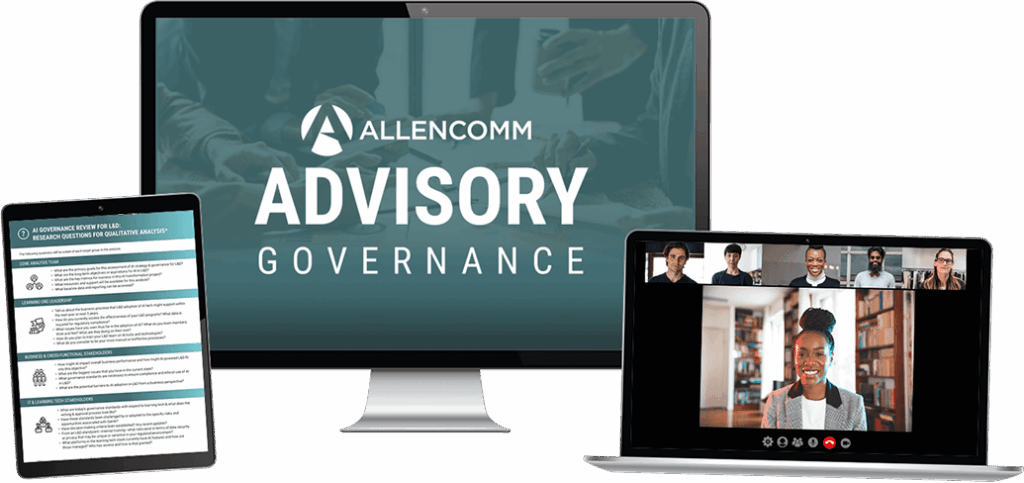
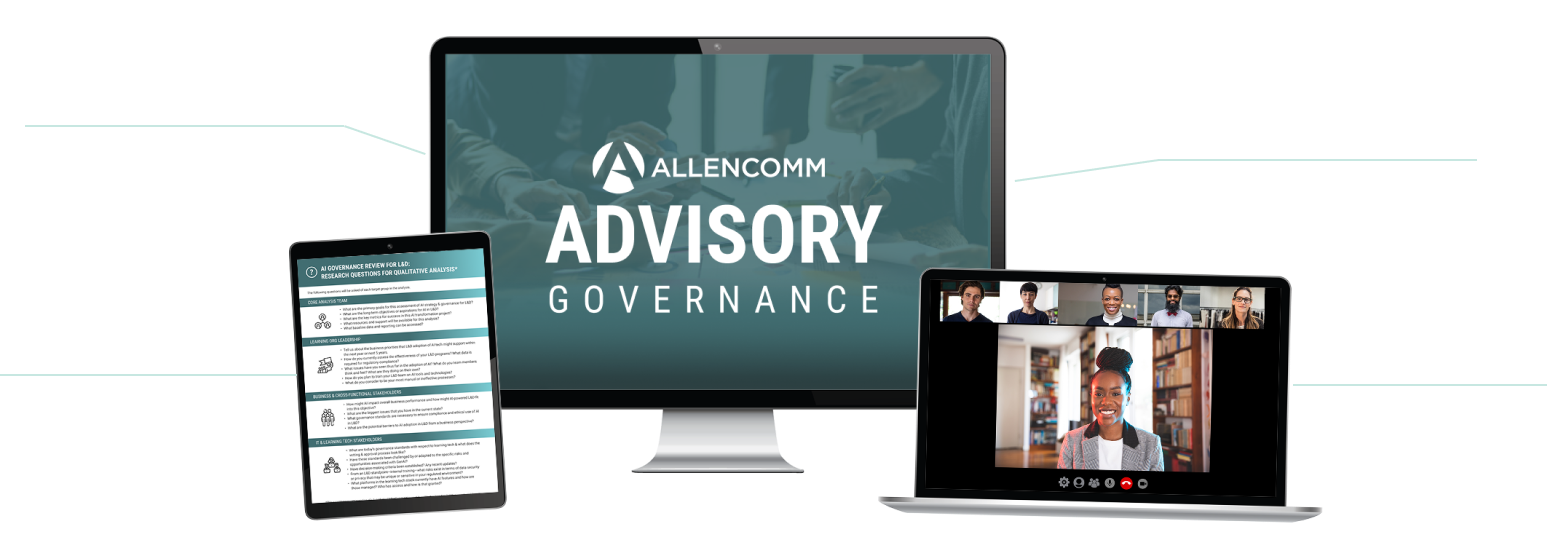
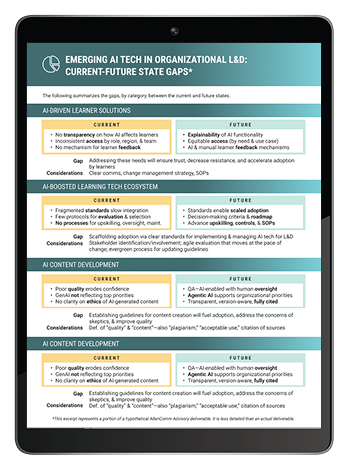
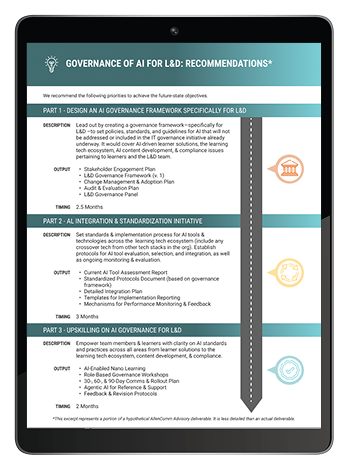
A Sneak Peek: Your New (Completely Personalized) Advisory Resources
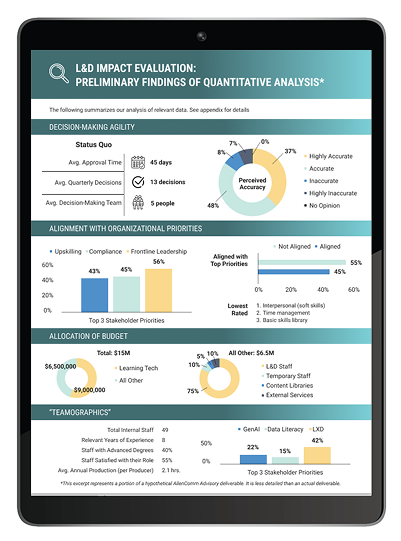
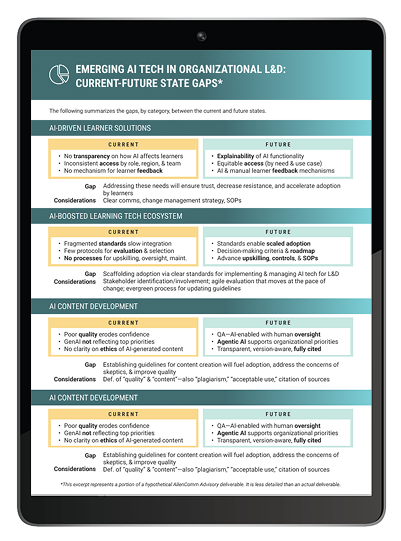
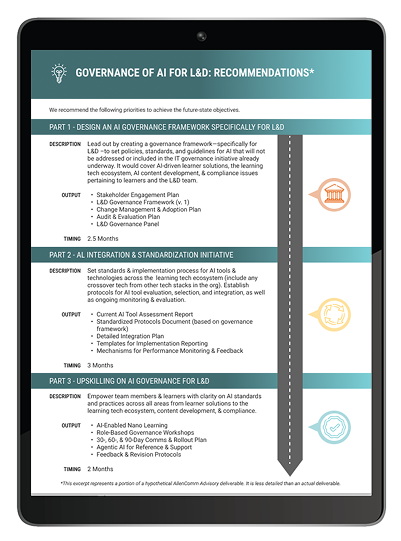
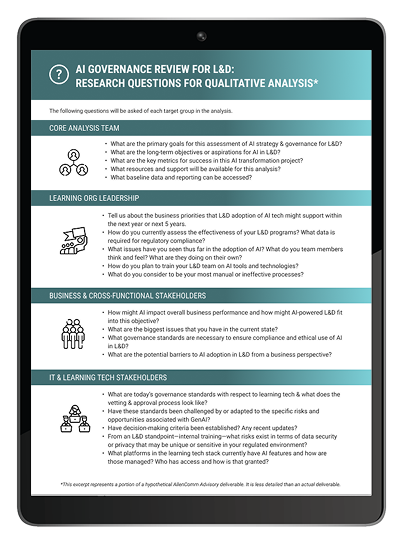
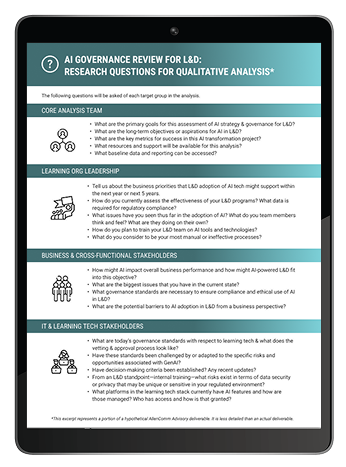
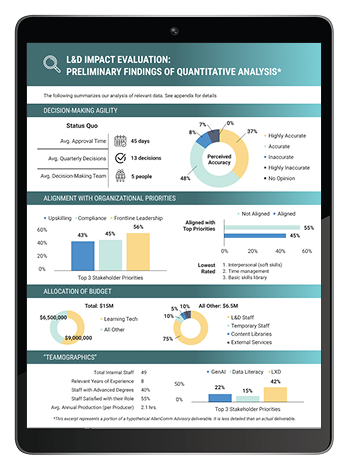
It’s great to dream big! We want to help you dream bigger—and more importantly, bring that dream to life. Whether you need a change management roadmap and communication plan for global L&D programs, skills mapping and governance advisory for digital learning transformations, or any other consultative need, we’ve got your back. Early in our advisory relationship, we’ll conduct a comprehensive analysis to identify objectives, desired outcomes, timelines, action items, and everything else critical to success. The results of this analysis will be compiled in four key deliverables, completely customized and unique to your own personal situation.
A Track Record of Success
We’re more than just our words, and we’re sure our other advisory clients would agree! Here are three examples from our portfolio that demonstrate our dedication to meeting each partner where they are with the services they need—but without the big investment (you’ll have with the big consulting firms). Did we mention we also help prove the value of the investment with evidence for key decision makers and stakeholders? Yeah, we do that too.
DATA-DRIVEN DECISIONS: Large global enterprises have their own unique challenges. Our recommendations helped Delta Air Lines to audit their cost allocations, create dashboards, and align analytics with reporting processes.
COMPLIANCE IN THE FLOW OF WORK: Culture and compliance aren’t always easy to blend together, but through an advisory partnership, we helped ADM demonstrate the case for change, align their strategy to the organization, and implement an advocacy program.
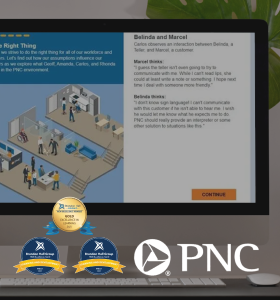
OPS GOVERNANCE: PNC needed to streamline processes and decrease costs through a scalable, repeatable process. We helped them update their vendor playbook, improve their template library and streamline their review & approval processes.
Effective Strategy and Governance Enables Transformation
Several factors contribute to the success of learning in an organization. Change readiness provides a communication and rollout strategy. Strategic governance of the learning and development function defines the roles and responsibilities. And skills mapping ensures alignment with all stakeholders on the priorities and outcomes for the training.
L&D Governance
We advise learning and development (L&D) and HR leadership on governance practices for the learning function. These may include definition of roles, responsibilities, and procedures for working with stakeholders, making key decisions, allocation of resources, etc.
Process
- Facilitate executive interviews & relationship-building with key decision makers such as the Chief Learning Officer, Chief Human Resources Officer, and other executive stakeholder
- Review current practices related to budget allocation, strategic planning processes, team structure, and operating principles
- Conduct a governance needs assessment that identifies the highest priorities for additional or improved governance with associated performance indicators (KPIs)
Outcomes
- Propose a governance structure or framework with clear role delineation for decision-making
- Establish governance processes and workflows to prioritize efforts that align with organizational goals, impact performance, and demonstrate a return on investment
- Create communication and implementation plans to communicate the governance model and processes to all levels as part of a roadmap aligned to key metrics
Change Management
Our approach to learning change management results in a change readiness assessment that has practical guidance for communications, rollout, knowledge transfer, and business integration.
Process
- Conduct current-state analysis via interviews, workshops, and audience surveys
- Assess the impact of change outlining both the benefits of the change and the factors causing resistance
- Map the workflows that outline how the change will impact operating procedures
Outcomes
- Present a communication plan with recommended messaging for each impacted team or group
- Lay out a change roadmap with milestones for key activities, skills management, and associated KPIs
- Recommend feedback mechanisms including prescribed check-ins and pulse surveys
Capability & Skill Mapping
The alignment of specific skills or capabilities to team members roles has evolved from job-task analyses and competency frameworks to today’s needs for personalized and dynamic skill or capability profiles. Alignment on prioritized skills is a key success factor for your learning initiative.
Process
- Identify critical skills and capabilities by consulting with stakeholders, conducting research, and reviewing requirements
- Gather and evaluate existing data and data from surveys, assessments, job descriptions, and performance reviews
- Map and visualize critical gaps between desired skillset and current individual and team skill levels
Outcomes
- Deliver a capabilities matrix to provide visibility into individual, team, and organizational talent profiles
- Create strategic workforce development plans to prioritize talent development efforts
- Align skills management processes with identified skills
Featured Insights
Your overall talent strategy benefits from a combination of in-house talent, trusted vendor partners, independent contractors, and outsourcing options to quickly scale and respond to rapidly changing organizational dynamics.
Advisory FAQ
How can learning strategy better align with organizational priorities?
Many organizations miss the mark by focusing too much on learner needs or organizational needs alone. A well-aligned learning strategy begins with a deep understanding of your organization’s business goals to uncover where learning can have the greatest impact on both aspects together—whether that’s accelerating onboarding, improving compliance, enabling sales teams, or supporting cultural transformation. This alignment includes mapping learning initiatives to key performance indicators and organizational objectives. The result is a learning strategy that’s not just supportive, but instrumental in driving business outcomes.
What type of HR or L&D governance is recommended for emerging tech like AI?
Emerging technologies like AI require intentional governance to ensure they’re used ethically, strategically, and in alignment with business goals. Many thought leaders recommend a cross-functional governance model that includes HR, L&D, IT, compliance, and business unit leadership. This group should guide AI policies and usage for the organization. An advisory partner can help establish these frameworks—balancing innovation with responsible oversight and ensuring AI-driven learning initiatives support learner rights, workforce development, and organizational priorities.
What types of learning analytics and reporting processes will enable data-driven decision-making?
Effective learning analytics combine multiple data sources to provide a clear picture of how training impacts performance. Key processes include tracking learner engagement, assessing knowledge retention, analyzing behavior patterns, and linking learning outcomes to business goals. Custom dashboards and targeted reports help stakeholders interpret this data, identify trends, and make informed decisions to improve learning strategy and results.
How can I measure effectiveness in my learning and talent development organization?
There are multiple ways to measure effectiveness. When designing an initiative, it helps to set meaningful, measurable benchmarks and goals that you can use to gauge how well the initiative is doing, where it can improve, and what trends may exist. You can also measure effectiveness by assessing knowledge retention, observing changes in behavior, tracking performance over time, gathering feedback, and checking in with learners (such as through surveys or 1-on-1s) to better understand engagement and satisfaction. By combining learner-centered results with actual business outcomes, you can craft a full picture of the value and impact of your learning efforts, especially when making a case for L&D investment with stakeholders.
How can I lower the cost of learning operations?
Strategies for lowering costs will be entirely dependent on your organization’s unique situation. However, some common approaches include identifying inefficiencies in processes or technology, aligning resources in more meaningful ways, using AI to streamline content development, automating administrative tasks, and more. To better understand your organization’s current investment value, as well as identify areas where spending can be shifted or reduced, it’s important to gather and analyze data that directly aligns with your most critical business goals.
What is the difference between AllenComm Advisory and a traditional L&D vendor partnership?
While many vendors focus primarily on off-the-shelf solutions or strictly design and development services, our advisory practice takes partnerships to the next level. Not only do we provide a full suite of custom learning services across a project, but we also support corporate L&D leaders in setting their strategic direction, establishing practices for effective decision-making, getting the stakeholder buy in needed to proceed, and enabling scale, innovation, and efficiency using technology. We’ll guide every step of the journey to reduce stress and facilitate an enjoyable collaboration among all parties, from a deep analysis of needs to actionable recommendations that make the most of your unique high-value opportunities for better results.
Meet With an Expert
We’d love to connect with you to learn more about your needs and goals! Request a free consultation with one of our strategy and governance experts so we can so we can better understand your situation, discuss how our services can personally help you, or offer guidance on other avenues to help you succeed.
Case Study
HP
The messaging and story told by representatives of an organization must be consistent and on-brand to build trust and have a positive impact. Multinational information technology innovator HP (Hewlett-Packard) had a critical organizational project: They needed to develop a global [...]
View case studyOrganizational Readiness Enables Transformative Learning
Several factors contribute to the success of learning in an organization. Change readiness provides a communication and rollout strategy. Strategic governance of the learning and development function defines the roles and responsibilities. And skills mapping ensures alignment with all stakeholders on the priorities and outcomes for the training.
Change Management
Our approach to learning change management results in a change readiness assessment that has practical guidance for communications, rollout, knowledge transfer, and business integration.
Process
- Conduct current-state analysis via interviews, workshops, and audience surveys
- Assess the impact of change outlining both the benefits of the change and the factors causing resistance
- Map the workflows that outline how the change will impact operating procedures
Outcomes
- Present a communication plan with recommended messaging for each impacted team or group
- Lay out a change roadmap with milestones for key activities, skills management, and associated KPIs
- Recommend feedback mechanisms including prescribed check-ins and pulse surveys
L&D Governance
We advise learning and development (L&D) and HR leadership on governance practices for the learning function. These may include definition of roles, responsibilities, and procedures for working with stakeholders, making key decisions, allocation of resources, etc.
Process
- Facilitate executive interviews & relationship-building with key decision makers such as the Chief Learning Officer, Chief Human Resources Officer, and other executive stakeholder
- Review current practices related to budget allocation, strategic planning processes, team structure, and operating principles
- Conduct a governance needs assessment that identifies the highest priorities for additional or improved governance with associated performance indicators (KPIs)
Outcomes
- Propose a governance structure or framework with clear role delineation for decision-making
- Establish governance processes and workflows to prioritize efforts that align with organizational goals, impact performance, and demonstrate a return on investment
- Create communication and implementation plans to communicate the governance model and processes to all levels as part of a roadmap aligned to key metrics
Capability & Skill Mapping
The alignment of specific skills or capabilities to team members roles has evolved from job-task analyses and competency frameworks to today’s needs for personalized and dynamic skill or capability profiles. Alignment on prioritized skills is a key success factor for your learning initiative.
Process
- Identify critical skills and capabilities by consulting with stakeholders, conducting research, and reviewing requirements
- Gather and evaluate existing data and data from surveys, assessments, job descriptions, and performance reviews
- Map and visualize critical gaps between desired skillset and current individual and team skill levels
Outcomes
- Deliver a capabilities matrix to provide visibility into individual, team, and organizational talent profiles
- Create strategic workforce development plans to prioritize talent development efforts
- Align skills management processes with identified skills
“Their strategic practice is the foundation of their expertise. AllenComm works with you to understand the business need…ensuring adoption, utilization, and integration are happening at maximum effectiveness.”
Matt Pittman
Principal HCM Analyst, Brandon Hall Group