

ALLENCOMM BLOG | Podcast
EPISODE 4: SUCCESSFULLY NAVIGATING CHANGE
November 12, 2024
Change can be anything. That’s part of what makes it so complex, and why people may hesitate to embrace it—or may even fear it. But leaders who master the art of navigating change can create high-impact opportunities to support learners and achieve critical business goals even during times of volatility. How prepared are you to navigate the nuances of change and help your organization thrive?
Find out by listening to the next episode of our Learner Experience Evolution podcast, which follows Dr. Kate Worlton-Pulham, Director of Strategic Solutions at AllenComm, and Becky Muller, General Manager of Learning Experience for Delta Reservations. They discuss Delta’s innovative approach to training and change management, particularly in the wake of the COVID-19 pandemic. They also share fresh insights into what it means to create training that empowers learners, harnesses creativity, promotes adaptability, and measures performance to inspire lifelong learning and growth.
Takeaways
- Lifelong learning is essential for professionals in the industry.
- Delta focuses on customer-centric training for specialists.
- Successful change management empowers employees with skills and confidence.
- Training should be continuous and adaptable to evolving needs.
- Creativity is essential in navigating large-scale changes.
- Virtual training can be as effective as in-person training.
- Measuring success is crucial for learning initiatives.
- Collaboration with leaders enhances measurement strategies.
- Trusting learners leads to quicker proficiency.
- A supportive environment is key to managing change.
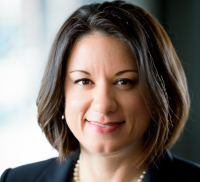
About Becky Muller, General Manager — Learner Experience, Delta
Becky Muller is a seasoned Talent Development Leader with over 15 years of experience in management, leadership development, and scalable learning programs. Currently serving as a General Manager – Learner Experience at Delta Air Lines, Becky has a proven track record in leading teams who design award-winning training initiatives that accelerate onboarding, foster leadership growth, and drive operational efficiency across large-scale organizations. Becky’s expertise lies in bridging the gap between technical and non-technical teams, bringing a data-driven approach to enhancing learning effectiveness. She has led strategic cross-functional projects that impact business performance, partnering with departments like finance, operations, and supply chain to deliver high-impact training solutions. Known for her people-first leadership style, Becky has successfully built and led high-performing teams that drive continuous improvement, foster employee engagement, and elevate organizational excellence. In addition to her role at Delta, Becky has been a mentor in the Pathbuilders’ PERCEPTA ®️ program, supporting the development of high-potential women leaders from prominent organizations. Her educational background includes a Bachelor of Science in Business Management and Six Sigma Greenbelt certification for Operations, underscoring her commitment to excellence and process improvement.
Kate Worlton-Pulham
Hi everyone, and welcome to the Learner Experience Evolution podcast. My name is Kate WorltonPulham, and here at AllenComm, I am a Director of Strategic Solutions. So I work with a lot of large industries and large organizations on their learning experiences and making change within their organizations.
We have a very exciting guest today who has a big story to tell. Her name is Becky Muller. She’s the General Manager and Learner Experience for Delta Airlines reservation sales and customer care. We’re really excited to have you, Becky. Thank you for joining us.
Becky Muller
Thanks Kate, I’m so excited to be here. I appreciate you asking me.
Kate Worlton-Pulham
Good, good. Becky and I have had a few chances to work together and much to my honor and privilege we’ve been able to produce some exciting work for Delta Reservation learners. Becky, tell us, summarize if you wouldn’t mind, what your work entails at Delta Reservations.
Becky Muller
So Kate, yeah, we do a lot at Delta in our organization. So first and foremost, what we’re responsible for is ensuring that our specialists are 100% prepared for speaking with our Delta customers, because at the forefront of everything we do is our customers. We want to make sure that they feel welcomed when they come to us.
We’re responsible for the training for that. We’re responsible for upskilling our specialists and giving them just a little bit more and a little bit more as they grow in their journey and their career at Delta. We also oversee the leader training for our division, which is quite a feat and quite a task and very, very rewarding work.
And lastly, we have a lot of what we do—what most learning organizations have—which is like strategic outlook on how we do learning and how we deliver learning. And we have a team that measures our successes. So in a nutshell, that’s essentially what we do.
Kate Worlton-Pulham
And I think a lot of people listening will be very curious as to how you did that last thing. And so we’ll get to that in a few minutes. I know because of the time we’ve spent together and worked together on various projects within that remit that you have had a strikingly unique set of problems to solve in the past few years, and no doubt have learned a lot of lessons. So I would just be really curious first at Delta Reservations, what does making and managing change look like through learning? What does a successful change through learning initiative look like for you?
Becky Muller
Yeah, for us making change is really about embracing a proactive approach to learning that really aligns with our evolving needs for our specialists and leaders. And change can be challenging, right? Especially in a high stakes environment like ours.
So when every interaction impacts both the customer experience and our brand loyalty, I view change management not just as a shift in those processes, but as an opportunity to really empower people with the skills and confidence that they need to thrive.
I guess too, for me, successful change through learning and innovation initiatives means that our specialists and leaders feel equipped, informed, and motivated, right? For example, right now we’re focusing on accelerating specialist proficiency by taking inventory of skills and building on those skills gradually throughout their career.
And this approach is going to enable our specialists to develop and adapt organically, right? Rather than just through one-time training events, which is currently really how we deliver training, as you’re well aware from your work with us.
But by breaking down learning into those manageable skill-building steps, we’re preparing them to deliver that best possible service to our customers at each stage of their journey, right? And as they grow in that role and promote into more complex lines of business, we want to make sure they’re equipped for that too. And change doesn’t happen in an instant. It always starts with the ability to communicate and the ability to influence.
Kate Worlton-Pulham
I love that you said that we’re not only equipping them with the skills and the knowledge, but also the motivation so that they feel empowered and equipped, but also motivated to do what they need to do for your customers and for the organization.
Becky Muller
Yeah, I know, I will say we’re very, very fortunate in our organization because we’ve got a culture that really looks to improve and develop in people’s roles. And we try and tap into that, those ambitious personalities, to really drive home like this is for you. When we present our training to them, we also present it in a way that is like, hey, this is for you to learn and grow, not just in your current role, but in any future role that you have with the company.
Kate Worlton-Pulham
Yeah, I definitely noticed that, with different learner groups that I spoke with, that Delta has a culture of growth. No one is expected to remain or stay stagnant in the role that they’re in. There’s always future growth.
Can you tell us about a story, an example, maybe it’s the ACE onboarding, the reservation specialist onboarding project we worked on together, when you’ve had this large-scale change that had to happen and what did you learn from that? Where did you want it to go? What were the major challenges?
I would love for you to relay that story. And now a few years on how that journey was and how it played out.
Becky Muller
Yeah, it’s been a few years. I think like a lot of industries we were faced with, okay, you how do you now upscale your operation in order to come out of COVID, right? To come out of the pandemic.
For us, that was—we had a very, very quick turnaround where we had to take our onboarding experience and we had to make it as efficient as possible. When we say as efficient as possible, we had to reduce the amount of time that it took to upscale our specialists. But at the same time, we had to get our teams ready to deliver that experience at a very, very high volume that they hadn’t been used to, right?
I mean, we’re talking like, we hired in the first six months of our new hire or our onboarding program, we hired probably about seven times what we would normally do in a year. We went from on average through attrition, upskilling maybe 400, 450 specialists to upskilling 3,000 in a half of a year. So it was quite a feat. We had to expand our team, and that’s how we got you guys involved in that with us and helped us with that, Kate. We had to bring in some experts that could quickly get us through that development process.
And we had to get really, really creative with how we approached training because we were delivering a pilot of a certain training piece and then continuing to work on the next piece or the next phase of the training. So there was a lot of creativity. We moved resources around. Everybody had to jump in and help. I myself was sitting in piloting classes and just everybody really had to jump in. Going to the managing change side of things, really what the biggest challenge was ensuring that everybody at that time was really accepting of the new approach we were taking. One of the major changes that we made with you, Kate, at that time was when do we get our specialists on the phone with our customers?
And we went from waiting until after our customers were on the phone or waiting to take that first call with a customer until after their training was completed to day five that they are a Delta employee, they’re taking their first call with their customer. And that was a change management piece. I kind of alluded to it a little bit earlier, but really what it’s about is communication and influence, right? It’s telling people this is the right thing to do and here’s why, and here are the fail-safes that we’ve set up and letting them know that it’s the right thing to do.
We had a lot of pushback about it, but we got out there and we communicated with road shows, with all kinds of things to make sure that not only were our newest employees ready for that experience, but that our employees who had had a different experience were ready for people coming in with that experience. So it was challenging.
Kate Worlton-Pulham
Yeah, lots of groups who had to buy in to a pretty revolutionary way of getting those learners working in the workflow. Would you do it again? Would you do that again? And what were the lessons learned?
Becky Muller
Would I do it again, on a personal level, Kate, to be honest with you? I don’t think I ever really want to do that at that scale again. Let’s not do that again. In reality though, yeah, I mean, I think that we took away a lot from that. I think what we took away was just being a little bit more agile in how we responded to our business needs.
And I think being okay with—we’ve got a pretty good idea of what we want to do and where we want to go. Let’s start heading in that direction. And if we have to pivot, we can. That’s one thing that I’ve heard working in the learning industry as long as I have is that the learning teams are never really responsive to the business needs, and while that’s true to a certain extent, it’s more usually about time and how long it is that they need something to take in order to go to market.
I think the lessons that I personally learned from that and a lot of my team learned from that is like sometimes it’s okay to not have all of the answers right away and you can get going on it. You can get moving. And it was transformative for us.
Kate Worlton-Pulham
Can we go into a little bit about it being transformative? Is the timeline or the story of noticing the change happening that you needed to have happen, or indeed noticing change happen that you needed to pivot on and maybe start back a little bit and course correct?
Becky Muller
Yeah, I think one of the biggest things, and this is kind of getting a little bit into what it is that we’re doing today, right? Coming out of the pandemic, we really had to do whatever it was that we could to meet the specialists where they were. And so a lot of our training was taken from a traditionally in-person facilitated format or modality to a modality that was virtual training. So what was really important about that transformation was understanding that we can do this in a virtual environment if we need to.
More recently, what we’re doing is we’re undergoing continued transformation in that space and really figuring out how to continue meeting specialists where they are. Because we’ve seen that our workforce in particular is more of a work from home workforce, and that’s growing and has been growing over the last year, year and a half. And it’s very exciting, right? It’s a really exciting thing, but it also is like, we are going to have to do learning just a little bit differently.
A lot of focus that we’ve had in the last year has been really on how do we take what we learned from the pandemic, and from being forced into this virtual world, and how do we make it world class? How do we make it the preferred method for training our specialists? And a lot of that has been through how we’ve digitized a lot of the new hire onboarding program and moved that into another project that you worked on with us, Kate, which is upscaling or what comes after six months of our specialists being enrolled.
We’ve taken that and we’ve made it a little bit more digital friendly. We’ve put a little bit of the onus on the specialists to pick up on some of those skills in that digital framework and reinforced it through simulation in the coaching and in the instructor-led pieces of it.
We’ve tried to look at some very creative ways to engage with the specialists through activity in that new virtual space. And we’ve also taken a look at something as simple as like, what are the behaviors that we expect out of our specialists when they’re in front of the camera or in front of their students, but now they’re sitting at a desk in front of a computer and they don’t have the energy? They don’t have the energy of those students in front of them.
We’ve done a lot of talking with other companies and talking with other industries and seeing what they’re doing and seeing how they’re doing things. We’ve adopted some of those things and piecemealed them, and that’s really the next step in our evolution.
Kate Worlton-Pulham
I was just going to say that you are describing evolution in a purest sense. You’ve got to adapt and survive. And if you don’t adapt to the reality of the learners, which is never going to be the same, so don’t expect it to go pre-2020 the same. You’ve learned that you have to adapt continuously. For any learning and development professional who might be listening, what would your advice be, regardless of industry?
I mean, you’re one of the largest airlines and most successful airlines in the whole world that is constantly changing by nature of the industry. But on top of that, I think we could safely say to any learning and development professional that we are constantly encountering change, or we should be. So what would your general advice for those professionals be?
Becky Muller
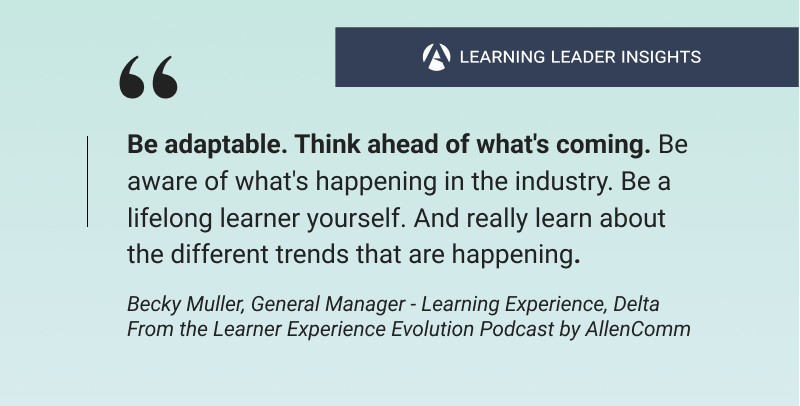
General advice, for me, it is be adaptable. And think ahead. Think ahead of what’s coming. Be aware of what’s happening in the industry. Be a lifelong learner yourself. And really learn about the different trends and things that are happening.
We’re in the AI space like a lot of other companies are diving or dipping their toe into the AI space. That’s a thing for the future. Get educated on it, start using it, and be prepared for it.
I think the other thing is that with the learning industry, we have many different frameworks that we use to do learning. Don’t get caught up so much in those frameworks as the spirit of what each of those steps are. I grew up in the ADDIE process, and I talk about it a lot, but in but in reality, the spirit of everything is in there but it doesn’t have to be a linear thing. It doesn’t have to be linear. You can skip steps you can go back steps.
But yes, you still have to make sure everything is there. You have to make sure you’ve done your due diligence. You’ve done your homework. You have to make sure you’ve got a plan for design. But in reality, you can design and then move to develop and then go back to design. And that doesn’t have to be limited.
Kate Worlton-Pulham
We iterate. We’re agile. Agile people. I would love to learn since the transformative learning approach that you took with the reservation specialists, and I would imagine many other learner groups you’ve worked on in the past few years, allowing them to be more resourceful and take more ownership over their own learning and directly connect that to performance in the workflow, namely bringing the reservation specialist to the phones after five days.
And I’m just curious if we could find out the results. What were some initial results? And how have those results from the learning approach evolved in the past few years?
Becky Muller
That’s a great question. Results-wise for us, just to start, speeding up our onboarding process was huge. So for us to be able to move from an organization without changing headcount, without changing resources—as a matter of fact, probably being fewer resources—that we were able to onboard the number of people that we onboarded in such a short period of time was, I’ll just say, all credit goes to my team for this, but miraculous.
The other thing that we did notice, there was an immediate excitement that happened after the specialists got on the phone on that fifth day, which was very rewarding to see. It was incredible to see the energy. They actually realized in that experience that they didn’t really have as much to be nervous about as they thought, that they really enjoyed talking to our customers and that they wanted to do it again. They wanted to do it really fast. So those are some of the ways that I think that we showed success.
From an organizational standpoint, we also improved on all of our metrics. We measure way too much. I’m sure any engagement center type organization will tell you that. But our average handle time of our customer intents had decreased, which was absolutely incredible. But what’s more important, our first specialist response had improved by some incredible marks. What that means is that the first time the customer contacted Delta, their issue was able to be solved. We noticed an increase in that, so more empowered specialists and specialists that were more ready for the work.
Then the other thing too was our NPS score just got better. I think because we took this approach of customer first with how we approach the training, and then also kind of released a lot of those nerves, our specialists were able to get up to professionalcy in all of those areas a lot quicker and we’re able to make our customers happy, which is ultimately what we’re here for.
Kate Worlton-Pulham
So we basically trusted the learners. We trusted them to own it, become more proficient sooner. And because of those expectations dialing up a little bit, they were able to meet them and even exceed them.
Becky Muller
Yes, absolutely, absolutely, or certainly quicker than previous.
Kate Worlton-Pulham
Do you have any advice for just L&D professionals who maybe don’t have a measurement system as mature as Delta Reservations does for great ways to start gathering data that can turn into action if they don’t have that in place like Delta does?
Becky Muller
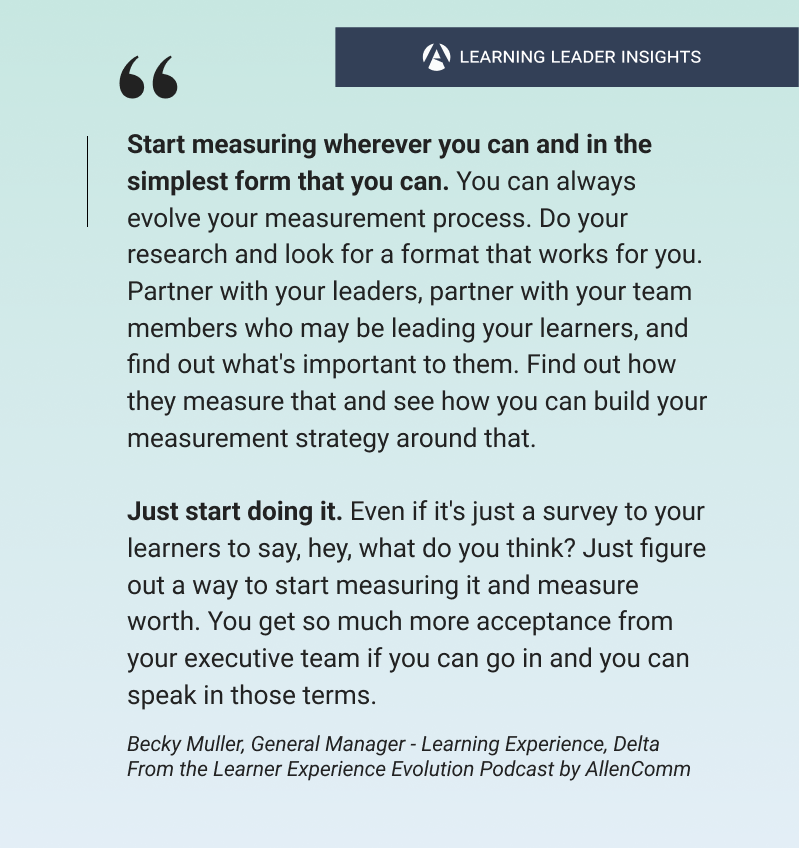
I think the biggest thing that I would say is start measuring. Start measuring wherever you can and in the simplest form that you can. You can always evolve your measurement process. Do your research and look for a format that works for you. There’s a lot of different formulas out there. There’s a lot of different programs out there for measuring learning.
The biggest thing can say is to partner with your leaders, partner with your team members who may be leading your learners, and find out what’s important to them. Find out how they measure that and see how you can build your measurement strategy around that. Those are those are three of the major things that I would give advice to for learners.
Kate Worlton-Pulham
So really, collaboration, collaboration, collaboration. And just to start.
Becky Muller
Just start, just get started, just start doing it. Even if it’s just a survey to your learners to say, hey, what do you think? Just figure out a way to start measuring it and measure worth. You get so much more acceptance from your executive team if you can go in and you can speak in those terms, if you can go in and you can say, hey, we’ve measured this training and we know that it’s effective because we’ve measured it in this way.
For me, when I go in there and look at it, all about how did the learners respond to it? That’s through our survey work. What were their test scores? What were their assessment scores? How did it move the mark? How are they performing compared to others?
If you make this one change, and you’re able to show that you’ve moved that mark and that that specialist or that employee is performing better than others who maybe didn’t go through that type of training, you’re right on the mark. You’re heading in the right direction.
Kate Worlton-Pulham
So planning ahead, being willing to pivot, being willing to adapt and iterate again. Those are some of the themes we’ve learned from Becky Muller today. We’re so grateful that she was able to join us and share her expertise and experiences, lessons learned over the past few years.
Becky, is there anything that you’d like to tell us about before we wrap?
Becky Muller
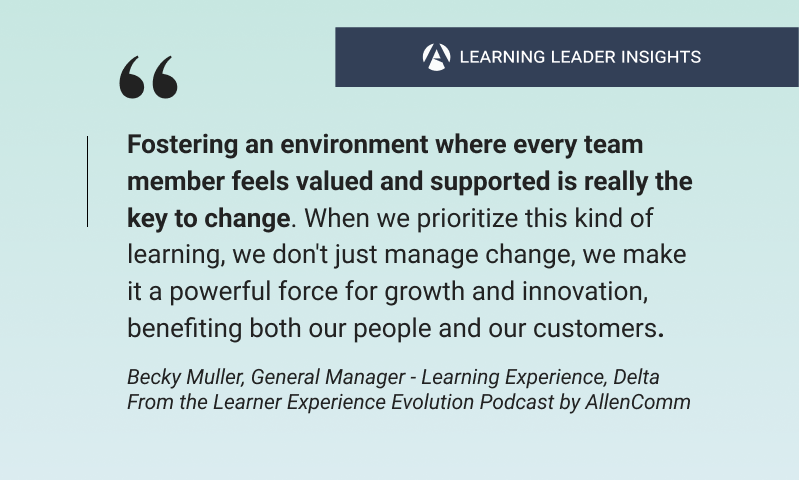
Yeah, Kate, I think for me, I just would like to leave everybody with just a thought, and that’s that fostering an environment where every team member feels valued and supported is really the key to change. When we prioritize this kind of learning, we don’t just manage change, we make it a powerful force for growth and innovation, benefiting both our people and our customers.
So yeah, I think that’s about it.
Kate Worlton-Pulham
Thank you so much. You’ve been listening to Learner Experience Evolution with Kate Wurlton-Pullum and Becky Muller, General Manager of Learning Experience for Delta Reservations. Thanks, Becky.
Becky Muller
Thank you.
The Learner Experience Evolution is a weekly podcast for L&D learning leaders to stay inspired and gain valuable insights from other industry leaders. Subscribe now to never miss an episode wherever you listen to your podcasts.




Resources For L&D Leaders
free guide
free guide
insights | on the blog
ALLENCOMM Press Releases
AllenComm Earns Spot on Best Mobile Learning Content Providers 2026 List
eLearning Industry honors AllenComm for its custom mobile learning solutions for enterprise, built to improve performance outcomes at scale. SALT LAKE CITY, [July 29, 2026] — AllenComm has been named to eLearning Industry’s...
ALLENCOMM Press Releases
AllenComm Named a Top Employee Engagement Training Provider by eLearning Industry
AllenComm has been recognized by eLearning Industry as a 2026 top provider for employee engagement, cited for scalable, personalized L&D that drives measurable results. SALT LAKE CITY, [June 24, 2026]...
ALLENCOMM Press Releases