

ALLENCOMM BLOG | Podcast
EPISODE 6: READINESS FOR THE FUTURE OF L&D
November 26, 2024
In this episode, Michael Noble and Michael Rochelle discuss the complexities of change management within learning and development. They explore the concept of change readiness, the importance of bite-size changes, and the decision-making processes involved in implementing change initiatives. The conversation also highlights the significance of sustaining change through consistency and measurement, as well as the current trends and future challenges facing learning leaders, particularly in relation to technological advancements.
Top Takeaways
- Change readiness is essential for successful transformation.
- Bite-size changes can build momentum and confidence.
- Stakeholder alignment is crucial for effective change management.
- Risk mitigation should be planned upfront in change initiatives.
- Communication about change must be clear and transparent.
- Change is a journey that requires ongoing effort and measurement.
- L&D teams must demonstrate the ROI of their initiatives.
- Technological advancements are reshaping the learning landscape.
- Digital dexterity is becoming increasingly important for L&D professionals.
- Organizations should prepare for change before it becomes necessary.

Michael Rochelle: Chief Strategy Officer and Principal Analyst for the Brandon Hall Group
Michael is the Chief Strategy Officer and a Co-founder at Brandon Hall Group. Michael serves in a variety of roles including overseeing research and advisory support for organizations and solution providers. Michael is one of the company’s principal analysts covering all areas of Human Capital Management. Michael has 40 years’ of experience in our space.
Michael Noble
Welcome to another episode of the Learner Experience Evolution. I’m Michael Noble, VP of AllenComm Advisory, and I’m your host for this episode. Our guest today is Michael Rochelle. We’re really excited to have Michael with us. He’s the Chief Strategy Officer and Principal Analyst for the Brandon Hall Group.
Full disclosure, AllenComm has had a long-standing partnership with the Brandon Hall Group. So I already know because of that that we’re going to have a great chat today. And let’s go ahead and get started. Welcome, Michael.
Michael Rochelle
Thanks Michael for inviting me on.
Michael Noble
Thanks. Let’s start by having you tell us a little bit about the work that you do.
Michael Rochelle
Well, it’s an interesting time here at Brandon Hall Group. There’s a lot of things going on. Many of you might be familiar with our International Awards Program. Many of the audience has probably submitted for awards. Hopefully, you’ve won.
We also do transformational work in the area of HR strategy and execution for global organizations. We also work with covering solution providers in the HR space in order to help organizations select the right solution providers. And we also offer a series of professional development.
All of this is under our umbrella of what we call the Institute, where HR professionals can come and be certified and receive certificates of achievement on a variety of different areas, help them grow and enhance their skills. So it keeps us pretty busy here. Being one of the co-founders of the firm, I’ve seen it all from the beginning
Michael Noble
You remind me as you explain that, I guess the most easily recognizable is the awards, which are kind of the gold standard of programs in the industry. But they might not know your work in strategy and analysis. And the theme of our podcast is kind of about change in the learner experience, but also change in how we deliver learning.
I know you’re often at the front lines. You’ve been a trusted advisor of ours. But maybe you could talk a little bit about your role as an analyst when it comes specifically to change.
Michael Rochelle
Sure, well, as you know, Michael, we generate a lot of research, a lot of data, create a lot of case studies. A big portion of those areas have to do with how to handle change within an organization—what does change readiness look like, what are the steps to becoming change ready, how do you make change readiness a core competency, don’t be afraid of change, but embrace change.
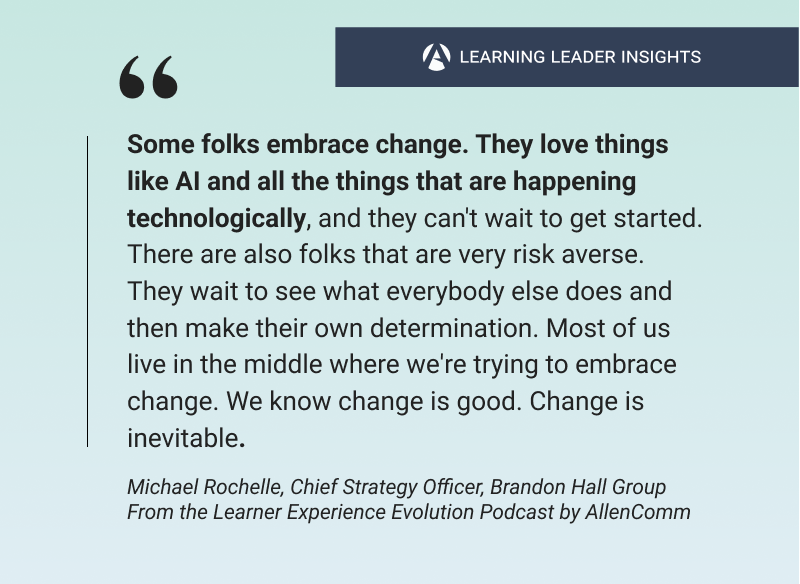
And that comes from either the smallest initiative to major transformations within an organization. It’s no surprise to you or anybody listening that organizations are on the spectrum with that. There’s a big bell curve. We’ve got the folks that embrace change, are very change ready. They love things like AI and all the things that are happening technologically, and they can’t wait to get started.
On the other extreme, there are folks that are very risk averse. They have a very, what we call, I guess lack of being ready and sometimes not wanting to be ready for change. So they kind of wait to see what everybody else does and then make their own determination. The small percentage of those are locked down in highly regulated environments. Change to them actually creates risk.
Most of us live in the middle, the middle of that spectrum, the middle of that curve where we’re trying to embrace change. We know change is good. Change is inevitable. And what we help organizations understand is how to be able to make change bite size.
How do you eat an elephant, as they say, like one bite at a time? And how do you make sure that you understand that change is behavioral for most of the workforce? It’s intrinsic to who they are. How do they feel about this? Do they understand the need for it? What’s addressing the change? How is it going to benefit them? Could there have been any risk involved in the change?
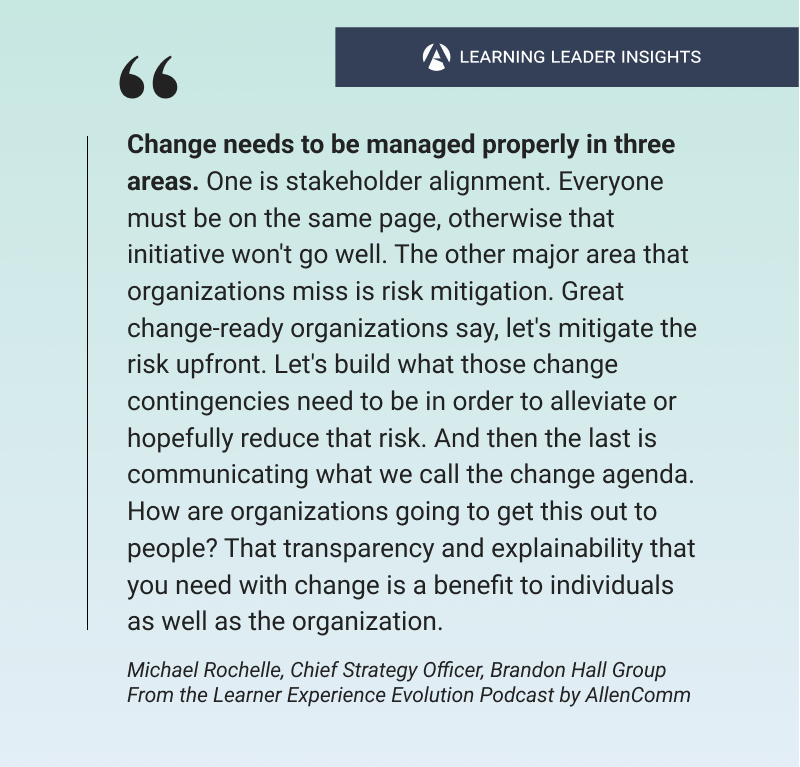
And when it comes to things like what we do in the HR world, a lot of that has to do with technological implementations or changing the way we decide to deliver learning or a variety of other aspects that create a different change environment. It’s change for the stakeholders, change for the internal HR processes, people themselves, but also the learners and what they may have to become different and better at over time, particularly in the digital. So we help organizations work through that. I’d summarize by saying change for us needs to be managed properly in three areas.
One is stakeholder alignment. Got to get everybody on the same page. Everyone’s got to agree on what time it is before we undertake that change environment. If we go in not agreeing on what time it is, then most likely that initiative won’t go well.
The other major area that organizations miss or at least have a gap is risk mitigation. People love to think it’s all going to go well and we’ll just kind of manage it as we go. But great change-ready organizations say, let’s mitigate the risk upfront. Who are the naysayers? Where are there going to be problems? Where can there be potential obstacles? Let’s build it now. Let’s build what those change contingencies need to be in order to alleviate or hopefully reduce that risk.
And then the last is communicating the change what we call the change agenda. And we work with organizations, say, how are you going to get this out to people? Are they going to be excited about it? What do they need to know? What we call that kind of transparency and explainability that you need with change. And getting that out of marketing to change, that’s a benefit to individuals as well as the organization. But again, organizations fall on a big curve when it comes to getting those things done.
Michael Noble
I hear you. I know I suffer from optimism bias like most humans. But if we’re looking at—you use this language of like kind of bite-size change, right? And with your concept of change readiness and as you’re basically acting as the guide for some of your clients in these situations, are there certain kinds of changes that are more bite size?
And maybe you could give an example, whereas these big transformations, or do you approach the big transformations as a series of bite-size changes? Maybe you could share some examples of the kinds of changes that you’ve been involved with.
Michael Rochelle
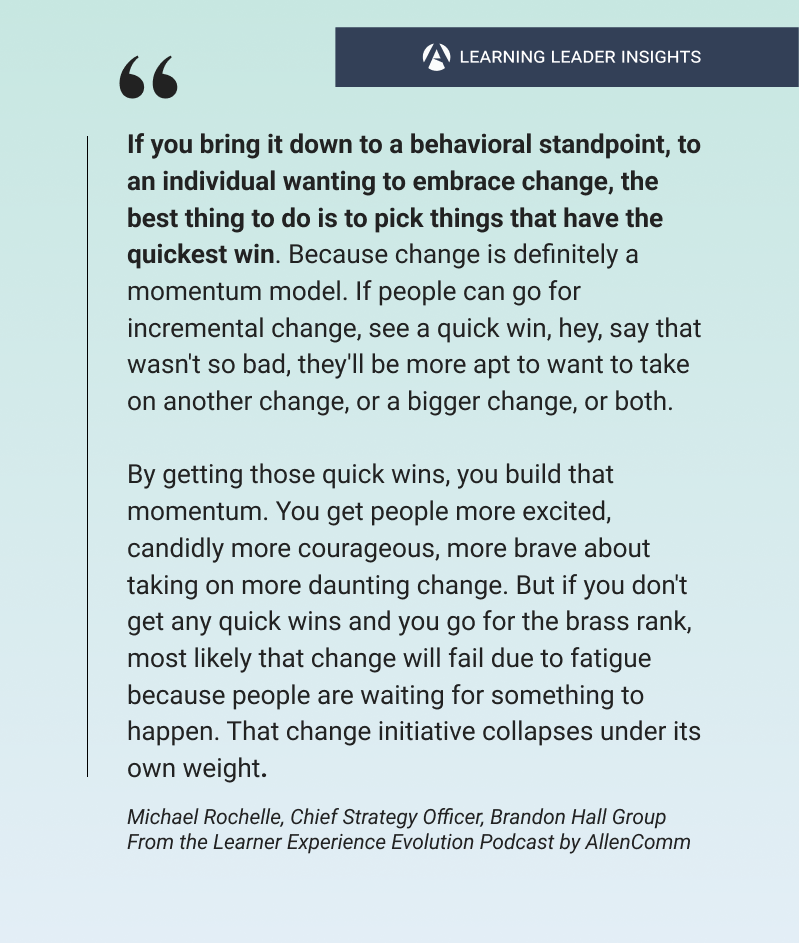
Well, if you bring it down to a behavioral standpoint, if you bring it down to an individual wanting to embrace change, the best thing to do is to pick things that have the quickest win. Because change is definitely a momentum model. If people can go for incremental change, see a quick win, hey, say that wasn’t so bad, they’ll be more apt to want to take on another change, or a bigger change, or both. So what you can’t do is you can’t go for the brass ring. Got to go for the quick wins.
You have to communicate those wins out to the rest of the organization by saying, see, this is the step that this group took and look at what the benefits are they’re achieving already. And then by getting those quick wins, you build that momentum. You get people more excited, candidly more courageous, more brave about taking on more daunting change.
But if you don’t get any quick wins and you go for the brass ring, most likely that change will fail due to fatigue because people are waiting for something to happen. They put a lot of time and energy in, and oftentimes that change initiative collapses under its own weight.
Michael Noble
In terms of like, and maybe it’s client related or organization related and not actually related to the type of change. I mean, those are interconnected. But if we’re looking at, you know, you’ve mentioned that readiness for change is one of the key success factors. I’m also wondering, in the decision process of even to make a change, what should go into that decision?
You mentioned some clients wait to kind of see what others are doing, let them kind of make the mistakes. If you’re a learning leader in an organization and you’re considering a change, you’ve given us some great advice for being change ready and how to make that change. But how do you break down the decision of go or no go on making the change?
Michael Rochelle
Well, great change initiatives are not driven from the top down, nor are they exclusively from the bottom up. You actually have to investigate both. If top management wants to get something done, they just can’t turn around and say, this is what’s going to happen. It can’t be a mandate or an edit. It has to be a negotiation to all levels of the organization to make sure that they understand what role they play and the importance of that role in achieving the change that’s needed.
The same thing is true that we have to be able to listen as top management that there’s a lot of change needed that percolates up from the bottom, from all the ranks of the organization. We have to be active listeners. We have to be willing to listen to our workforce, to our employees, to our lower mid-level leaders, and be able to say, what changes do they see we need to do?
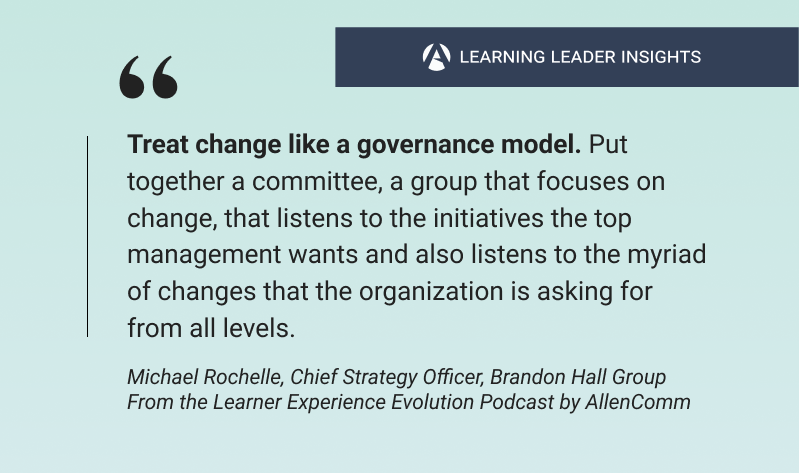
The key is to stay away from just driving it down through the organization or just driving it up without any connection to the overall business needs. It’s kind of a handshake. It’s kind of meeting in the middle. Oftentimes I suggest to organizations, and I think it works well, is treat change like a governance model. Put together a committee, a group that focuses on change, that listens to the initiatives the top management wants and also listens to the myriad of changes that the organization is asking for from all levels. Meet, prioritize, decide how important they are, what’s going to be funded, how is it going to be funded, the timing. This way, at least if a change initiative doesn’t take place, the organization understands why, understands priority, understands limitation of resources. It just wasn’t ignored.
So the thing I would wrap up with on this is change has to be innately part of your culture. Not handling change well can definitely have a negative impact on your culture.
Michael Noble
Are you ever involved in like the—I know you’re involved at the beginning of the process. Are you involved at the end, what they’re doing a post-mortem or retrospective on, hey, we had this big change initiative. How do you help that process of analysis of why change didn’t take?
Michael Rochelle
That’s a great question. We’re involved in the beginning, middle, and the sustainability. Oftentimes when we even get the initiative off the ground, we’ll tell our clients, this is the end of the beginning. Now the hard stuff starts because change really has to be driven by three features.
One is consistency. You can’t change your mind in the middle of initiative. You have to do what we call standing tall in the windy gap. When things get hard, you have to stick with your netting. You can’t change your mind because then that just takes a lot of the wind out of the sails to change. People are like, okay, this is like a flavor of the day. So it’s got to be consistent approach.
It also has to be sustainable, which is what you’re getting at is change is not a destination, it’s a journey. We have to create milestones. It may take us years to get to the ultimate milestone of percent change or reduction in or growth in something. So we have to set milestones for ourselves, but the change never stops. You have to have a sustainable model.
But the one that I think a lot of organizations don’t spend enough time on is the reproducibility of change. What I mean by that is change doesn’t have to seem brand new every time. We can become agile with change.
So when we work with organizations, we help them, to your point, when we’re checking in or seeing how things went, we try to show them that if you can build incrementally this change off of people’s previous change experience and say, look, this is very similar to what you’ve done before, kind of that old ontology approach, it’s not too different. Just a little bit of a stretch or you can apply a lot of what you went through the last time to do this, that reproducibility aspect, not making it sound like we’re starting at the bottom of K2, I’m going to climb it by next Tuesday with no oxygen.
Is to have change feel like, know what, we’ve done this before, something similar. And although it’s a bit of a stretch, I think we’ve got good footing and we can continue on this. All of these things lead to that flywheel effect, that change momentum that we’re looking for. And that’s what we really try to get organizations to follow up on.
And then the last thing is you have to have measurement in place. Even for an organization like ours to come in, you need to have a before and after or you’ve got to establish a baseline or a starting line. And I think this is another mess with organizations. They build the change management initiative, but they don’t build in KPIs. They only build in lag ones, like the scoreboard on a game, like 16 to 7, we lost, 16 to 7, we won.
Where are the lead indicators? What are we going to build in along the way to measure to see if we’re on the right track? Is behavior changing with our employees based on the initiative? Are we getting the proper change effect we’re looking for? How often are we measuring? And then most importantly, how are we going to remediate? How are we going to step in if the change is stalling out or maybe creating a backlash within the organization?
So there’s a lot of different things you have to put in place and do well and have a sustainable effect of that, even with the team that works on it. These are the things that we kind of work through when we’re helping organizations.
Michael Noble
Yeah, I’ll just add a big amen to that. I mean, certainly I’ve seen that and experienced it both. We have no definition here of whether we’re succeeding or failing or what’s on track or what isn’t, and the value of those leading indicators to keep everybody focused and on target and not waiting around for lagging results that really are dependent upon what you’re talking about.
So, Michael, now that we’ve talked a little bit about change readiness, the process of change, we happen to be in a period of a lot of change in the industry. It’s the confluence of change, right? We’ve got social change, economic change, changes in the workplace and how we interact with one another. I know that Brandon Hall’s done quite a bit of research and strategy work in this area.
And you mentioned AI earlier, that’s one of the big changes, but I’d love to hear what you think are kind of the big changes that learning leaders are facing kind of at this moment in time and kind of give us your insights into some of those changes.
Michael Rochelle
Well, I think the L&D teams that are out there worldwide are facing critical changes in people, process, and technology. And they’re happening all at the same time. They play off of one another. You take advancements like AI, that puts a lot of pressure on your tech stack. But also, it could potentially make you rethink your processes. Then you have to think about, do I have the right people in place with the right skills and competency to be able to manage those new processes in tech?
And then you can kind of play from the other angle. You were bringing up lot of people issues in your question. Where do people stand right now? What are their personal and professional development needs within the L&D department?
Instructional designers oftentimes think AI or GenAI is an extinction-level event. And it really isn’t. I kind of tell people when they ask me that, say, you’re not going to be replaced by a GenAI. What you may be in trouble with is someone who learns how to use GenAI.
So how do you get people to settle in? How do you get people to settle in that aren’t back at the office full time anymore? Teams are the best fragment at times, they’re transient or can’t get together, which adds complications on their own. How much are we investing in that infrastructure of people and creating it? Hardly anything gets done as an individual anymore.
In the old days, you could just say, okay, everybody, you know, that term heads down. Now it’s, let’s go to the conference room and pound this out. Everything’s done in teams. So we have to think about all of these changes and the impact that it’s had on people being able to interact with each other in the way that they’d like to, the way to be efficient and effective without fatiguing them.
The pandemic showed us how often we were living on a screen. Stanford did a study that said, when you measure the actual size of what you look like on the screen and put that into human terms, it’s like we’re spending eight or nine hours a day, 12 inches away from everybody. I mean, that’s pretty intense. That’s well within most people’s personal space. So we have to kind of do—what are we going to do for the conditions of the L&D professionals themselves to make them feel like they can win?
Adding that all up, the biggest is L&D has a lot of pressure on them now in order to achieve results for the organization. The need for, and I’ve seen this working with many clients, is the big drivers in coming to work with us and want to see our research and benchmark in our case studies is they have to prove out the return on learning. What is the ROI? Summing it up from what we’re talking about, that’s a big change event.
Most learning organizations report out learning metrics, satisfaction scores, completion rates, certification completions, completions of the course themselves, grades. Now we’re looking for, okay, you delivered that learning, did you help us launch that new product or improve our customer satisfaction scores or reduce risk and gain profitability. We have to know now as an organization, the investments we’re making in learning and development, how they directly impact the organization. And so that’s a huge change.
Just the way in which you look at yourself, what’s important, how you’re measured, the effort that’s put in, what’s going to count, what doesn’t. There’s a new term I heard that now you’ve got a situation where people are saying, is it no win? They’re asking for an ROI, but we’ve got budget cuts, reduction in workforce, rescinded hires, had to put off spending, so now we’re trying to do more with less.
So the one thing that we’ll say, bringing this back to change and wrapping up, is most organizations make the mistake of working on change and change readiness when the change is amongst us or in front of us or happening. Rather than practicing change and raising the change readiness when we’re not under a tremendous change curve. I mean, there’s always changes going on, but you have to get people prepared. The worst thing you can do is just wait for all these big changes to take place and then come to people and say, you know what we have to change for a variety of reasons, let’s go. You know behavior doesn’t change that fast.
Michael Noble
I can totally appreciate what you’ve shared here. It strikes me just that that big change of measurement and being able to demonstrate our value. I’ve been doing this for 20+ years and that’s kind of always been on the horizon as where we want to go and what we want to do. And it’s been the change that has most tripped up people, right? It’s the change that has been the most difficult.
They can change the designs, the modalities, the kinds of things we’re using, but that particular change has been elusive in many contexts and organizations. So I think your insight there is definitely valuable. Is there anything on the horizon in terms of change that should be on the radar of our listeners, but might not be? It might be a few years out, but what are you seeing out on the horizon?
Michael Rochelle
Well, I think we’re moving into, or least a lot of people think we’re potentially in the middle of the fourth technological revolution. And you can’t underplay that. The level of change that we’ve seen, even when ChatGPT came out in November of 2022, like literally two years ago, and they had a hundred million users within a month, which is the quickest uptake in the technology application, the history of the planet.
We have to realize that the thing that we need to pay attention to is the thing that we know is inevitable. We are now moving into new ages of tech. You can watch TV, you can look at ads, can look at media, you can look at the way we run our lives on a day-to-day basis. The single biggest thing that we see happening is tech. So tech is a known and unknown. It’s the big unknown. Like, what’s going to happen next? What is it going to lead to? What are the consequences of that?
How do we have to learn how to use that or what’s the inevitability of it? I think it’s something that we kind of take for granted, but this is just the start of these huge technological advances that are going to take place. So what do we need to do?
One is we have to be diligent in understanding it. We can’t just wait till it’s out our front door. We have to spend time learning about what’s on the horizon, what could be the potential new idea, what could be the intended purpose of that and begin to get educated.
Secondly, we have to decide whether or not we’re a technologically driven organization. It’s not going to be people driven, it’s not going to be process driven, it’s going to be tech driven. People in process will be reacting to tech. We used to make tech the last decision. We had great people that built great processes and then we scaled it with tech. The rules are reversed now. Now it’s tech and it has an impact on everything.
It’s something that we know, but the big thing is, is how do you get ready for the unknown with tech? There’s a couple things. One is what’s your level of digital dexterity within your workforce and your L&D team? Do they like tech? Do they understand tech as well as they should? Are you investing in having them go learn about tech? I mean, in this day and age, you could see L&D groups someday having to learn how to write code in these open LLMs. The possibilities are endless, but we’ve got to get our digital dexterity up.
Secondly, providers are going to be in a position technologically to be advancing much faster than what L&D teams can keep up with. The traditional checklist of what I need from tech and why it’s important to the organization is rapidly moving out of the grasp. We have to bring it back. We have to say, what do we ask for? Why is it important? Do we understand the consequences of it?
I would say that this is the time now, if we haven’t learned from the last two years, this is the time now to see how much time we have to put in as an L&D team to embrace this big change management. It’s happening literally minute by minute is the tech environment. We’ve never lived through this ever before and it’s only going to get faster.
Michael Noble
Well, you’ve just added a few extra dimensions to my understanding of enabling technology and what that means in the future. So thank you, Michael, very much for sharing your time and your expertise with us. I hope you’ll join us again in the future.
Listeners, thank you for tuning in. Please tell your friends about us and drop us a line at info@allencomm.com if you have ideas or questions for a future episode. Thanks, Michael.
Michael Rochelle
Thank you very much, Michael.
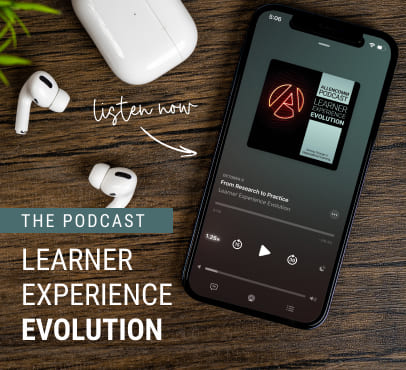
The Learner Experience Evolution is a weekly podcast for L&D learning leaders to stay inspired and gain valuable insights from other industry leaders. Subscribe now to never miss an episode wherever you listen to your podcasts.




Resources For L&D Leaders
free guide
free guide
insights | on the blog
ALLENCOMM Press Releases
AllenComm Earns Spot on Best Mobile Learning Content Providers 2026 List
eLearning Industry honors AllenComm for its custom mobile learning solutions for enterprise, built to improve performance outcomes at scale. SALT LAKE CITY, [July 29, 2026] — AllenComm has been named to eLearning Industry’s...
ALLENCOMM Press Releases
AllenComm Named a Top Employee Engagement Training Provider by eLearning Industry
AllenComm has been recognized by eLearning Industry as a 2026 top provider for employee engagement, cited for scalable, personalized L&D that drives measurable results. SALT LAKE CITY, [June 24, 2026]...
ALLENCOMM Press Releases