

ALLENCOMM BLOG | Podcast
EPISODE 7: INNOVATING LEARNING SOLUTIONS
December 3, 2024
In an age of advancing technology, soft skills are becoming more important than ever. No machine can replicate creativity and empathy. Especially when leading teams through change, being able to embrace the humanity behind the successes and struggles is what can make all the difference in creating a culture where team members thrive.
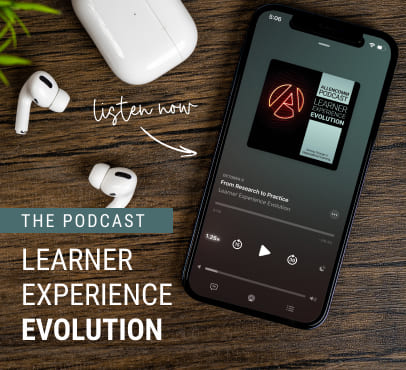
In this episode of the Learner Experience Revolution, Michael Noble, VP of AllenComm Advisory, speaks with Jack Reid, a Leadership Development Partner at Pure Storage. They explore these topics at a deeper level from the perspective of the Simply Pure program, a new and innovative learning experience designed to create a shared understanding of company culture. Listen as they share lessons learned from the initiative, including insights into sustaining change, being adaptable, and fostering continuous improvement to overcome challenges and achieve long-term results.
Takeaways
- Pure Storage focuses on enabling soft skills for leadership development.
- Change is a continuous process of moving from point A to point B.
- Simply Pure was created to establish a shared foundation for all employees.
- Understanding company culture is crucial for employee engagement.
- Innovative learning experiences are essential for effective training.
- Audience reception was positive, especially among long-term employees.
- Marketing strategies played a key role in program participation.
- Sustaining change requires ongoing adaptation to business needs.
- Lessons learned include the importance of setting realistic goals.
- Data tracking is vital for understanding program effectiveness.

Jack Reid: Leadership Development Partner at Pure Storage
Jack is a Leadership Development Partner with a background in Industrial and Organizational Psychology. Having worked at tech companies like Uber, Robinhood, and now Pure Storage, he focuses on identifying the strategies that truly move the needle. Rooted in research but always outcome-driven, Jack is passionate about delivering meaningful impact.
Michael Noble
Welcome to another episode of the Learner Experience Evolution. I’m Michael Noble, VP of AllenComm Advisory, and I am your host for this episode. Our guest today is Jack Reid. We’re very excited to have Jack with us. He’s a Leadership Partner for the Leadership Academy at Pure Storage.
Jack has worked with AllenComm in the past. We’ve worked together on one of the foundational programs for the Leadership Academy. So I already know that we’re going to have a great conversation today. Let’s get started. Welcome, Jack.
Jack Reid
Great. Thanks, Michael. I’m excited to be here.
Michael Noble
Let’s start by having you tell us a little bit about Pure Storage and the work that you do there.
Jack Reid
Pure Storage, at our core, we’re a data storage company. We’ve been around for 12+ years now and really started as a glorified flash stick. So rather than the CD spinning disks, we started with the flash technology that was stationary, it was more effective, more efficient. That’s grown since then and evolved over time, where the company has now become more of a platform-based company, still with that flash storage at its core, but the set of offerings have continued to grow and evolve over time.
And so here, my role, I’m under the Leadership Academy team, which is learning and development under HR. Our goal is really to enable the soft skills, especially around the leadership development capabilities, across all employees at Pure.
We’re a global company, about 6,000 people across the globe headquartered in the Bay Area. And we really think about what are those soft skills for each role, each position, each of the major levels, as we think about the employee base and what is it going to take to get our employees to continue developing both for themselves but also to make the impact and grow Pure Storage.
Michael Noble
Very cool. So we focus on change in our podcast. Would you mind sharing a little bit about how you think about and define change in your role with the Leadership Academy? How does that intersect with kind of organizational change?
Jack Reid
At our core, the way we’re thinking about change, or at least the way I’m thinking about change, is we’re at point A and we need to get to point B. And the change process is what does it take to get from A to B? Once we’re at the next point, there’s always going to be another change that’s constantly evolving and changing. We’re never going to be satisfied with where we are.
The way that we support it is as a human resources function, soft skill development, we are often times not tied to the end result of a company’s financial numbers. We are at our core a support function, and the way that we look at the offerings that we build and launch and have people spend their time—and time is worth a great amount—is really focusing on the right skill sets that we need to enable and change in order to then waterfall down into more of the business outcomes.
So thinking about change from a lens of skill sets is really—we’ve hired a lot of employees. Some have been with us for 10+ years, others are brand new. And as we’re thinking about those different groups, we don’t expect employees to stay the same. We expect them to change and evolve with their roles, their wants, their desires.
It really ends up being more of a, what are the near-term goals and what are the longer-term goals that we’re trying to get to? And then if we could build our offerings en suite of programs in order to build them up towards those end goals, that’s really what our mindset is when we develop trainings.
Michael Noble
Thank you. So at this point, if I had some confetti, I would throw it in the air because over the past few months, one of the foundational courses in the Leadership Academy—a program called Simply Pure—it’s won a Gold Brandon Hall Award, a Silver Summit Award, and a Silver Davy Award. Let’s talk a little bit about that project.
Can you tell us about the genesis of that initiative and why it was important to the organization?
Jack Reid
This was one of our very first programs that we built as part of the Leadership Academy. And the Leadership Academy is just basically our fancy way of saying a compilation of different programs to fit different needs within the employee base. Simply Pure is the program that we worked on with AllenComm. And this really stems from a need to set everyone on a similar foundation across all employees.
Again, some people have been here for a long time, short time, different departments, different skill sets. A couple of the big things that we wanted to target was really at its core, what do all employees need to know? And that comes down to who are we as a company, including what’s our culture here? Who are we? What is our identity as a company? What are the values that we have? How do we interact with each other? How do we show up? What’s our mission, our purpose, our history, what we’re trying to do to really understand the core of who we are as a company. And really that was the foundation.
What we wanted employees to be able to do was understand, hey, here I am in my role. How on earth am I connected to the bigger picture? By giving them more ownership and more connection to the company’s purpose, we believe that they’ll be able to work more efficiently, have better relationships with their teammates, and ultimately, just be more invested because they want to be more invested in the company.
And so that touched again on history, who we are. It touched on what are our products. Data storage is a very complicated technical piece of technology. We found that most employees did not actually fully understand what the product was beyond its data storage. So that really then allowed us to say, okay, great. We need to start from scratch and explain these highly complicated technologies in basic English. Huge challenge to do.
But again, so before I go too far down that rabbit hole and talking on our mission, our culture, our products, but also who are our customers? What do they need? Who are they? And how can we best serve them? And then really having this all compiled into a digital course that people could navigate freely in order to figure out, hey, here’s who we are. I get it. And that was really the goal of coming together with AllenComm and building this offering.
Michael Noble
I want to connect what you’ve just said to our theme of change. Because I think the idea that you’ve just shared about, we want everyone to have this kind of shared understanding, whether we call it a foundation or this baseline, it’s almost like, hey, we want this shared knowledge but also culture of what it means to be at Pure Storage and what we do and what our mission is.
In some ways, I think that intersects with organizational change in that the organization has been going through a period of rapid growth, right? Where it’s hard to maintain that shared story. That was a big part of the why, was it not?
Jack Reid
It really was. As we got started on this project together, we knew that the company was about to go through a lot of change very quickly. Becoming a platform-based company, really thinking about our markets in a very different way. And in order to best support that change, we wanted all employees to truly understand the mission that we were setting out on.
This course ended up really being foundational to, if nothing else, empowering a common language in a shared understanding in order to best be ready to show up at that starting line and be ready to run that race.
Michael Noble
Cool, so another type of change is that this course, which talks about all those things, does not use a lot of the conventions of a typical eLearning course, right? There’s a design change going on here. We’re changing that learner experience. Maybe you could share a little bit about what you envisioned as that change or how it would be different from a traditional eLearning course.
Jack Reid
This is where a lot of my personal beliefs come in. The classic trainings don’t work anymore. The sit down, watch the lecture, take notes, take a quiz. It’s out of date. The research out there really shows that, hey, people best learn by practicing, by engaging in the contents, figuring out like, what does it actually mean to them?
So we wanted to throw out the basic styles of a training because we look at the data, we look at the people going through it. I’m guilty of it too. Someone sends me a training. I’m clicking next, next, next, as fast as I possibly can just to get that completion mark. And then whatever team is in charge of it doesn’t go bug me.
We wanted to instead make a training that people wanted to take that wasn’t required, wasn’t forced. It was fun, engaging, colorful, full of amazing content. So instead of focusing on what a classic training looks like, it’s hey, what if we made this to be more of a free roaming course? You don’t actually have to complete the whole thing. You don’t have to take it in a specific order.
If you’re a salesperson, you probably know the products better than the courses explaining it. Skip that section. Same thing with the software engineers. Like go to the pieces that you really want to learn about. With that mindset, we really decided to think differently about it and think about what types of content goes into it. And I’ll pass it back to you.
Michael Noble
Given that shift in changing the paradigm a little bit of what is a learning experience, right? Instead of a little bit more reflection, a little bit more independence, more storytelling, more media. How did your audience accept this change?
Jack Reid
It was fascinating to see the results come through. I would say there’s maybe two, maybe three big different groups who took it.
The one group was really the employees who have been with Pure Storage for years and years and years. They know the product at its core, but really didn’t, they never got an offering that explained it in basic human language. And so, oftentimes they were talking with their own friends or colleagues and the classic question of like, what do you do? Like, what’s your job? What’s that company do?
They couldn’t explain it beyond its data storage. Yeah. It’s not self-storage in a warehouse somewhere. Nope. I guess the technology, it’s the data storage behind it. And there’s a lot of really cool stuff behind that. But you could only speak so far to someone else with that. And so there was a lot of appreciation.
We had a ton of leaders reaching out saying, hey, I wish I had this when I started eight years ago. Like I understand what the product is fundamentally because of this in a way that I could communicate with clients, with customers. We use partners for our sales. So communicating with partners and then of course the fun family friend outings as well. So that’s one group, kind of the more existing employees.
The other group was more like—Pure Storage has grown pretty darn quickly. All of the new hires that have joined in the last, especially two years, I would say, it allowed them to say, here’s how my role, whether it’s in marketing, legal, sales, or whatever it may be, connects to the bigger picture. And so really it enabled different groups to get connected with that mission and vision of the company of eliminating disk storage, bringing flash storage to the industry, and then really becoming the biggest player in that market as well.
It really, I believe, lit a fire under a lot of, I would say the majority of the employees, in understanding what the actual goal is.
Michael Noble
I mean, those are some truly enviable outcomes, right? That people would experience it that way. But then you get to that other point, which the instinct, I think, of many in L&D would be, well, we have this great experience. Let’s make everyone go through it. Let’s make it mandatory.
You mentioned before that, hey, you wanted a program that was appealing enough that people would go do it and would choose the parts that they wanted to do to, you know, it’s the field of dreams. If you build it, they will come. Did they come? Did enough? How did it meet your expectations in terms of volunteer completion of the program?
Jack Reid
Right, so we did play the game of marketing and kind of making sure it was seen and known, but it’s not a required course. And so really, what are the numbers? I could do a quick poll, but we have about at least half the company having gone through and taken it.
Michael Noble
With a volunteer program, that’s impressive. How did you market? I mean, you mentioned the marketing and promotion of the program, a communications piece. What kinds of communications did you do? I mean, I think that is often part of change management.
Jack Reid
So this course, Simply Pure, we really marketed it well as part of the Leadership Academy launch. Because at the time we had a people manager course for the essentials and then we had Simply Pure. That was it. We had an inclusion course as well. We chose Simply Pure as the flagship program to launch the Leadership Academy with.
So with that, we made this big deal around Leadership Academy, we’ve been talking about it for over a year now, it’s here. And here’s the start. More is coming soon in different programs that we’re going to offer, but this is the flagship program. Everyone, please come take it, come check it out.
We partnered and included videos from our founder who is this amazing human, smart, and everyone loves him. Having his face also embedded into the course really helped because people were like, I want to hear the actual story of how did we get started? What’s our history? Why did we pick the color orange? Why our logo? Why this? Why that?
Really, the storytelling behind it was what I believe drew people in because it showed here’s who we are. Again, nothing’s required, but here’s who we are. Come check it out. And really open door policy, very easily accessible by any of the employees. We made sure the link was everywhere so they didn’t just miss one email or ignore all the system emails. We made sure they could find it no matter where they were. Then it was on them to dive in if they chose.
Michael Noble
So you’re off to a really good start. You’ve got this flagship program that features the founder sharing some great stories. Tell me a little bit about how you sustain change at that Academy level. It’s like you’ve got this. You’ve got this launch. What’s your approach to sustaining that change or carrying it through? Because you mentioned at the beginning, it’s a change journey from point A to point B. What does the rest of the journey look like?
Jack Reid
That’s a great question. Simply Pure was the first big program launch. We have all these other programs that we realized, hey, we need to target the director audience, the vice president audience, the individual contributors, you name it, all these different groups. We’re still continuing to build that, but we’re never going to be fully caught up with what the business needs.
Right now, we’re going through the cycle of what are the priorities for next year? And based off those discussions at the executive level and a bunch of others included, that would change our direction again. Hey, we have our foundation, which we believe is the right foundation. At our core, we’re a tech company. The soft skills and leadership capabilities that we need, any other company needs. But being able to have that foundation, which is simply Pure, helps towards some of our other programs help towards, then gives us the confidence to say, we know what we have is good, really good. How do we need to redirect for the following year?
And sometimes I say, hey, drop what you’re doing. We need to change that priority midway through the year too. That’s fine. As long as we think about these programs in a way that does carry an element of flexibility and adaptability, no matter what change happens, we’ll be able to figure it out just fine. It’s just a matter of sometimes time and money, resources in order to make that change happen, or a whole lot of creativity if you don’t have any of those resources.
Michael Noble
Let’s talk lessons learned. If you could go back in time, knowing what you’ve learned with this initiative and other changes that you’ve managed, what are some of those things that, yeah, hindsight’s 20-20. I wish I’d known X, Y, or Z?
Jack Reid
It’s a hard question to answer and I have been struggling with it, but the few things that come to mind, there’s a lot of personalities in the room. There’s the time to collect all the feedback and then there’s the time to say, heard, we’re moving forward.
And I think that was a bit of a struggle we had, especially with certain roles maybe having some more say than other roles who were involved is like, okay, at what point are we striving for, it’s good enough, let’s launch it, compared to let’s get it perfect to launch. Like perfect doesn’t exist. I think there was a period of time, especially with this offering, we were striving for perfect, and we were pretty darn close too.
But then something fundamental would change and the company is like, no, we need to go back to the drawing board. AllenComm, this is now out of scope. We need to add stuff. Let’s have a conversation. We were really striving for that perfect.
The lesson learned for me was definitely, okay, what is good enough? And like, how do we keep that as the immediate goal? And then we could strive for better and better over time.
Michael Noble
I think that’s fair. Yeah. What’s the minimally viable version of this?
Jack Reid
That’s it. MVP.
Michael Noble
And then let’s use the data to help us improve it over time.
Jack Reid
The data was the one other piece as well, where because we made, I’m still speaking on behalf of Simply Pure, we have to live through data. And we’re a data storage company too. We should be able to do that really darn well. HR sometimes plays a little bit of catch up in that area and some of our systems and tools don’t always capture data in the best of ways.
So we made this very free course that people could pick and choose and navigate however they wanted. Towards the end, we realized we don’t really have a great way of tracking that. So we were able to go back and put some things into the engineering of the course. But that was something that I regret not thinking a little bit more about and embedding from the beginning so that we could have a better understanding of how are people navigating with the different pieces of contents. And then what does that mean to kind of those bigger company goals, like how do they relate?
Michael Noble
I mean with such a different course experience, you almost want to use more traditional marketing metrics on views and impressions and okay, where are people going? That totally makes sense. Well, our time is up, Jack. It’s been a pleasure talking to you. Thank you very much for sharing your time and your expertise with us. I really hope you’ll join us again in a future podcast.
Listeners, thank you for tuning in. Please tell your friends about us. Drop us a line at info@allencomm.com if you have ideas or questions. But thank you, Jack, and thanks listeners. Have a great week.
Jack Reid
Thanks for the time, Michael.
The Learner Experience Evolution is a weekly podcast for L&D learning leaders to stay inspired and gain valuable insights from other industry leaders. Subscribe now to never miss an episode wherever you listen to your podcasts.




Resources For L&D Leaders
free guide
free guide
insights | on the blog
ALLENCOMM Press Releases
AllenComm Earns Spot on Best Mobile Learning Content Providers 2026 List
eLearning Industry honors AllenComm for its custom mobile learning solutions for enterprise, built to improve performance outcomes at scale. SALT LAKE CITY, [July 29, 2026] — AllenComm has been named to eLearning Industry’s...
ALLENCOMM Press Releases
AllenComm Named a Top Employee Engagement Training Provider by eLearning Industry
AllenComm has been recognized by eLearning Industry as a 2026 top provider for employee engagement, cited for scalable, personalized L&D that drives measurable results. SALT LAKE CITY, [June 24, 2026]...
ALLENCOMM Press Releases