

ALLENCOMM BLOG | Podcast
EPISODE 10: THE FUTURE OF LEADERSHIP DEVELOPMENT
January 7, 2025
Did you know? Change management and leadership development go hand in hand. In the next installment of our podcast, Michael Noble meets with Jen Fox to discuss this intersection. They share insights into how organizations can prepare to navigate constant change, build change agility, and understand the role of disruption in effective change management. It’s clear that the future of leadership development is bright—especially for leaders who can embrace authenticity and experiential learning to create transformative opportunities in today’s dynamic work environment.
Top Takeaways
- Change is omnipresent in our personal and professional lives.
- Organizations often react to change rather than proactively manage it.
- Recognizing patterns in change can help organizations navigate it better.
- Building change agility is essential for both individuals and organizations.
- Disruption can be a valuable part of the change process.
- Leaders must be authentic and transparent about their mistakes.
- Experiential learning is crucial for effective leadership development.
- The next generation of workers demands authenticity from their leaders.
- Organizations should focus on long-term change rather than quick fixes.
- Aligning individual values with organizational goals can enhance retention.

Jen Fox: Executive Coach and Corporate Learning Facilitator
Jen Fox has spent the last 25 years working inside and outside of global organizations, listening to employees, facilitating learning and leading cultural change. Hailed as one of the “most no-nonsense learning & development professionals on the planet”, she brings pragmatic solutions to the most complex workplace challenges. She is a trusted executive coach, dynamic facilitator and advocate for flexible work. She balances the demands of her solopreneur career with raising 3 kids by unapologetically consuming a lot of Starbucks in her hometown of Princeton, NJ. Visit Jen’s website here: https://www.orgsavvy.com/home
Michael Noble
Welcome to another episode of the Learner Experience Evolution. I’m Michael Noble, VP of AllenComm Advisory, and I’m your host for this episode. Our guest today is Jen Fox. We’re very excited to have Jen with us.
Jen is an expert in leadership, among other things, and has her own coaching and consulting practice. I first met Jen a couple of months ago when she was partnering with AllenComm on an opportunity. So I already know that we’re going to have a great conversation today. And let’s get started. Welcome, Jen.
Jen Fox
Thank you, thanks so much for having me.
Michael Noble
Of course. Let’s start out by having you tell us a little bit about your consulting practice and the work that you do.
Jen Fox
You bet. So I’ve spent the last 25-ish, I’m in that starting to round down phase of life intentionally, 25 or so years, both inside and outside of organizations, primarily within the human resources function. But really the through line has been listening to employees, facilitating learning, and really driving organizational communication and cultural experiences. So that’s taken a lot of different forms. In my coaching and consulting practice, I get to be that sort of outside voice that comes in and supports clients sort of with whatever leadership or organizational challenge that they might be going through.
Michael Noble
Very cool, very cool. So our theme in the podcast is change, right? We can talk about change in all kinds of ways, organizational change, we’re particularly interested in change in learning, but both for the learning from the learning leader’s perspective, but also from the perspective of learners.
I would love to hear a little bit about how the work that you do, you know, in leadership development, in coaching, in culture, how does that intersect? How does that tend to intersect with change or how do those things tend to relate to each other?
Jen Fox
Yeah, I love that that’s your focus and it’s interesting actually thinking about it as an intersection. I guess I would think about it more as the like the background.
It’s almost, I think, especially in these days, although I know people are always sort of like, what do mean these days? But I feel like change is that sort of water we swim in. And our environment, whether it’s personal or professional within an organization, within our school system, politics, whatever, we are bombarded with so much change at every level, at every moment, that I don’t even think we recognize it anymore.
And I think that makes it interesting when you do think about layering on, well, how do we learn about it? How do we get better at it? And I remember one of my earlier experiences learning the sort of traditional leading change model. And it felt very groundbreaking, because I could almost pinpoint a moment, OK, here’s a change in a box. And now we’re going to go through this process.
And now, fast forward, what I guess, 25 years since I took that very first class. And it’s just everything is so fluid and you’re constantly at some different phase of navigating so many different changes at once. So I guess that’s how I look at it right now. I think that it’s the background we are in, and I don’t think we’re paying enough attention to how to navigate change effectively. I have a lot of feelings, big feelings about that.
Michael Noble
Well, I think there’s some insight there. So I want to dig in a little bit on the—because if we’re so immersed in change, if I extend that out and, okay, I’m trying to do a leadership development program or something, right? I’m assuming there’s some discussion upfront about even helping people recognize, because they’re so immersed in change all the time, how do we define or draw some boundaries around what we’re talking about from a definition or even kind of current state, future state, where we want to go?
Jen Fox
So I think that right there actually gets to one of the things that I’m quite passionate about, which is certainly there’s value. Say in an organization, you’re about to go through an acquisition. Or in your case, you want to design a particular learning program or intervention for a particular thing. That’s fine. It could sort of have a beginning and an end to it.
I guess one of the things I’m interested in when I think about that of how do we define it, how do we put some boundaries around it if it’s always going on, is to zoom out a bit and to look for the patterns in how we have navigated change, and more so, how we’d like to navigate change in the future.
Let me share with you a quick story. Think about sort of 2020 to 2021. I know, it just brings up all kinds of things, especially for those of us in the human resources sort of space. The organization I was with, we were navigating quite well, I think, not perfect in any way, all of the cultural, social, systemic, all of the unrest and sort of disruption that was going on in the world at that time.
And every single time there would be this sort of, let’s call it a crisis. That might be dramatic, but okay, what are we going to do? What are we going to say to employees? What are we going to teach them? What are the learning moments that are possible here, right? What’s the communication, et cetera, et cetera, et cetera. So you get through that, you exhale, got through it. And I remember having these conversations about like, we should probably start thinking about the next one.
But when the pressure’s off and there’s a million other things competing for your attention, it doesn’t feel urgent. Well, we don’t have to think too hard for how, you know, I mean, we went days sometimes only in between sort of huge events during that time. And here we’d go again. Crisis, communication, learning, intervention, bring the people in, all this stuff.
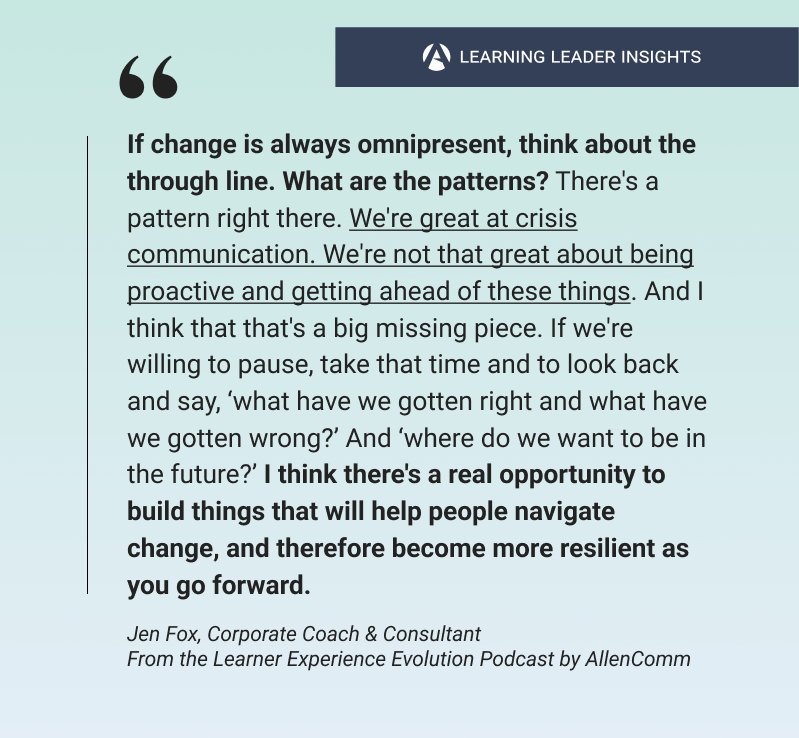
So I guess when I’m thinking about how can organizations think about change if it’s always omnipresent is to think about what’s the through line? What are the patterns? There’s a pattern right there. We’re great at crisis communication. Maybe not so much at the sort of proactive always-on sort of sustained support that we might want to do. We’re not that great about being proactive and getting ahead of these things. And I think that that’s a big missing piece.
If we’re willing to sort of pause, take that time and to look back and say, what have we gotten right and what have we gotten wrong? And more so where do we want to be in the future? I think there’s a real opportunity to build things that will help people navigate change, and therefore become more resilient as you go forward and collectively then the organization itself.
Michael Noble
Yeah, I love where that’s going. If the goal then becomes a certain change agility or a capability for the learner, for the learning organization, for the larger organization, that hey, instead of just being acted upon by all these different things that come at us, we’re going to develop that capability, that skill set of managing change proactively. I love that. I love that so much.
I would love to hear your progress in helping teams or moving programs in that direction, if that’s something that you feel like even where even baby steps have been made.
Jen Fox
So I can speak to an example that I have supported a client with that I think will answer that question in terms of making those sort of baby steps. They were going through fairly hefty organizational change. They knew that the model that they had in their company, it wasn’t working. I use the phrase borrowed from Marshall Goldsmith all the time, what got you here won’t get you there. It was truly one of those cases.
In order to turn the ship, there was a lot of change they were facing. Roles, organization, levels, compensation, job duties, really all of it. And I think that one of the things that that I kept coming back to with that—this was a company over 30 years old some of these habits and behaviors were deeply entrenched. I would say a sort of a recurring behavior of going for the quick fix band-aid solution that got them to a point where they had a sort of sum total of results that they that they weren’t happy with.
Part of supporting them and navigating through that change was every time one of those came up, for sure it would have been the easier path of least resistance. Every single time, taking the time to ask that question, is this the right decision, the right model, the right idea for this moment? Or is it for, and let’s just say the horizon is two years, right? Two to three years. It’s such a hard time right now to plan anything beyond that.
So I think in practice one of the things that people can do to help get better at navigating change, there’s the looking at the patterns as I said. But one of those baby steps is just recognizing, where are those sort of go-to behaviors that don’t necessarily lead you to the results that you want to have? And what are those little questions, practices, checkpoints that you can have to keep you honest about changing the behaviors?
You and I were just discussing—we’re recording this after holiday, right? We’re discussing, did we overindulge or not? So you think about on a personal level, it’s so easy to understand. It’s like, yeah, I would not eat Thanksgiving turkey and gravy and stuffing 365 days a year. However, in an organization, there’s some of these default things that it’s just easier. There’s no friction. We don’t have the time to deal with it.
I think that’s one of the things I would really offer in those baby steps is look for those little shortcuts, know where your weak points are, and then be able to ask those questions with rigor and honesty to be able to hold yourself accountable to start to change in the direction you want to go.
Michael Noble
Love that, love that. So there’s a couple things that came up in what you just said. If we’re developing a change agility as a capability, right? How big is it and how does it scale? Because at some point we have to draw a line between “pretty much all of our practices need to change” and “okay, this is the one that’s most business critical right now at the moment that we target that.” And you’re facing inevitable resistance from people who, “oh this is how we’ve done it, what we’re doing.” You’re facing fatigue from, “oh, here we go again on another change.”
What have you learned? And maybe you could share an example in terms of facing those challenges or what’s going to work in terms of countering some of that inevitable resistance and fatigue.
Jen Fox
Yeah, and I don’t know if my view is controversial. I could find as many people to agree with what I’m about to say as I could disagree, so whatever that means. I am more of a rip the band-aid and then let it settle kind of person.
There’s pros and cons, right? There’s the change it all, throw it all up, change it all. It can be crazy chaos, and then you’re able to come down and settle and let the new system, learning, training, program, whatever, whatever to take effect.
Or there’s this serial change where it’s just like one thing after another after another after another, my own view is that that’s what leads to the fatigue and the burnout and that creates this feeling of like, what’s next? Here we go again, here we go again.
As opposed to, I feel like if we can, in the case I was talking about with you, when we can put it all together and acknowledge this is significant, and we’re going to break it down, we’re going to make it digestible, but we’re going to explain to you how the parts all go together, I feel like actually people have an extraordinary capacity to handle massive change.
Look back to 2020, look at what the human nature just came through. I think we have a huge capacity to handle more than maybe what organizations sometimes think we do. This drip feed of change, these little things, I think it causes fatigue. I also think it makes it very, very easy to keep old habits and behaviors in place. I think it feels impossible to keep momentum.
I’ll tell you, was working on it with a potential new client, and at first they had a timeframe of sort of end of this year, and then they thought maybe on to next year, and then maybe a little bit further down the road. And I was like, that’s great if your timeline has moved, but we won’t start the engagement now, if it’s a three month project, and extend it for 12. Let’s start in the three months when you’re ready to do it because it’s just impossible to sustain things. Their business is going to change. There’s a million things that are going to change between now and then.
So I guess that’s my sort of view of it. I like to think about going for the big bang, but doing it thoughtfully, keeping people at the center 100% of the time. And then we’re not going to get it all right.
So there’s always going to be some fallout from those pretty significant changes. And then we sort of course correct as we go there as opposed to the always on.
Michael Noble
Okay, so that’s takeaway number two. If takeaway number one was about change agility, I think takeaway number two is about the value of disruption, right? I hear you, because I think, okay, yeah, it is a little bit counterintuitive that we would want to make a change without ruffling any feathers, without disturbing the status quo.
And that shouldn’t be the goal of change management. Which is, okay, let’s see how we can make this change without really changing anything.
Jen Fox
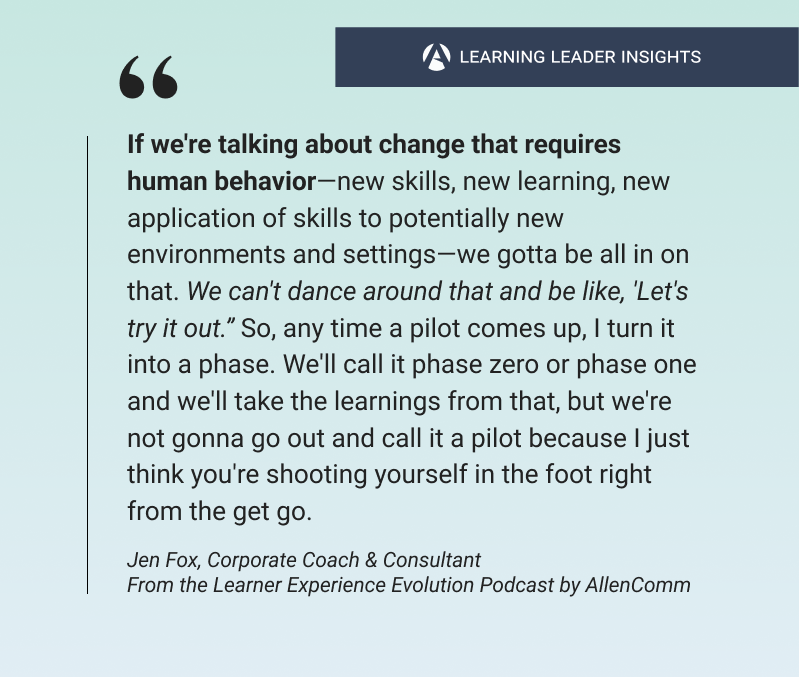
Well, yeah, what’s the point, right? And I think that that’s at the core of it. If you’re changing a process that someone goes in and the way they submit their time, OK, fine. But if we’re talking about change that requires human behavior, new skills, new learning, new application of skills to potentially new environments and settings, we have to be all in on that. We can’t dance around that and be like, let’s try it out.
I’ll tell you, and all of my clients could testify to this, I loathe doing a pilot. I know this is a learning podcast and I might get flack for this. I’m all for trial, I’m all for due diligence. The reason I don’t like positioning things, especially learning interventions, as a pilot is to me it signals to the organization, we’re not sure. We’re not quite committed. We don’t really know if this is going to work and therefore we’re not actually going to hold you to account for trying this new thing or implementing this new behavior.
So anytime a pilot comes up, I turn it into a phase. Okay, we’ll call it phase zero or phase one, and we’ll take the learnings from that, but we’re not going to go out and call it a pilot because I just think you’re sort of like shooting yourself in the foot right from the get go.
Michael Noble
Yeah, it’s an experiment. It’s optional. It communicates. It’s communicating. I get that. I get that. I like that. We’ll do a phased approach from now on. So I’d be interested to hear, let’s take one of your worst experiences that you’ve had in trying to pull off a change. Could you tell us a little bit about what sunk the battleship in that situation?
Jen Fox
Boy, we’re going to get a little deep here. I mean, I’ve had a lot, right? I’ve just been, because my career has spanned so many different organizations. There was a time when I was on a team that I thought was highly dysfunctional. And yet, nobody was talking about it.
Picture one of these situations where the family dinner table is perfect since we’re talking about the holidays. Where everybody’s just being cordial and nice, and you know there’s these boundaries around here’s what we’re going to talk about, here’s what we’re not. But put that into a team environment. Magnify that by saying that that’s an HR team. So you look around, where’s HR for HR? Non-existent in most organizations, it’s non-existent.
When I think about trying to navigate that change and trying to sort of lead from within, lead from below, influence without authority, I would say, is another sort of competency that would come up there. I would say some of the learnings that if I could look back, I would say I should have paid more attention to timing, should have been more in tune with the broader political landscape. I’m one of these optimistic people that like to think that everybody’s like on the up and up. It’s not necessarily the case. I was naive in that, I would say.
And then I think just also sort of being able to sort of see the forest for the trees, right? Sometimes drama and change happens at work and it just becomes everything. It’s all consuming, right? And then you layer on if there’s external factors going on. I’m a mom of three so there’s always something going on in my life.
So I would say those are the things that the lessons when I look back with hindsight I’d say I could have done better. What I’m proud of—and I would say that this is one of the most important things that I feel so strongly about for people going through any type of change—is being true to my values. I’m clear about my values. I’ve done a lot of values work. I was able to have the courage to recognize and to sort of speak out and act when the environment was out of alignment with my values. And I think tap into that authenticity of just knowing what the cost was of that misalignment for me.
When I think about, so often, people in my coaching practice, so often we have this conversation, I don’t know, should I stay, should I go, something’s just not right. And I always go back to that. It doesn’t have to be personal, but that fit, that inner fit, that feeling you get in the morning, like wanting to be somewhere, it’s so rarely about the things that you’re doing. It’s so rarely about the task. It’s about how do you feel? Do you feel like you can, are you supported? Do you feel encouraged? Are you challenged? Are you learning? It’s a lot of those types of things.
And I think that we don’t pay enough attention because we’re just like, go, go, go. We don’t pay enough attention to zooming out and saying, is this the right fit for me for right now? And I think that we’re taught too early to find like the fit as though it’s out there. And I like to have people just like shorten the timeline. Like this chapter right now for what’s important to you, is this the right fit for you right now? And if not, then let’s have that conversation because there’s so much possible, so much freedom to be had when you can go and actually pursue that right fit.
And so I think that the through line between an individual’s values and what they’re committed to in the organization, we just have to pay a lot more attention to that. I think it’s a huge unlock for employee retention, honestly.
Michael Noble
Okay, so that takes me to what will probably be our last question for today. But I’d love to hear, you’ve been doing this for a while. One of the great things about working with multiple different organizations is you have a good sense of what are some of the unique things and what are some of the universals?
I’d love to hear how you think—this is a different way of looking at change—but how is leadership development changing? And what do you see ahead in terms of that ongoing change as we try to be proactive about our own work? What change do you see on the horizon?
Jen Fox
Yeah, I love that question because it’s just, I think leadership has never been more important. I think what’s changing the most is that, especially as we have five generations in the workplace now and the newest generation demands authenticity. The commonplace leadership platitudes of the, love all the sort of the Druckers and the Coveys and all the guys that have all the books, but those platitudes don’t work anymore.
This next generation will call you out in a heartbeat if there is dissonance between what you’re saying and how you’re showing up. I have an open door and then you go and you share a complaint and it goes sideways? No, no, no, no.
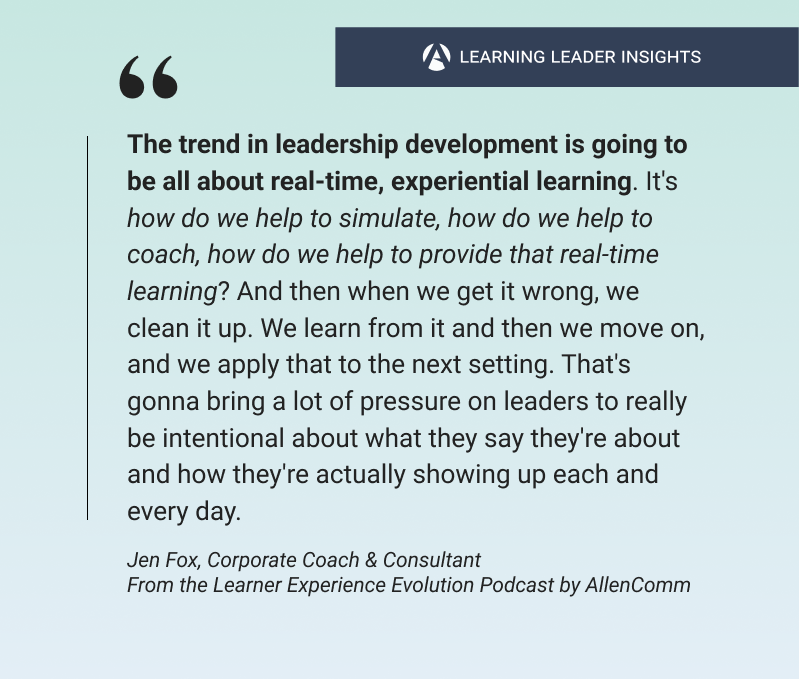
So I think the trend in leadership development is going to be all about real-time, experiential learning. It’s how do we help to simulate, how do we help to coach, how do we help to provide that real-time learning. And then when we get it wrong, we clean it up. We learn from it and then we move on and we apply that to the next setting. I think that’s what people are going to watch out for.
I can tell you the leaders that I admire the most, they are not the perfect leaders in any way. They’re the ones that had the courage to stand up in front of the room on the stage and say, “I got this wrong. I made the wrong decision. I’ve learned from it. Here’s what we’re going to do different.” That to me is just like, that’s leadership.
So I do think that that is a trend that I see is just more and more, that’s going to bring a lot of pressure on leaders to really be intentional about what they say they’re about and how they’re actually showing up each and every day.
Michael Noble
So my summary isn’t going to do justice to your answer. But what I’m kind of hearing is like, a shift from the almost performative leadership development to experiential, authentic, imperfect as it may be, but it is on that journey. It’s that learner experience journey. I think that’s an exciting vision of the future. So thank you for sharing that because I haven’t really—like you, I admire that the audacity of that generation in like, yeah, I’m not, why are we playing these games? That’s just how we do it. And we play these games and I’ve learned to play the games. I’m going to get my straight A’s and I’m going to keep on doing that.
I think that’s a bright and kind of ambitious target for us, which is how do I make that? I can learn by instruction, I can learn by example, I can learn by experience, and the authenticity, and the fancy word that I would throw in there would be verisimilitude, which is it’s more like what they would actually need to do as a leader, right? Because of that authenticity, the similarity between that learning experience and it’s learned by doing. And I think that’s a bright future.
Well, thank you so much, Jen. This has been a very fun few minutes that we’ve spent together. I really hope you’ll join us again in the future, and I’m hoping we get a chance to work together in the future.
Learners, thank you. Learning leaders, thank you very much for tuning in. Please tell your friends about us and drop us a line at info@allencomm.com if you have any ideas or questions. So thank you, Jen, and thank you, audience.
Jen Fox
Thanks so much.
The Learner Experience Evolution is a weekly podcast for L&D learning leaders to stay inspired and gain valuable insights from other industry leaders. Subscribe now to never miss an episode wherever you listen to your podcasts.




Resources For L&D Leaders
free guide
free guide
insights | on the blog

ALLENCOMM Press Releases
AllenComm Earns Spot on Best Mobile Learning Content Providers 2026 List
eLearning Industry honors AllenComm for its custom mobile learning solutions for enterprise, built to improve performance outcomes at scale. SALT LAKE CITY, [July 29, 2026] — AllenComm has been named to eLearning Industry’s...
ALLENCOMM Press Releases
AllenComm Named a Top Employee Engagement Training Provider by eLearning Industry
AllenComm has been recognized by eLearning Industry as a 2026 top provider for employee engagement, cited for scalable, personalized L&D that drives measurable results. SALT LAKE CITY, [June 24, 2026]...
ALLENCOMM Press Releases