

ALLENCOMM BLOG | Podcast
EPISODE 12: WORKPLACE MENTAL HEALTH & LEADERSHIP DEVELOPMENT
January 21, 2025
Mental health has never been more important than it is now, especially when it comes to overcoming or preventing burnout in the workplace. Michael Noble and Dr. Allessandria Polizzi, founder of Verdant Consulting, take a deep dive into how learning leaders can spot the signs of burnout early, and steps they can take to build competencies around mental health as a critical aspect of employee well-being. It’s about strategic approaches—not quick fixes—to truly build a resilient, psychologically safe future.
Takeaways
- Workplace mental health is as crucial as physical health.
- Investing in psychological health yields a significant ROI.
- Organizations need to build strategies, not just seek quick solutions.
- Leadership development should include mental health competencies.
- Loneliness and burnout are prevalent among leaders.
- Mental health skills are essential life skills.
- Future challenges will require resilience and coping strategies.
- Emotional navigation is key in the age of AI.
- Trusting the process is vital for long-term change.

Dr. Allessandria Polizzi: CEO and Founder of Verdant Consulting
Dr. Allessandria Polizzi (or Dr. Al) is an award-winning and globally recognized thought leader and top-rated speaker on workplace mental health, psychological health and safety, and building resilient organizations. A former HR executive with experience in 20+ industries, she is now the CEO of Verdant Consulting, a top 20 workplace wellness provider of 2022, as well as the ISO global liaison for occupational health and safety. She also serves as an expert on psychological health and safety for professional associations, media, and the National Safety Council and recently published the Workplace Mental Health Strategy Workbook for companies to proactively address this issue. Her entertaining and informative talks inspire audiences while providing practical tactics based on decades of scientific research. Dr. Al weaves together data, stories, audience interaction, self-reflection, and her quirky sense of humor to create memorable and actionable experiences that can transform how we work.
Michael Noble
Welcome to another episode of the LX Evolution. I’m Michael Noble, VP of AllenComm Advisory, and I’m your host for this episode. Our guest today is Dr. Allessandria Polizzi. We’re very excited to have Allessandria here with us. She’s the CEO and founder of Verdant Consulting. I’ll let her tell us about that in just a moment.
I first met Al over 20 years ago. Over the course of our careers, we’ve crossed paths many times. When she was at Cambridge Integrated Services, at Intuit, Pizza Hut, 7-Eleven, and the Boston Beer Company. So I already know this is going to be one of my favorite podcast episodes. Let’s get started. Welcome, Al.
Dr. Allessandria Polizzi
Hi Michael, how are you?
Michael Noble
I’m doing well.
Dr. Allessandria Polizzi
Good!
Michael Noble
First off, tell us a little bit about Verdant Consulting. And then once you tell us a little bit about the focus of your organization, I’d love to hear what led you to kind of found the company.
Dr. Allessandria Polizzi
Yeah, so I’ll start there actually. I founded the company in 2021 following my own experience with burnout as a chief people officer. I had focused on the mental health of our employees. At the time, I was working for a veterinary hospital company. And I realized that I had completely burned myself out along the way.
While I took time off to handle that, I started researching what causes burnout, how can I prevent it in the future? And I kind of locked into this treasure trove of data and research around workplace mental health, psychological health and safety, resiliency, and burnout prevention. And of course, with me, the world must know, right?
I’m an educator, been an educator since I taught college my first career. So I decided to pivot and focus on helping organizations implement the global standards and the scientific research around creating healthy and thriving workplaces. That’s what Verdant focuses on. We help organizations implement the global guidelines around psychological health and safety and workplace mental health. And we also help them build resilient leaders and teams.
Michael Noble
That’s exciting to me for a couple of reasons. One of them is I think there’s a big gap. The experience that you’ve had, many of us will recognize that in our own careers as something that can be difficult to manage and to juggle. Our podcast is about change, evolution and learning, right? And you’re kind of on the avant-garde of change in the mental health work. Maybe the first time you’ve been called avantgarde.
But I know that one of the things that you’ve done is you have published a book, the “Workplace Mental Health Strategy Workbook.” I know it takes a lot of discipline and effort to complete a book project. It takes a lot of that passion. What change are you trying to accomplish? You’ve mentioned a little bit about your organization. Talk a little bit about the workbook itself as a change agent or as a tool.
Dr. Allessandria Polizzi
The change that I’m helping to shepherd is for the United States to catch up to other parts of the world that have already gone through this change, which is to recognize that our mental health is as impacted by work as our physical health can be.
And so from an occupational health and safety perspective, countries like Australia, Canada, many countries in the EU, Mexico, even Puerto Rico have acknowledged and have laws around holding companies responsible for psychological injury in the same way that they would be held responsible for a physical injury that happens as a result of work.
That’s a radical notion for us here in the United States where the belief system has been, historically, that people own and are responsible for their own mental health. And if there are injuries that happen, it’s a weakness on the part of the individual, not a root cause to the business or the industry, what have you. And so, similar to how 50 years ago, if you were injured physically at work, it was your responsibility, despite the fact that it may have been caused by faulty equipment or standards within the workplace.
When OSHA passed, that mindset shifted. That’s the change that’s been happening globally since 2017 around our psychological health and safety. And so that’s a big shift. It’s a big change. It can be perceived as kind of unrealistic because these concepts seem squishy, but they really aren’t. They’re a science. We have standards. Those have been established and published. They’re all based on research. And again, countries are ahead of us on this.
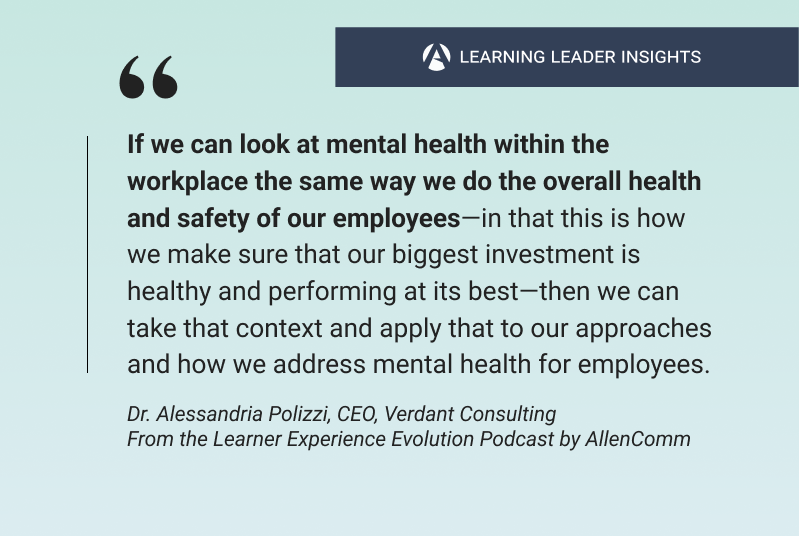
So what drove me to write the book was that what I saw was a lot of my fellow chief people officers, and I did this as well when I was a CPO, going for solutions as opposed to building a strategy. And if we can pull back from the latest app or whatever vendor has come in, or a thing I can get for free through my EAP, and instead look at mental health within the workplace the same way we do the overall health and safety of our employees—in that this is how we make sure that our biggest investment is healthy and performing at its best—then we can take that context and apply that to our approaches and how we address this for employees.
The strategy workbook I built as a workbook because I know when I was a CPO, I wouldn’t have had time to learn all these things, and so it gives a framework for people to just fill out based on their parts of their strategies and priorities for their business. So we’ve got I think 24 different business priorities and objectives, both areas of focus, future focus, things like that, and then we have frameworks people can use to help implement the scientific standards around creating psychologically healthy and thriving workplaces.
Michael Noble
If we think about change and getting people to change their minds, it’s even harder to get institutions and cultures to change their mind. I’d love to hear a little bit about how this is received by your customers or like, hey, you’ve got a champion that brings you in, how do you build enough influence to actually initiate change in an organization, or does it take a crisis?
Dr. Allessandria Polizzi
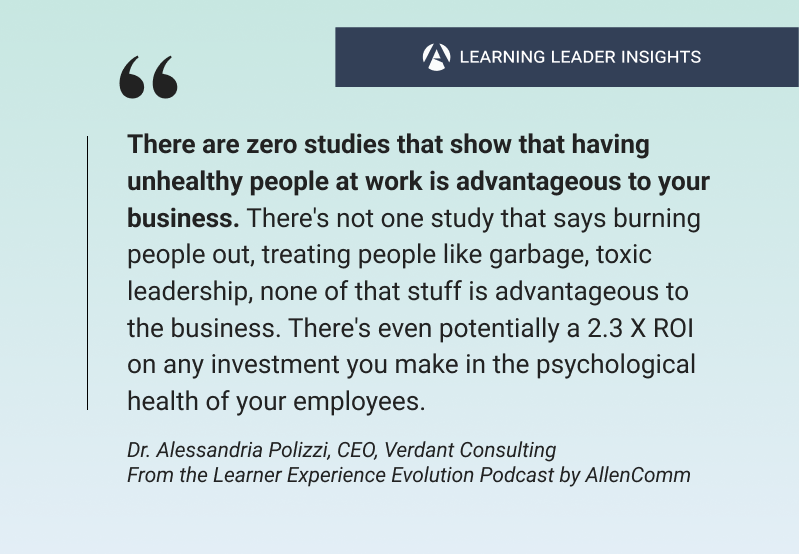
That’s interesting you say that about taking a crisis. It really depends. When people ask me what my industry is, my cheeky answer is any industry where people experience stress and they have an executive team that cares. And so the hard facts are that there are zero studies that show that having unhealthy people at work is advantageous to your business. Like there’s not one study that says burning people out, treating people like garbage, toxic leadership, none of that stuff is advantageous to the business.
So the opposite of course is true that, there’s even the first page of my book actually has this listed, which is that one of the big four consulting companies did research on Australia, and there’s a 2.3 X ROI on any investment you make in the psychological health of your employees.
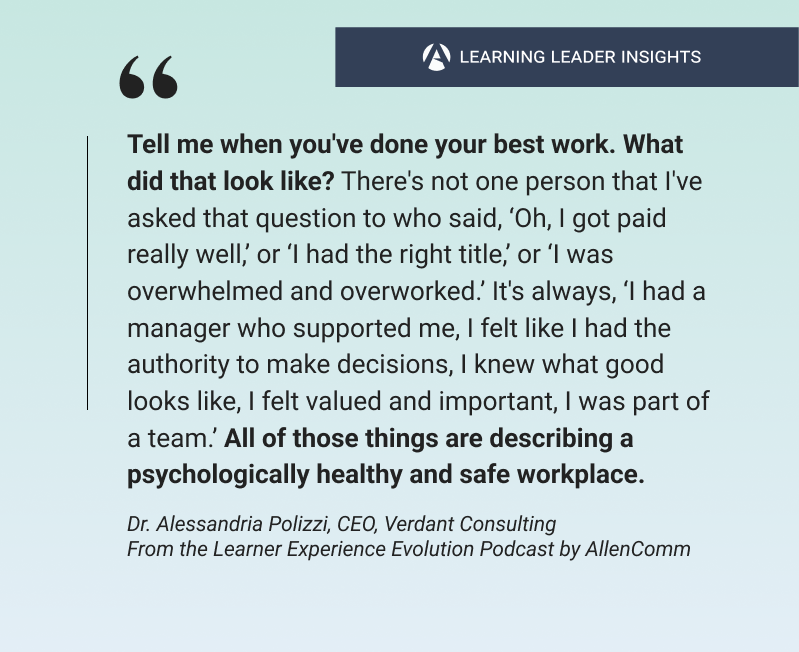
The business case that I make is I ask a very simple question, which is, “Tell me when you’ve done your best work.” Actually, I’ll ask you, Michael. Tell me a time in your career when you’ve done your best work. What did that look like?
Michael Noble
Yeah, I mean, the times in my life where I was able to do my best work, where there is psychological safety, the ability to be creative, right? Where there’s that self-efficacy element that I know that I can do this thing. And yeah, you just take off from there. But, you know, I’ve gotten wiser, I think, over the course of my career and can recognize those situations better. But yeah, it’s a constant struggle, I think.
Dr. Allessandria Polizzi
Yeah, so to the person, there’s not one person that I’ve asked that question to who said, “Oh, I got paid really well,” or “I had the right title,” or “I was overwhelmed and overworked.”
It’s always, “I had a manager who supported me, I felt like I had the authority to make decisions, I knew what good looks like, I felt valued and important, I was part of a team.” All of those things are describing a psychologically healthy and safe workplace.
And so all we do is try to have most days be the best days for most workers. And that has the biggest ROI. And everyone has experienced both when that works well and when that doesn’t work well. And we all know through our own experience how effective we were when it didn’t work. And so that’s just a simple way of articulating what we’re trying to do is help people do their best work most of the time.
Michael Noble
In addition to this focus that you have workplace mental health, the kind of broader HR umbrella that it falls under, I know you’ve got an extensive background in learning and development as well. A lot of our listeners are coming specifically from that aspect of L&D. This is one of those topics that I think sometimes it’s like, we meet the need for DEI because we have this course, or we meet the need for this because we’ve offered this training on anti-harassment, or you know what I mean?
For leaders in learning, how do they keep this from becoming just another symbolic gesture of a course offering, of how to stay mentally healthy at work?
Dr. Allessandria Polizzi
Yeah, so there’s a ton of ways they can do that. Of course, we offer programs that do that. But so one of them, for example, we have is a burnout first aid or certification. That means you have people embedded in the organization whose side job or who are skilled at identifying the root causes of burnout and intervening where possible and supporting where perhaps it isn’t. That’s a great way to have that embedded skill set.
I consider us a leadership and competency development company. I’m not a mental health company. We are about building competencies and skills around creating emotional agility, resiliency, and an understanding of human-centric factors that then can be applied in the real world in a practical and pragmatic way. We’re not a therapy-providing company. We don’t address mental illness. We create mental health.
So those are skills, those are competencies. Everything we do is around building those skills. If we focus on this as skill development, as learning and development professionals, we know one-and-done doesn’t work, it doesn’t stick. So we offer something I’ve called “nano learning,” which is one little topic, one refresher, one idea on a regular cadence. We do it via texting where we can do the reinforcement and the sustainability real time and in very, very tiny, tiny little bites. Not even bites. Nibbles. Hums.
Michael Noble
Yeah, love that idea. Also loved the idea you brought up before about kind of the first responder approach. If we look at the context of, over the last couple of years and the pushback against certain kinds of programs at work, DEI is the most obvious one. You had mentioned that you view yourself as— you’re not a mental health organization, right? And I really like the idea that this is part of leadership. And even leadership has been reinvented over the last few years, democratized to the point where it’s like, okay, that’s how we get our interpersonal skills, right?
I’m wondering as you talk about some of these smaller moments in a journey, have you done any work where it was meshing or bringing this into—kind of harmonizing or orchestrating an approach to leadership that includes this kind of insight?
Dr. Allessandria Polizzi
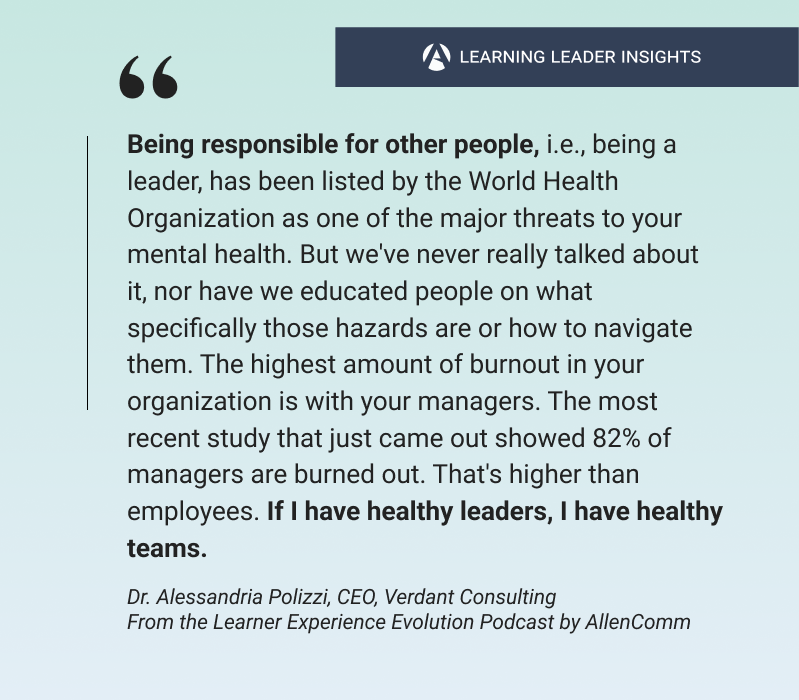
Yes. Yeah, so I actually strongly believe that this should be the foundational part of any leadership development program. Because one, there are research studies on the mental health impacts of being responsible for other people. Being responsible for other people, i.e., being a leader, has been listed by the World Health Organization as one of the major threats to your mental health.
And any of us who’ve managed people can probably nod our heads and say, “Yeah, absolutely, that checks out.” But we’ve never really talked about it, nor have we educated people on what specifically those hazards are or how to navigate them.
My hypothesis and strong belief is that all these other leadership strategies are great, but if I’m not grounded in my purpose as a leader and how I can navigate my emotional challenges, or whatever those situations may come up for me, none of that other stuff is going to stick. I really do feel strongly, and I think it’s kind of like Emotional Intelligence 2.0, I like Emotional Agility better, but with specificity about what are the specific hazards for being a leader?
I mean I literally taught this today around the concepts of loneliness as an example. Loneliness is rampant among leaders. Guess what? The highest amount of burnout in your organization is with your managers. The most recent study that just came out showed 82% of managers are burned out. That’s higher than employees.
So we have to do things, and when you talk about making things stick, if I have healthy leaders, I have healthy teams. And that’s what really can drive this in the organization as well.
Michael Noble
Yeah, it really does spark a bunch of related ideas around like… if you said, for example, you like to start, like make it the foundation of a leadership program, my mind immediately goes to… well, I’ll use this example. Compliance training, for example, when you do it a certain way, it can help people learn to be accountable for each other and be responsible in the workplace and improve outcomes in productivity and performance that weren’t even metrics that had anything to do with regulatory compliance.
But they changed how people related to each other. And so there were these ripple effects. And I’m assuming you’ve looked at that. You cited that statistic on the ROI from this. Is that where that value is coming from? Or what are some of the different ways that you realize value through this strategy?
Dr. Allessandria Polizzi
I would say if compliance, which is not really the most motivating human factor in the world, can create connection, even more so is understanding your purpose and your why. And so understanding our values as leaders, identifying my purpose and my why, that has been scientifically proven to help me navigate most challenges ahead of me.
There’s also things like self-compassion, radical acceptance. These are concepts that have been proven over and over again to work, and work more impactfully with leaders themselves when they look at it within the leadership context.
If I don’t have that grounding, that foundation, I call it your leadership DNA, if I don’t have that how am I going to run the report if I’m distracted by some other deliverable I have? Or, you know, I had a tough conversation with my boss and I don’t know how to let that go, or I’m feeling imposter syndrome because I don’t feel confident in my ability to do the work I’m being asked to do. All of these things become barriers to learning and absorbing everything else that we try to teach our leaders.
Michael Noble
So now I’m thinking ahead. I’m thinking of like, where does this go? And I’m thinking the context where, since COVID in particular, we’ve had a lot more remote interaction. We have AI supplementing a lot of the work that we do, at least a lot of the work that some of us knowledge workers do at this point.
In terms of the future of where this particular change goes, because you have to be able to sustain a change, what do you tell your clients about where this is going? And how do you sustain this kind of initiative?
Dr. Allessandria Polizzi
Well, I think one, embedding these skills, these are life skills, they aren’t just work skills, so they apply pretty universally. But let’s talk about the challenges that lie ahead. None of those are challenges that don’t come without some level of anxiety and fear, which of course impacts our behavior at work.
The World Health Organization actually lists the biggest threat to our mental health, not as COVID, but climate change. And as the number of natural disasters increase as a result of climate change, research shows it increases the amount of people who experience trauma and PTSD symptoms. This is going to show up at work. So our future is not looking like a very mentally healthy future, unfortunately, for now. Giving people skills to cope with that in a way that prevents them from burning out or breaking is only going to be advantageous to your business. That’s one.
Secondly, let’s talk about AI. The only difference between AI and humans is the fact that we have emotions. We are feeling creatures who also think. If we don’t know how to navigate those emotions, then we’re kind of at the mercy of those emotions. We can’t outthink AI, but we can add the human element to it, which is what really differentiates us from the machines.
Michael Noble
Yeah, I love that as we embrace what makes us human, mastery of our mental health, or at least maybe mastery is the wrong word, maybe agility or resilience. I really like that.
Dr. Allessandria Polizzi
It’s agility, agility, yeah.
Michael Noble
As you’re thinking back, I mean, you’ve been doing this for a few years now. What would you tell yourself a few years ago, right? What have you learned to expect? What have been some of the insights that have kind of surprised you that you would send back in time if you could?
Dr. Allessandria Polizzi
That’s a very great question. Several things. One, not everyone is going to see the vision as clearly as I see it. It’s not as obvious. So just be patient. We were really early to market. No one was really doing anything in this space when we started. And very few are doing it now. So again, be patient, and I think, you know, what do they say? Trust the process.
Michael Noble
That’s what my son tells me when I’m nagging him about getting anything done. He’s like, yeah, trust the process, Dad.
Dr. Allessandria Polizzi
This is a thing the kids say. This is a new thing the kids say I have learned.
Michael Noble
Yeah. Well, Al, thank you so much for being our guest on the podcast. I’ll remind everybody the title of your book is the “Workplace Mental Health Strategy Workbook.” I love the book in that it is so interactive and engaging, and it kind of invites you to participate in a way.
I’m a skimmer, unless it’s a good novel, I’m going to skim. If it’s a novel, I’m going to savor every word. But I found myself answering the questions and unable to skim because it really brings you in. And I think this is an important topic and relates to leadership development and onboarding and all the things that we try to accomplish.
But to your point, I think we’re missing some of the fundamentals and some of the things that would create a context where learning could actually happen. So thanks for your time. I hope you’ll join us again soon. And listeners, thank you for tuning in. Tell your friends about us. Drop us a line at info@allencomm.com if you have ideas or questions. And until next time.
The Learner Experience Evolution is a weekly podcast for L&D learning leaders to stay inspired and gain valuable insights from other industry leaders. Subscribe now to never miss an episode wherever you listen to your podcasts.




Resources For L&D Leaders
free guide
free guide
insights | on the blog
ALLENCOMM Press Releases
AllenComm Earns Spot on Best Mobile Learning Content Providers 2026 List
eLearning Industry honors AllenComm for its custom mobile learning solutions for enterprise, built to improve performance outcomes at scale. SALT LAKE CITY, [July 29, 2026] — AllenComm has been named to eLearning Industry’s...
ALLENCOMM Press Releases
AllenComm Named a Top Employee Engagement Training Provider by eLearning Industry
AllenComm has been recognized by eLearning Industry as a 2026 top provider for employee engagement, cited for scalable, personalized L&D that drives measurable results. SALT LAKE CITY, [June 24, 2026]...
ALLENCOMM Press Releases