

ALLENCOMM BLOG | Podcast
EPISODE 13: NAVIGATING COMFORT ZONES IN CORPORATE TRAINING
January 28, 2025
Everyone’s comfort zone is different (especially when it comes to AI). That’s why it’s important to meet people where they are to better understand how they feel and how they learn best in a corporate training environment. In this episode, Ron Zamir and Jeff Martin, Senior Performance Consultant and Learning Strategist at AllenComm, discuss what it means to balance content and skills within someone’s comfort zone—as well as how AI can enhance creativity and effectiveness when paired with the right human oversight throughout the learning journey.
Takeaways
- The evolution of learning experiences is crucial for 2025.
- Performance consultants play a key role in adapting innovation.
- Understanding comfort zones is essential for effective learning.
- AI can enhance learning experiences but requires careful integration.
- Balancing content and skills is vital for learner engagement.
- Disruption is necessary to cut through the noise in corporate training.
- AI serves as a creative partner in the learning process.
- Human oversight is critical when using AI for content generation.
- Meeting clients where they are fosters better learning outcomes.
- Continuous adaptation and innovation are necessary in learning and development.

Jeff Martin: Senior Performance Consultant and Learning Strategist at AllenComm
Jeff Martin is a senior performance consultant and learning strategist with a proven track record of integrating AI-driven solutions to create innovative, user-centric learning programs. Starting as a high school teacher in 2008, Jeff began training new teachers after his first year of teaching. He has since been a teacher facilitator for JHU, helped develop a leading edtech iPad reading comprehension app, and has worked in global training for a company out of China. Having transitioned into the corporate L&D sphere in 2016, Jeff has led significant transformations by turning complex content into scenario-based, skill-building experiences. At AllenComm, he pioneered an AI club, where his hands-on approach to up-skilling teams and driving efficiency has earned leadership recognition. In his free time, Jeff enjoys playing experimental music and Tetris.
Ron Zamir
Well, hello everybody. This is Ron Zamir again, CEO of AllenComm. Welcome to episode 13 of our podcast, which is all about the evolution of the learning experience, about innovation. And I am really excited for today’s episode. I am joined by Jeff Martin, one of our team members. He will talk about himself in a minute.
And this is going to be an exciting episode where we’re going to explore the edges and the comfort zones of how learning and development evolves in 2025, and some of the ways that we could do the best job we can do to really embrace AI and other technologies that are really at our request.
So Jeff, let’s start. I know we all have interesting journeys that brought us into this industry. Can you share some of your personal journey?
Jeff Martin
I studied political science, and so it was obvious that I would become a high school teacher. Before doing that though, I did have a small business that I ran, kind of selling artsy, reconstructed vintage clothes. And so I had experience as a small business owner, which really prepared me to be a teacher, because being a teacher is like being a small business owner. You have to know your product and know your policies and be really clear on, for lack of a better term, what you’re selling.
I only taught for three years, and then I was able to ride a wave with Johns Hopkins, with facilitating teachers. That led me to an iPad EdTech app that led me to corporate training. And I worked for an interesting company out of China for a year and a half before I joined AllenComm. That was kind of my intro into corporate training. And now I’ve been at AllenComm going on seven, eight years now.
Ron Zamir
Starting in the new year. So if you look at that journey from kind of a teacher, entrepreneur, by the way, I have two degrees in international relations, so the journey is weird. I did not go through high school. I taught at university for a while. But how has that prepared you? Talk about your role. You’re what we call one of our performance consultants. It’s the tip of our spear when it comes to learning experience. hare
a bit about that and how that’s informing you about how to adapt innovation.
Jeff Martin
Yeah, so I think one of the main things that I learned as a high school teacher was I had roughly 160 students across five periods every day that I saw every day. And I learned through trial and error, teaching the same class my first year, five periods in a row, what stuck and what didn’t stick, what worked and what didn’t work.
And what’s really interesting is that those instincts that I developed in the classroom, working with teenagers, have really translated well into corporate training, I would say, in terms of making sure that, I still do think of my students in a way, would this pass their sniff test? Would they buy into this?
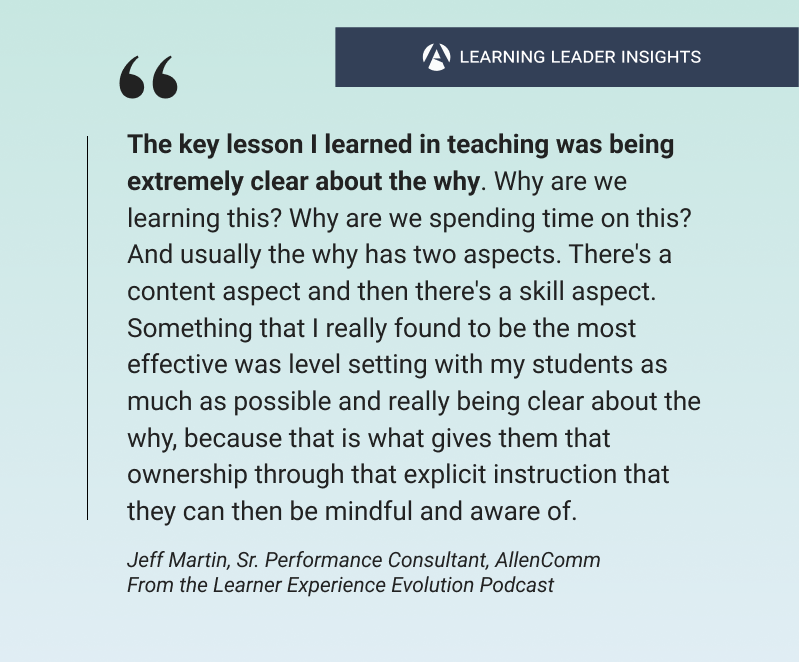
And the key lesson that I feel like I learned in teaching was being extremely clear about the why. Why are we learning this? Why are we spending time on this? And usually the why has two aspects. There’s like a content aspect and then there’s a skill aspect. And that was something that I really found to be the most effective was level setting with my students as much as possible and really being clear about the why, because that is what gives them that ownership through that explicit instruction that they can then be mindful and aware of.
It’s not just about the content, it’s not just about the skills, but it’s that balance between those two. And I think that initial relationship that I developed with instruction, I’ve relied on and even sharpened in a corporate setting around how I think about learners first and how I, to be honest, even to this day, it’s so long since I was in that setting, but to this day, I still do think of my students who are now in corporate jobs.
And I think of them as like potential learners because I feel connected to them still in a way. So, yeah, I mean, there’s obviously more than that to the switch to corporate training, but it’s one of the themes that has really carried over.
Ron Zamir
Yeah, I will say when we look at the industry, when we talk to our even our customers that are some of the biggest corporations in the country, a lot of them do come from higher education. A lot of them do come from K-12. And I think the aspect of igniting, motivating learning, we all remember the best teacher we had.
If it was the English teacher, the science teacher, the math teacher, social studies, and how they were able to, through that ignition, encapsulate the why. And of course, when we look at adult education, that why is so much more critical to frame the learning experience.
Ron Zamir
So let’s talk about the learning experience. How does your job now differ from an instructional esigner?
Where does it go from designing an event to designing an experience? And if you can share some thoughts about how we can innovate in designing learning experiences or looking at it differently than you would look at a design.
One of the things that AllenComm is known for is being able to take a learning objective and turn it into an experience. When we look at the role of a performance consultant, it’s not just to take the content and design an intervention. It’s really, how do we look at the broader life of the learner and what they have to do? This is where innovation happens. This is where the learning experience—let’s talk about the learning experience for a bit.
Jeff Martin
Yeah, so I think one of the key things that I’ve learned as a performance consultant is that there’s always a context behind the scenes of what’s going on that either drives the need, it might be influencing the challenge in terms of how employees are struggling. And the more I’ve worked with dozens of clients, the more I’m always looking at and thinking about the context of how whatever project or component fits into the bigger ecosystem.
Specifically thinking about even change management, what are some of the factors that might be incentivizing or disincentivizing employees to do or not do something? And one of the themes that has emerged as I’ve focused on the bigger picture is setting expectations, very similar to what I learned as a teacher, which is explaining that “why” and setting those clear expectations and the purpose, but then also looking at who are the players involved. Usually we’re talking about employees, but very often… there’s kind of a focus on employees and what they need to be able to do or what success looks like for them. We are often forgetting the managers and the other supports that are surrounding that employee and are so critical to their success.
And thinking through, the more projects I’ve worked on, the more I understand kind of how organizations are structured and thinking through fairness at all of those levels that, to some extent, everyone needs the right balance of guidance, of modeling opportunities to practice and really become proficient at the key competencies that are going to help them succeed in their role. What I see sometimes is that we’re looking at the kind of ground level and we’re not necessarily looking across the organization.
Ron Zamir
Yeah, I think you bring up some good points and I would like to share this with the audience. We often look at—we still are entrapped within our module world. It doesn’t matter if it’s a micromodule, if it’s five minutes, 10 minutes, an hour. When we move to an experience design, we’re actually looking at the multitude of inputs that impact a corporate citizen or a learner.
And that actually changes our approach and how we balance the interaction with the content. Where suddenly we’re using the same experience, but now morphing it to the manager, employee experience, the employee, in a self-paced and of course an employee interacting with other employees. And I think the critical aspect becomes how much do we want to disrupt the employee from his day to day? ecause
we do need to disrupt, because we do need to cut through the noise. But how much we also want to
embed it within the natural environment that the employee is working?
Ron Zamir
And that brings us to a term I’ve heard you and other performance consultants use, is that comfort one.
Where do you find that line that you can push any employee, any corporate construct, any corporate environment? But at some point, by pushing it too much, you’re actually creating a reflexive movement to shut down. And this is critical. That comfort zone is critical because this is where technology comes into play. This is where innovation comes into play and where we pushed employee and the organization, the learning group, to that comfort zone and help them expand that comfort zone versus trying to cut through the noise, break through that comfort zone, and kind of shake things up.
Can you share some of your thoughts? How do you identify, in your case it would be one of our partners or customers, their comfort zone and how do you design to that?
Jeff Martin
So usually we’ll work with the learning team and learning leaders to kind of understand ideally from a metrics-based standpoint, like how much are they tracking and what do they understand about their employees? And that’s usually the first take that we get. We’re asking leaders to fill us in on what they’re doing or what they’re not doing.
But then as we start to get into, depending on the project, as we get into deeper discussions around defining what successful performance looks like, what those gaps look like, then we start—then I, as I shift into the design mode, I start thinking, well, I’m a learner in this role, what’s in it for me? And how is the time that you’re going to take out of my day going to benefit me and help me do my job better?
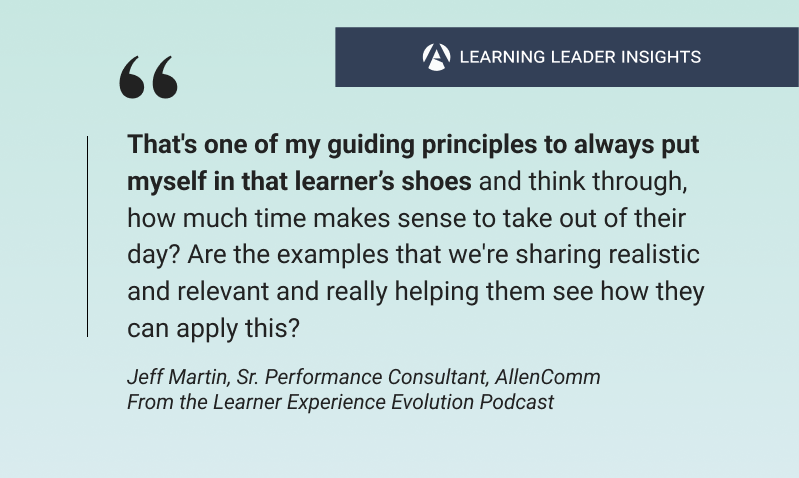
I feel like it’s a worthwhile endeavor to understand those incentives, whether it’s adult learning principles or whether it’s compensation. Lots of times, the net result of that improved performance is compensation. And I think that’s one of my guiding principles to always put myself in that learner’s shoes and think through, how much time makes sense to take out of their day? Are the examples that we’re sharing realistic and relevant and really helping them see how they can apply this?
That’s in like a learning sense, but ultimately, if we can’t relate what we’re training them on to their dayto- ay, their day-to-day job, and help them see how this is going to help them do their job better and overall improve their performance and even day-to-day, then I think it’s an uphill battle from that point because we’re not speaking at a human level to learners about like, almost conversationally and frankly, about how this fits into their role and how they’ll benefit from it.
Ron Zamir
I think that lot of the theorizing around these comfort zones is tied to cognitive loads. When sometimes we try to push too much too quickly or we adapt modalities that don’t really fit or are too far away from the current situation.
Where this comes into the topic that we’ve been talking about for 13 episodes is how do you progress from point A to point B without shaking things up too much? It’s not just how you define the learning objectives or how you deliver the content. It’s also what technology you use, how far you take it out of the past state into the current state, and using every intervention, because at the end of the day, L&D teams intervene, or support, or scaffold, to use some of the terms we’re familiar with. And how you do that is critical and how you adapt new technologies.
We’re going to talk a lot about AI in a minute. I really recommend, and I’ve learned from our CLO and from you and others on the performance consulting team, that the best way to an objective is the way that learners can relate to versus trying to pull them, because what happens is when you don’t consider the learner’s existing journey, when you design your new journey, is it becomes just an intrusion.
And we see that a lot in compliance education, where compliance education, instead of equipping employees with tools so they can be more aligned with the organization’s needs, they see the compliance education as something that is just a hammer that they need to avoid. And we never want to design to that.
Ron Zamir
Well, let’s do a little shift because I think for a lot of the people that are watching these podcasts, that
have been reading, they’re asking themselves, is the AI impetus, which is impacting every workplace, is
that going to be a big change in our world versus other changes when we went from classroom to web, when we went from instructor-led to self-paced, when we started using other technology metaphors.
Talk a little bit about your journey into implementing AI into your workflow and what you’ve learned from it, as we’ve been at AllenComm really pushing hard into adopting AI into how we service ourselves and our clients.
Jeff Martin
Yeah, it was December of 2022. I was visiting with my neighbor who’s a programmer and he was like, you have to check out ChatGPT. And I’m like, okay. He’s like, it’s a game changer. And it’s funny for me to think ack about when I first heard that, where my imagination was in terms of how this tool might help me. And I sat on it for a couple months.
I played around with it a little bit, but I almost didn’t even know how to approach it. And it wasn’t until a client had brought it up in early 2023, are there ways we could use AI? That I caught myself kind of almost dismissing it. And then I was like, wait a minute, like, how could I use this?
I was able to go in and start, for lack of a better term, I started using it to like do some performance mapping and help me identify business impacts and help me figure out like, I don’t have access to a SME. So what might be the gaps that an employee or the skepticism that an employee might have about this topic? I started realizing you can use it for all sorts of purposes.
And so to be honest, it was February of ‘23. I just kind of never looked back because I realized it was so powerful as a tool. Humbling. I think the term I used was it was humbling and inspiring because it’s like amazing what it was able to do. And this was like even back in earlier models.
So, since then I’ve used it on a daily basis, and I would say that maybe to some extent using AI so much has almost changed some of my neural pathways or like my thinking, even my whole paradigm of how I approach any project or any problem in terms of… I’ll give it the context that it needs to be able to understand the type of output that I’m looking for, but then use it to, I download it with all of my thinking, what’s my gut telling me? What’s my read?
And that first pass, I’ll give it, it’ll be kind of sloppy notes a little bit and just all of my thinking around it. And then it does a great job of helping to not only organize my thinking in a structured way, but it can also be a really powerful tool to explore comprehensiveness, right? Making exhaustive lists and how we’re using it to build out potentialities to where then it started to bleed into, well, now we can use this to make more nuanced quiz questions.
We used it on one project with a client that was in manufacturing. I was working with an instructional designer and we were able to use it to develop within scope all of these different impact statements for different employees at different roles in the manufacturing environment, to really make this impact calculator more personalized to their role and deliver more value for the client.
So we’ve already started using it to build efficiencies to give more robust and comprehensive solutions to clients. And I don’t see that, if we’re talking about AI as a disruptive force, I don’t see it going away. If anything, it’s kind of staggering, even in the last couple of years, where I remember if I gave it more than a paragraph, it would time out. And now we have models that I literally have uploaded 20 pages of Word doc content into a prompt and it’s been able to wrangle that into a useful output that really hit the mark.
Ron Zamir
And I think I want to hone in on something you said in the beginning of your remarks. Look, we can talk about an hour on AI. We’re not. I think there’s a lot of content out there. The key in our context is how these tools help us be more innovative within our practice. Going back to high school, lot of high schoolers sadly are using AI engines to write papers for them, right? To do their homework for them. We’re not talking about that. We’re talking about a tool that helps us in our creative process.
You mentioned context a lot. And I want to stress this because we’ve all now looked at this as using AI s something that enables us to organize our thoughts better. Basically using it as almost like an echo
chamber to our gut, to our data collection, and then helping it become a more organizational tool. In
that sense, AI serves some of the things that we were used when we first got Excel at our fingertips.
Being able to organize information, being able to connect information.
But what it has that Excel never had is the ability to make us more creative. We’re going to talk about the
production because that is evolving. We’re using it a lot actually for production. But the 2023-2024 was
really about being able to develop more complex prompts as a way to get back feedback from this
engine, from this statistical proximity-based model to enable us to create better contextual design for
our clients.
You mentioned a term that may not be familiar to our listeners is when we do impact calculators, what
we’re trying to do is get the learner to answer the “what’s in it for me?” question on his own versus us
telling them they’re going through an exercise at an AllenComm design, where they’re going through
certain prompts and eventually seeing how… by them learning whatever they’re having to learn, they’re
going to have this personal and organizational impact in the company they work for.
Ron Zamir
So, we look at AI as that creative partner. What’s next? Talk a bit about how AI is now becoming also a
production partner. Where do you see that going and being disruptive or innovative for our L&D team?
Jeff Martin
It’s an interesting question because it’s hard to not get too lost in the disruptive ramifications of AI’s
ability to at first help people be more effective. You can think of the shifts that that has on individual
roles, how the ways of working shift and how even the responsibilities and the skills that they might
need to employ are shifting.
And it’s not going to be like a one stop, it’s going to look different for every company, and it’s going to be
likely implemented in phases through waves as companies become more and more capable of leveraging
these technologies to find the areas that they can scale.
So that’s how I see it playing out, is production and even our imagination around how we’re working. I
don’t see any reason that it wouldn’t transform, maybe not in the next five years, but in the next 10 to
15, it could almost change certain—maybe like certain industries are going to get hit even more than
other industries—but it’s certainly going to have widespread impacts, not just on learning and
development, but on change, like how an organization is even structured and how they’re navigating
that. And the critical role that learning plays, like learning and development throughout all of that,
because whatever new skills, whatever new expectations are set out for an employee, those need to—
just like we talked about at the beginning—those need to be clearly communicated and expressed in a
way that…
Ron Zamir
Yeah, in other words, creating learning about AI for learners that have to embrace AI. I think the
interesting, again, I’m going to use the term comfort zone between using AI as an assistant to make you
more creative, to give you better information so you could apply it in your role task analysis, so you can
apply it in how you’re creating certain contextual content for your learning, maybe relying less on your
SMEs, being able to do stuff that you can do on your own before as an instructional designer.
There is the aspect of when is it too much, right? There’s some great examples now I see a lot on the
web. Here’s a video, which of the videos is AI generated? And people look for it, and there is something
we do warn our clients in kind of a positive way. Do it, but be careful, is that sometimes going too deep
into the production side of AI may create certain credibility gaps within your learning.
I think that just like, by the time this episode comes out, there would be so many AI innovations that
everything I’m saying is outdated. And I’m talking about weeks or months, not months. But I think when
you look at the disruptive nature of AI and how we can use it to evolve, I think your first point is critical.
We don’t have to go to the full production mode where we’re suddenly replacing a writer or a graphic
artist. But first use it as a tool, to use a Microsoft term, as a co-pilot, to let you better understand the
learning context and the learning objectives and do a better job designing. So that’s the first step.
And I think that in itself will get you to the edges of your comfort zone. After that, and it’s fluid, okay,
where can I now inject more animation into my learning experience, enrich it by letting AI take on a task
and do the task and then I can refine it, versus pre-imposing AI before I do my task. I think that’s where
we’re all going to have to be open to change.
But I would say again, for those that are listening to us, for those that are seeing this podcast, we could
replace ourselves with certain AI tools. But if you look at it from a most specific perspective, can we
adopt any technology, just like when we adopted desktop publishing not too many years ago, or Adobe
tool sets or other tool sets to let us be better in visual aspects? Can we become more productive using AI
tools and/or could we output better design?
And I think that’s the key is to look at any technology and how it makes us more efficient and better at
our jobs.
Ron Zamir
So with that, are there any examples you want to share of specific AI, you mentioned a bit the context,
but things that have kind of lit those light bulbs for you? And then we’ll start wrapping up with our last
question.
Jeff Martin
Yeah. So, I think of it in terms of early on in a project, I talked about it a little bit when we’re in
performance mapping mode and we’re getting the lay of the land. It can be a really powerful tool to
better use SME time because we can come more prepared for SMEs to react to things, and confirm
things, and sharpen, and edit, and revise as opposed to starting from a tabula rasa, so to speak. Then
when you get into the design mode, AI can almost be like a laser, meaning you can take any version of a
design and work it through to its eventual—you can build out the outline of a course or you can build out
even a whole learning path.
But you have to be really careful shooting that laser because if it’s not accurately lined up, it’ll give you a
slice of something that seems very confident and it seems like, that seems feasible because it’s just going
to give you its response. And if there isn’t an expert there to see it and understand the nuance of what
about that solution that AI gave us works and what doesn’t, it could replace us. It can generate content.
It can generate what you ask it to do.
But more often than not, I’m having to give it feedback to sharpen and refine things. It’s like still that you
need an expert human there to be able to interpolate and validate from your own context. I would just
say, be careful trusting in it too much, even on the front end, and then just make sure that the sights are
lined up before you kind of start shooting the AI laser, because it can take you towards any number of
eventualities.
Ron Zamir
I would say, to coin a term, just because I’m going to make it up now, there is AI hubris. I love the term
hubris because everybody can get to it. I will also add one more cautionary note, which I am very
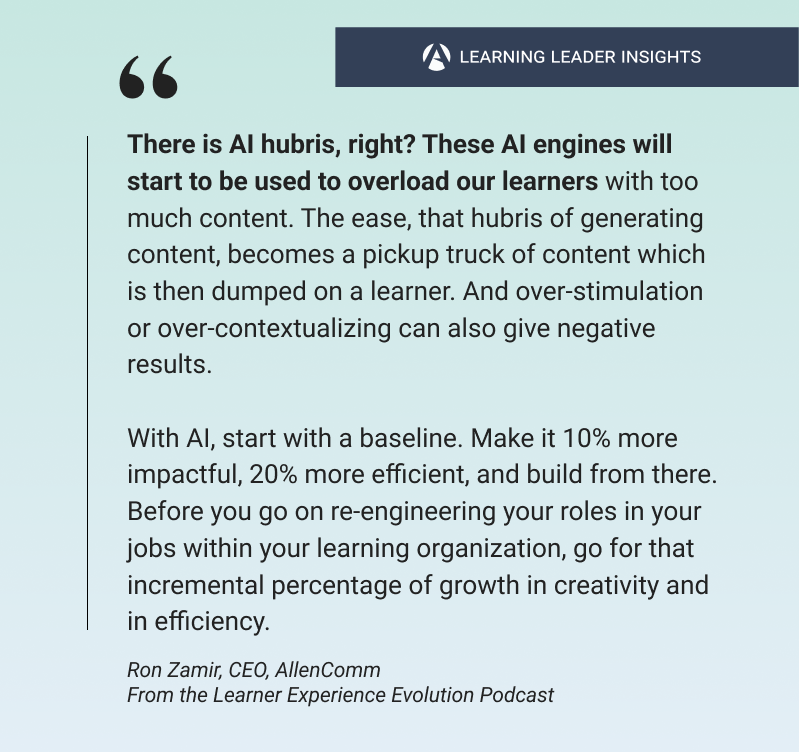
concerned about. I’ve talked and written about this, is these AI engines will start be used to overload our
learners with too much content, right? The ease that hubris of generating content becomes a pickup
truck of content which is then dumped on a learner.
And over-stimulation or over-contextualizing can also give negative results. So that’s maybe a little of the
gloom and doom. I don’t want to end this AI question with too much pessimism because we do see it at
AllenComm as we challenge ourselves and every one of our clients to say, this technology, start with the
baseline. Make it yourself 10% more impactful, 20% more efficient, and build from there. Before you go
on re-engineering your roles in your jobs within your learning organization, go for that incremental
percentages of growth in creativity and in efficiency.
Ron Zamir
Let’s get to our last question. We’re nearing the end of this podcast. You’ve been here close to eight
years. You had a journey before you joined AllenComm. If you look back and you could say something to
that teacher that now wants to go in into adult education, go into technology-driven education, what do
you wish you would have known then that you do now? And how could that serve as a guide to our
listeners and to our viewers?
Jeff Martin
I guess I would say, one of the key lessons I’ve learned is early on, I don’t know where this came from, it
was like, I was talking with the client and it just came out as this almost like dichotomy of is it helpful and
is it feasible and balancing those two. Understanding the context of where the client is in terms of their
organizational landscape, their learning and development maturity.
I’m one, you know me, like I love the innovative solution and I love finding new ways to do things.
Sometimes that’s not always the best way, because back to that point about zone of proximal
development, like how do we—we’re trying to push our clients and we’re trying to like help them get the
vision and see how innovative tools can help them improve the learning experience. That’s one of the
real, maybe you can’t get that other than from experience, but that’s what I wish I could have had from
the very beginning.
And it’s not like I’m promoting unfeasible solutions, but it’s just really about meeting clients where they
are and finding that proximal development, right? What’s that zone where you can push them to be
excited about a solution and take on new ways of thinking and working in their own space to become
leaders in their own company for demonstrating ROI, demonstrating measurable success and
measurable impact?
Ron Zamir
That is great advice and I will share it. We talk a lot in AllenComm design about comfort zones. We are
excited about AI. We’re excited about how any organization can go through a really good process of
stretching those limits, making that learning experience better. And with that, I’m going to end this
episode.
Hopefully you’ve tuned in to past episodes. We really tried to balance some of our internal experts,
external experts, and of course our customers to bring to all of you a really good experience about
understanding the learning process and of course innovating within that learning experience.
So with that, I will sign off, and thank you again for joining us. And I’m sure I’ll see you all again soon.
The Learner Experience Evolution is a weekly podcast for L&D learning leaders to stay inspired and gain valuable insights from other industry leaders.
Subscribe now to never miss an episode wherever you listen to your podcasts




Resources For L&D Leaders

free guide
free guide
insights | on the blog
ALLENCOMM Press Releases
AllenComm Earns Spot on Best Mobile Learning Content Providers 2026 List
eLearning Industry honors AllenComm for its custom mobile learning solutions for enterprise, built to improve performance outcomes at scale. SALT LAKE CITY, [July 29, 2026] — AllenComm has been named to eLearning Industry’s...
ALLENCOMM Press Releases
AllenComm Named a Top Employee Engagement Training Provider by eLearning Industry
AllenComm has been recognized by eLearning Industry as a 2026 top provider for employee engagement, cited for scalable, personalized L&D that drives measurable results. SALT LAKE CITY, [June 24, 2026]...
ALLENCOMM Press Releases