

ALLENCOMM BLOG | Podcast
Episode 14: Practical AI L&D Applications for the Workplace
February 4, 2025
We’re continuing the journey into AI, but this time we want to do it a little differently… What’s ideal may not always be what’s practical, and what’s practical should be rooted in realistic experiences and results, not rumors and trends. In this episode, Michael Noble meets with Kari Naimon, CEO of AIxHR, to discuss her own journey in the HR leadership space, as well as how she became passionate about integrating AI into employee engagement and organizational change. She shares practical AI applications and use cases throughout the employee lifecycle, personal stories of success, and advice to help leaders overcome barriers while measuring the impact of AI on business-critical goals.
Takeaways
- AI can significantly enhance employee engagement and productivity.
- Practical applications of AI are crucial for organizations to adopt.
- Many people start using AI for personal tasks before applying it at work.
- Organizations often have varying levels of restrictions on AI use.
- AI should be seen as a tool to elevate human work, not replace it.
- The importance of prompting AI correctly to get desired results.
- Overcoming fear and resistance to AI is essential for adoption.
- Measuring the impact of AI requires new benchmarks and metrics.
- AI has the potential to create positive personal impacts beyond the workplace.

Kari Naimon: CEO of AixHR
Kari Naimon, the founder of AixHR, boasts an impressive track record with over two decades of expertise in the full scope of HR, including pivotal roles at companies like Amazon, Toyota, Qualcomm, andGeneral Dynamics. Her career has spanned across the globe, with significant contributions both in the EU and New Zealand. The advent of artificial intelligence (AI) marked a turning point in her career, sparking a profound transformation in her professional outlook. Initially, Kari’s interest in AI was driven by a personal fascination with its capabilities. However, this quickly evolved into a broader vision. Dedicated to helping others recognize and harness the power of AI, Kari leveraged her extensive experience and global perspective to make a meaningful impact in the field. At the heart of AixHR lies a mission to kindle a passionate and fearless approach among HR professionals towards AI. Kari and her team are committed to creating transformative experiences.They aim to generate those pivotal Ai-Aha moments that empower individuals to unleash the full potential of Ai in their work. Kari’s journey from personal curiosity to pioneering change in the HR field exemplifies her dedication to innovation and empowerment in the realm of human resources.
Michael Noble
Welcome to another episode of the LX Evolution. I’m Michael Noble, VP of AllenComm Advisory, and I am your host for this episode. Our guest today is Kari Naimon. We’re excited to have Kari here with us. Kari’s a global HR and AI evangelist and advisor. She’s got her own firm, AixHR. We’re excited to talk with her. Welcome, Kari.
Kari Naimon
Thank you so much. appreciate being here.
Michael Noble
Yeah, I first met Kari virtually many years ago. Since then, I’ve kind of followed your career and I was excited to learn that you’d started your own practice a couple of years ago. So I’d like to start there. Tell us a little bit about AixHR, and it’d be great to hear some of your backstory and what led you to found the company.
Kari Naimon
Thank you for asking that question. I have been in the HR leadership development space for a very long time, probably 25 years. I’ve worked for Amazon and Toyota and some other big companies globally, US, Europe. I worked in New Zealand for a year and a half, which was a lot of fun. I was introduced to AI at about the same time, probably we all were.
I started hearing about ChatGPT. I was working for a company where I had a particular project that I happened to be working on at the time, and it was an employee engagement survey. It just coincidentally became very clear that AI was a solution that I could use for that project. And I used it, and I was absolutely shocked at the impact. So I became a believer of the technology.
I was working in an organization, and I think we’re going to be digging into change a bit in this podcast, but I was working for an organization that wasn’t super welcoming of any kind of change. And I just got too excited about the potential. So I started trying to teach other people in the company and they got excited, but there just was no support from above.
And I thought, what, I am way too excited about this to let the opportunity fly by. I left that job and I started my own company. Now I spend my days, nights, weekends happily helping teams across the globe really learn how to use AI.
Michael Noble
You mentioned your own personal interests really were driving a lot of this, right? You had that firsthand experience, you discovered the value of it. You mentioned the theme of our podcast, which is change. I think there’s like, just listening to you, I’m reminded, well, there’s change I need to make as a professional. And then there’s change I need to make as a leader in terms of driving change.
You kind of work on the front lines now with your practice, especially over the last couple of years as we’ve seen so much there. Tell us a little bit about how do you think you take change and make it actionable?
Kari Naimon
My entire practice is founded on practical application of AI. When I speak at conferences, or for professional associations, or specifically with HR teams and organizations, my entry point is showing people how they can actually start using the technology today to help them in their day-to-day work. And that generates an incredible amount of excitement because there is a lot of talk right now about AI, AI all the time, can’t get past one news article practically without seeing something about AI. There’s very little in the way of sharing practical applications.
By doing that, people can start to truly see themselves using it in a way that feels non-intimidating to them. So that really seems to be the spark that lights the fire under a lot of people that I interact with to just start to give it a try and see how it might help them. Without that practical view, it’s really, really hard to envision how you might start using it, what it even means to you. What is AI, and how does it work, and what does this mean to me on a day-to-day basis? It starts answering those questions.
Michael Noble
Do you find that there is a lot of variety in terms of where people are starting?
Kari Naimon
Yes, however, I will say that the vast majority of people that I work with have started with very personal use cases. So they’ll use AI to help them create a grocery list or create a cat video or to plan a vacation. But there’s still a large gap between that and really understanding how you might use it at work—and especially how you might use it at work without needing fancy tools and resources to get started.
Michael Noble
That’s really interesting. I think I’m probably the exception where I’m like, this is so helpful at work. Now how can it help me personally? But there’s been so much, and it also kind of depends on like how locked down is your work environment, right? Are you seeing where there’s, you know, with your clients that you’ve been working with, do a lot of them have really locked down environments or are they able to experiment?
Kari Naimon
It really varies. I’ve worked with companies that are very, very locked down, do not use anything without our approval and have policies that say AI is not allowed. And then basically what happens is people are starting to use AI at home and not telling their boss that they’re using it or not telling their company you’re using it. It is a bit of a drug. I hate to say it, but once you get a taste, it’s hard to put it away and you really start to see the productivity gains.
So if a company—the vast majority of companies that I’ve dealt with who have had policies that just say, no, you can’t use it… People are still using it and seeing the benefit, but from maybe using their personal email address or something like that. That is not the direction… That is not the stance that you want to take because people are going to use it anyway. So even if they are locked down, it’s not effective.
And then I’ve got other companies that are exactly the opposite, which is they’re not locked down and they’re actually not even really thinking about it. So you’ve got different employees using different tools and platforms without guidance at all. Between those two extremes is what I’ve seen be the most effective, which is just put a basic policy in place until we know the direction that we’re going. Just don’t put in any company confidential information or any proprietary information, but let’s just make this a fun experience and see what you can do with AI right now. Share your use cases, your success stories, and let’s start to get excited about this. In terms of approaches, that’s the one that I’ve seen to be the most effective as a starting point.
Michael Noble
You mentioned use cases. I’m wondering if you could share some examples of some of those really good entry point use cases.
Kari Naimon
This could be an hour answer on its own. How I usually do this, Michael, is I look at all parts of the employee life cycle. I start from talent acquisition and I go all the way to exit. And I probably have five or six examples of ways that you could today start using AI without any fancy tools.
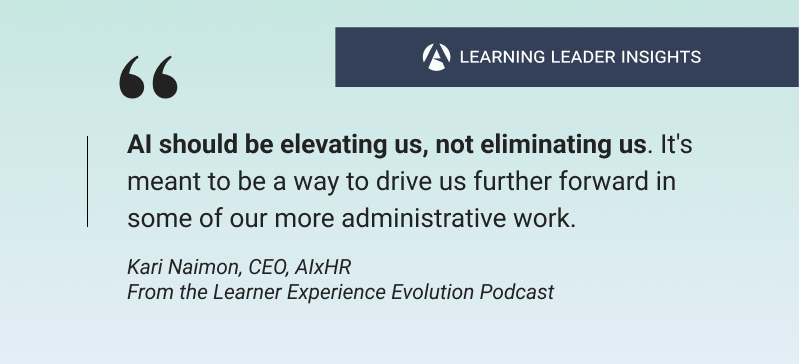
So let’s just say, talent acquisition. Writing job descriptions, creating interview questions, summarizing interview notes, making recommendations about whether or not to push a potential candidate through to the next step in the pipeline. And I want to take a step back for a second and say my approach is that AI should be elevating us, not eliminating us. In no way in any of these use cases is it meant to be a copy paste, take what the AI says as gospel. It’s meant to be a way to drive us further forward in some of our more administrative work.
Jumping from talent acquisition to onboarding, creating onboarding plans, creating 90 day goals, for example, SMART goals, OKRs, KPIs, whatever it is you need to create for the person or help the new person create as they enter into the organization.
From an L&D perspective, I know you have a lot of L&D people here, so creating content for learning sessions can also—and this is one of my most favorite use cases—take any content you create and turn it into VBA code, which is what PowerPoint reads. You can dump that VBA code into PowerPoint and it’ll create the deck for you. For example, your starter deck. And now you don’t have to deal with all of that. You’ve got a 60% final product before you even really dive in to the meat of the content.
It just takes away so much of that work that really doesn’t tax your brain. You’ve done it a thousand times and it gets you to the point where you’re doing the more fun part of the work.
Michael Noble
I like that in terms of, okay, what’s the man and machine, right? What’s the right mix of, hey, what parts of this—where does my human critical thinking and judgment come into play? And not trying to replace that piece, but trying to replace some of the other pieces that might be kind of time consuming. I think it’s natural that a lot of us are starting at that point of, okay, the uses tend to be more acceleration of things that we’re already doing or augmentation enhancement of what we’re already doing.
Are any of your clients yet into new use cases of things that maybe they weren’t even doing before? I guess I’m thinking of on the horizon, at least, we see the possibility of AI-driven practice, which before, we weren’t able to do that, at least not with good old fashioned AI, but not with some of the machine learning kind of algorithms that we have today. And, I think there is like this… I don’t know that they share their competitive, but there’s definitely a use case difference between “we’re going to do this for ourselves to make ourselves more efficient” and also there’s new possibilities out there of things we can do leveraging this technology. And I wondered who might be or what you’re seeing on the—we’ve gotten started. Now we’re taking this into a new direction, what you might be seeing there?
Kari Naimon
Well, I think what I’m seeing more than anything is organizations that do not realize how much they can do right now. They’ll start with super basic use cases. And then once you really kind of get accustomed to using AI to help you with those basic use cases, they will then themselves start to build on maybe more complex use cases.
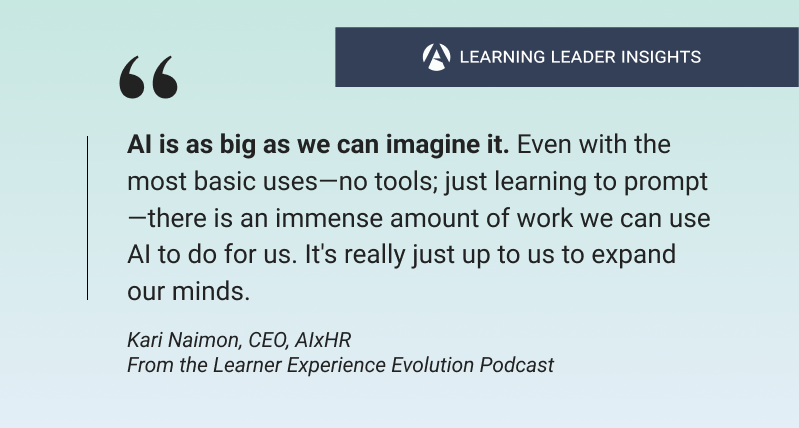
So if it can do this, can it do that? If it can do that, can it do this? And 99 times out of 100, the answer is yes, but it is unusual and a different way for us to be thinking because historically we’ve been used to very limited uses for the technology that we’ve been using, very confined. AI is not like that at all. It’s as big as we can imagine it. And that is a very different way to think about tech for us.
Even with the most basic, no tools, just learning to prompt, there is an immense amount of work we can use AI to do for us. It’s really just kind of up to us to expand our minds a bit. There’s lots of talk now about AI agents that are going to do things for us without us needing to do anything. I’m sure there are some organizations now that I’m working with right now that are starting to lean more towards that.
But so many of us are at the beginning stages of really thinking about how to even use this that most of the people that I talk to, that’s further down the road and maybe even less helpful than us just learning how to use AI ourselves.
Michael Noble
Do you find anybody that is kind of paralyzed by all the change and feels like, I’ll just hold out until we get past this early adoption phase?
Kari Naimon
I have talked to many people like that, and oftentimes they’re overwhelmed by the number of tools that are out there that you can choose from, truly. So they’ll go to a trade show and the entire expo hall is filled with AI this and AI that. This is now at this, this thing that I’ve been using for the last 15 years now has an AI element. Like, should I use it? Shouldn’t I use it? Is it safe? it not safe? Is it going to hold my data? Are people going to find out proprietary information about my organization? All these questions.
The way that I really approach this is I’m completely tool agnostic in my approach with organizations. It’s really about empowering people to learn how to prompt. Once you take away the need to start making decisions on what purchases you might make to do specific things, and you really think about, what, I’m just going to train myself up or have somebody ideally help me learn how to use AI myself so I can create prompts or sequences of prompts that work specifically for me and the work that I’m doing every day.
The mindset shift is this is not one technology that’s going to work the same for everybody. Even if you and I have the same job, you may do a particular task differently than I do. You can create prompts or sequences of prompts that are going to work for you. I can do the same for me. And there then just by default, we’ve got things that work for us individually.
It really is like thinking about hiring an intern, your own personal assistant. And again, you’re going to use that assistant differently than I’m going to use my assistant or leverage my assistant. So we need to step away, I said this earlier, from the confines of technology that we’re so used to and really open up our minds to the expansive support that AI can give us.
Michael Noble
No, think that’s really smart. Start with some really simple use cases, build from there, really have kind of that playful open mindset. I like what you’re also saying about not getting caught up in tools. think we’ve let tools, especially in L&D, drive the innovation.
I do think that this is, it’s a little bit different paradigm here in terms of at least how we’re getting introduced to the technology. I mean, in terms of things that your people are going to encounter on their journey, we’ve been at this for a year plus, right? We’re headed into 2025. What are some of the things that might derail us that we need to watch out for and be resilient? And what are some of the things that maybe we should challenge ourselves to do differently?
Kari Naimon
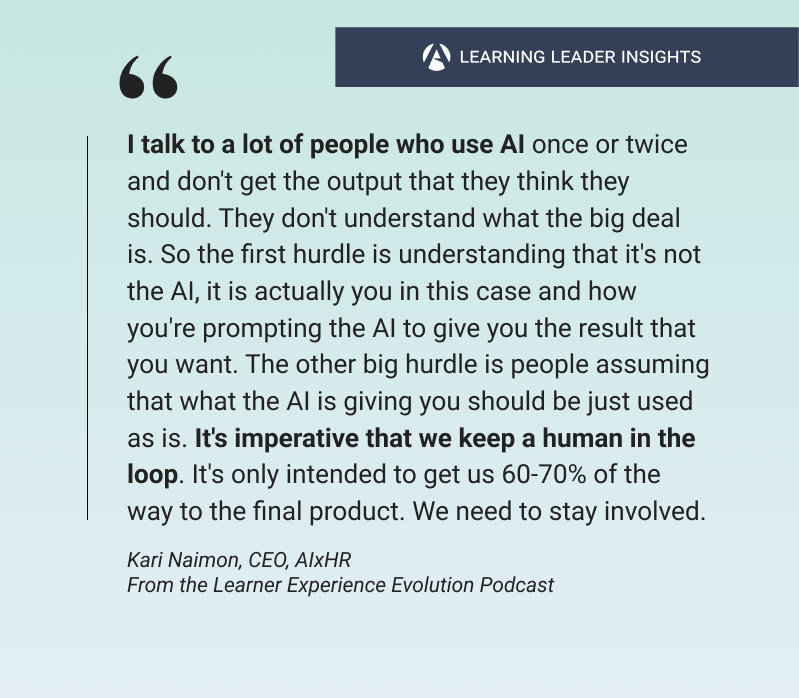
As individual users, I’ll speak about that first. I talk to a lot of people who use it once or twice and don’t get the output that they think they should. Maybe it’s not as high quality or it’s kind of meh. And they don’t understand what the big deal is. “I don’t understand what all the fuss is. Why are people so engaged with this technology?”
So the first hurdle is understanding that it’s not the AI, it is actually you in this case and how you’re prompting the AI to give you the result that you want. Once you get better at that, you can partner with the AI much better to actually give you the result that you want.
The other big hurdle is people assuming that what the AI is giving you should be just used as is and that we step out of the loop. My whole thing, and I’m not the only person saying this, is it’s so imperative that we keep a human in the loop. It’s only intended to get us 60-70% of the way to the final product. We need to stay involved.
And then the third thing I think that really does paralyze people is just fear. “I’m too old for this, this new technology. I have too much on my plate right now. I don’t have time to learn this.” And also fear of it taking our jobs, right? And so I hate to use this because so many people say this, but it really is true that it’s not AI that’s going to take your job. It is someone that knows AI and has integrated it into the way that they do their work every day.
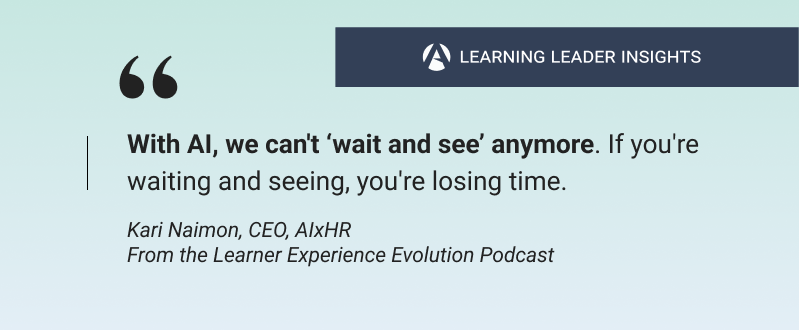
Those are just three individual things to be paying attention to. I think from sort of an organizational perspective, the biggest hurdle is truly not understanding the value that it can bring you as an organization. And kind of what you were saying before, like, let’s just wait and see. We can’t wait and see anymore. If you’re waiting and seeing, you’re losing time at this point. You have to start to jump in somewhere. It’s just, you have to, it’s just too prevalent not to.
Michael Noble
And if you were saying, hey, what would you hold up as benchmarks? Let’s say I’m an L&D leader in an enterprise organization. I’m leading my team. We’ve done some, yeah, we’re using ChatGPT. Maybe we’re using Copilot. Maybe we’re using Gemini. How do we measure how we’re doing on the journey? What benchmarks do we use to chart our progress on that journey?
Kari Naimon
Because this is so new, I have not seen a lot of organizations create benchmarks, or everybody’s screaming for ROI. What’s the ROI? Because this is the way we’re used to doing business. It’s incredibly hard to measure. My suggestion is to be looking at how productive we are compared to maybe how we were before. But even more, how are we spending our time?
If I’m an L&D person, am I spending time with a blank PowerPoint presentation in front of me, having no idea how to start creating whatever content I need to create, or am I actually using my probably highly educated and/or highly trained brain to do the more fun part of the work, which is how do I make this content the most engaging? How do I make sure that it’s the most complete? How do I make sure that it’s going to land well with our intended audience?
So how am I spending my time? Do I feel like I’m using the higher order of my brain more regularly than maybe I used to before? And to me, that then leads down the road to engagement. It’s going to be a longer term measurement because engagement doesn’t change right away, but it is the less time I’m spending on admin stuff and things that I feel like are just like, I’ve got to do this again versus the really fun part of the work that I want to be doing anyway.
I think that’s a really good gauge and that ultimately is going to impact how engaged you are in your work and maybe with your organization.
Michael Noble
Now, I like where you’re going with that, which is kind of like, hey, if you’re externally for benchmarks, maybe you also need to look at, well, what does the current state look like? In order to have a benchmark on productivity, you have to know how much time it’s taking now. And we find this all the time in our learning solutions. It’s the same thing. it’s like you have to have something to measure against and maybe some good metrics of, well, what’s the old way or at least the current state and then what are we learning? I think that’s good advice. We sometimes want a ready benchmark that’s out there, but often we have to create our own.
Kari Naimon
Yeah, they don’t exist yet. It’s too soon. I mean, honestly, it’s just too soon. I just don’t think in most areas of the business, it just doesn’t exist yet. So if I were going to lean on something, I would lean on employee feedback on the way that they’re spending their time, how long it’s taking them to get the same thing done with AI versus not with AI. And ultimately, like I was saying earlier, it’s just, you having more fun at work? I mean, that’s kind of a nice measurement, right? Is this more fun for you now because you’re working on more meaningful stuff?
Michael Noble
One of the things that, in any kind of change-like experience, when you do your retrospective or your post-mortem and you look back, there’s always things that you like, “I wish I had known this,” at the beginning, right? Because hindsight’s always 20-20. You’re a little bit ahead of the rest of us in terms of some of your adoption of the technology. I’d love to hear just specifically with regard to this technology, but also in the course of the larger scope of your career. What have you learned that you wish you’d known earlier?
Kari Naimon
I think the bigger personal lesson for me was to find the thing that was the most, it probably sounds cliché, but that I felt like was having the most positive impact on others. And I have to tell you, the stories, one would never think—I didn’t going into this so that AI could have such an incredibly huge personal impact on people. But I’ve heard stories from clients that I’ve had about how they brought what they’ve learned home. One in particular that I’m thinking about who’s got a son that is on the autism spectrum was having a very challenging time getting out into the job market, being confident in his interviews, writing up his, when he was applying for job, his job applications and that kind of thing.
And she taught him how to use AI and now he’s fully employed, fully engaged, feeling really good about the work that he’s doing. The link there was really him starting to lean on AI to help him with those things. And I teared up when she was telling me this story. This isn’t the only story that I’ve had where the technology has had such a profound impact on people’s lives.
So while it may seem like something we’re just focusing on at work there and the personal use cases maybe that you’re hearing about are not super impactful. There are a lot of use cases out there that are much more impactful. And you just think about access, right? I mean, as long as you’ve got a phone, which at this point, there aren’t a lot of people in the world that at least don’t have access to cell technology, not everybody, but many more than maybe 10 years ago. And you just pull up ChatGPT on your phone, or any other model on your phone, and you have access to a world of information that you didn’t have before just by asking it questions.
I just think there’s huge positive potential amongst all of these. The robots are going to take over fear mongering things that we hear. There’s such an incredible amount of positive impact this can have. So I may not have directly answered your question, but I do feel like I am incredibly passionate about this because of the positive impact. And for me, I’ve been looking for that avenue for a very long time.
Michael Noble
No, I think this is a great way for us to wrap up because we got the inspiration and the passion as well as the practical side of this. it’s been a pleasure reconnecting with you, Kari, and learning from you over the past few minutes. Thank you very much for sharing your time and expertise with us.
Kari Naimon
Thank you for having me.
Michael Noble
Listeners, thank you for tuning in. Please tell your friends about us and drop us a line at info@allencomm.com if you have ideas or questions about the podcast. Thank you.
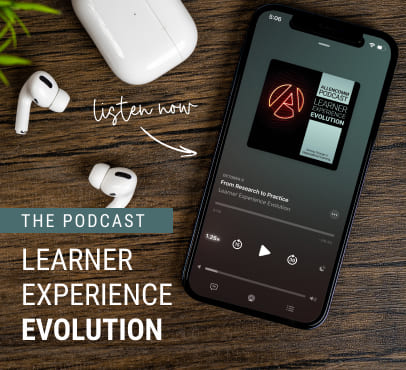
The Learner Experience Evolution is a weekly podcast for L&D learning leaders to stay inspired and gain valuable insights from other industry leaders. Subscribe now to never miss an episode wherever you listen to your podcasts




Resources For L&D Leaders
free guide
free guide
insights | on the blog
ALLENCOMM Press Releases
AllenComm Earns Spot on Best Mobile Learning Content Providers 2026 List
eLearning Industry honors AllenComm for its custom mobile learning solutions for enterprise, built to improve performance outcomes at scale. SALT LAKE CITY, [July 29, 2026] — AllenComm has been named to eLearning Industry’s...
ALLENCOMM Press Releases
AllenComm Named a Top Employee Engagement Training Provider by eLearning Industry
AllenComm has been recognized by eLearning Industry as a 2026 top provider for employee engagement, cited for scalable, personalized L&D that drives measurable results. SALT LAKE CITY, [June 24, 2026]...
ALLENCOMM Press Releases