

ALLENCOMM BLOG | Podcast
Episode 15: The Future of Training Industry
February 17, 2025
In this episode, Ron Zamir and Ken Taylor discuss the evolving landscape of change and innovation in the learning and development sector. They explore the challenges organizations face in adapting to rapid changes, particularly with the rise of AI, and the importance of governance in navigating these shifts. The conversation highlights the need for L&D professionals to build networks, measure impact, and embrace new technologies to enhance training effectiveness. They also touch on the significance of leadership development and the blurring lines between training and change management.
Takeaways
- Training and development often lag behind business changes.
- Organizations must adapt quickly to the speed of change.
- Building a network is crucial for success in L&D.
- Governance structures help maintain focus and consistency.
- AI can enhance training but requires careful implementation.
- Leadership development is a critical area of focus for organizations.
- Cultural resilience is essential for navigating change.
- L&D must measure impact to communicate value effectively.
- Networking can provide valuable insights and solutions.
- The role of L&D is evolving to include change management responsibilities.

Ken Taylor : Chief executive officer of Training Industry, Inc
Ken Taylor is chief executive officer of Training Industry, Inc., and has spent nearly 18 years guiding the team. Prior to that Ken spent 17 years in the tech industry in a variety of leadership positions in marketing, operations and finance.
His prior experience and current focus combine to give him a unique perspective on the training function and marketplace, understanding both the challenges of learning leaders and the perspectives of leadership teams tasked with driving business performance.
His experience also enables him to make connections between companies and individuals who operate as suppliers and buyers of learning products and services and detect changes in the corporate learning landscape.
Ron Zamir
Hello, everyone, and we are at another episode of our podcast about change and innovation in our
industry. I am really, really excited to have Ken Taylor with us for this episode. Me and Ken go back well
over 20 years. I hope you guys don’t mind a bit of a look back and a look forward by people that have
been doing this for a while.
With that, I’m going to have Ken jump in and talk a bit about his journey in this industry.
Ken Taylor
Thanks for having me on, Ron. It’s been an interesting journey. I spent 17 years in tech and telecom
companies and worked in six different cities and trooped all around North America, moved the family
many, many times, and then started this thing called Training Industry with a good business partner of
mine, Doug Harward. We’ve been at this now for almost… this will be our 20th year for Training Industry.
I’ve been here 19 years, so Doug had a little bit of a head start, but not too much. But it’s been a blast.
We went from two or three of us in Training Industry to 35 people, and probably about 10 instructors
part-time also teaching our courses around helping people in learning and development do their job a
little bit better.
Ron Zamir
That’s great. We’re going to really dig into that a little bit because that perspective, when we look at yet
another big change in our industry, like AI, that’s driving us to think about how we innovate, like the
skills-based organization, all these things are really good when you could look at them at, “Okay, is this
another cycle or is this different?”
And with that, I do want to talk a bit about change and innovation because we tend to come from
organizations that are very reactive and react to things they’ve been asked to do, or they’re kind of
subservient to the governance that they have to work in. Talk to us a bit about how you and your
organization measure or define change and innovation. I know you guys do a lot of surveys on this.
Ken Taylor
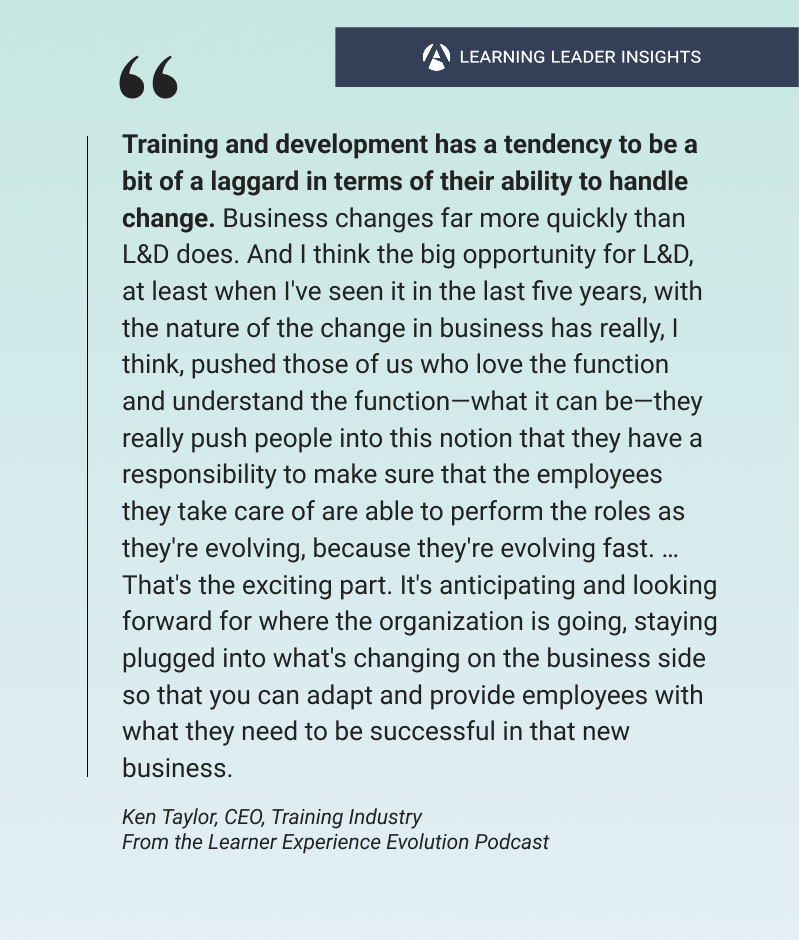
That’s a great question. What we try and do at Training Industry is collect all of the brightest ideas and
bring them to our audience. We’re a couple hundred thousand L&D professionals. With the idea that we
can’t create all of the best ideas, they’re already out there. We just have to go find them. So we have a
great editorial staff that gets out there and nurtures a big group of writers to help get the best ideas in
front of the people that need to see them.
What I’ve noticed in the period of time I’ve been at Training Industry and we’ve been in this journey is
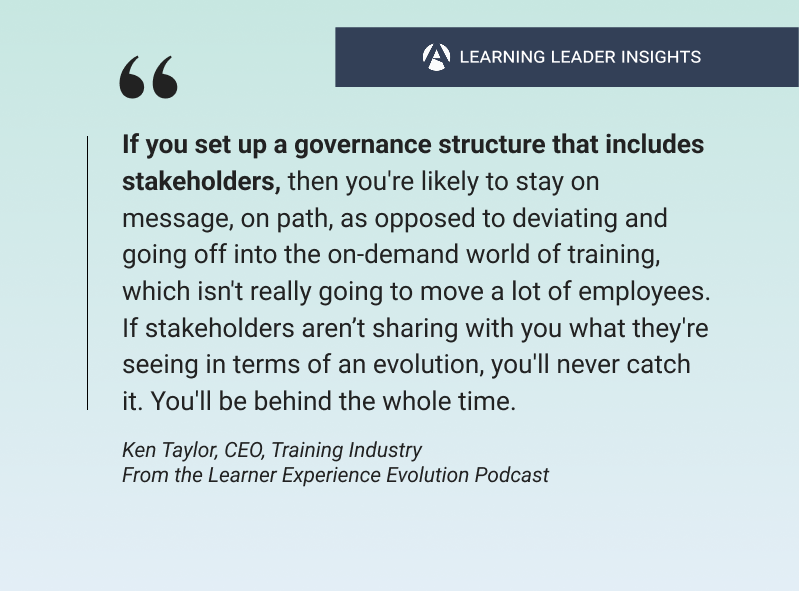
training and development has a tendency to be a bit of a laggard in terms of their ability to handle
change. Business changes far more quickly than L&D does. And I think the big opportunity for L&D, at
least when I’ve seen it in the last five years, with the nature of the change in business has really, I think,
pushed those of us who love the function and understand the function—what it can be—they really
push people into this notion that they have a responsibility to make sure that the employees they take
care of are able to perform the roles as they’re evolving, because they’re evolving fast.
So I think that’s the exciting part. It’s anticipating and looking forward for where the organization is
going, staying plugged into what’s changing on the business side so that you can adapt and tack
providing employees with what they need to be successful in that new business.
Ron Zamir
We’re all seeing that, right? Because it’s not just about the change, it’s the frequency of change and how
that’s how you were set up as an organization to innovate and find your comfort zone within that new
technology, within that new constraint in your organization. When we look back, and I even look back as
our organization—100-plus people that have to service the industry—how do we… what’s our speed and
what’s the speed of our customers? And I look back at like digitization, which was a big part of our world for the past five years. Our customers, our clients, adapted really way behind the marketing department,
way behind even the IT group.
And I think that’s changing. Again, we’re overusing the word change. I apologize to the listeners. But the
idea that our organizations can afford to lag behind or that we’re expected to lag behind, we’re given like
a free pass, is really not the same as it was.
When we look at how organizations are ditching traditional curriculum design models, and you may talk
about that when we’re looking how new technologies are not just speeding up things, but are actually
going to change every job description we have in corporate America. It’s really about how does an
organization today, not five years ago, build the resilience and the capacity to work at that speed. So it’s
not just change, it’s a speed of change.
And with that, how do we keep up? What are some of the things that you’re hearing, not just from the
learning departments, but even the vendors that you talk to, what is happening to that speed of change?
What is happening to that need to be more resilient and more set up for success?
Ken Taylor
Well, it’s interesting you asked me that question that way. My kickoff presentation every year at our
conference, Training Industry conference and expo, always starts off with me telling you, if you have a
problem and you’re the head of L&D, there’s a vendor in the room that’s probably solved it a hundred
times. So perhaps you should talk to them and you shouldn’t be scared.
Ron Zamir
Thank you for that softball. Love it guys, but we’re not here to sell, but that was a good statement.
Ken Taylor
But it’s a fact, right? A lot of people ask me sort of, what should I… what is the first thing I need to do to
be effective in this kind of a role? You’ve got to know people. Because again, you’re not going to come up
with a novel solution to every problem that your company’s having. You have to have a network. You
have to read. You have to be a student of Training Industry and ATD and all of these organizations that
are out there trying to get you the information you need to be better at what you do.
And I think it’s getting that mindset to like, there’s a collection of stories out there that I just need access
to. And that’ll make me better at my job. Yeah, many times. They happen all the time in our webinars. It’s
incredible where you’ll get someone to demo something that solves their problem.
I’ll give you a perfect example. At Training Industry, we built an agent called Tia, which is part of our
membership offering. And it ingested all of the content and all of the webinars and all of the research
that Training Industry does. And she just answers questions on any subject related to training and
development.
So we were showcasing that at our conference last year. That was our soft launch. And I had a lady come
up to me after she asked Tia a bunch of questions. She said, “It just gave me the answer that it took us
six months as a department to figure out on our own.” And that’s the power of being outside of your
bubble. Talking to people, networking with groups, being part of, you know, some sort of a community
that you can talk to, that they can get ideas from. It’s amazing.
Ron Zamir
So to tease that out a bit, I mean, and this excites us because there’s better access, right? It’s out there,
not just AI agents, but even just roundtables, sharing, webinars. They do enable people to connect with
each other, to learn from each other. The ATD model of having local ATDs is now all national. You’re not
limited to networking with your Atlanta base or your San Francisco base. You have small conferences like yours that are very specific and very impactful and large conferences like ATD.
I still worry about roadblocks. I still worry about the idea that people come back pumped from an event,
they really get ignited, I’m using a kind colorful term from a discussion, and then they come back to their reality. And their reality is all about the day-to-day and stuff that limits innovation. Talk to me a bit about what you’ve seen that has limited innovation, limited ability to change in our industry.
Ken Taylor
Well, I think one of the things that’s limited the ability for the industry to change has been sort of our
lack of confidence in connecting the dots between what we’re doing and the impact it has on the
organization. Sure, everyone’s going to call that measuring ROI. No, no, no. I’m saying just understand
the impact you can have and be able to communicate impact. If you can communicate impact, then
you’re going to get support.
A perfect example is through the—organizations are rolling out AI, every team needs to learn how to do
it. I had a great example yesterday. I was having a chat with my daughter, and she was talking about an
employee who used AI to write a piece of copy and then mentioned to the team that the piece of copy
was written by AI. And it’s a teachable moment, right? You wrote the copy. The machine might have
helped you. But you ultimately have to own that answer.
I think that’s really the same thing for L&D. We have to own that if we’re going to take employees’ time,
we have to own that it’s going to be impactful and move them. And move them towards the goals that
the organization has, the objectives that the organization has. Give them the tools that are really going
to help them. And if we always use that as the bar, we’re going to be involved in a lot of conversations.
Ron Zamir
We could talk for an hour about the holy grail in our industry, which is measuring impact, analytics, and
being part of the discussion. My experience has been talking one-on-one with some of the most, I
believe, the most brightest, most ambitious, most passionate learning leaders from big aviation
companies, manufacturing, some of the largest insurance agencies, people that make my job fun
because I see how much passion they have, and how much caring they have, is that they are stifled. And
that stifling could be a limiting factor or something that you own.
For example, measurement has always been a challenge. I would say four out of five of our customers
don’t have good access to the BI world that their company invested. And some of the times we help them with that, even by just telling them, please do it. I beg you to do it. And here’s a model that you
could do it with. So I think a lot of that comes from organizational structure.
And the more we talk about it, maybe we can help educate organizations that L&D is not just a reactive
organization. So there is a cultural issue that I think AI is not going to solve, but it does maybe facilitate a discussion.
Ken Taylor
I was just going to say on that point, right? It’s okay to serve as an organization. But you’ve also got to
lead a little bit too. I mean, people have opinions. I remember back when I was in industry, and I was
running finance at a part of the business. And it was like, I had an opinion on what training I wanted my
employees to have. But how I could have been talked into, what frequency, what was the reinforcement
strategy that went along with it, I would have been open to all that. But I knew what I wanted them to
learn.
Ron Zamir
Yeah. And that’s because you’re closest, right? You’re closest and you have the passion for it. You think
about it all day. And again, that’s something that we have to always recognize our industry for caring and wanting to do that. People don’t just get assigned to L&D. A lot of them want to do it. A lot of them now study that at university.
I think one other factor, which I would love to hear your opinion on, is governance. And even though
sometimes L&D is part of the discussion, but the example I see now daily, I had a discussion about it this morning, is that companies are rolling out AI agents. They started by rolling out query engines. You can ask, like the example you gave, you can ask your agent a question on the content that you’ve developed, and know-how, the insights you’ve developed.
And then there’s also—those are being rolled out. We have customers that have rolled out I would say
between four to five… I have one that rolled out eight agents already, a software company that works in
the networking world. And then we also have customers that are starting to roll out automation based
on AI. That part of their organization is now being handled by an AI agent. It’s existed for a while. People, those of you that have been old enough, remember Watson, the first IBM agent out there.
And then the question becomes, what I’m trying to understand more is, how does L&D navigate that?
Are they able to just use it? Do they have to have a governance model that gives them access or they can enter new areas? They could be part of the training of the AI agent. Can they create subsets?
For example, we talk about learning in the workflow. Is that a world where we now have to automate
that? Not just co-pilot it, not just assist it, right? And then, of course, we’re going to have whole other sessions about how do the roles in L&D change because of AI. But I don’t just want to talk about AI. I
want to elevate it to governance. Where does governance help and hinder learning organizations?
Ken Taylor
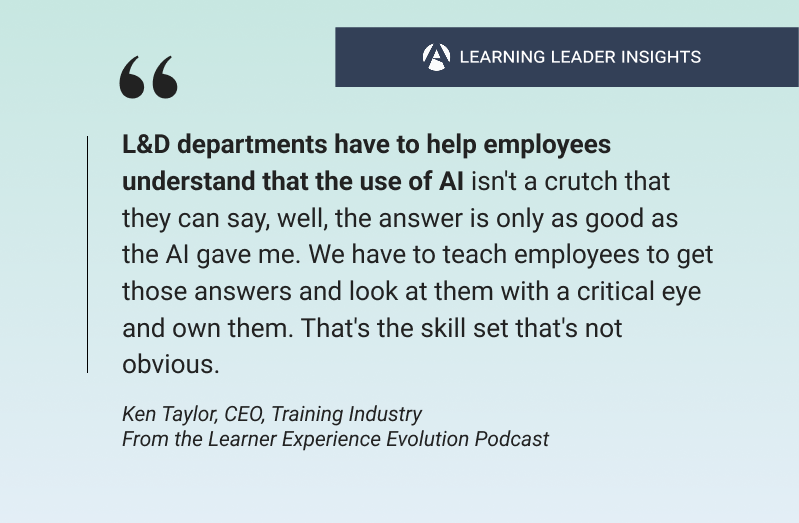
Well, I think it can help because if you set up a governance structure that includes stakeholders, then
you’re likely to stay on message, on path, as opposed to kind of deviate and go off into the on-demand,
whatever you want, world of training, which isn’t really going to move a lot of employees. So I think
that’s a super important role for governance.
In terms of content strategy, again, I think stakeholders at the table are super important because it’s
moving so fast right now that if they’re not sharing with you what they’re seeing in terms of an
evolution, you’ll never catch it. You’ll be behind the whole time. So I really do think that’s important.
When it comes to AI use governance, which I know is a whole slightly different topic, I think the bandaid’s been pulled off now. Organizations need to put in place data rules, but I would say most employees
are using some form of AI, ChatGPT, Copilot, whatever, all day, every day in their job.
Ron Zamir
Yeah, so the affordance is there. It’s already being part of the…
Ken Taylor
It’s over. So I think the smartest companies are structuring the information that the employees can
receive. One of the things I think is super interesting to me is the idea of an agent that’s an expert on a
specific topic area. I even think the evolution of a course arguably is always going to have an agent that
leaves behind after you finish the course. You take the course and the agent’s there, especially in
thinking compliance, right?
If there’s a specific way you want someone to do something, you teach it to them and then you should
forever have somebody there saying like, what’s the next step? Here it is. And all they know is the
information, all the agent knows is the information that it was fed. So it can tell you, I don’t have an
answer to that question. That’s perfectly fine. But it won’t create an answer.
Ron Zamir
Well, and I was going to say, when we look at adoption of AI, to actually be part of the training process
versus to assist the designer or the graphic artist or the employee, it’s really, we see it a lot in call
centers. We’re seeing it in tech support. In areas where the information is stratified enough, you
mentioned compliance, where it could be managed, the governance model can provide the answer with
a citation. And the citation covers the compliance issues of… you can’t sue an AI agent. You can only sue a company. That’s the negative. The plus is it speeds up things.
One of the biggest insights that we’ve seen with governance in general, but it’s come to the fore with AI
and other trends, we’re going to talk about trends in a second, the trends that you think are the most
significant. And it can’t just be AI. I’m going to make it hard.
A lot of people are approaching us now with what they want to do. They’re seeing a future changing
around them. They want to be part of that future. And we often think they’re overshooting because
governance and structures are, and what they need to find is what they can do, the stretch. And a large
part of our initial engagements is just really finding that median between where they are, their current
comfort zone, which they want to get out of—they wouldn’t be approaching a company like Allen or
using research by Ken and his organization—and their ambition to what they can do.
And in the middle, there is that stretch area. We talk a lot about that. We train our designers to help our
clients identify not the want, per se, but the need and how that need can move the organization, stretch
it in the right organization.
So with that context, where do you most see the stretching that we can do in the short term? If you’re
now sitting in front of an L&D leader, you say this is where you need to focus your efforts.
Ken Taylor
So if you haven’t built a plan to help employees handle the use of AI on their job, you’re too late.
Ron Zamir
So trainings for using AI, because they’re using it already.
Ken Taylor
Yeah, exactly. I think you need to think about the next thing, which is helping them choose prompts
wisely and helping them understand the step beyond AI. It comes back to that story I kind of mentioned
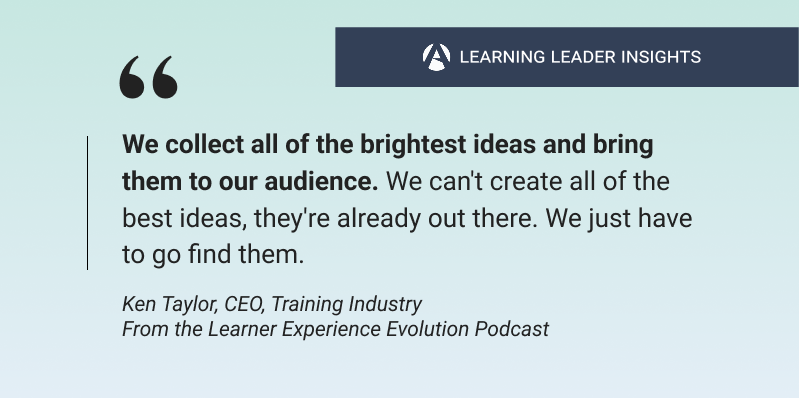
again. Like I really think that L&D departments have to help employees understand that the use of an AI
isn’t a crutch that they can say, well, the answer is only as good as the AI gave me. We have to teach
employees to get those answers and look at them with a critical eye and own them. Because I think
that’s the skill set that’s not obvious, right?
Ron Zamir
Anna, our CLO, was trying to educate me today, because you have to educate your boss sometimes. And
she was talking about the super designer. And I go, but we have great designers, what do you mean
they’re not super? No, no. And she was showing me how using technology, not just AI, but moving to
more skill-based models for designing learning interventions, we’re creating super designers.
I would say back, because I like it made colorful, and the narrative is, when you look at your own team as an L&D department, how are they becoming super designers? When you look at the SMEs you work
with, how are you working differently with them? It can’t just be all about teaching prompt engineering.
So let’s try to broaden. Let’s say AI is happening already. The big guys that are controlling our lives, if you believe the former president and the current president, they’re already out there.
What are some of the other changes in our industry that can drive innovation for learning and
development functions in large organizations or small for them?
Ken Taylor
Yeah, so to me, it’s sort of the democratization of coaching. I’m excited to see that we’re going to
leverage these new technologies to create job coaches for employees all across the organization. Just
think of it like a marketeer, somebody in the marketing department will have a functional job coach with
them all the time that knows all of the ways that leadership wants the marketing team to 1) approach
problem solving, but 2) stay current with it. Because the exciting thing for me around the AI agent
development is really the ease with which it can ingest content. You can keep these models current.
So if I go back the history of us surveying organizations, coaching is always an aspirational want for
organizations, but it was always way too expensive to provide. This is going to change that model,
because you’re going to be able to build and continue to educate agents to stay current with current
market realities for many functions inside the organization. Marketing is a great example. There’s a new
digital marketing reality every day. So the agent can be taught that, and then it can teach all of your
marketing people how to solve that problem every time they have it.
Ron Zamir
Yeah, that brings us, I think, a trend that I don’t know if we’re afraid to talk about or it’s not surveyed
enough. It’s one of the biggest trends I see developing now. We see through our work and our technical
advisory and how we look at a company’s, just their subscriptions for learners across the organization, is cost. I would say, and I’m hoping your research either does it or gets to it, is that we are now in a period of time where costs for running a rich experience for a learner to receive the skills they want, know how to apply those skills within the jobs they’re given, and work on perfecting themselves and elevating themselves for the organization for future skills. The price of doing that is going to go down immensely.
And it’s not just because of AI, it’s because of redundancy. I had a chance to spend a few days with some system integrators around HR systems, like SuccessFactors, like Oracle, like Workday. Those vendors are doing things now that will lower the need for redundancy.
One of the things that I think is the biggest eye-opener for our customers is just a very quick down and
dirty review of their redundancies. And those redundancies came because we were always trying to
expand and innovate in the learning experience. I think not just AI, but also the skill-based organization
that makes it into more particular things to be done. I think there’s a great opportunity for L&D teams to
innovate, raise the level of the experience, raise the consistency of the experience, which is important
for compliance issues and for measurement, but lower the cost.
Ken Taylor
It’s interesting, Ron, we actually did do—we’ve been asking the market that question now for three
quarters in a row. And I’d say last year, most people felt that, if I’m working with a vendor and they’re
using AI or they’re not using AI, it should cost about the same. By this quarter, when we did the same
survey, everybody’s now started to say, no, hold on a minute, it should be way less expensive, and it
should be way better in terms of the experience.
So there’s been a shift and I think people are starting to realize and recognize that they can vastly
improve the quality of what they’re doing for the same costs.
Ron Zamir
Yeah, but I would say that the content costs are the small. The big delta is every company complains
about all the LMSs they have and what their LXP does versus their LMS, their data warehousing, their
analytics. I think that there’s an amazing opportunity to rationalize that. For example, our experience has been—there’s two ways you can take on… it is an hour of learning content, and we shouldn’t be talking in hours anymore, that’s an anachronism… but let’s say for the sake of convenience, is it now we’re going from x to x minus y, or is that x now giving you x plus y?
Ken Taylor
And I think the market thinks it’s the latter. I don’t think anybody’s looking to cut the cost of developing a
program. I think that they’re wanting it to be a super rich experience. And that’s why I say, if you’re going
to develop a course for me, as we learn to figure out what the new definition of a course is, but I want an
agent that comes with it, that learned everything that’s in the course. And I want that.
Ron Zamir
But again, the agent runs into governance. Our challenge has been when we come to our clients and say, we can integrate an expert into your system, a majority of our clients are not allowed to bring in and
educate outside agents. I’m just bringing that as a data point. We can connect to their agents, right? But
the governance around agents that have existing customer content is pretty strict. And it should be,
because like I said, you can’t sue an agent.
Ken Taylor
Right, but I’m not talking about an agent that has any of the customer’s content. I’m saying that the
agent knows only the contents of the course.
Ron Zamir
Again, we’ve seen some issues around data related to that, but I would support that this is something
that’s going to happen. What we’re seeing and we’re doing, I mean, it’s actually, we’re just trying to
educate the customers to demand it, is that you don’t have to give up on rich media anymore because of
your budget. You don’t have to use just standard visuals. You can adopt those visuals to really reflect
your culture.
You know, what everybody’s doing with AI agents to take something you buy from your library of content
and how you can morph that to reflect the age, the sentiment, and then interject that into your
scenarios to make them real. We used to look at the cost of branching scenarios, and that’s going down.
The only area that I’m still hoping to see is true adaptive learning. And that does relate to the amount of
content that could be injected into a course, right? That richness of content that enables, but we’re
getting there.
Ken Taylor
Yeah, well, and I think that’s the trade off when you bring up your government and your compliance
concerns. I think that’s really the next generation of agents leverages large language models to
understand how to review and serve content, but it doesn’t ever serve any of the content from those
large language models. That’s a change.
Ron Zamir
Look, we’re talking too much about AI. We’re going to move to the next question, but I will say to all of
us, to myself as well, whatever is happening now, whatever your situation is, your governance, how your
organization has picked up AI, how many team members you have, how much the day-to-day stops you
from doing anything, you can stretch more. And the only caution I would give you, because I don’t want
to caution stretching and changing and innovating, is realizing that going too far may set you back.
Really work well internally with your stakeholders, with your people, with any vendors you use to
identify those areas that you can stretch. It doesn’t have to be only in AI. It could be also in adaptive
ways to make learning more relevant to people. It could be just changing the cadence of what you do
and getting to a higher cadence.
With that, just to move this on, and we’re going to have to control our use of the letter AI a bit, when
you look at the trends beyond AI, when you look at the aspirations versus frustrations of learning
leaders, what are some of the things that stand out the most?
Ken Taylor
Well, topically, where we’re hearing the most interest is still leadership because we’re realizing that
organizations still have a problem there. And it’s shocking to me, it’s not in any one function, it’s in all
functions, where they’re at the point where their leadership teams are turning over and new people are
put into leadership positions and there’s not a lot of support for them. So we are seeing that a big area
of focus for organizations. And leading in this changing business environment too, leading in the context
of change is a big area of focus.
I think you touched on another one that I’m seeing in terms of current challenges for heads of L&D and
that’s consistency. When rolling out these significant change programs, there’s a real struggle to make
the experience consistent across the organization. So that’s another big topic area that folks are
struggling with.
Ron Zamir
Yeah, I’m going to throw one into the hat ourselves, because it’s driven a change in our business. So that
means a lot to me personally. There’s always been a very clear differentiation between training and
change management. In fact, structurally, it’s different people many times. It’s a change management
team that follows very… you get certified in it, there’s models, and the learning team that knows how to
do learning and knows how to do engagement around learning a new skill, leading to a competency,
leading to fulfilling a job in the best way possible. That line is blurring.
The amount of requests we’ve gotten to come in earlier than we usually do to set up the change
management around the training that will have to be done has skyrocketed. I would say that, and that’s
forced us to build our practice out. I think that technology is supporting that as well.
But it’s also that businesses are heavily focused on culture. It’s always been popular. There’s been books
about it. But right now, I think for some reason, the C-suite is realizing that their biggest lever, besides
merger and acquisition, and maybe as a result of merger acquisition, is to build a resilient, strong culture.
I think COVID scared a lot of people to realize that things are going to change. We can’t control a
pandemic. We can’t control the political situation in the world. But what we can influence, and it goes to
that consistency, is culture.
And I would say to the listeners of this and the viewers of this podcast, look at how much you’re being
asked to be part of the change management team, number one. And number two, are you a player? Are
you a partner in efforts that are being put in the organization to create a consistent culture that can drive growth and resiliency?
I know for us, it’s triggered building out our change management practice. It’s triggered our looking and
finding new models for design that impact not just a specific, like I need to do this, but actually create
the context by which that learning is seen through the prism of the culture, the desired culture of the
organization.
We have some amazing customers. Some of them are big vendors that do a lot of chicken, I won’t
mention their name, amazing culture. And some other companies that have done so great in letting their
culture push their success.
Ken Taylor
It was interesting, Ron, you actually touched on a point there that I think takes me back to some
research that we did together almost 10 years ago now, I think, where we looked at the evolving skills of
the training department. And one of the areas that we saw emerging was this whole notion of the
marketing skills necessary to do a launch. Organizations, like leading organizations, were already starting
to say, well, I’m part of this change thing. So I need like, how do I get people in the classes? How do I
make their excitement about…?
Ron Zamir
Yeah, that’s the marketing of it.
So last question. This is my favorite. We’ll see how good you answer it. I have less hair than you, yours a
bit whiter, but let’s assume we both have been doing this for a while. If you could look back from today,
tell something to yourself when you were starting that would have really impacted your trajectory, what
would you tell yourself?
Ken Taylor
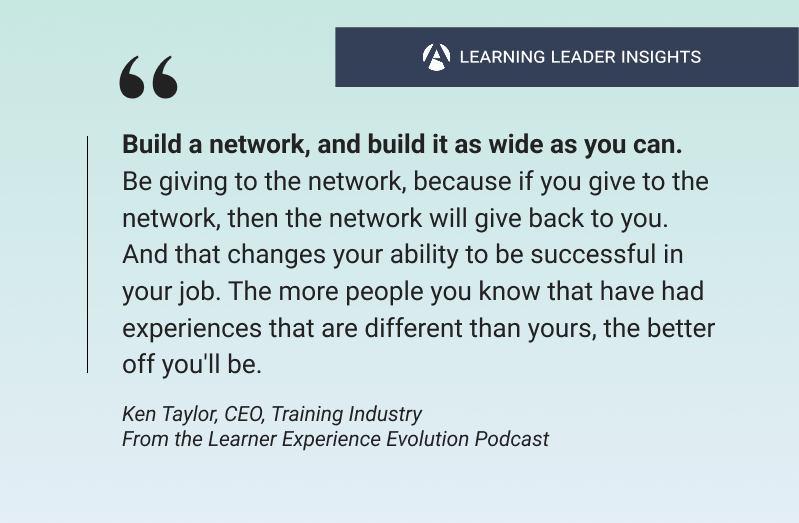
I give this advice regularly: build a network, and build it as wide as you can. Be giving to the network,
because if you give to the network, then the network will give back to you. And that changes your ability
to be successful in your job. The more people you know that have had experiences that are different
than yours, the better off you’ll be.
Ron Zamir
That’s one of the best answers we got so far. So I really, really thank you, and I thank our viewers,
listeners, however you get this content. Enjoy the market, enjoy the change, enjoy the innovation, and
hopefully you’ll join us for our next episode of this podcast. Thank you so much.
Ken Taylor
Thanks, Ron.
Resources For L&D Leaders
free guide
free guide
insights | on the blog
ALLENCOMM Press Releases
AllenComm Earns Spot on Best Mobile Learning Content Providers 2026 List
eLearning Industry honors AllenComm for its custom mobile learning solutions for enterprise, built to improve performance outcomes at scale. SALT LAKE CITY, [July 29, 2026] — AllenComm has been named to eLearning Industry’s...
ALLENCOMM Press Releases
AllenComm Named a Top Employee Engagement Training Provider by eLearning Industry
AllenComm has been recognized by eLearning Industry as a 2026 top provider for employee engagement, cited for scalable, personalized L&D that drives measurable results. SALT LAKE CITY, [June 24, 2026]...
ALLENCOMM Press Releases