

ALLENCOMM BLOG | Podcast
Episode 16: The Evolving Workforce: AI & Upskilling in L&D
March 4, 2025
Great talent management is integral to your organization’s ability to achieve goals. But when it comes to change and innovation in the talent management space, there’s so much to consider—sometimes even more than other areas of the business! Don’t worry, though. Ron Zamir and Bernadette Sciarabba are here to break it down for you. In this episode, they discuss some of those key considerations, like the role of leadership, the importance of data access, and the impact of AI. Even more, they share insights and strategies for breaking the process down into simpler steps to successfully navigate tomorrow’s challenges.
Takeaways
- Change is about understanding the skills needed for the future.
- Leadership must drive the message of change from the top down.
- Data access is crucial for effective change management.
- Incremental change is essential for successful transformation.
- Building a roadmap helps in achieving minimal viable products.
- AI will accelerate change in talent management.
- Upskilling is necessary for adapting to new technologies.
- Networking can provide valuable insights and opportunities.
- Change management requires collaboration across disciplines.
- The future of work will demand deeper skills and fluency in AI.
Bernadette Sciarabba is an award-winning leader in learning, talent development, and business transformation with 15+ years of experience at Fortune 500 companies, Big 4 firms, and Wall Street. As an SVP at Human Capital Advisors.ai, she designs and implements enterprise-wide strategies that drive business growth, workforce capability, and digital innovation. She leverages cutting-edge technology, including AI-driven learning platforms and advanced analytics, to redefine how organizations equip employees and customers for success.
Previously, Bernadette spearheaded large-scale initiatives at BNY and KPMG, including transforming global learning functions, launching award-winning learning platforms, and leading compliance responses to the SEC. She is known for building high-performing teams, cultivating stakeholder relationships, and integrating talent strategies with business objectives. Her passion for innovation has earned her numerous awards, including the Degreed Visionary Award and Chief Learning Officer Learning in Practice Award. She holds certifications in AI in HR and Employee Experience, and an MS in Human Resources from Fordham University.
Ron Zamir
Welcome everybody. Another session of our podcast about change and innovation in the learning space. I am very happy to be joined by somebody I’ve gotten to know really well over the past few months, Bernadette Sciarabba. She’s going to join us. She’s going to tell us about her experiences and her background. I’ll let her do that in a minute.
But just a reminder, this is a series of, I think we have over 12 or 13 podcasts already under our belt. All of them bring a different perspective, some from practitioners, some from leaders, and some from people that have been watching our industry for years. So I hope this provides value to all of you as we keep doing these podcasts about change and innovation.
With that, Bernadette, I’m going to let you introduce yourself and tell us a bit about your journey in this space.
Bernadette Lawler Sciarabba
Sure. First, I just want to say thank you, Ron. It’s great to see you again. I’m looking forward to our discussion. I’m Bernadette Sciarabba, as you said, and I’ve been in the talent leadership and learning development space for 15+ years, covering Big Four, also Fortune 500 companies, and always just really working with the C-level to enable skills transformation.
It’s very exciting, and I’ve really enjoyed the technology element. I think that that’s a huge part of the transformation that’s coming.
Ron Zamir
I think we got to know each other when you were at KPMG. Did I get that right?
Bernadette Lawler Sciarabba
Yes, yes, and I think also when we’re at McGraw Hill and Standard & Poor’s, we did a little bit of work together as well.
Ron Zamir
Yeah, that’s right. You know, people don’t realize these Big Four, they’re not just accounting firms, they do amazing change management. And we still look very fondly at the project we did there for onboarding accountants in the industry. So with that, we’re going to dive right into it.
This is about change, this is about innovation. So share with us a bit how, as you’ve worked with all these C-levels, as you’ve worked with these large companies, how would you define change and innovation within the talent space?
Bernadette Lawler Sciarabba
It’s transformed rapidly even just in the last year or two. But I think when you look at it, it’s looking at people and the skills that they need to really enable solutions that are either customer centric or employee centric, and sitting down at the C-level and then the level below and really understanding what we need to do to profile the workforce, the future, and their skills. And I think as you look at it, the skills of the future are massively going to change. The AI fluency, the data fluency, and the ability to pivot rapidly and to accelerate workforce transformation is phenomenal right now.
Ron Zamir
So we’re always changing, right? But sometimes the speed of change is accelerated or de-accelerated. One of the things I like teasing out—and I guess it’s a… I wouldn’t call it a weakness, but it is a constraint in our industry—is how does our ability to change differ from let’s say how marketing, IT, and operations change? Are we as fast? Are we slower? What are some of the things that influence our ability to change that you’ve observed when you’ve been involved in these large organizations?
Bernadette Lawler Sciarabba
Right, I think it depends on the footprint of the organization and the risk tolerance for change. And then also if leadership is really trying to transform the organization, and doing innovation, and telling people that change is okay, that message has to come from the top down. If it doesn’t, those transformations are going to ultimately fail.
So in the HR space, I think we’re seeing more workforce planning. Folks talk to the talent and development people, they’re talking to the technology people, and then the business, and understanding the business problem that you’re trying to solve, and then really interconnecting all those pieces is going to make the change management part of the program much more accelerated. It’s going to accelerate the skills and it’s also going to be successful.
Ron Zamir
So sometimes, when we look at large organizations, what party you’re invited to influences how you can change, right? Are you part of the discussion? Are you reactive to something that’s changed? You may have heard about it, but you’re told what you need to do. If you looked at the person you’re trying to help, how would you encourage them or how would you help them be part of the more substantive conversations they need to be part of?
Bernadette Lawler Sciarabba
Sure, I think it’s looking at data, it’s looking at programs that have been successfully done at other peer organizations, and really just letting them understand that, yes, it’s difficult and it’s hard to get there, but if we’re all in it together and we can work towards that vision and that goal, the acceleration on the bottom line, the acceleration at the people level, and the experience level can be transformation in an exponential way.
Ron Zamir
Bernadette, guys, she brings up an amazing issue, which is something we ask very early in our own scoping process with our clients: access to data.
When I reflect on some of the areas where we have clients who know where they want to be, they have this ambition to change around—if it’s in the old days, i.e., the last few years, it was going more to microlearning or being more involved in coaching and things like that is—those ambitions sometimes don’t match their comfort zone.
And I think that one of things I would advise us all to take to heart something that was just said, it’s that access to data. Where you can stretch, right? And we’re going to talk about how we stretch, but where you can stretch is heavily influenced by your ability to bring data to be part of that conversation to contribute versus being told what to do.
Has it gotten better with the data, from your experience? Are things getting better or are they pretty much the same?
Bernadette Lawler Sciarabba
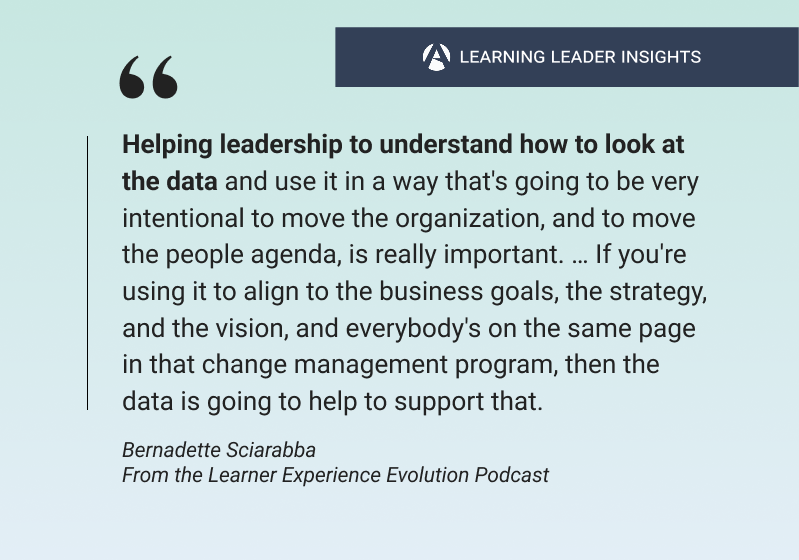
I think it’s gotten better. Helping leadership to understand how to look at that data and use it in a way that’s going to be very intentional to move the organization, and to move the people agenda, is really important. And often people will say, “Well, you could use that data lots of different ways.” But if you’re using it to align to the business goals, the strategy, and the vision, and everybody’s on the same page in that change management program, then the data is going to help to support that.
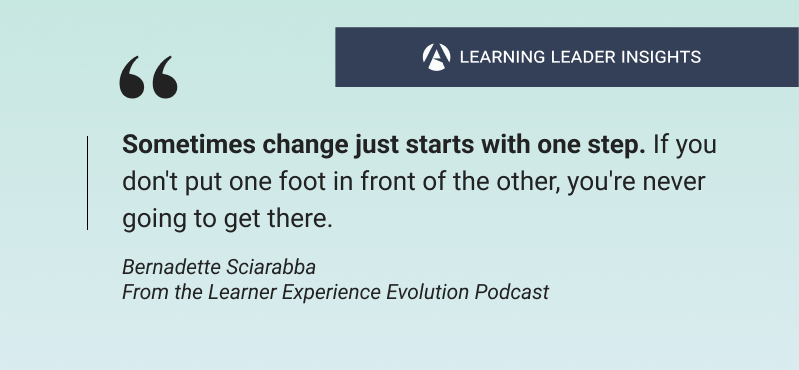
And sometimes change just starts with one step. And often I say to people, “I know you want to get here, and it’s a year or two-year transformation project, but change has to start with that first step. And if you don’t put one foot in front of the other, you’re never going to get there.”
Getting everybody to align to that vision is always the best place to start. And then just being honest, and pivoting when you need to, refining, and being agile in your philosophy, and just looking at what change management model works—whether it’s ADKAR, Prosci, or whichever one you’re using—and then just making sure that you have a really robust communications awareness.
And then if there’s a learning development piece to that, bringing that learning development piece and the technology piece all together.
Ron Zamir
Wow, you threw a lot of good stuff out there. I’m going to try to parse it out for ourselves and for our viewers and listeners. I always say both because some people are seeing us, viewing us, some are listening to us. It’s great. As you all know, we’re on all the major podcast networks and my kids still find it funny that I tell them, “Hey, I’m on Spotify.” They still don’t get what am I doing on Spotify. That’s okay, that’s their problem. Their dad’s on Spotify.
So one of the things I wanted to parse out is the issue of incremental nature or the best practice around that. We talked about data and we also talked about where you can stretch versus where you want to be versus where you need to be. Let’s talk about that a bit.
What are the ways that you can pace yourself? And why do we connect, at least in our world, change with innovation? Are they always together? Are they not together?
So I asked you two questions here. One, what does it mean to be incremental in how we adopt change? And two, how much is innovation a critical part of change?
Bernadette Lawler Sciarabba
So I think I’ll start with innovation is a critical part of change, and innovating how you look at change is key. When you look at change management—and you want to look at the incremental changes—I think it’s taking it a piece at a time and not trying to get to the North Star today, but laying out that vision and then taking actionable steps to get there. And sometimes that’s bringing together an agile part of people that have never worked together, whether that’s marketing, communications, HR, all the different disciplines in the business, and talking about it. Even if it’s a customer-facing organization, what customers are seeing, and bringing all those disciplines together.
What you’ll find often in change is that all the disciplines often have a lot of commonality. And I think once you can breed commonality, and people can understand that there’s a common vision and that you’re all trying to drive towards the same goal, and the same objective, and the same KPIs, that really helps to drive the incremental changes.
And then leveraging MVPs as your initial rollout is always helpful. Some people call them pilots. You can call them whatever you want, but it’s a proof of concept. And putting those out and then continuing to be agile, and looking at it, and refining that strategy, and getting the right communications from the leadership to cascade within the organization.
Ron Zamir
Yeah, so that issue of the minimal viable product, right? The MVP, we get asked a lot, I’m sure you are also, how can I build a roadmap for this? How should I start that?
And one of things I would encourage us all—sometimes we’re lucky to be involved in the change management discipline in the company we work for. Sometimes we’re not. It doesn’t mean that we don’t have a say or we can’t be part of it, but we have to also expect or at least observe that many times the work we do in L&D as part of talent management, sometimes we’re kind of cut out of that discussion. And how to get into that discussion is a great topic for a whole session that we can do around change management and learning.
I did want to explore with you a little bit the issue of roadmapping. You know, how to get to where that minimal viable product—how to set your sights not too high, but really specific to where you can achieve. Can you bring an example from your work in some of the companies, even when you were working internal, on how you were able to pinpoint the right level of innovation and change you had to drive to be successful? Not biting off too much than you can chew, so to speak.
Bernadette Lawler Sciarabba
So many examples, but I think that over time what you need to do for the MVP is really look at, and a lot of people call it low hanging fruit, but those quick wins that really can bring some of the sponsors along. Sometimes you have people within the change program that are detractors. And if you can neutralize the detractors, and even better yet get them onto your side, it really, really helps to make people evangelists of the change.
The MVP is really important because what it does is it shows early on that you’re able to actually accomplish whatever the change is, whether it’s a technology system, a talent experience platform, a learning experience platform, or a leadership program, et cetera. And really looking at that MVP and making sure that it has quantifiable measurements that you can prove that you’re moving the needle. That MVP is really important.
If you look at all the great innovation companies, like you look at Apple, Google, et cetera, and then you’re looking at some of the new artificial intelligence upstarts, all of them come out with MVP, and then they continue to refine it, right? So you look at ChatGPT and how many versions came out in a rapid amount of time. So continuing to curate that strategy and pivot on it where you need to, and just driving towards the vision and making sure that you’re meeting those KPIs.
Ron Zamir
I want to bring up—So we recently did a webinar here at Allen where we talked about that incremental process, finding that stretch zone, you know, versus being too ambitious. So we will put, hopefully a link to that in the notes. One of the examples that stood out for me is one of our customers that really, really wanted adaptive learning. They wanted to personalize the learning experience so they can gather very specific data so that they could perfect design, but understanding the different audiences.
And that is a hard endeavor, right? There’s a technology component, and of course the content components. Again, this is all pre-AI full adoption. We’ll talk about AI influences, personalization, adoption. And what they ended up doing in their minimal viable product or their pilot was using pre-assessments and wizards to let the learner in a nonlinear fashion go through the content in the way that was more personal to them. So the content didn’t change, but the choices the learner had in engaging with the content changed.
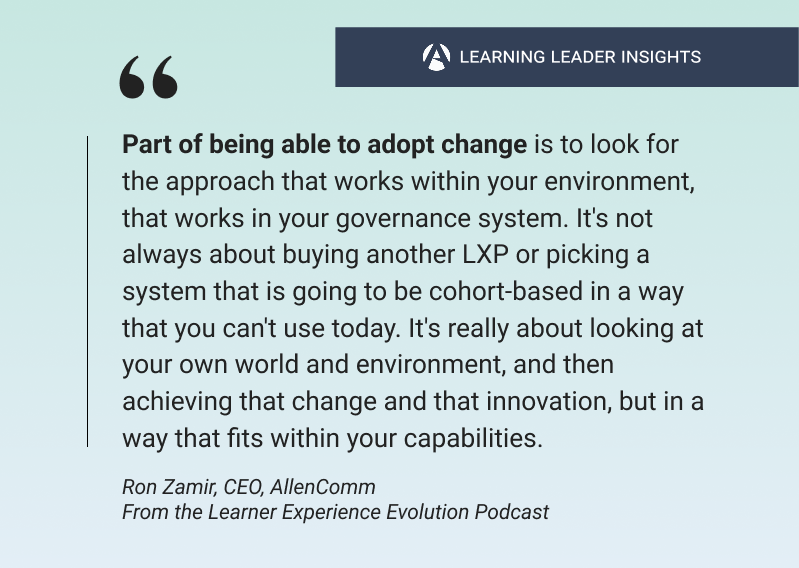
I bring up that example not because we’re here to talk about instructional design, but part of being able to adopt change is to look for the approach that works within your environment, that works in your governance system. It’s not always about buying another LXP or picking a system that is going to be cohort-based in a way that you can’t use today. It’s really about looking at your own world and environment, and then achieving that change and that innovation, but in a way that fits within your capabilities.
I think it could be very exhausting in our space because of our lack of access to the data that you were mentioning, and because the bandwidth we had within the people we had is so limited. But that’s why experts like you come in. That’s why sometimes we are brought in here, to promote us, but there’s definitely a way to bring outside help when you need it.
Let’s pivot to AI a little bit, because everybody’s talking about it. This is not a session about AI, but is the transformation that’s happening outside L&D around AI, is that going to accelerate, in your opinion, how change is accepted into the talent management space? And more importantly, what are some examples that you think are going to be the early adopters of AI change in talent?
Bernadette Lawler Sciarabba
Yes, and it’s already happening.
Ron Zamir
Yeah, the acceleration is here.
Bernadette Lawler Sciarabba
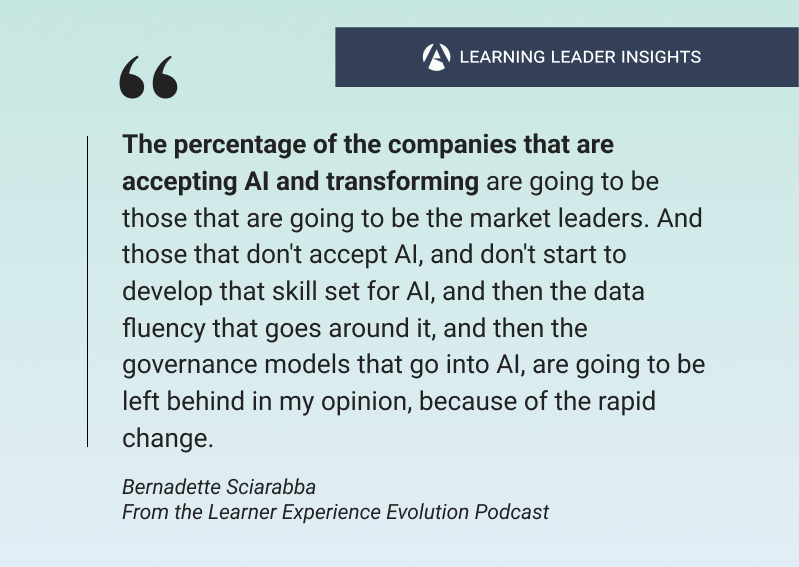
The percentage of the companies that are accepting of it and transforming are going to be those that are going to be the market leaders. And those that don’t accept AI, and don’t start to develop that skill set for AI, and then the data fluency that goes around it, and then the governance models that go into AI, are going to be left behind in my opinion, because of the rapid change. Some of the analysts are saying that you could move your business at nine times the speed by embracing artificial intelligence.
And it is a change initiative at the same time because people need to understand that their job is not going to go away. How they do their job is going to be very different. And it actually, in my opinion, often will reduce some of the repetitive tasks and make things easier to access in a quicker fashion so that you can serve customers better, you can increase productivity, you can give external recruits a better experience so that when they come in, the onboarding experience is tied all the way through. And so just looking at AI, and embracing that, and helping leaders to get more comfortable with it is critical, and that will help.
Josh Burson in his recent podcast, I think it was in the last week or so, very, very interesting stat. He said that most large organizations have anywhere from 90–95 systems within the organization that employees touch. And then the small companies is 9–10. So you think about that all of those systems are going to have an AI agent. Well, you’re going to need to be able to have fluency in that, and then understand how the governance sits behind that, and then how to function and work with that in a very different way to serve, whether it’s internal clients or external clients.
Ron Zamir
So if we take that down a notch to the actual learning and development group, which is a subset of course of talent management, we’ve seen quickly how, because people are using it, how individuals within the learning organizations are getting help. They’re using different—let’s call them co-pilots, to steal Microsoft brand—tools that make their work less repetitive, make it better. Yet the promise of AI is way beyond that, isn’t it? It’s about adopting agents that do the work for you, that shorten or expand.
So is this about enhancing our ability to work or just doing our work less expensively?
Bernadette Lawler Sciarabba
I think it’s a combination of both. I think you’re going to do work more inexpensively. And then your focus of what you’re doing is going to be on your core, whatever your business is, and really driving institutional knowledge to a deeper level.
And so if you look at some of the stats, 73% of skills are much deeper now than they were 20 years ago, which is a really fascinating statistic. As you look at AI and you see that people get deeper into it, they’re able to better serve whatever market or whatever customers were internal, external, and achieve the vision in a more rapid manner.
Ron Zamir
This morning I had a discussion with Anna, our CLO, and she’d also been at the Burson podcast, and we’d been doing research rapidly, rapid change, you talked about the velocity. And one of the things she introduced to me was, it’s not that—we have a lot of designers, right? We have designers that do the work for our clients. This is about becoming a super designer. It’s not about leaving your profession or getting pushed out. It’s about how you use these technologies to really able to do a lot more than you could before.
And I think that that’s an area where…
Bernadette Lawler Sciarabba
In a different way.
Ron Zamir
In a different way for sure, right? And you’re a different part of the process. So one of the reasons that we’re seeing so much angst in corporate America, is they realize this is not just about digital transformation, which was a few years ago, seems like eight eons ago, which changed job types and processes. This is about a total re-constitution of those processes and job types.
And yet we tend to lag behind. That’s something I really could use—we could all use help from you and others. You know, traditionally L&D talent management has lagged behind, let’s say, operations, marketing, IT. And you mentioned it is about getting access to data, being part of conversations. Do you think that finally we are going to be, at this speed, are we going to be developing our own AI agents? Are we going to be dependent on other parts of the organization? What is going to happen to L&D with this scramble to change so rapidly given by AI?
Bernadette Lawler Sciarabba
Yes, so friends of mine that are in the Big Four are developing their own agents. They’re certifying their own people in GenAI. They are creating content at a rapid pace. And so they’re having better conversations, and more elevated skills, because now it’s about the relationship skills and really understanding what you’re targeting as the business need or the business solution that you’re trying to solve.
I think that when you look at it, just moving towards that vision and getting the AI fluency is really, really critical and developing the upskilling for that. So if you look at upskilling, which is really critical to this, you’re going to have to reskill a large portion of your workforce, whether that’s a base set of skills or higher level skills. And so if you look at skills adjacency, it’s really important to look at your organization and not just say, well, you know what, we don’t think they have the skills, so we’re going to ref them. Because that’s not going to work, especially when you look at the talent shortages.
So what you can do is you can look at skills adjacencies, which we did at the bank, and we were able to take and reconstitute wholesale groups of job roles and say, these are the new job roles of the future, and that we found skills matched between that.
Now, was it 100%? No. But if you have 70% and you have deep institutional knowledge, you don’t want that to go out the door. Because by the time you upskill them, train them, bring them in, and you look at all the statistics, the cost is very, very significant to the business itself, but also to whatever markets you’re serving. So just doing that and looking at that and seeing what’s the skills of the future that I need to move to, what’s the footprint I have, and—you mentioned the word earlier, roadmap—building up that roadmap, continually having those conversations, continue building out MVPs, and then certifying those individuals in that.
Ron Zamir
Yeah, so we’re kind of getting to our final questions. But again, I hate to pass over some really important things you said. The upskilling or new skills, that goes into another big trend, which has gone hidden by AI, which is the skill-based organization. You know, finally moving away from broader linear type onboarding processes, curriculum processes, but also for any person, any L&D organization, any learning leader to say, “I need to be very up to speed on the skills my organization needs. And yes, there are technologies that help me categorize it, but it’s really the roadmap on empowering those skills and continually refreshing that process.”
For that reason, to all those out there thinking that AI or any technology is going to replace the need for a really strong L&D team, I think it’s the opposite. I think as AI changes processes, changes roles, we’re going to be very busy.
Make sure that the organization is ready for that upskilling, that it knows what it needs to do, and that it knows, going back to data, to measure it, understand it, and learn, if we’re talking about an MVP and others, learn from what they’re doing today to inform them what they need to do tomorrow.
I’m going to get to our last question, which is my favorite question.
Bernadette Lawler Sciarabba
Well, just one point on that. We could spend hours just on upskilling itself and how to move the strategy along for the talent organization and for HR as a whole. And so I know we talked about it earlier, so we’d love to do another discussion.
Ron Zamir
Yeah, we’re going to talk about it a lot. And I would remind anybody that listens, if you are working in a large organization, also if you’re in a small organization, there’s stuff happening, stuff around you. We’ve categorized, you know, I think two thirds of our large clients, clients with over 10,000 employees, that they’ve already rolled out AI agents within the larger organization. And the learning team is now trying to access those educated internal systems.
I mean, there’s a whole issue of governance, which I think is a whole different discussion. One of the things that I would really advise everybody, and it goes right into what you said to be ready for that skill-based organization, you have the right governance models. You have to have the right roadmaps. These are things that are not that hard to do but you do have to give them attention.
So going back to I think what brings us all together… We live in a very unique time now that we’re seeing this rapid inflection of technology. It’s not that technology doesn’t change all the time, it’s how rapid it is. If there was something you can tell yourself when you started along this path, these 15, 16, 17 years of working with these large complex organizations, what can you tell yourself from what you know now then that would have made your life a lot more interesting and better? Assuming your life is not perfect, but maybe it is. You can always give me that short answer.
Bernadette Lawler Sciarabba
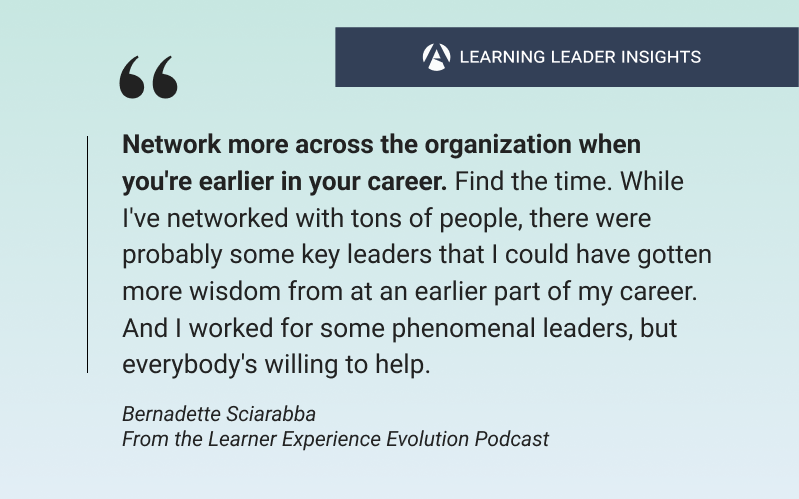
Yeah, I would say network more across the organization when you’re earlier in your career. Find the time. While I’ve networked with tons of people, there were probably some key leaders that I could have gotten more wisdom from at an earlier part of my career. And I worked for some phenomenal leaders, but everybody’s willing to help, in most cases. Ask the questions, network a bit more.
It’s interesting to ask that because I’m intentionally re-networking with a tremendous number of people in my network that I’ve worked with over the years and I’m having a great time. So I’m talking to five to seven people a week that I’ve either worked for or worked with, and it’s really enjoyable to see how their careers have been guided by certain philosophies and just to see where we’ve all landed, and it’s been invaluable to me.
Ron Zamir
There’s a lot of wisdom there. We reconnected on that process, right? We found each other and reconnected. So I’m going to leave everybody with that curiosity, networking, and you know, it’s so hard when you’re starting off to really have that broad view. So it’s a good thing to remind your younger self if you could go back in time.
So with that, thank you guys for joining us for another session of this podcast about innovation and change, and we will see you again when we have some other amazing guests that join us. Thank you.
Bernadette Lawler Sciarabba
Great. Thank you.
The Learner Experience Evolution is a weekly podcast for L&D learning leaders to stay inspired and gain valuable insights from other industry leaders. Subscribe now to never miss an episode wherever you listen to your podcasts.




Resources For L&D Leaders
free guide
free guide
insights | on the blog
ALLENCOMM Press Releases
AllenComm Earns Spot on Best Mobile Learning Content Providers 2026 List
eLearning Industry honors AllenComm for its custom mobile learning solutions for enterprise, built to improve performance outcomes at scale. SALT LAKE CITY, [July 29, 2026] — AllenComm has been named to eLearning Industry’s...
ALLENCOMM Press Releases
AllenComm Named a Top Employee Engagement Training Provider by eLearning Industry
AllenComm has been recognized by eLearning Industry as a 2026 top provider for employee engagement, cited for scalable, personalized L&D that drives measurable results. SALT LAKE CITY, [June 24, 2026]...
ALLENCOMM Press Releases