

ALLENCOMM BLOG | Podcast
Episode 17: Bridging Tradition & Technology in Hunter Education
March 21, 2025
Innovation, change, and evolution… these three things go hand in hand. For the National Rifle Association (NRA), innovation and change were exactly what enabled them to evolve the Hunter Education curriculum into a best-in-class free learning solution for hunters worldwide. In this episode, Ron Zamir and Peter Churchbourne discuss the history of NRA’s program, as well as the challenges of introducing new learning methods in a traditional field. They also share insights into engaging learners and making an impact on a community, even if it means pushing the boundaries of what’s comfortable to inspire others to embrace change for a better future.Bridging Tradition & Technology in Hunter Education.
takeaways
- The NRA started the first hunter safety programs in 1949.
- Innovation in education requires challenging the status quo.
- The online hunter education course was developed to improve learning outcomes.
- Feedback from learners has been overwhelmingly positive.
- Offering the course for free has increased accessibility for families.
- Engaging content is crucial for effective learning experiences.
- Resistance to change often comes from established programs and practices.
- The course has led to improvements in the overall quality of hunter education.
- Pushing for innovation can lead to significant positive changes in an industry.
- Collaboration with other organizations has expanded the reach and impact of the course.
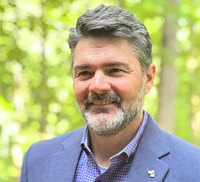
Peter Churchbourne: Managing Director of NRA’s Hunting, Conservation & Ranges Division and the Hunters’ Leadership Forum
Peter Churchbourne, Managing Director of NRA’s Hunting, Conservation & Ranges Division and the Hunters’ Leadership Forum. Peter Churchbourne is an avid outdoorsman, conservationist, and steadfast advocate for all hunters. His passion is anything to do with the outdoors, but most important to him is hunting waterfowl with his labs, chasing turkeys, bow hunting, and introducing new people to the life outside. Peter is a certified NRA shotgun, pistol, and rifle instructor who enjoys competition shooting in USPSA, 3-Gun, and 2-Gun tournaments. Peter is currently the Managing Director of the NRA Hunters’ Leadership Forum and the Hunting, Conservation and Ranges Division at the NRA, where he is engaged in building new NRA hunting programs and fighting for hunters’ rights. Before working for the NRA, Peter worked at Ducks Unlimited for 17 years in various leadership positions around the country. In his first few years at the NRA Peter was responsible for the production of the award-winning online hunter education course, and is also responsible for the creation of the newly released “How to Talk About Hunting” book, and associated communication strategies in support of hunting. Peter sits on several boards for various outdoor organizations and enjoys helping create new leaders within the outdoor professional arena.
Ron Zamir
Welcome, welcome everybody to the 17th episode of our podcast on change and innovation in the learning space. I’m so fortunate to be joined by somebody I’ve known for years now and worked with for years, Peter Churchbourne. He’s going to define his own from the hunting and education side of the NRA Foundation. We’ve worked with them for years promoting the idea of safe hunting across the United States.
And Peter, I’m going to let you introduce yourself and your journey, but I do want to stress to our listeners, innovating and learning is not just the the bollywock of the corporate world. We find at AllenComm that we work with some amazing nonprofits and through them, they tend to, I think, be more adventurous sometimes. We get a lot of innovation from what Peter’s doing in his organization, what the American Hospital Association is doing, what the Office of Mental Health in New York is doing, what so many organizations that we work with are doing. So it’s always a pleasure to invite one of our nonprofit clients to join us.
With that, Peter, why don’t you introduce yourself and then we can get going on this podcast?
Peter Churchbourne
Thank you, Ron. Great to be here. I’m Peter Churchbourne and I run a division at the NRA called Hunting, Ranges & Conservation. And most importantly to this podcast is to talk about our online learning platform that we have with AllenComm.
I have been in the outdoor space my entire life. I grew up in the woods. I never watched sports and I never took an active role in sports. I just wanted to be outside in the woods. So that led me to my first career. I worked for a nonprofit organization called Ducks Unlimited. I was a fundraiser doing fundraising for conservation work across the United States. I was there for almost 18 years, and then I was recruited to come over to the NRA to help them manage and increase the programs that they do for the American Hunter, which led us to our online learning platform.
Ron Zamir
Yeah, and just to remind, at least my impression, it could be a wrong impression, because I’m not a hunter, but I do have a hunting dog, so I’ve kind of learned a bit about the nature of how amazing it is to be outside with a dog that’s really attached to you as a person, and maybe I should have been a hunter for Kasha, but I’m not. Too much information here.
But I will say there’s always places to innovate in one of the oldest sports in the country. I think the sport of hunting, the necessity of hunting, is part of the stories we hear from our founding fathers. And we’re almost 250 years ahead of that now.
So I’m fascinated by the idea on… where do you innovate to a population that’s learned what they know from their grandfathers, from their fathers, from their brothers, their sisters? I don’t want say this is just a male endeavor. So talk a bit about what does innovation mean? What does change mean in the world of hunting and hunting safety?
Peter Churchbourne
Sure, that’s a great question because it leads us to exactly what we did. So actually back in 1949, the NRA was the organization that started the first hunter safety programs in the United States. We wrote a curriculum, it was in a small little book. Back in 1949, Hunter Education was pretty simple. You had to be safe with a firearm in the field and then you had to do some wildlife identification. It’s come a long way in those years since 1949.
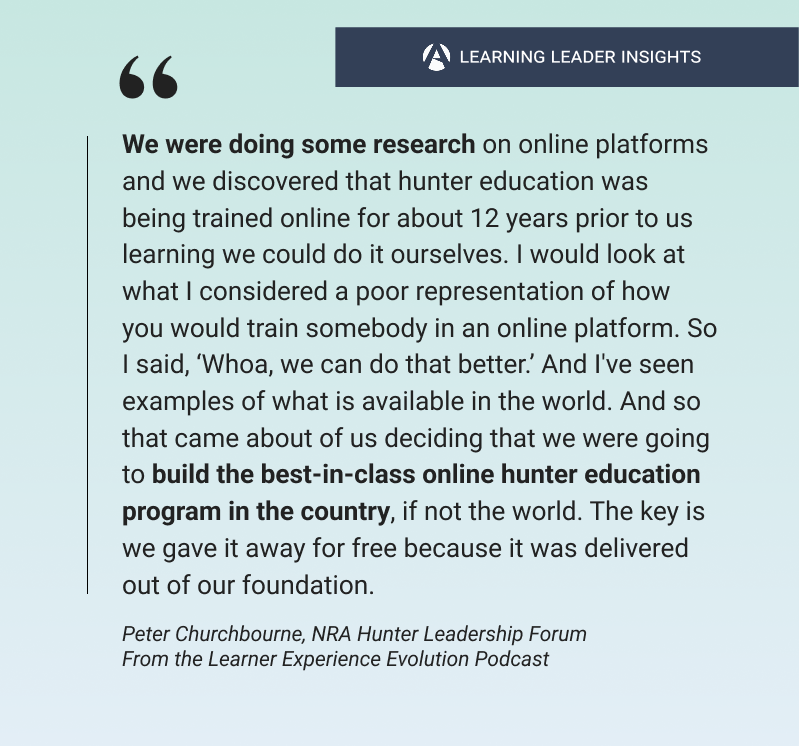
And that’s why we actually started this online program. We wanted to get back into how people were learning Hunter Education. We were doing some research on online platforms internally for some other things that we were doing. And that led us to, “Oh my goodness, we have a great opportunity to serve America because we are the founders of Hunter Education and gun safety training.” It’s kind of perfect to go together. And we discovered that Hunter Education was being trained online for about 12 years prior to us learning we could do it ourselves.
It just was serendipitous that we got into this because we had an executive that wanted to learn to hunt, and they came to me and they said, “Teach me to hunt.” And I said, “Okay, well, you have to get your hunter safety first. And they’re like, “Well, okay, we’ll look online to see where there’s an in-person class in Virginia.” The closest in-person class was eight hours away and it was four months down the road.
But we saw that there was an online class being taught by a vendor. So I said, “Well, take that thing and then we can cross off the box of hunter safety and get you out hunting.” So while he’s taking that course, I’m checking in on him from day to day, because it’s a mandatory requirement of eight hours of instruction online. I would look over his shoulder every now and again and I would look at what I considered a poor representation of how you would train somebody in an online platform. And at the same time, we were looking at online training to do some other stuff we were doing in the building. So I said, “Whoa, we can do that better.” And I’ve seen examples of what is available in the world.
And so that came about of us deciding that we were going to build the best-in-class online Hunter Education program in the country, if not the world. The key is we gave it away for free because it was delivered out of our foundation.
Ron Zamir
Yeah, and it’s interesting, I’ll draw a corporate parallel. Corporations don’t charge their employees to take compliance training. In fact, in some cases, the employees would pay their company not to have to take the compliance training. But if you think about it, issues—we have 50 states, all different states. The issue of safety… there’s hunting in almost every state. I don’t know, is there a state where there’s no hunting?
Peter Churchbourne
Every state.
Ron Zamir
Every state. And it has to do with safety. It has to do with sometimes unlearning bad lessons you may have learned, you know, from a relative who maybe hunted in a day where things…
Peter Churchbourne
Especially for older hunters, our advanced aged hunters, absolutely there’s some unlearning that needs to be done.
Ron Zamir
Unlearning that needs to be done. So if you think about it though, the status quo, because what I hear when I think about our banking clients, and our hospital clients, and our insurance clients is sometimes innovation is just not accepting the status quo. You know, in your case you said you looked at what was out there and said that is not what should be done, can be done, and you tied it into the mission and vision of your organization.
I try to draw a parallel, for other nonprofit clients and our for-profit clients, is innovation sometimes is all about saying we can do better. So now let’s go from there.
What does it mean to do better? And how do you balance that with the constraints of your learners themselves? The time they have, you work with 50 jurisdictions of different states… how do you balance innovation with the things that constrain innovation in your case?
Peter Churchbourne
It’s interesting because as I mentioned, it was the perfect setup, and we weren’t even thinking about doing an online class. It was just… I knew we could do something better, and I saw what could be done. So it just came together at the right time.
I was tasked with creating better programs, and I was like, what better program to create, then make an online course that is better than what’s currently available that people were paying for. And it was not really that difficult because the other courses were so poor. It was not that hard. We didn’t start with AllenComm. We started looking at other platforms, and we went into the full filming. We took about a year and a half to write the curriculum.
So Hunter Education is required in the United States to start hunting. And there are—it’s an organization that sets the standards. So even with innovating… we innovate the standards because we looked at the standards from that organization that hadn’t been revisited in probably 13 to 14 years, and we know that the hunting industry had changed dramatically from how people use tree stands, to the firearms they use, to the technology being used, and the standards weren’t updated.
So the first thing we did was we innovated in coming up with our own standards. I always say that our course has 30% better standards than the standard-setting organization because it was built by lifetime hunters, myself and Matt Fleming, who was a big part of building this. Between the two of us, we probably have a hundred years of experience in the field and we knew that we could do better.
Ron Zamir
Yeah, and again, I just can’t help but draw the parallels with any organization that gets standards. We think of our banking clients—don’t want to bore you, Peter—but they have so many standards they have to comply with.
Peter Churchbourne
Regulations probably, yeah.
Ron Zamir
Regulations from FINRA and other organizations. The ones that are trying to just check the box work in a certain way. And then there’s the ones that are trying to be change agents and they actually add to the standards. They contextualize them in a way that makes sense for their organization.
Talk about resistance to change. We talk a lot about your change. Where did you meet resistance in this journey?
Peter Churchbourne
Well, I work in a world that if it’s not your idea, then we don’t want to support it. So that was one of our biggest challenges and it still is today. There’s people that have a lot of ownerships, and I’m not taking anything away from them, but they have ownerships in their state programs. But we come along on the market with some whiz bang new shiny product that is truly great, met sometimes with a little bit of resistance, unfortunately.
Ron Zamir
Yeah, and just to add to that, it’s not just when you come in with new content, right? And again, in a nonprofit world, you’re working with SMEs, you bring in a whole new area of curriculum or content. It’s also the experience of taking that content. Peter and his organization, and others, use also our learning experience portal, which crouches the content with an experience that supports the competencies you’re trying to teach.
Where was the resistance higher? Was it in that you were just providing new content, a new context, or was it in the experience itself?
Peter Churchbourne
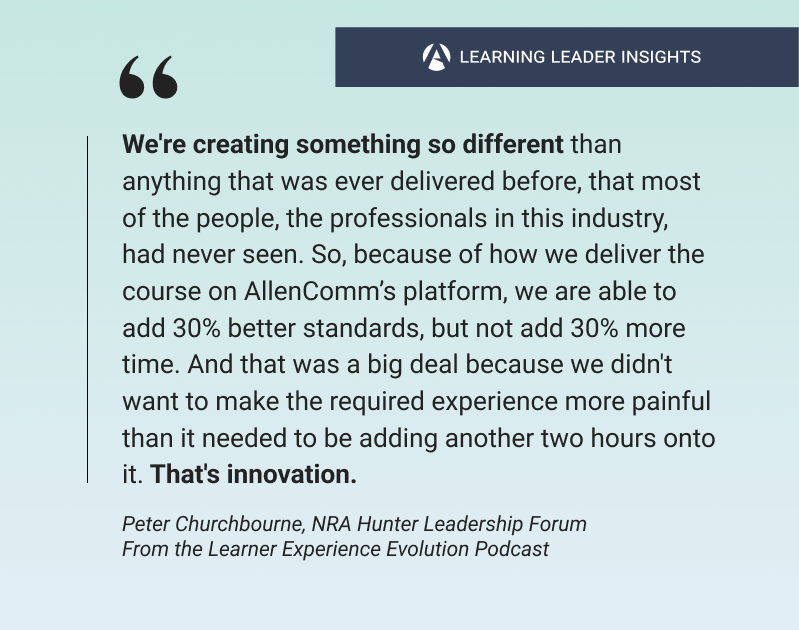
It definitely wasn’t the experience because that’s awesome. I mean, we’re creating… it’s something so different than anything that was ever delivered before, that most of the people, the professionals in this industry, had never seen. And until they took the course, or maybe some of them still haven’t, just didn’t believe how good it was.
You’re talking about innovation there and allowing us to teach more in the same amount of time. So, because of how we deliver the course on your platform, we are able to add 30% better standards, but not add 30% more time. And that was a big deal because we didn’t want to make this requirement, which it is, it’s a requirement to go hunting, we didn’t want to make it more painful than it needed to be adding another two hours onto it. And all of a sudden making students take 10 hours worth of instruction.
The way we teach it on your platform, with all the videos and interactivity, we are able to add that content in and not add any more time. That’s innovation.
Ron Zamir
So, yeah, because what Peter’s referring to is some states have seat time requirements, which you have to adhere to, but you can provide more in that seat time and definitely don’t want to make it longer. In some areas where you can support shorter seat time, you can support that as well.
And we don’t always talk about that in innovation and design, is what are you trying to… how are you trying to help the learner along? Right. Our content experts, our regulatory organizations, tend to elongate the seat time of any learning experience. And it doesn’t have to be in hunting. It could be in, you know, in any state, if you want to hunt, if you want to have a boat on a reservoir, if you want to go with your dog out and you encounter sheds, you have to take a certification.
And those certifications are usually, and this is pre-Peter’s work, are usually a video with some slides accompanying a talking head, right? Where your focus, from a learning perspective, is on the person who’s usually not very charismatic or maybe even drones… or in the best case, is charismatic, but he’s locked into a lot of content, so you lose connection with that person quickly. Versus an experience where you can go through content, video, simulations, questions, reflective activities.
And the challenge is, and I won’t speak for Peter, I’ll speak for the state where I’m in, in Utah, is often you don’t get that opportunity to engage with the content. You have to go through a recording and answer a few questions and you’re done. So I think when we talk about innovation, it’s also stretching our comfort zone out of that kind of standard way of engaging on content.
Talk a bit about how this has been received, about some of the feedback you’ve gotten from the field, positive and negative. I’m curious about that.
Peter Churchbourne
Oh, well, you know, it’s funny, we have a SurveyMonkey survey at the end of the course where we just let people take it. Anybody out there listening, you understand that surveys are—your finish rate is about 0.2% of the people that you ask. And if you get 2%, that’s a great return rate unless they’re required to do it.
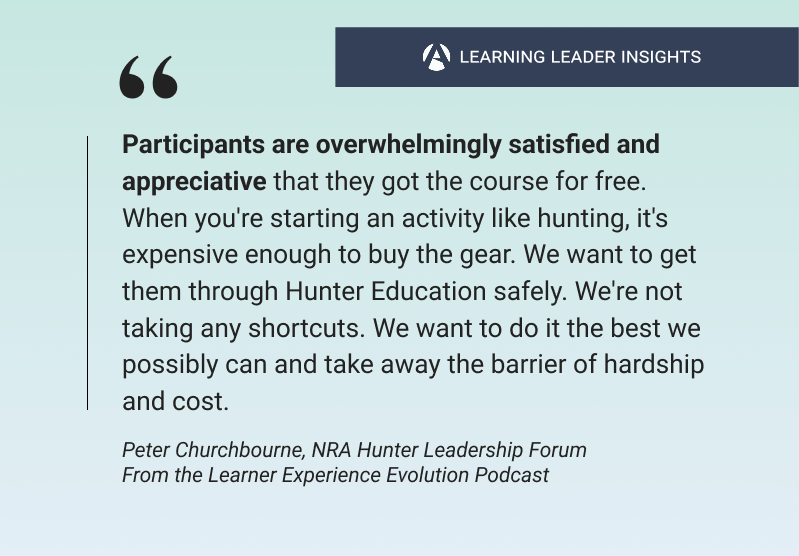
We make it totally voluntary, and we get about a 5% completion rate. Remember, we give this course away for free. The competitor who sells it is anywhere from $35 to $79, depending on what deal they’ve made with the state wildlife agency they’re working in. So they’re grateful that they’re getting it for free and it’s fun. I mean, this is an interactive fun course, and you should see some of the responses we get from people that have taken the course. They are overwhelmingly satisfied and appreciative that they got it for free.
You look at some of the states we’re in, like Florida, the average income of a family was there, and if they have three kids that need to go through Hunter Ed and they need to pay it online, they may be paying 110 bucks for all three kids to take it, but we just gave it to them for free. And when you’re starting an activity like hunting, it’s expensive enough to buy the gear, that you want the first step… we want to get them through Hunter Education safely. We’re not taking any shortcuts. We want to do it the best we possibly can and take away the barrier of hardship and cost. And we did that with this course.
Ron Zamir
I reflect on that because we’re talking about consumer education, right? We’re not talking about training people inside a company. We’re not talking about what people in the military have to learn about their guns, where their survey, they all—they’re told “You better fill out that survey.”
And again, how to innovate in a world where you want to bring the consumer along from point A to point B, where sometimes it makes a lot of sense not to charge. Because you’re really trying to meet your nonprofit objective of having the hunting endeavor to be a safer and fun activity so you can preserve that legacy. And again, I don’t have to be a hunter to appreciate that hunting is a core part of the American way of life. And nothing would turn anybody off more if they felt scared or something happened, if there was a safety issue related with that endeavor.
How do you deal though with the naysayers? How do you basically push them to do better without actually being partnered with them?
Peter Churchbourne
You know, this course has done so many interesting things for the entire Hunter Education community. Because prior to us coming on the market with the course, the vendors—there was six of them at the time, and now there’s only one. That vendor bought all the others and threw the product away so they could just order their one program. And it was, like you said, it was a PowerPoint on steroids. You watch a video, and you could let it run for 10 to 15 minutes and walk away from your computer, and go cook breakfast and come back, and maybe answer the questions correctly and move on.
So when we partnered with AllenComm, obviously it’s the tile-ized format. The chooser gets to kind of pick their way on that screen. They’re engaged in the content. I don’t think there’s any part of our course where the user can’t be there for less than two minutes engaged in the content, interactivity, making them make a path of choice or choose an answer or go to the next phase… they have to stay there. They can’t walk away. They walk away, they don’t finish the course.
You proved to me that that makes them learn better. The way that they’re learning it makes them retain it, which obviously in our world makes them safer. That’s what we want. We want them to leave this course being safer hunters in the field. And that course made us do that.
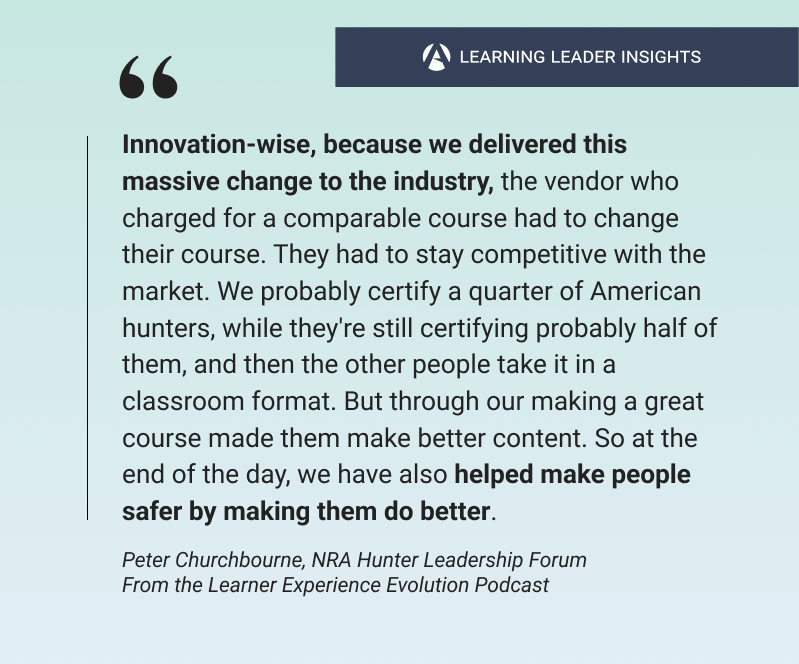
But also innovation-wise, because we delivered this massive change to the industry, the vendor who charged for it had to change their course. They had to stay competitive with the market. And one of their employees actually that doesn’t work for them anymore said to me at one time, “You innovated them to make them have to change their course.”
We probably certify a quarter of American hunters, while they’re still certifying probably half of them, and then the other people take it in a classroom format. But through our making a great course made them make better content. So at the end of the day, we have also helped make people safer by making them do better.
Ron Zamir
Yeah, and just a reminder, one of our earlier episodes was with USA Clay. Kind of we had the inversion.
Peter Churchbourne
John Nelson.
Ron Zamir
Yeah, the idea that you can make people safer, you can make them more enthusiastic about it. And we’ll put some screenshots, I’m sure Peter wouldn’t mind, of the course that you guys do in our show notes down so people could see that if they want. And we won awards with our clients for some of these programs.
And I think that approach to kind of… get out of the comfort zone of the industry, which you’re describing, and push it, stretch it, which what you’ve done with your content, is pretty important. And I would want, and people have heard me say this, our listeners, a lot of success is predicated on your ability to get out of your comfort zone. Learning, training, changing opinions, adding competency, those are creative endeavors. It’s not something that we could dial into a computer. No matter what AI is going to give us over the next few years, we still need that penny to drop when it comes to the way we learn.
There’s a lot to be said for stretching out of that comfort zone and reaching a point where you can kind of shake things up. In your case, you shook up the industry. Now again, these are our nonprofit clients. They’re not there to make money off their content, but they are there to make an impact.
And so I think what I’ve heard you say is your impact goes well beyond the participants and the states that use your content. It’s actually impacting all the states, those that use your content and those that do not.
Peter Churchbourne
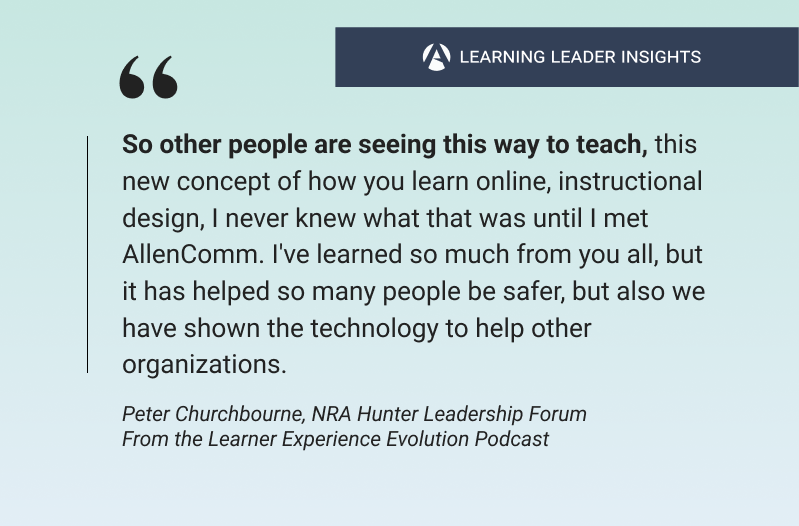
Absolutely. There’s been so many—we’ve had half a million completions of this course so far, but it has led to so many other relationships, like we’ve done with the Boone and Crockett Foundation, the one that came in with the First Hunt Foundation, creating their training course, and then obviously USA Clay Target. So other people are seeing this way to teach, this new concept of how you learn online, instructional design, I never knew what that was until I met you all.
I’ll go to the woods, I don’t know anything about this. I’ve learned so much from you all, but it has helped so many people be safer, but also we have shown the technology to help other organizations. I think a school just joined up with you all. From one of their students taking our course, he emailed me and he said, “Who did this phenomenal course?” And I made the introduction. I understand the other day they’re signed up and you’re going to make a course for their private school.
Ron Zamir
Yeah, we love education. Again, I think consumer-facing stuff is very unique. I would love people to see some of the visuals we’ve created for you and other similar organizations. Just to get us kind of towards the end, I mean, to wrap up, you know, you’ve done a lot to impact people. You mentioned half a million completions and what you’ve done for the industry. And we’re so proud of this partnership. Let’s make it personal for a second.
You look back, and again, I’m not going to say you’ve been an instructional designer for 30 years like me, but you’ve definitely been outdoors probably 30 times more than me over those past 30 years. If you were standing in a place to go back in time and talk to yourself in the beginning of your journey, in this whole area of hunting, hunting education, maintaining that—I’m not going to call it an art form, but that tradition of American culture—what would you tell yourself to make your journey so much better over these past 30 years?
Peter Churchbourne
In relation to this course, definitely I was fortunate that I had support from behind to do this. Because doing it in today’s world would have been so much harder, just the environment that I have right now versus the environment then. But also, if I hadn’t pushed, and I probably could have pushed a little harder to do a little more, is to push the envelope. And I am an envelope pusher. Some people will call me that and other things.
But I definitely would recommend that if you believe in something, and you know it can make a difference—When we first did this program, we don’t have time to go into it, but there’s other ramifications of how states get some benefits from using our course. And people looked at me, at that time, like I was nuts that this wouldn’t work. But I made sure I pushed through and I had some good support to get that done.
So I would tell others that if you feel that you know and you’re being held back, just keep pushing. Because if you know it, and you are the subject matter expert, don’t let others hold you back. Find another way to get in there and get it done. Because I don’t think that if I hadn’t pushed harder for this, it may not have been done. And that if we had waited just two years, it probably would have never been done. And it has changed so much for so many people.
Ron Zamir
That’s fascinating, and I think teaching our younger selves to be less risk aversive and push what we believe in is something. It’s a good lesson for us all.
With that, I’m going to wrap up our latest episode. I want to thank you for joining us. I want to thank Peter for being such a good partner with AllenComm and also for joining me. You’ve inspired me to get out there more. So I will do that as well. Thank you everybody.
Peter Churchbourne
Thank you.
Resources For L&D Leaders
free guide
free guide
insights | on the blog
ALLENCOMM Press Releases
AllenComm Earns Spot on Best Mobile Learning Content Providers 2026 List
eLearning Industry honors AllenComm for its custom mobile learning solutions for enterprise, built to improve performance outcomes at scale. SALT LAKE CITY, [July 29, 2026] — AllenComm has been named to eLearning Industry’s...
ALLENCOMM Press Releases
AllenComm Named a Top Employee Engagement Training Provider by eLearning Industry
AllenComm has been recognized by eLearning Industry as a 2026 top provider for employee engagement, cited for scalable, personalized L&D that drives measurable results. SALT LAKE CITY, [June 24, 2026]...
ALLENCOMM Press Releases