

ALLENCOMM BLOG | Podcast
Episode 18: Strategic L&D: Building a Foundation for Success
April 22, 2025
Every leader’s L&D journey begins somewhere. For Justin Bridegan, Vice President of Training & Development at Stellar, that journey involved building an L&D department from the ground up. It wasn’t easy, but it was extremely rewarding… and even resulted in a comprehensive learning solution with over 10,000 courses. Listen as Ron and Justin discuss this transition, including working with stakeholders to get buy in, utilizing existing technology to streamline implementation, and keeping employees involved and engaged at every step to foster a lifelong culture of learning for the organization.
Top Takeaways
- Justin Bridegan transitioned from marketing to L&D to make a meaningful impact.
- A strong onboarding program is crucial for employee retention.
- Gaining buy-in from leadership is essential for L&D success.
- Communication and transparency help manage expectations during change.
- Leveraging existing resources can enhance training programs.
- In-house experts can provide valuable training insights.
- Personalized learning experiences improve employee engagement.
- Measuring training impact is vital for demonstrating value.
- Investing in employee development positively affects retention rates.
- Embracing challenges is key to success in L&D.

Justin Bridegan: Vice President Training & Development for Stellar
Mr. Bridegan is the Vice President of Training & Development. As such, he is responsible for accelerating the skill development and professional growth of Stellar employees through hands-on training, best practices and industry-leading management training. In March of 2024 the iMPACT corporate training program was launched with a new LMS, featuring on demand eLearning courses, customized learning paths along with employee development tracking and reporting. More than 2,500 courses were taken by Stellar employees in the first year, 15% decrease in turnover rate, and new hire retention has increased from 73% to 88%.
Justin’s professional experience spans over 20 years as a training and marketing leader in the B2B and B2C industries. At MarketingSherpa he worked with leading companies around the world including Google, Facebook, LinkedIn and Salesforce. He was a featured speaker at numerous Summits and discussed topics ranging from long-term optimization strategies to ROI tracking for social media campaigns. He has been featured in several articles including Florida Magazine Association and BtoB Online Magazine discussing online marketing strategy and social media. Prior to joining Stellar in 2013, Justin was a marketing manager for MECLABS/MarketingSherpa and got his start in marketing at Software Quality Engineering in Jacksonville, Florida. Justin has a wife, Gwen, and a 13-year old son, Reagan.
Ron Zamir
Welcome to another one of our podcasts on how we innovate in the learning space. We have a fun time in these episodes introducing our clients, experts we meet along the way, and people that can really give us insight about our industry and about their personal journey in the field of L&D.
Today, I am joined by Justin Bridegan—I think I pronounced his last name right—from Stellar, he’s going to talk about his journey. I’m really looking forward to this conversation because we actually share similar journeys going from marketing into L&D. In my case, it was L&D, marketing, and L&D.
Justin, why don’t we just start off with your personal journey and story, and then we’ll get into more specific areas of innovation and change in L&D?
Justin Bridegan
Sure, thanks Ron, I appreciate it. So I’ve been at Stellar for about 13 years, pretty much in the marketing world for most of that. I worked for a company called MarketingSherpa, and MET Labs, and so I got into training and development and helping marketers grow their careers for a number of years.
I was recruited by Stellar about 13 years ago and kind of came in and immediately got into the marketing world. That’s really where I spent most of my career for the last 10 years, was the Vice President of Marketing, and then a new opportunity arose that we can talk a little bit about.
Ron Zamir
Yeah, let’s talk about it, how easy the transition was to go from a place where you’re working with a lot of external technologies, where you’re doing positioning, placement, and all the great marketing stuff, to really impacting people in your organization.
Justin Bridegan
Yeah, so it’s one of those things where I remember talking to the CEO and I was like, “Man, I want to grow and I want to develop, but at the same time I want to make an impact.” And so that was always the challenge. Like, how could I do that? How could I do that effectively?
Well, one of the areas I think that we were really trying to push and understand is we need to really enrich the lives of the employees. One of the ways that we did that was we had training parts happening in each of the different divisions, but nothing corporately was set up.
So the idea was, well, why don’t we do that? Why don’t we go ahead and start an L&D department from scratch? I put together a strategic plan and said, “Hey, here’s what I want to do over the next three to five years. Can I get some buy-in? Can we get some resources? Let’s go. Let’s see how this works.”
Ron Zamir
You were on what I call the origin team, you know, getting it started. And for those who know, Stellar is a design to plan or construction company, right, in the refrigeration space.
Justin Bridegan
Yeah, Stellar is basically a design build firm. A lot of people are familiar kind of with the AEC industry. So architecture, engineering, construction. They’ve been around for about 40 years. So they’re celebrating 40 years this year, and about 750 employees, and our goal is about a billion dollars in revenue. Primarily what we’re focused on is kind of the big food processing plants of Starbucks, Kraft, Nestlé, Jack Link’s. A lot of those big facilities, couple million square feet, we’re building on the East coast, West coast, and around the country.
Ron Zamir
So let’s riff off that idea of… you’re starting almost from scratch, right? You’re forming a department. What are some of the principles or some of the approaches that came out of your strategic research that you wanted to lay down as foundations for the building of this new L&D team?
Justin Bridegan
Well, I think for us, first and foremost, we had to get it right in the growth side of it, right? So we had to start—the very first thing we thought of was “How can we fix the onboarding?” Before they even get in, forget about training employees, like how was our onboarding program? And it really was lacking. There was all kind of a hodgepodge of things happening in different areas depending on when you came in. So we needed a whole new onboarding program from the get-go, I think, to kind of start things out.
After that, we realized that… What about L&D? What do we have as far as staff and building that? I had some experience working a little bit, like I said, in the training and development side, but I needed resources. So immediately I had to go out and really do my research on finding a good company that I could work with when I didn’t have the experience. Someone I could lean on to help me do that as well.
Ron Zamir
Yeah, we sometimes forget the hand-holding aspect when we’re trying to get started. The good news is it’s easy. And I always tell our peers in the industry, it’s so easy to find great people now, both part-time, contingent, and full-time, depending on how you want to structure.
Talk about setting expectations. A lot of the challenges we have as L&D professionals is we’re very reactive to what our company needs. A new onboarding process, a new supervisor training… How do you go about setting expectations? One, getting the right guidance you need from your CEO and other business units, but also setting expectations for them so you’re set up for success.
Justin Bridegan
Yeah, I think the best part that I did, and I’ve learned this in my career, is you got to go and get the buy-in and the understanding and really kind of what they were looking for.
So I sat down with them for a number of weeks and picked their brain. What are the things that you’d like to see? What are the challenges we’re facing? Whether it’s project managers dealing with, you know, these billion dollar deals, kind of understanding how they can work and understand and do things with the owners of companies. So, if things go wrong, we’ve got to make sure we have the best practices and things like that. That was a big part of it.
Then it had to do with the more… what I would call the skill sets. Where are we having challenges? If it’s in our accounting process of getting invoices paid and doing things like that. So it really was just buy-in first, then more of like a research and development side. I had to go into a mode where I was meeting with about 40 to 45 leaders throughout the company and saying, “What do you do well? What do you not do so well? What would you like to see done in your group?”
I did that for about three months. I combined all that information, and then put it together, and then hosted a meeting with everybody. So basically pulling all the leadership together and said, “This is what you guys are telling me. Are you starting to see some of the similarities?” And immediately a lot of things rose to the top. There were four or five things where they all were like, “Yeah, these are the challenges we need to focus on first.”
So once I showcased what they wanted, the buy-in and understanding, then I showed them the research. We basically said, “Are we all aligned? Because I’m going to need some resources. I’m going to need some time to put this together.”
Ron Zamir
I love that because if I’m understanding correctly, you married their perceptions of what was working, what was not working, to what you were researching by yourself as well. And through that, cater to that common ground where you still had some level of influence and say, “Well, I heard you. This is what I found. This is where we need to be.”
Justin Bridegan
Yeah, so it was almost like, “Hey, this is what you told me. Like if I’m misinterpreting something or I don’t understand, and then we all agreed…”
When we left that meeting, I said, “Do we all agree? These are the first three or four courses that need to be built, and we’re all aligned, and these will make the biggest impact for the business.”
That’s something I learned in the L&D space working with AllenComm before is you definitely don’t want to go down a road where we’re just turning out training that doesn’t really apply, or isn’t needed, or doesn’t have a real ROI for the company. So I wanted to make sure that we were all aligned quickly and that we can do it.
Once I got the marching orders, then it was, okay, I need experts, I need help. Now that I know what to do, I need help to go figure out how to do it.
Ron Zamir
Yeah, so before we get to some of those great tactical issues, and I want to also talk to you about the infrastructure you put in place, I hear a lot of great marketing tips coming from you because you’re kind of setting expectations and defining what the future state will be.
One of the challenges we have as learning professionals, and I think this podcast explores that through many different interviews, is how aggressive should we be in setting the before and after? Are you making the promises that “You give me the resources, I’ll use those resources, I will take you from point A to point B”? And any insights around how aggressive you want it to be in setting that before and after scenario for your leaders?
Justin Bridegan
It’s funny because just like I’ve learned it, I didn’t know much about the construction industry when I was first working with this company. What I’ve learned is just no surprises is a great thing. They don’t mind that stuff’s going to change as long as you keep them in the loop. So I said, “Here’s what we’re going to do. Here’s the schedule.” But I constantly, every single month, would say, “Hey, here’s where I’m at. Here’s where it’s going. If anything changes, let me know.”
I think keeping them in the loop, luckily, we hit most of those aggressive deadlines that we wanted to do, but obviously the biggest one for me was I knew I had a date of March of 2024, which is “I’m going to launch this in front of the entire company and I have to be ready by that date.”
Ron Zamir
I think when you get permission to innovate, it’s critical that you over-communicate. I think I may even rhyme there. But I really like that approach of earning that right by the pre-work you did and then over-communicating. So everybody feels that they know where you are, they know where they’re going. And of course, everybody’s waiting for that big reveal, right?
Justin Bridegan
Yeah. Like I said, it wasn’t a surprise to the people I was working with closely on the program because I kept them in the loop and showed them what I was doing. For everybody else, it was a big surprise. But for the people that I was working with, they knew along the way what was going to happen.
Ron Zamir
So let’s talk about some of the decisions you made in that process around how you got help, what technologies were fostered on you or you looked for. How did you set up yourself for success?
Justin Bridegan
I think anything I’ve learned in marketing, one of the first things I learned is it’s okay if you don’t know, just say it, don’t fake it, don’t try to do anything. Like if you don’t know, that’s okay. And I realized my hands… I was not an L&D expert, nor was I ready to say I can do all of this stuff.
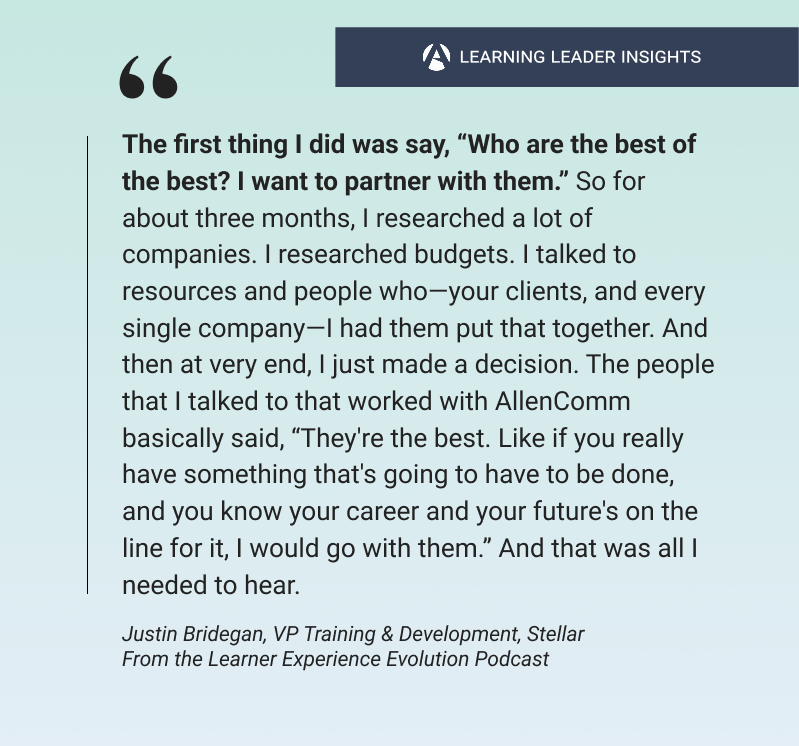
The first thing I did was say, “Who are the best of the best? I want to partner with them.” So for about three months, I researched a lot of companies, and I know this isn’t a plug for your company or anything like that, but…
Ron Zamir
Yeah, not necessarily, but I wouldn’t mind a compliment now and then.
Justin Bridegan
Yeah, but I definitely did. I researched budgets. I talked to resources and people who—your clients, and every single company—I had them put that together. And then at very end, I just made a decision. The people that I talked to that worked with AllenComm basically said, “They’re the best. Like if you really have something that’s going to have to be done, and you know your career and your future’s on the line for it, I would go with them.” And that was all I needed to hear.
Ron Zamir
Yeah, nothing like the threat of failure or the pleasure of success to motivate you to find the right partner. Well, thank you for that plug. But I want to broaden a bit, okay?
Specifically, I know you sourced assets, people, from AllenComm, but I also know that you inherited some… like an LMS or some things you had to work with. Talk a bit about how you navigated that stream. How did you make sure you were getting the right resource? You know, the process of… there are people that listen to this that do have contingent team members on their team. So some of that process of knowing, “I want that person,” but also that infrastructure you had to work with and how you made that all sync together.
Justin Bridegan
Sure. Yeah, there were a few things that I had to understand. Once I determined, okay, I have the partner I need, that was checked. Okay. I’ve got the expert support. Now I needed resources.
So the first thing I did is I went to the CHRO—which is our Chief Human Resource Officer, who’s my supervisor, Stacey—and I said, listen, I need the best of the best. I need someone who’s going to… anyone that you know in the company who can really just be on their toes, is very aggressive, can meet deadlines, can also be smart and witty, and really wants to grow in their career.
She says, “I think I have someone actually in our HR department that really has been phenomenal. We hate to lose her in the role she’s in, but I think this would be a great opportunity for her.”
And so really getting Angela Pesina, who is now our training specialist in there, she was the kind of the first piece that I basically said, “Here’s the vision, here’s what we’re doing. I’d love for you to be aboard. What do you think about this?” And she’s like, “I love it. I think it’d be great if I really kind of stepped in.”
She immediately became that resource, my go-to person to say, “Okay, I need your help with these particular things.” And one of them definitely was UKG. That was chosen by the accounting department, and with HR, to replace Paycom that we were using. What we didn’t know is that UKG actually had like a Pro Learning side of things.
The great thing is the HR department said, “Listen, we’ve already bought the software. We were already doing this, but there was a Pro Learning side to this. So if you’d like to use it, you’re welcome to. If not, you still can go out and find an LMS that you think is out there.” So again, more research, more stuff was done. And really I decided… this is the system that’s already purchased, and we’re already meeting with some of the experts. Let me go ahead and piggyback. And so we really pretty much did that.
As soon as UKG, and I kid you not, was launching instead of Paycom for our accounting system, I quickly got onto the list of… we’re going to launch the Pro Learning side just a month later. So you guys are going to launch it, I want to know the backend and start learning the Pro Learning side of things. And that’s when Angela and I became experts in UKG and understanding the Pro Learning side.
Ron Zamir
For some of our viewers, UKG is a big company that provides HRM payroll systems. They’re a merger of KRONOS and Ultimate Software from a few years ago. But they do have a product, again, we’re not here to plug any LMS, so we work with multiple LMSs, but they do have a nice approach to feeding in off-the-shelf content—maybe we’ll talk a bit about the LinkedIn Learning stuff you did—but also some level of ability to help the learner personalize his journey.
And I know our viewers are very interested in personalization. Do people like it? Do people use it? And so talk a little bit about how did you structure… you have the onboarding programs you did, you have the supervisor programs you did. How did that all play nicely together with the infrastructure you had to adapt?
Justin Bridegan
Yeah, so the first thing that I thought was a benefit that I didn’t even really know or understand is once HR chose UKG, they obviously put all the HR information in there. So onboarding and having all the people already in the system was great.
Then it became, okay, on the learning side, since they’re connected, can I immediately use some of this to assign people training? Do things with that? Do I have access to create groups? Yes. So that was a great benefit as well.
With the onboarding, immediately, one of the things we decided is we’re not going to send computers out, you know, do different things. We’re going to fly everyone into our Jacksonville, Florida headquarters and put them in the hotel for two days, and then, really, hands-on training every two weeks. So every two weeks we have a new batch of employees come in, and for two days they go through and meet each of the different sectors, and meet with the executives, kind of understand… so a more personalized approach. That was the big thing that we did there.
On the UKG Learning side, we recognized pretty quickly, I can probably build with my team, probably four to five courses a year, but that’s only four to five courses. I needed a lot more for the individuals who weren’t going to be in those four to five courses that we were going to do.
So we decided to partner and look at all different types of learning, you know, LinkedIn Learning, a lot of other programs as well. And we pretty much decided that we like the consistency of the LinkedIn Learning because some of the other programs would bring in hundreds of thousands of training courses, but some of them were high def, some of them were low, some of them… the quality and stuff, depending on what they had, wasn’t the same, it wasn’t uniform.
What I really liked about LinkedIn was we could actually pull in their courses, and every quarter we’ll pretty much kind of update. So we have about 10,000 courses that we pulled into UKG, and then we just update every time every quarter comes around. Now I have a whole library of 10,000 courses that are easily searched by keyword. And it’s great.
People will log in, they’ll get their computer, they’ll go to our iMPACT training program that we’ve created, and then they can easily see their photo, they can add their information, they can add any training that they had from other companies, so they can kind of build their profile. It immediately became a host platform for people to put their training.
Ron Zamir
Yeah, and I think there’s… in innovation, we always think it has to be complex, right? We have to go from simple to complex to make it feel like we’re innovating. But what you’re describing is innovation based on knowing how to utilize the resources your company has already invested in and looking for simple ways to create a consistency of an experience.
And like I said, we don’t plug any specific platform here, but we do appreciate as we come in and help with the design of those unique culture aspects, the value-based courses, the onboarding, the leadership, that there is a good infrastructure to support the learners in their general need to be upskilled. And I think there’s a really, really good value on that.
So let’s try to get down to more practical advice. I mean, you’ve given us a lot of good strategies, again, utilizing what your company’s invested in, setting expectations right, knowing to pick a right partner. What are some of those little wins that you can share? If I had all of our hundreds of customers and people that listen, if they were now in the room with you, crowding you in there, what is some of the tactical advice you would give them?
Justin Bridegan
I think the really tactical stuff is kind of getting in between. I definitely get in there and learn the programs and understand what it could do and not. So getting into the tactics, I think for me was kind of… I needed to get into the weeds a little bit, right? It couldn’t just be high level. So really understanding and giving training on how to use this new software. I would give demos, “Okay, this is how you do it.”
One thing we learned, and I think this was a big takeaway for us, is that we thought, well, we don’t have professional trainers at Stellar. Why don’t we bring outside professional people in to train?
Well, we did that and the feedback wasn’t as good. And then we basically took people who weren’t professional trainers, just project managers or leads, you know, what they were doing, trained them up and then had them give the course, and the ratings went up by half a point to a point. That helped me to realize and say, “Okay, maybe just the best of the best, even on the outside coming in, isn’t as valuable to the people who have real-world experience.” It may not be professional speakers or trainers, but they really appreciated that more on the employee side.
So I quickly learned that it’s better to use your in-house people to teach and to train better. That was something I immediately saw in the results when I did that. And so we just constantly optimized little things here and there to make it better.
Ron Zamir
Yeah, and sometimes there’s a scalability issue because if you have to go really big and fast, and we definitely recommend our clients to do both, do it like A/B testing from the old marketing speak, is look at where it’s easier to scale but also easier to get a consistency of good smiley sheets or good ratings for your courses.
We’re going to go to our last question in a second. But before we do that, I do want to ask you a bit about how you prove the value of the program. You were there, you were new, all eyes are on you, you can’t blame your predecessor for anything, right? So talk a bit about kind of that measurement of impact or how you were able to float up the success of the program.
Justin Bridegan
I ran the executive team through our Supervisor 101 training to begin with. So I immediately said, “Okay, leadership, if everyone’s going to be taking this, I want you to take it first.” It was great to have our leadership team go through the training that even other people wouldn’t do. They were invested in it. And so I started out saying, “You’re the top. I want to make sure you’re setting that example first.” So they did. They went through the training themselves, and then we rolled it out to the 120 other supervisors.
And I think for us, the results were in the excitement that we started to see. Getting them engaged in the eLearning courses that we did through Quality. All the employees took it. All the employees started getting into the training. We started putting leaderboards on our TVs at all our different offices so people could see what division was doing well. Kind of a little friendly competition. Yeah, and all that helped.
I think really when the impact started with the onboarding, and we saw we had a 15% increase in retention, we immediately saw, “Okay, my goodness, this is great.” And we saw that the ratings of the trainings were going up and up and the activity of people that were engaged in training was going up and up. And that resulted in people who gave us feedback. We then would say, “Hey, you’re doing great in the training. You took this many courses.” We could start to see a correlation, right?
So people got to review time. It was great because then we could see the people that were high performers. Are they doing their training more? Well, if not, maybe some of those low performers, we can assign some training to them and see if that helps too. Seeing those actionable results, I think the results speak for itself too when we had about 2,500 courses taken within a year’s time. I mean, that’s something that had never been done.
I think between the retention, the activity, and the excitement, and now it’s, okay, what new courses are coming? People are excited and they’re involved.
Ron Zamir
Okay, well, I love that and I think we see a lot, and I want to stress that for people, is that we sometimes focus most of our trading dollars on the leaders, the senior people in our organization that are motivated differently, and their attention is based on a lot of things that are, you know, their ability to control, their ability to strategize, their ability to impact their teams.
But when you go to the broader employee base, where companies have retention issues, in our case, it could be in a large call center retention, could be in field workers, people that are being hired, even seasonal in some cases, but need to be rehired again when you get busy again… just investing in their professional development does impact retention. You go quickly from zero to one, two, three, four, five, in getting them connected to the company just by really doing a lot of good onboarding and good support for their professional development.
So my last question, and there were a few others I didn’t get to ask, but the last question is really something I love asking because it’s very personal, is even though you’re kind of relatively new in this role, but if you were giving advice to somebody now, you are going to hire somebody that you want to be your successor or somebody to be in this role way after you leave, what advice you would give them? And how to look at this role, look at how to manage it, do it, and do it successfully.
Justin Bridegan
Yeah, I think first and foremost, you really got to love a challenge. I think L&D is about innovation. It’s about learning. It’s about growing. So if you’re challenging yourself, if you want to grow, L&D is really where you want to be because you’re seeing what’s working and not working. I feel like the A/B testing mentality and marketing that we were talking about, I love it because you really get to see how things are making a difference on a bigger scale.
So many times we get in this silo of like, I do this and here was the result. It’s different when it’s corporate wide and everybody’s involved in it, and it’s helping some, and it’s making a bigger impact on others, and maybe others are so busy they haven’t really gotten into it yet. But I think it’s really the challenge of just… be open to it. Be willing to risk—so what if you fail? At least you try, right? And I think that mentality was—the best we could do is try to invest in people, and I think that to me was worth the chance. That was worth the risk to see if it paid off.
Ron Zamir
I love that. I’m going to end our amazing discussion with everybody be up for the challenge. You could create great impact as L&D and have fun at the same time, right? While being challenged. Well, Justin, thank you so much. I look forward to hearing how you grow your department over the next few years. And I’m glad that we’ve met you on the beginning of your journey. It can follow you throughout that journey for years to come. So thanks a lot.
Justin Bridegan
Appreciate it. Thanks. Have a great day.
Resources For L&D Leaders
free guide
free guide
insights | on the blog
ALLENCOMM Press Releases
AllenComm Earns Spot on Best Mobile Learning Content Providers 2026 List
eLearning Industry honors AllenComm for its custom mobile learning solutions for enterprise, built to improve performance outcomes at scale. SALT LAKE CITY, [July 29, 2026] — AllenComm has been named to eLearning Industry’s...
ALLENCOMM Press Releases
AllenComm Named a Top Employee Engagement Training Provider by eLearning Industry
AllenComm has been recognized by eLearning Industry as a 2026 top provider for employee engagement, cited for scalable, personalized L&D that drives measurable results. SALT LAKE CITY, [June 24, 2026]...
ALLENCOMM Press Releases