

ALLENCOMM BLOG | Podcast
Episode 19: Addressing the Humanity Behind L&D, Technology, and Change
May 6, 2025
In some ways, people are not so different from our technology counterparts… and yet, there are so many special things that only a human can do. This episode follows a conversation between Michael Noble and Alison Shea, senior learning leader, as they discuss Alison’s personal philosophy on change—that is, while innovations like AI provide incredible opportunities for those who can embrace them in their daily work and personal lives, the humanity behind learning is a unique force that drives the success of transformational change.
Top Takeaways
- Alison Shea is a fourth-generation educator with a passion for transformative learning.
- Change is constant, but growth is a choice we make.
- Effective learning should focus on retention and application, not just information acquisition.
- AI can enhance learning but requires careful implementation and ethical considerations.
- Data should be used to foster growth, not as a punitive measure.
- Transformational change often requires a strategic approach rather than just superficial adjustments.
- In regulated industries, understanding the rules can help create engaging learning experiences.
- Learning initiatives should aim to leave organizations better than they found them.
- Personalization in learning is evolving with AI, moving beyond simple name insertion.
- The future of learning will involve a partnership between AI and human insight.
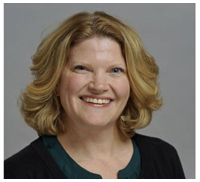
Alison Shea: M.Ed. is a fourth-generation educator
Alison Shea, M.Ed. is a fourth-generation educator whose path in learning and talent
development was less a choice and more a calling she couldn’t, and wouldn’t, outrun. With a career that spans classrooms, boardrooms, and global learning ecosystems, Alison has led transformative work across every facet of Learning and Talent Development.
She began as a classroom teacher and instructional designer, ultimately evolving into a leader of custom learning solutions for global financial institutions and a U.S. financial regulator. At State Street, she helped steer large-scale organizational transformation through strategic learning, talent development, and Diversity, Equity, Inclusion, and Belonging (DEIB) initiatives.
She later joined a high-growth tech startup, where she built global learning and DEIB programs that spanned five continents.
Today, Alison focuses on helping organizations scale sustainably, merging human-centered learning design with AI-enabled tools that drive clarity, culture, and business outcomes. An award-winning workshop facilitator and sought-after speaker, she is known for translating
complexity into clarity and designing learning that sticks.
She holds a Master’s in Curriculum and Instructional Technology and is the voice behind The Learning Manifesto , a blog exploring the future of learning, leadership, and inclusion. Deeply committed to mentorship and community, Alison brings generosity, grit, and a sense of purpose to everything she builds, and to everyone she helps grow.
Michael Noble
Welcome to another episode of the Learner Experience Evolution. I’m Michael Noble, EVP of AllenComm Advisory, and I will be your host for this episode. Today’s guest is Alison Shea. We’re very excited to have Alison with us. Alison’s a senior learning leader. She’s worked for several organizations, including State Street and others. We’ll have her tell us a little about her background in just a bit. We at AllenComm met Alison just a couple of months ago.
She was one of our first members for Learning Leader Connect, which is a networking and collaboration group started by our CEO. Anyway, let’s get started. Welcome, Alison. Tell us a little bit about your background, the work that you do, maybe some of the roles in industries in which you’ve worked.
Alison Shea
Sure. So I like to say that I couldn’t fight my destiny kicking and screaming. I am a fourth generation educator. My mother was a teacher. My grandmother taught in a one room schoolhouse. Like it goes back quite a bit. And everything I’ve ever done, there has been an element of teaching.
And so everything from kindergarten to college, before I climbed my way into the corporate world, I say that with a little bit of a nod and a wink because after teaching first grade, I started teaching rock climbing because I’m afraid of heights. I taught a Chief Learning Officer how to rock climb, and we started chit chatting. It turned out that he was also a professor. When I heard the name of the class he was teaching, it was something like… this is going to show you how long ago it was, it was like “The Internet for Educators” or something like that. And I said, that sounds like a class I’d take.
I’m getting my master’s in curriculum and instructional technology. And then he told me that he was a Chief Learning Officer and said, “Do you want a job?” And I was like, yeah, okay. So I wound up getting this job in corporate America, and it was at a time where we were in a time of really great change, as learning the way it was done in companies was radically shifting with this technological revolution that was coming in, with this crazy thing called, you know, virtual technology and virtual learning, right? Which then ultimately became eLearning and then other things from there.
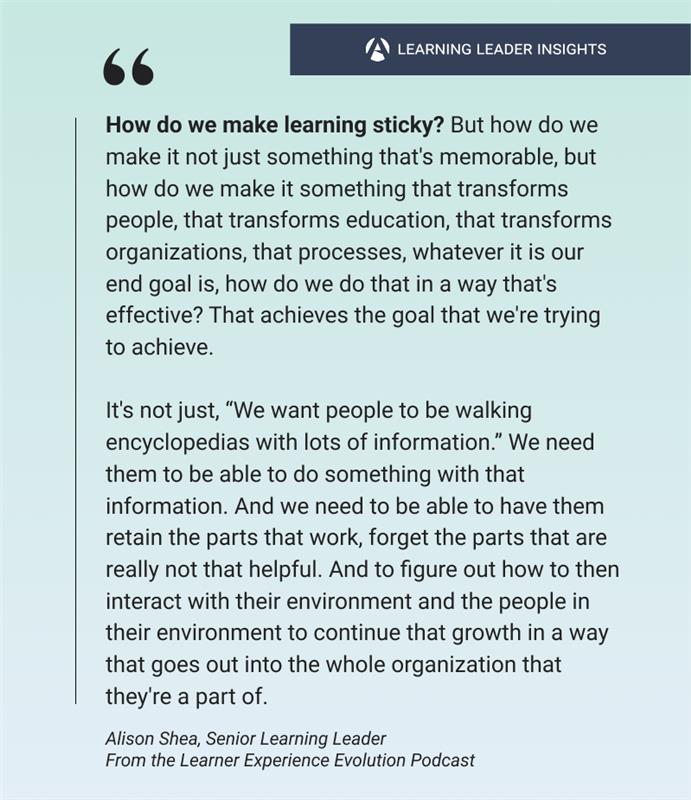
So I think that the piece about that that was so exciting to me was I have always been motivated to find the better mouse trap. Or I guess the brain trap in this case, right? Like how do we make learning sticky? But how do we make it not just something that’s memorable, but how do we make it something that transforms people, that transforms education, that transforms organizations, that processes, whatever it is our end goal is, how do we do that in a way that’s effective? That achieves the goal that we’re trying to achieve.
It’s not just, “We want people to be walking encyclopedias with lots of information.” We need them to be able to do something with that information. And we need to be able to have them retain the parts that work, forget the parts that are really not that helpful, right? And to figure out how to then interact with their environment and the people in their environment to continue that growth in a way that goes out into the whole organization that they’re a part of.
I want them to be able to do these things with joy. I want learning to be a catalyst. I love to share, not scare, in life. But I think sometimes learning really does involve a little bit of scaring in the beginning, especially in times of great change.
And it turns out that one of the main themes throughout my career has been sort of like arriving on scene almost as a first responder for times when we are shifting. We are shifting from an old way of doing things that isn’t really working anymore. We know we’re going over here. We know the future is that way, but we have really no idea how we’re getting there. We don’t know what tools we’re going to need in our toolbox once we get there.
And really helping humans to get from here to there in a way that is focused on growth, that is focused on being able to understand and measure what’s effective even before we know what our measurement unit is going to be because we’re creating it at the same time we’re trying to measure it. And really being able to manage the fact that humans are not bits and bytes. We
behave like machines sometimes, but we’re not. We have these things called feelings. And unless we address that as part of any growth, or change, or transformation, or learning initiatives, whatever words we want to call this process of going from the here and the now to the there we need to be in the future, we have to address that.
And we have to, I think, especially now, in the world of AI, right? This is so fascinating because if we look at how AI functions, and how computers function, and how humans function, it’s not that we’re the same, but it’s also not that we’re totally different. We have these components to both that perform the same function.
So think about humans. Humans flinch. AI’s glitch. It’s kind of the same thing. And so where’s the corollary? When we look at how we learn, how we learn isn’t necessarily different, although the tools are different, the environment is different, the expectations are different, all of that. But we have kind of the same way that we do it. And anyway, I could go on about this for years.
Michael Noble
Yeah, thank you. I mean, thank you very much for not only the great origin story, but also for your philosophy. It segues really nicely into our topic today. Most of our listeners know our focus is change in learning and development.
One of the things you mentioned is you happened to move into the industry during a period when, yeah, there’s a lot of change going on. We’ve been lucky that has been an extended digital transformation of learning, and not even just in the corporate space, but all of education, how we think of education and whether it’s a crisis or whether it’s an opportunity, there’s a lot there.
I think your philosophy and your approach, that’s one of the things that I would like to get into a little bit. Tell us a little bit about the status quo and how you got to that future state or maybe even how you formed some of your philosophy about change. Let’s slide into an example if you’ve got one.
Alison Shea
So I found this bumper sticker a long time ago when we used to do things like that, right? And it said, change is inevitable, growth is optional. And that has been a main theme throughout my life because we are constantly handed change all the time, like even the weather changes. But what we then do with it, that’s what makes the difference. And so especially in times of great technological change, that’s going to change the needs of how people function.
So I actually started college when I was in high school. By the time I graduated from high school, I was like a second semester sophomore at Binghamton University. And I majored in English and creative writing with a specialization in poetry, Southern fiction, and children’s literature, and a minor in cultural anthropology. So I like to say that it’s like I was allergic to getting a job upon graduation.
But what it did give me was, oh, and I also took classes that had nothing to do with anything other than satisfying my curiosity, you know? Which I feel really grateful that I was of a generation where that’s what we did in education. We didn’t start specializing when we were really, really young with the thing we were sure we wanted to do. Because the thing I was sure I wanted to do changed for a long time. And still until finding this career where there was enough change within what was needed to do my job, that it satisfied that desire to be constantly growing and trying new things.
I mean, I was a kid who used to assign myself research projects over the summer, not just because I was a nerd, which I was, but also because I was just insatiably curious about everything and everyone and super nosy, you know? And I think that because of that personality trait, I have had an experience in my corporate career where if there was a change initiative going on, sooner or later, somebody was like, “Hey, why don’t we put Alison on that?” Probably because I was standing by the door being like, need any help? What you got going on there? You know, just nosy about what was coming in terms of the change.
I think one of the things that’s so important to me about that saying that change is inevitable, growth is optional, is that we often have these initiatives where we’re changing things, but it feels like we’re changing things because we feel like the living room needs redecorating, not because we’re actually pointing towards a new direction with an idea and a goal in mind of what the future will look like and why it’s worth the pain of the change.
And so one of those pieces is just frenetic. The other piece is really strategic and intentional. I think that that really gets to… not just my philosophy of learning, but also my philosophy of AI and learning, but all of my philosophical foundations about why we do what we do and how we should do it well. And I don’t think that we need to always know exactly where we need to go, especially with some of the things that we’re doing now. But we do need to know how we’re going to set up a data feedback loop for the changes that we’re making.
Because we’re in the situation right now where what we can do is growing so quickly. We’re finding that things that would take us a month to do a year ago, suddenly we can do that in an afternoon. And so what does that mean? And one of the things I was really afraid about in the beginning of the sort of AI revolution within learning was that it would allow us to make more terrible learning faster. And we saw that for a while, right? We saw that too when like PowerPoint started being what we called learning in many organizations. It’s like, we’ve got a training on that. And it’s like, no, you’ve got an ill-conceived PowerPoint with pretty pictures. That’s not training my friends.
I think that we walk this line between pretty and effective. And we walk the line between easy and something that actually works. And so that’s where I really, really love the work of Will Thalheimer and LTEM and other measures of whether or not this learning is effective. And being able to parse out what does effective mean? What does knowledge acquisition mean in the context of that person’s job, right?
Think about how many roles we have, where somebody can have all of the like, technical manual information, they would pass every test at like 120%. They got the knowledge. But what they don’t have is the ability to implement that knowledge talking to humans. Like working in an environment that doesn’t always function like a model, right? When suddenly there are things coming in and there’s, you know, being an accountant and being a firefighter in a forest fire are two entirely different jobs. And you probably need really different skills for either one of those jobs. How do we parse out what skills you need and what’s the right methodology, modality, like all of those things.
So, so often it’s not about good or bad, though we’re often shoved into corners fighting over whether something’s good or bad. When really it’s just a matter of, you know, a swimsuit and a raincoat are both outfits to deal with water, but they’re not for the same function. And we have to think about that with our learning design, but even more important now when data rules our world.
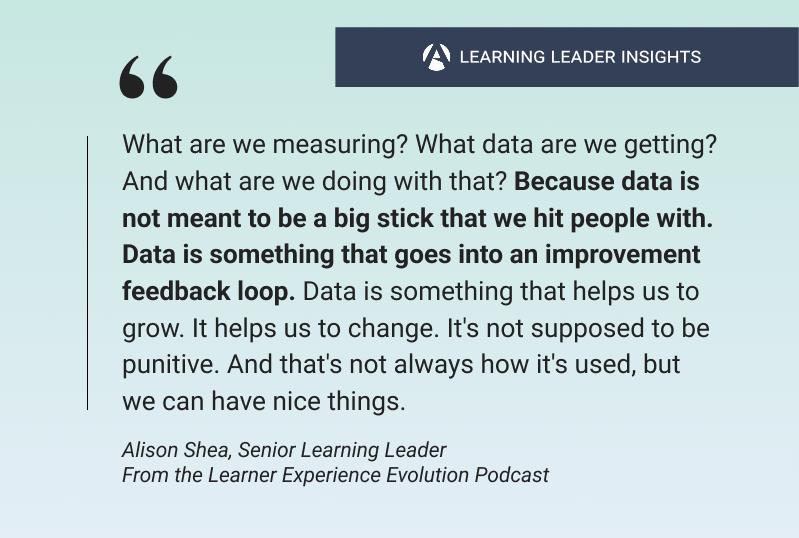
We have to think about that with our evaluations. And I don’t mean like, did you like it? I mean, like, what are we measuring? What data are we getting? And what are we doing with that? Because data is not meant to be a big stick that we hit people with. Data is something that goes into an improvement feedback loop. Data is something that helps us to grow. It helps us to change. It’s not supposed to be punitive. And that’s not always how it’s used, but we can have nice things.
Michael Noble
Yeah. So I’m going to insert a promo moment, just because you mentioned Will Thalheimer and he’s been a guest on our podcast. So listeners, go back to some of our early episodes. You can check out the podcast with Will. The other thing I wanted to just mention, you had talked a little bit about, you know, we’re so surrounded by change, but a lot of that change is low stakes furniture shuffling sort of change, and I think we recognize that it’s urgency.
But let’s talk about change with a capital C. Maybe you could share an example of the type of change that was truly a transformation, and tell us a little bit about how you approached it. I know you’re a super positive person, that’s clear, but maybe where it was a little intimidating, maybe you weren’t sure of success. Maybe you could share an example of one of those big, hey, this is kind of a… this is a little bit different than the furniture shuffling we get so much of.
Alison Shea
Yeah, I have a really good one for you. And it’s funny because now the idea of teaching this feels like, why would you need to do that, right? But cast your mind back before the pandemic. How many people were having, you know, Webexes and Zooms? Was Zoom allowed in corporate America? We’re lazy in the day, you know. But whatever the virtual platform you were using, it was a way to share slideshows. It was a way where you might have the person talking be on camera, but it was not being used the way we use it today.
I am like, again a bit of a nerd when it comes to this stuff, and so I had done a lot of work in terms of virtual learning, and my thesis actually when I got my master’s degree was could you use the same learning philosophy to develop an in-person class and an online class. Now you have to understand this is very long time ago where dinosaurs were roaming the Earth with their very heavy rock laptops, right? So the technology was not there. An online course back then was like a bulletin board that people wrote to. Like it was really, you know, this is not entirely true, but it was not what it is today with all of the options.
But the idea was, could you develop materials for both modalities using the same basic philosophy? If you equalized the how you were going to do it to meet the same tenants of that philosophy for the same content, that you could achieve the same outcomes. And so basically that was kind of my research there. Very small scale. Don’t look it up. It’s not worth it because everything’s changed since then. But that mechanism still holds true. We have to plan how we’re going to do this.
OK, flash forward. 2020, March happens, things are going crazy. And I’m working for State Street at the time. So we have this global organization. We’ve got… normally we were meeting in person, leaders are flying around. We have all of these big initiatives. We’re in the middle of a transformation initiative that we were working with a consulting firm, lots of big things happening. And the pandemic hits and everybody shuts down and we’ve got Webex and that’s our platform.
But like, how are we going to do what we do, business as usual, in this new way? I was a leader for one of our ERGs or BRGs, right? And I was very involved with a lot of the other ERGs and BRGs and I knew how to do this. I started doing these like sessions of how to do some of these things online. It started almost like a little bit of a side gig, right? Like just volunteering because I saw the need and I wound up basically training people on how to use this tool to get to that space of… this is how you used to do it in the office and this is how you can do it on this tool using the different features and things like that.
Now, today, we don’t even think of that as something that you would need to teach because like, you know, kindergartners are doing it. We actually had a new baby during that time in our family and like, she thought her grandparents lived in the computer for the longest time and was so surprised when she actually met them in person that they were three-dimensional. So it was a very, very different time.
But it was something that then… I was able to take the fact that we had built this skill set so rapidly among a much larger percentage of our population that it helped us to boost our working online. And so then from there, I was able to turn that into a component in many of our formal learning programs, but also teaching that skill of how you have to stop and do that planning piece for the work you’re going to do online.
Now you do it, you say, okay, we’re going to do this as part of the virtual. But the reality is it’s actually a really good step for everything we’re doing. And so the backdoor way to make a big change to how we were working in a way that made it better because it made it more intentional, and it gave us a moment to really work through how we would work.
I think sometimes that’s the benefit of a change that is sort of voiced upon you with a time imperative because everything has changed. Now we don’t always get the benefit of a global pandemic to help us to force that urgency. But I think whatever you do, wherever you’re working, anytime you see a way that you can tag onto something big that’s happening globally, and add a skill building piece to it, it’s like going in through the back door, right?
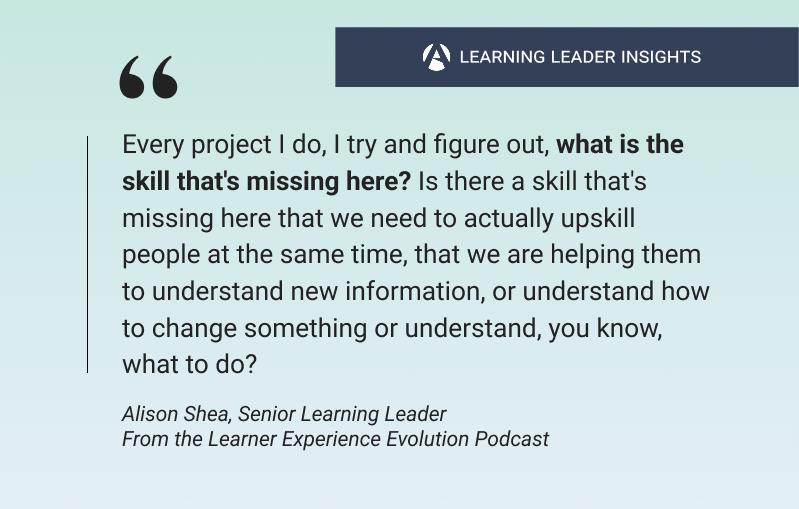
And so I think that’s one of the things that I’ve tried to do is every big change… who am I kidding? Every project I do, I try and figure out like, what is the skill that’s missing here? Is there a skill that’s missing here that we need to actually upskill people at the same time, that we are helping them to understand new information, or understand how to change something or understand, you know, what to do?
We have to look for those sort of low hanging fruit moments where you can glom onto either someone else’s initiative or something that has a higher status of elevation of like, this is important, and figure out how you then also bring the learning piece in there. Because I think a lot of what we should be doing in our organizations is kind of like the campsite rule, right? You want to leave it better than you found it for humans and for organizations.
And so that’s, I think, the role that we have because so often L&D people, we have our hands in many pots, and we have the ability to sort of move through organizations in a way where we’re not in our swim lanes. In fact, we’re inviting others into the pool to have fun, but we really need to make sure that we’re safe, and we’re thinking about reapplying sunscreen, and we’re thinking about is there thunder, right? Like we have to really think about our safety, our practices, but also what’s it going to look like in a month? What’s it going to look like in a year? Are we on the track to get there?
Michael Noble
Now, you mentioned a little bit your background in the financial industry. Of course, any industry is going to say change is difficult. My own personal experience is that yes, but it’s exponentially more challenging and more complex in the financial industry because it’s a regulated industry, because of the scale. There are several reasons for that. It’s a great case study for change in some ways in the financial industry because it is a strategic thing and it is harder to do that kind of back door individual initiative kind of change.
Just pulling on your experience in the financial industry, what other tips or tricks would you provide when you’re like, you’re in an environment where change is difficult? Some setbacks? You know, how do you create an agile change process that can duck and weave?
Alison Shea
First of all, you have to understand your environment, right? So I first started in corporate America, you know, basically in a service function within financial services. Now at the time, I had been teaching rock climbing. I did not… I didn’t know the difference between a 401k and a 403b and a hole in the wall. Like I had no idea and I had to learn all of these things.
But I think one of the benefits of coming into it focused on learning sort of like the regulatory schema is that it gave me this sense of where the walls and the rules were and those bumpers to make sure my bowling ball didn’t wind up in the gutter before I’d even had a chance to play the game. And I think that that’s something that if you find yourself in a new industry… I do like to jump industries because I love, well, again, learning nerd, I love to learn all these new things that I didn’t have a need to learn before. But I think one of the things to pay attention to is what are those guardrails? Because if you have any kind of regulatory required whatever within your organization, you already have an opportunity to build on that.
And what I mean by that is that in every company basically, there are going to be some things that you have to do because you have to do them, because there’s a rule, or a regulation, or a practice, or whatever. But that doesn’t mean it has to be boring. And that doesn’t mean that it has to be check the box, right?
It’s also because so much of that aspect of learning in organizations, which really is often not, it’s usually bad and it’s usually torture. But what that means is that you can make it better than it is and people will be happy. But imagine if you could make it amazing, and imagine if you could make it like a trap door into not only making sure your organization is safer because people are actually listening and understanding what you’re trying to tell them, but what if you could use that as really the fertile ground to plant those seeds for how people can, you know, go from there or grow from there, really, right?
And so I think that, you know, I’m always looking for the have to do’s, because nobody often likes the have to do’s, because very often the have to do’s are badly done, right? It’s not always true. I’ve seen some amazing stuff. Amazing compliance courses that you were like really immersed and you wanted to know what happened and you felt like empowered to do it. That absolutely exists. But that’s not what I have seen, as the majority of what happens when it is a, you know, need to do, check the box, blah, blah, blah… Everybody’s gotta sign off. So I think that’s a really great place to start.
If you’re in an organization where there’s not a lot of… social cache, I don’t know exactly what the term is, where like, sometimes we go to organizations and learning has a bad name within the organization. And sometimes it’s earned its bad name within the organization, maybe because it was not empowered, maybe because the people doing learning were not actually people who had any training or understanding of what good learning was.
I mean, think of how many organizations, they’re like, “We need training on XYZ,” and they like look around and there’s like one person standing there who didn’t realize they were talking about something, and they’re like, “You, okay, you’ve voluntold you’re going to do this,” right? And that person after 10 years of making a terrible PowerPoint and calling it training believes that they’re a training expert, and they don’t hire people who actually have an expertise in that because then they might be found out to be the emperor with no clothes. And so it just gets worse.
That is not training everywhere, but that is what training is in some places. And so any time you have an opportunity to glom onto something that has to be done and make it better, you immediately have a pipeline to begin to show people a whole new world. I feel like there’s a Broadway song that needs to accompany this happening. But I think that is a great place to start.
Michael Noble
Our time is almost up, but I want to squeeze in one more question, if I can. You’ve mentioned that you’re a learning nerd. I want to hear what you are learning next. What’s next for you in terms of your own learning journey? What do you want to know more about? What are you learning right now?
Alison Shea
Well, I’ve been doing a lot with AI, and not just because companies have a real need right now to understand what is AI in learning? How are we using it? And I think at first, of course, the focus was on how do we use it to produce learning? But I think really the magic there is not just in the learning itself. It’s in the data feedback loop. It’s in making this learning be responsive to us individually, right? I think that’s really key.
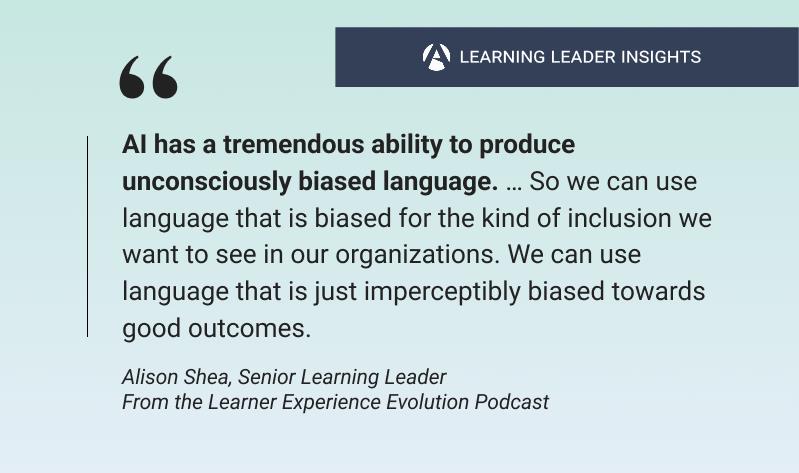
And then the other thing that AI can do so effectively… now, this is one of those things, like many technologies accomplish things for good or for bad. It’s a matter of which way you point it, right? And AI has a tremendous ability to produce unconsciously biased language. Now, that is something we can use for good or evil. So we can use language that is biased for the kind of inclusion we want to see in our organizations. We can use language that is just imperceptibly biased towards good outcomes. It’s fascinating stuff. And we’ve got the ability to just within microseconds to get the content written to different focuses, different groups.
So the personalization is not just like, “Today is a great day, Michael.” “Michael, today we will do that.” I mean, remember what personalization used to be? It used to be like every so often your name would be inserted. That’s not personalization, that’s like labeling. But we now have an ability to move towards that really quickly.
The other thing about the AI and what it offers to us is it offers to us the ability to recognize when we’re headed in the wrong direction and course correct faster. But the only way we’re going to be able to do that is if we’ve set up appropriate measurements. And what are we measuring? We now have the ability to measure so many things at the same time, but we have the ability to use AI to focus that in a way that our human brains can then make decisions about it. And I think really there’s going to be an exciting partnership with AI and with human brains who can look at the same two things.
And remember, I think so many of the things that we’re doing, they’re corollary. They’re not that different, but we have different speeds of which we can do it. We need to have checks and balances on all of these things. Humans need checks and balances. Otherwise we wind up with bad PowerPoint as learning. And AI needs checks and balances. Otherwise, sometimes we wind up with hallucinations passing as fact, and they’re not, you know? And so I think that’s really a great new area.
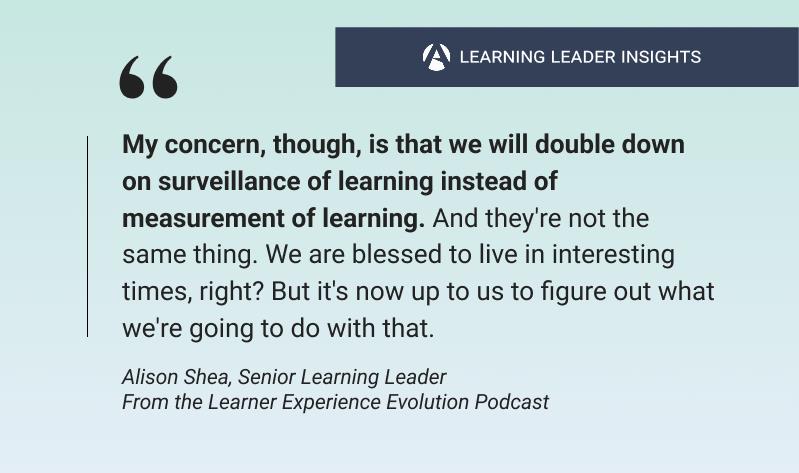
The other thing too is the portability of learning, but the portability in a way where it becomes a much more interactive experience. And that interactive experience is feeding measurement. My concern, though, is that we will double down on surveillance of learning instead of measurement of learning. And they’re not the same thing. We are blessed to live in interesting times. But it’s now up to us to figure out what we’re going to do with that.
And so I am finding like, I am programming chat bots to deal with specific needs, both like you know, in the corporate world and at home. Like there is a way to make a chat bot that helps you with your menu planning. There are all of these things that are specific to each individual human that we can then do. And it really is an offshoot of learning and you know, see one, do one, teach one, right?
Michael Noble
Well, I love both your vision and your call to action there. So thank you very much for sharing your time and expertise with us. I hope you’ll join us again in the future. Listeners, thank you for tuning in. Please tell your friends about us. And please drop us a line at info@allencomm.com if you have ideas or questions for our show. Thanks, Alison.
Alison Shea
Thank you so much, Michael.
Resources For L&D Leaders
free guide
free guide
insights | on the blog
ALLENCOMM Press Releases
AllenComm Earns Spot on Best Mobile Learning Content Providers 2026 List
eLearning Industry honors AllenComm for its custom mobile learning solutions for enterprise, built to improve performance outcomes at scale. SALT LAKE CITY, [July 29, 2026] — AllenComm has been named to eLearning Industry’s...
ALLENCOMM Press Releases
AllenComm Named a Top Employee Engagement Training Provider by eLearning Industry
AllenComm has been recognized by eLearning Industry as a 2026 top provider for employee engagement, cited for scalable, personalized L&D that drives measurable results. SALT LAKE CITY, [June 24, 2026]...
ALLENCOMM Press Releases