

ALLENCOMM BLOG | Podcast
Episode 20: Using AI & Data-Driven Strategies for Growth & Leadership Development
June 3, 2025
What’s the secret to getting buy in and other support (so you don’t have to do it all yourself)? Michael Noble and Amanda Myton, Head of Learning and Development at Snowflake, discuss how AI and data-driven strategies can help. Especially today, when L&D teams are smaller than ever—but the asks have only gotten larger—being able to customize training and collaborate effectively across teams is critical to making your next initiative a success.
Top Takeaways
- The team is building a leadership foundation with a people leader code.
- AI is being used to identify and level skills effectively.
- Organizational culture must be co-built, not just top-down.
- Building modular training programs allows for flexibility and reuse.
- Collaboration with stakeholders is crucial for success.
- Generative AI accelerates the creation of customized learning content.
- The future of learning involves creating tools for learners to develop themselves.
- Mentorship matching is being prototyped to enhance career development.
- The shift from traditional training models to more agile approaches is essential.

Amanda Myton: Head of Learning & Development, Snowflake
Amanda leads learning and development at Snowflake, with 15+ years of expertise in people strategy across diverse tech companies. She has a strong background in designing impactful programs for performance management, talent development, and employee engagement. Previously, Amanda was Director of People Strategy at Lattice and held leadership roles at Ironclad and Anaplan.
Michael Noble
Welcome to another episode of the Learner Experience Evolution. I’m Michael Noble, Vice President of AllenComm Advisory, and I will be your host for this episode. Today’s guest is Amanda Myton. We’re very excited to have Amanda with us.
Amanda’s the Head of Learning and Development at Snowflake. We’ll have her tell us about that in just a minute. We at AllenComm met Amanda a couple of months ago. She was one of our first members for Learning Leader Connect, which is a networking and collaboration group started by our CEO.
So anyway, let’s get started. Welcome, Amanda.
Amanda Myton
Yeah, thank you. Thank you for having me.
Michael Noble
Why don’t you tell us a little bit about your role and the industry in which you work?
Amanda Myton
I’m Amanda Myton, and I lead global learning and development at Snowflake. Snowflake is an AI platform, right? So kind of this big warehouse where organizations can bring together all of their data sources and work through how we make it meaningful, how you explore, share, and unlock the power of that data. For me as a learning person, this is a really exciting place to be because it’s one of the first times where we’re really starting to figure out how we bring all of our learning touch points better into our data ecosystem. So it’s a really unique place to do that.
I own, like I said, enterprise-wide globally, we have about 8,000 employees around the world. And that’s everything from manager and leadership training, to enablement on our broader programs like performance, and into things like onboarding and skills development.
Michael Noble
Fun, fun. I think that’s going to lead to a really interesting conversation just because I think a lot of us have been looking at AI. We’re kind of in this wave of AI where everyone’s like… the novelty of the technology and the reality of the data strategy hasn’t quite kicked in yet.
And yet, I think there’s a huge opportunity for us there in that whether you think of it as data or content curation, or design engineering, whatever name we’re going to end up giving that work, but it’s exciting work. It’s an exciting change. And that’s our focus of our podcast is change.
I’d love to hear a change story. It doesn’t have to be about AI. It can be anything that might tell us a little bit about your approach to change. And I’m wondering if you could maybe have an example you could share.
Amanda Myton
Yeah, for sure. I’m going to go back a little bit and I’m going to share a story from a previous tech company. We had been at a moment, like a real inflection point. We had been without a CEO for about a year. A new CEO had joined. We had a new Chief People Officer. It was our first time having a Chief People Officer. And we, in the meantime, had still been growing really, really fast.
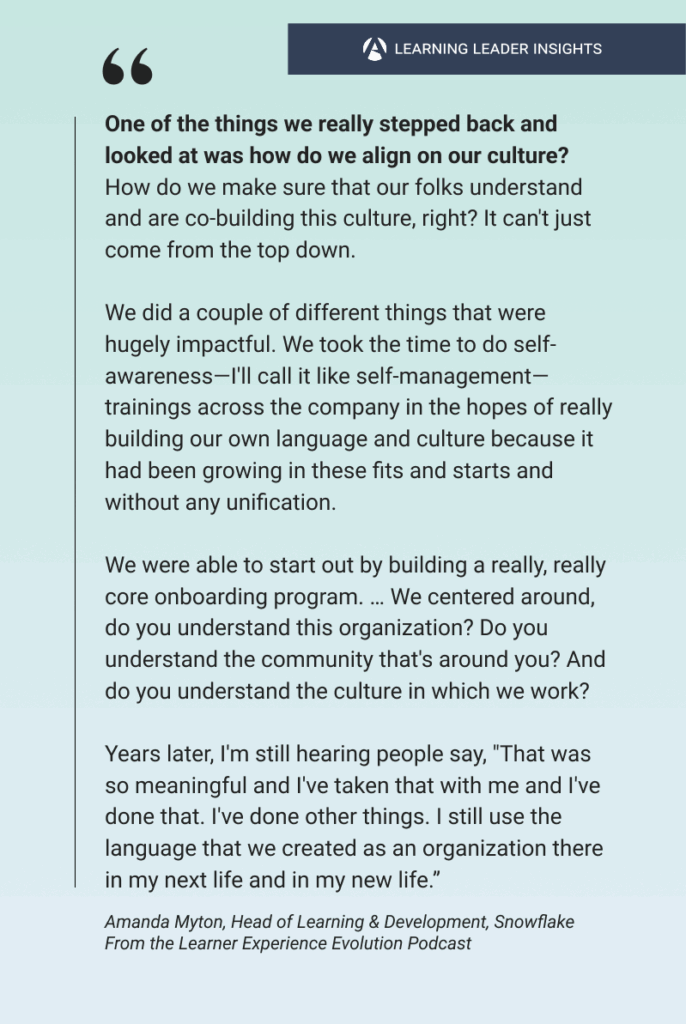
And so you can imagine there’s just sort of all of this flux. One of the things we really stepped back and looked at was how do we align on our culture? How do we make sure that our folks understand and are co-building this culture, right? It can’t just come from the top down.
We did a couple of different things that were hugely impactful. We took the time to do self-awareness—I’ll call it like self-management—trainings across the company in the hopes of really building our own language and culture because it had been growing in these fits and starts and without any unification. And I had the pleasure of leading that. It was amazing.
We were able to start out by building a really, really core onboarding program. And then we were able to actually parlay that into like a re-onboarding for everyone who had been there who didn’t get to do that work. We centered around, do you understand this organization, right? Do you understand the community that’s around you? And do you understand the culture in which we work? Absolutely incredible.
I’m several years away from this now and I still get people who message me on LinkedIn and different things and say, “When we did that, that was absolutely like a change point.” And it really… we were working in a magical time in that space. I got to know my colleagues in a way I never could have. We were able to build in these amazing feedback programs where we actually were generating thousands of feedback points a quarter amongst people. Like just being able to do that, build that.
And then years later, I’m still hearing people say, “That was so meaningful and I’ve taken that with me and I’ve done that. I’ve done other things. I still use the language that we created as an organization there in my next life and in my new life,” and on and on and on.
I think when we said we have to start with rebuilding our organization’s culture, because if we have a really strong culture, then we can survive all of this like crazy change. And we did that, you know, from there we went on and continued growing, we IPO’d right after that, etc. So just really, really a big organizational-wide change.
Michael Noble
You know, it occurs to me listening to you share that one of the unique things about high tech is because of how the investment’s funded, because of the rapid growth, because of how it scales, it really is different from a learning and development standpoint in terms of like… there’s this moment where suddenly something that was not funded or paid attention to or anything, suddenly out of the blue becomes critical.
Amanda Myton
Yes, priority number one, right?
Michael Noble
And because I’ve seen that with some of our clients too where it’s like, okay, now you’re moving out of the founder, you know, innovation in the garage and scaling at such a rapid pace. How do you maintain who you are? And, you know, things like culture training, onboarding, those kinds of things are doing something. Well, in some ways, it’s just more intentional than maybe a traditional growth pattern of where we had something and then it’s a little bit more sophisticated, it’s a little bit more iterative, whereas in high tech, it almost kind of comes out of, you know…
Amanda Myton
Necessity and a constant, right? One of the things I didn’t mention is I’ve spent most of my career in the high tech space, in SaaS, in startups and scale ups. And the number one thing there is it is always changing. When you’re doubling the size of your organization, year over year, when you’re doubling your AR, those things are huge, huge drivers of change and huge constants. The leadership that you have at a startup phase is really different than the leadership that you’ll be bringing in when you move into that scale up phase.
How do you, as a learning and development or the talent development professional, help those folks decide? How do I get to that next level? Can I lead at that next level? Do I want to lead at that next level? Is the other really critical inflection point in tech. Because there are people who love that one phase of growth and not another. And that’s okay too.
Michael Noble
So in terms of getting something off the ground like this, one of these pretty enterprise-wide change in a culture where we’re not replacing something. This is new. What were some of the challenges that you faced or some of the key milestones? You’ve talked about a little bit of that from the learner journey and the people in the organization, there’s probably some crossover there. But as a learning leader, did you face any moments where, okay, I wasn’t expecting to have to build this business case or wow, this is much easier than I thought it was going to be. I mean, what were some of those moments?
Amanda Myton
I might actually fast forward a little bit here because one of the reasons I actually joined Snowflake is where we are and the sort of challenge that we’re dealing with in change too, right? So really exciting organization leading in the AI space, but also an organization that didn’t have any kind of L&D focus prior to my joining. They’ve never had an enterprise-wide learning and development leader. You’ve got sales enablement, yep. You’ve got some departmental pieces, but nobody talking about it at that level.
So when you come into an organization that’s this size and they don’t have any of that infrastructure, I was like, yes, please let me try to solve this problem. I have worked on this at really small and I’ve grown it, but I was like, but I’ve never said, okay, let’s try it. And so I’m very much in this phase of like, thinking about how we bring about this organizational change in a large organization with a really small team.
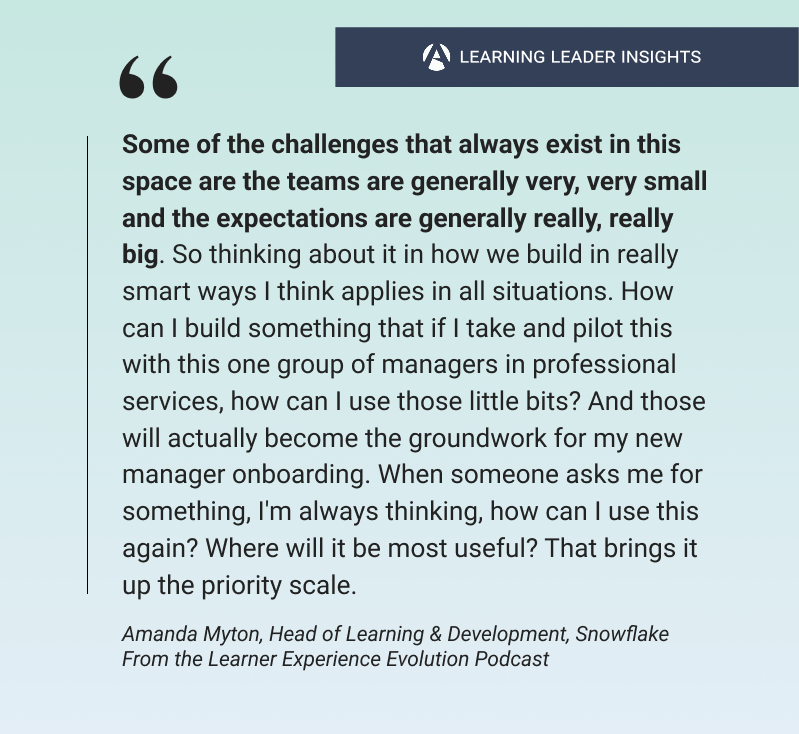
Some of the challenges that always exist in this space are the teams are generally very, very small and the expectations are generally really, really big. I think about that in a couple of ways. At the moment, these folks don’t have a lot of learning available to them. So anything we’re bringing, folks are like, this is interesting. Tell me more. They’re not necessarily committed and we’re not leading from the top down. This isn’t a place where, you know, someone says, “We’re going to do this big initiative.” We’re still at very much a grassroots level.
So thinking about it in how we build in really smart ways I think applies in all situations. I’m building things that are extremely modular. How can I build something that if I take and pilot this with this one group of managers in professional services, how can I use those little bits? And those will actually become the groundwork for my new manager onboarding. So nothing is ever sort of like… when someone asks me for something, I’m always thinking, how can I use this again? Where will it be most useful? That brings it up the priority scale.
And the other thing is when someone comes to me and says, can we? I say, great, which role do you want to play? Right? So I have a lot of times HR business partners coming to me saying like, we want to do an engineering communications intensive. Cool. That sounds really fun to build. And that’ll be some great groundwork. But also I can’t run the administration of that. Do you have an EA who can come in and they know the players, they know where the rooms are? They know all of these things I don’t necessarily have context for? I’ve had really good success with that.
I think next, as our programs get a little more mature, that next phase will look like train the trainer and scaling through some of our global partners. But I’m always thinking about those two things. How can I reuse this? And who can I get to help me? Because when you work in an environment with high expectations of speed too, my goodness, we wanted this yesterday.
So really just trying to make sure I’m balancing and prioritizing and getting those things right out because you’re right. I never know exactly what that thing’s going to be that is the immediate focus and priority. But if I’m being smart, and building in chunked ways, and really paying attention, I probably have something we can build upon. So I’m not starting from zero.
Michael Noble
Well, and I think there is a good takeaway in the idea that your capacity might be bigger than you think if you have a small team. By forging some of those alliances with your stakeholders, yeah, they want this to succeed as well. They want this as well. And yeah, they can commit some time and some resources to that and thinking through, okay, I’ve got my team, but I’ve also got the extended team. I’ve got relationships with partners and vendors and everything in that capacity. And the expertise available to me is probably bigger maybe than it looks like when I’m facing one of those changes.
Amanda Myton
I always tell folks too, like when you’re facing… you know, I’ve got so much ground to cover. Again, that’s part of why I joined. But also that means I kind of get to choose where I begin. And for me, I want to go where that love is. I want to go where the people are like, yes, I want to do this. Yes, I want to be a part of this. Yes, I’ll help you build it. That’s going to make it more successful. And if I can build some successful programs, then we can start to replicate, scale, customize, et cetera.
And I’m very frank with my partners, I tell them, “Hey, we’re going to build this. And I want you to know, I’m looking at this as about 80% has to apply to anyone in the organization or pretty broadly.” I said, “In that top 20%, I want that to be where you really bring your expertise.” And just being really specific with those asks of my partners and stakeholders, it makes the relationship function so, so much better.
I have tried working the other way. I’ve tried saying, “Here’s what we’ve said we needed. Here’s the needs analysis I did.” That is a really hard way to work. I was stressed out. I felt like I was always engaged in some kind of Sisyphean task, like holding this boulder or pushing it up a hill. And here I’m like, okay, well, we can do this. And it’s not that it’s not going to be hard and it’s still going to be a lot of work, but also I think we’re all going to feel really rallied around this point. And that’s so, that’s just a much better place to operate from.
Michael Noble
And your philosophy on like looking for the opportunities for reuse, it actually is underlying that other part about people as well because these are relationships that you’re investing in. Beyond just pushing the stone up the hill, it’s more like Atlas holding up the whole enterprise, right?
Amanda Myton
Only you get a whole bunch of other people with at least one finger on the globe, then you know like it’s not just me.
Michael Noble
I think that reuse is so… people were not using them as relationships we’re investing in, but with the content and the reuse, like okay, I can do this now, but it can be in these different modalities, with this different design, and also now AI has expanded the use case for that expertise or made it easier to do some of the things that we’ve wanted to do, right?
Amanda Myton
Yeah, no kidding. I’ll jump ahead a little bit here maybe, but I could not be working at the pace that I am working today, and we could not be producing the type of customization and quality that we’re getting to without generative AI.
So we’re doing things where I can say like, great, here’s the core content. And now I want to create use cases. If you lived in the training and development space and learning development space 10 years ago, creating a use case or like a business scenario or simulation was like the worst task, right? You feel like you don’t have enough skills. Nobody in the business has time.
Those we’re generating so much faster. And then I can say to my stakeholders, Hey, let’s review this and like, let’s tweak and we can roll. Not only can I make it faster, but the level of customization is so much higher.
We did some work this week on feedback, and I was working with managers to think about how they actually broadly source and synthesize feedback, not just from one-on-one, but how do you get feedback as you’re reading maybe messages people wrote in Slack or from project closeout reports and those sorts of things.
And so we generated a whole bunch of that stuff, and gave it to the managers and said, okay, how are you going to deal with this? And they had these amazing conversations. Some of them actually then, very meta, they went back to generative AI and said, what are some themes we might be seeing here? But the level and the quality of the conversation was so much higher than if I had had to use generic prompts or generic polls or generic feedback because it was very, very real and it was customized to job descriptions that I know those managers teach or lead.
Michael Noble
This is definitely taking us to kind of where we are in this moment and looking ahead at like what’s possible for us. The past couple of years have been interesting, but what’s really interesting at this point in time is we’re starting to move past the possibilities into some of the realities. I’m wondering, as you look at your change roadmap of what you’ve got near term, you know, as you look ahead at some of that change, maybe you could bridge the kind of lessons learned with what you have ahead? And what do you think is going to be critical going forward?
Amanda Myton
Yeah. I think, you know, like, when I started my career, I worked in a place that like used full like ADDIE Model training, like the time to develop was so long and it was so thorough and so like perfected and practiced and field tested before anything went out.
And over my career, I’ve seen that start to shift. We’ve moved from having a lot of instructional designers and facilitators to this new role of like a program manager and kind of this all-in-one thinking about how you own something and really create it. And I think there’s a really interesting place for that to develop and continue decentralizing.
So what can I build as an infrastructure for your learning that is maybe… I’ll tell you one of the things that we’re kind of working on right now, because I think it could become even cooler as the tech gets better and as we get better at leveraging it. But, you know, career development is always huge, right? Especially in tech. And we’re working with our, well, I’m working on a course right now to take some materials about like building a career roadmap. And actually we’re transitioning them to how do you build your own custom career coach inside of Gemini.
So here’s all the things that we have. Here’s the things you can feed it from our job descriptions, your job description, things you find cool on LinkedIn. And how do you use that and leverage that and plan that out? And then how do you start to seek those resources?
We’re really thinking about not necessarily that we’ll be creating all of these things, but that we’ll actually be creating tools for our learners to create with each other and for themselves, which is really, really, really cool. I have the privilege, like I said, of being at a data and AI company. One of the first things I did is I found a couple of AIML engineers and said, like, “Tell me what exists internally that I can use. How can I start to build this on our own platform? What do we know about this?”
And actually we’re prototyping right now a mentorship… like a mentor matching that takes in information about you, and your role, and answers you give to the forum. And it starts to say like, okay, great. Here are the trends we’re seeing. Here are the outliers that might be interesting. Here’s how some proposed matches could look. All being able to build that inside on Snowflake is really, really cool.
And then, you know, what comes back to me and my team is, okay, how do we facilitate this in smart ways? How do we give people the tools to have those good conversations? How do we solve for the fact that there’s always lots of mentees and not mentors? Those are really, really interesting versus doing the stuff that’s not interesting, like reading a hundred things and being like, how many times did I see somebody talk about communication, right? Or trying to run pivot tables or develop very basic algorithms or even around scheduling and matching.
The possibilities are really, really cool there. We’re just starting to get into some of it. We’re using some external things like Google Gemini, and then we also are building some things internally. Our sales enablement has built some cool things internally. So I think that it’s just a really cool and exciting time to be where I am. I’m privileged to be there.
Michael Noble
Yeah, it’s—There’s just a few things again I want to just pull out from what you said that I want our listeners to hear. One of them is they probably have some technology internally. I think what’s different about this particular technological shift is before it was like, I need to go out and buy a new platform or a new tech.
And being on the same platform as the enterprise is strategic in this case, not just because it gets you past governance issues and all kinds of other things you don’t want to deal with. It’s also going to be a huge accelerator and put learning in the flow of work in a way that we haven’t always been true to our principles with our past solutions. So those are very exciting and relevant examples.
And yes, you happen to be at Snowflake, which is in an exciting space and doing some other things. But even some of the more traditional enterprises, there are more opportunity. We have to approach this a little bit different way through alliances, cross-disciplinary projects.
I also love the thing you said about program management and you referenced ADDIE. I can’t help it when someone references ADDIE and you use this example of pushing the stone up the hill and I’m like, that’s a model that tells us to keep pushing the stone up the hill instead of pushing the stone up the hill and then pushing it a little bit more and pushing it more.
And if we can learn to do that in our process, that’s just something to aspire to that’s going to get us all, I think, energized about kind of what’s coming.
So Amanda, our time is almost up. But I’d like to know, maybe there’s something that you’ve been thinking about that we haven’t talked about yet that you’d like to share with our listeners before you go.
Amanda Myton
Yeah. So I want to talk about something that’s like in its very sort of nascent stage, but is really, really exciting. And I think in the next 6 months, 12 months, will be a really, really big moment for us as a learning team.
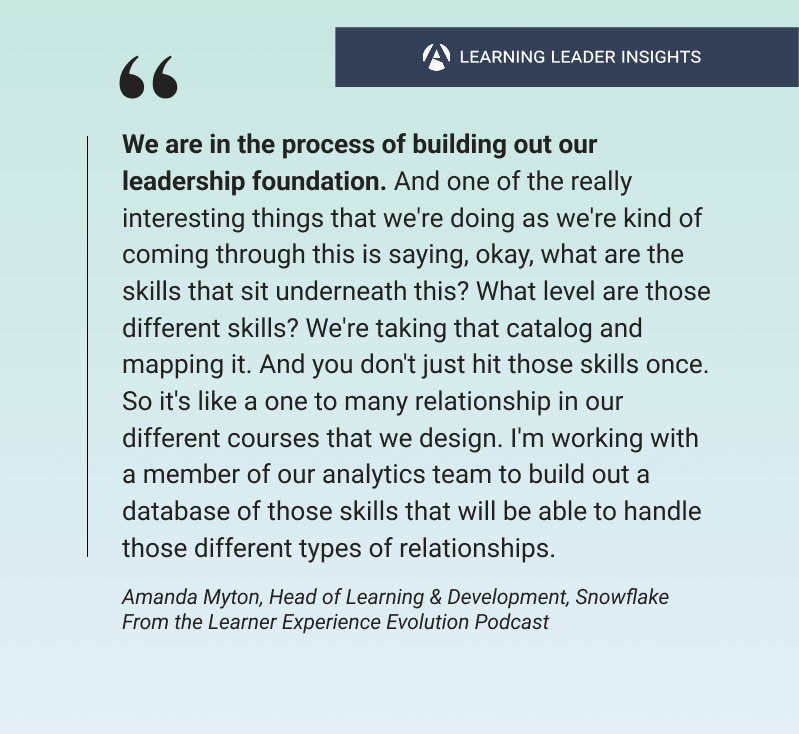
We are in the process of building out our leadership foundation. So we’ve designed our people leader code. That’s kind of the pillars and commitments and expectations. We’re building a new manager onboarding that’s kind of connected in there. And one of the really interesting things that we’re doing as we’re kind of coming through this is saying, okay, what are the skills that sit underneath this? What level are those different skills?
We use a lot of snow and ice analogies at Snowflake. So we’re really thinking about them in terms of like, are they a bunny slope skill? Are they a green circle? Are they a black diamond skill? Right? So we’re both able to identify and level these skills. And we’re using AI very heavily to really build out that catalog.
What’s cool is we’re taking that catalog and mapping it. And you don’t just hit those skills once. So it’s like a one to many relationship in our different courses that we design. You might be talking about this or you might be talking about that. And so I’m working with a member of our analytics team to build out a database of those skills that will be able to handle those different types of relationships.
So those one to many relationships, we’re then going to be able to do some understanding of, okay, they’ve looked at these, they’ve participated in these kinds of learning activities, or their performance is hitting this way, or these people on their team are being promoted. So we’re actually going to be able to bring a bunch of that together in a way that I’ve never actually been able to do before, right?
We’re always saying as learning leaders, how do we know if these things are having an impact? I think it’s really going to answer that question. But in the forefront, it’s also going to help us answer this question of like, what if somebody already like feels like they know that skill? How can we assess that? And where do we start to place them in? How do we start to level up those things?
We’re going to be able to get information back from that that’s like, okay, we think this should be an outcome. Well, if they’re already getting those outcomes, then that should be proof of learning. So it’s actually going to be a really cool two-way system where we get information about what our managers and leaders have accomplished to start leveling up those skills off of the bunny slope and up towards the double black diamond. And also, they’ve done these things in learning, are we seeing the outcomes that we hope through those kinds of, not just in course, but networking, mentorship, and experiential activities that we’re asking them to participate in?
So really cool. I’m really excited about building it. And I’m really looking forward to getting to that stage of having some of that info.
Michael Noble
I totally agree. That is exciting. I mean, we talk about skills-based learning, but we’ve rarely seen it with the adaptive elements that you’re describing or with the omni-channel measurement and tracking of that, which I think that’s exciting. That is a worthy change.
Amanda Myton
It’s like worth my time, right? I want to build this. I don’t care if it’s hard. Let’s do it. We’ll figure it out. Who else do I have to get on my team? Okay, people analytics. Okay. I’ve got some folks in the machine learning group. Like who else wants to work on this problem with me? And the answer is everyone’s like, oh wait, that’s really interesting. Whereas when you try to get buy-in for like, oh, I want to have a training class, are like, no, this is cool.
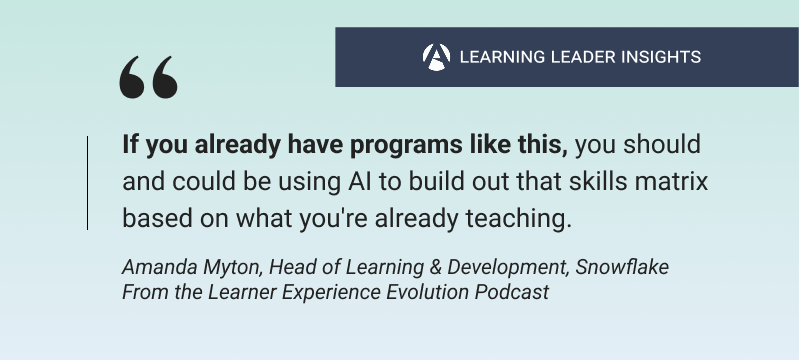
Because we’re building the program also from the ground up, I think we have a unique sort of space to say like, okay, when do we bring in these skills? What level are these skills, et cetera, et cetera? But I would say like, if you already have programs like this, you should and could be using AI to build out that skills matrix based on what you’re already teaching, right? Like, what are we doing and at what level?
If you’re not using AI much, it’s a great activity to sort of learn more about it. How does AI think about this? Ask AI, right? Like why did you put this as a basic skill versus an advanced skill? So whether you’re where I am, which is like building from the ground up, or you already have things, I think there’s a lot of good to be figured out and sourced through there.
Michael Noble
That’s great advice. Thank you so much, for sharing your time and your expertise. And I hope you’ll join us again in the future.
Amanda Myton
Thanks for having me.
Michael Noble
Listeners, thank you for tuning in. Please tell your friends about us and drop us a line at info@allencomm.com if you have any ideas or questions.
Resources For L&D Leaders
free guide
free guide
insights | on the blog
ALLENCOMM Press Releases
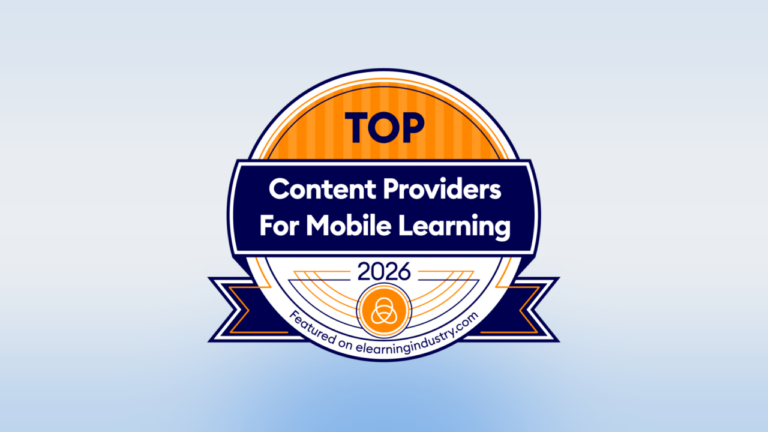
AllenComm Earns Spot on Best Mobile Learning Content Providers 2026 List
eLearning Industry honors AllenComm for its custom mobile learning solutions for enterprise, built to improve performance outcomes at scale. SALT LAKE CITY, [July 29, 2026] — AllenComm has been named to eLearning Industry’s...
ALLENCOMM Press Releases
AllenComm Named a Top Employee Engagement Training Provider by eLearning Industry
AllenComm has been recognized by eLearning Industry as a 2026 top provider for employee engagement, cited for scalable, personalized L&D that drives measurable results. SALT LAKE CITY, [June 24, 2026]...
ALLENCOMM Press Releases