

ALLENCOMM BLOG | Podcast
Episode 21: AI & the Future of Corporate Learning
June 24, 2025
In this episode of LX Evolution, host Michael Noble speaks with Ron Zamir, CEO of AllenComm, about the transformative impact of AI on the Learning and Development (L&D) industry. They discuss AllenComm’s journey in integrating AI into their processes, the importance of exploration and discovery in AI implementation, and how to measure success and innovation. The conversation also covers the significance of governance in AI adoption, the challenges and opportunities in investing in AI technologies, and key takeaways for learning leaders navigating this evolving landscape.
Top Takeaways
- AI is a transformative force in the L&D industry.
- Exploration and discovery are crucial for effective AI implementation.
- Governance can accelerate AI adoption by building trust.
- Learning leaders must lean into existing technologies.
- Experimentation with AI tools is essential for innovation.
- Measuring success is key to understanding AI’s impact.
- Client comfort zones must be understood and stretched.
- The barrier to entry for AI solutions is low.
- Investing in AI should focus on enhancing learning experiences.
- Don’t hesitate to demand more from vendors.

Ron Zamir: CEO of AllenComm
Ron Zamir has been the AllenComm CEO since 2003, but his expertise in leading global learning and business organizations begins as early as 1991. With over 22 years of experience, he’s achieved a mastery of marketing, sales, and education methodologies within the corporate training realm, and he’s been featured in multiple magazines, digital publications, and conferences across the globe. He holds Honors in multiple academic degrees and certifications, and he is the recipient of the Raoul Wallenberg Fellowship for Leadership and Democracy. In his free time, he volunteers in his community to assist economic development and support local charter schools.
Michael Noble
Welcome to another episode of the LX Evolution. I’m Michael Noble and I’m a principal consultant for AllenComm Advisory. I’ll be your host for this episode.
Today’s guest is CEO of AllenComm, Ron Zamir. Ron’s hosted several episodes of our podcast over the past year, but we haven’t had him as a guest since episode one. And we’re having him as a guest this week because we want to focus on the biggest change that we as learning leaders have faced, I think in a generation.
You’ve probably already guessed that that change is AI. We want to talk to Ron about it for a couple of reasons. One, he has a unique insight based on our firsthand experience in working with client AI initiatives. Secondly, Ron leads a networking and collaboration group called Learning Leader Connect.
It’s a group for senior leaders that come together to discuss their top challenges. And as the leader of that group, he has the opportunity to talk to a lot of learning leaders in Fortune 500 companies, mid-sized companies. So I think he’s got a unique and valuable perspective on AI that we want to explore in this episode. Anyway, let’s begin. Ron, welcome back to the hot seat.
Ron Zamir
I am so pleased to be in the hot seat. No, it’s been great, and it actually is a bit easier when you’re asked questions versus having to ask them. So I’m looking forward to a relaxing event here today.
Michael Noble
Thank you. Well, let’s set the stage a little bit. I think there’s a couple of narratives we’d like to hear you tell us about. One of those is about the overall L&D market and the narrative there. But the other is AllenComm’s backstory and narrative and how we have understood… You can start with either of those narratives. We’ll cover both of them.
Ron Zamir
Look, at the very core, our value to our clients from Fortune 10 to Fortune 500, even 1000, is to help them innovate, scale, and get better impact for their training and education efforts. So we can’t rest on our laurels. So I remember like yesterday, it was a formative event when I first got a chance to play with ChatGPT 3.
It had launched, our CTO got to it first. He’s always quick on the draw, quicker than me, Todd. And I got to play with it. And I realized, you know, and I wasn’t unique, that the idea that you can communicate with the technology and have it as a partner in your creative endeavor was going to transform our industry.
You know, at the end of the day, we as learners, as educators, as trainers, we’re in this to transform people’s capabilities around whatever they have to do, what’s important for them. Combine that with their feeling of self-worth and ability to be successful. So it’s finding that we can have a creative partner was as exciting.
I remember when Adobe started coming out with all their great tools, we realized we can do a lot more. So that started a journey, which we’re still on. And we could talk about that journey stage by stage.
Michael Noble
Well, let’s get into the journey, because I mean, it’s a little bit of a half step back, but I love hearing kind of context and like the origin of like, what factors were we dealing with? If we talk about… let’s talk about AllenComm and the different milestones on that journey as you see it. And then we can also talk about the parallel journey that we’ve been on with our clients.
Ron Zamir
Yeah, and I think it still is great and informs our clients, but we had more time and that’s okay. That’s our job. We’re seen as the experts. People come to us for insight, but I believe that journey is relevant and I’ll explain how.
The first part of the journey, and again, we had over six months to do it, was really accept that we had to engage with our expert population, our designers, our graphic artists, our performance consultants, our technologists, and really encourage them to explore. Just explore it. Don’t use it yet for any clients. Don’t implement it in any way, but just explore. It doesn’t matter if it’s for your hobbies or your work. Explore the large language models. Look at some of the tools that are coming out around video or around audio.
We actually gathered articles from MIT’s magazine and others. We encouraged people to take online courses that were coming out for free on YouTube. I enjoyed some of the MIT courses only because they made me feel kind of stupid, but I felt stretched a little bit because I had to learn new terminology.
And that was a six-month process. We didn’t ask them to achieve any efficiencies yet. We didn’t ask them to incorporate it. We just said, use it. Tell us what excites you about it. Tell us what makes you cautious or even intimidates you. And let’s talk when we finish that process.
Now, I don’t think our clients need to take that six months now. And again, we took it from ChatGPT 3 to 3.5. I don’t even know if we had to do it 4. And by then also, Microsoft was coming out with some of the preliminary tools. Copilot wasn’t out yet. Again, this was almost two years ago. But it was a process that we had to do. And the results of that process were super exciting.
Michael Noble
So as a business leader that’s focused on kind of the bottom line and what you’re doing, how do you justify that kind of exploration and discovery? Why is it different this time around?
Ron Zamir
Well, I would be blunt. I mean, I don’t think our clients need to spend as much time as we did. And I think the tools are a lot better. But without that familiarity, without that ability to get people excited, it’s really hard to get the uptick. Using and being assisted in your creative process, that’s not a compliance endeavor. You can’t just tell them use it or not.
And again, I’m only talking about the aspect of AI as an efficiency creative tool for you. We actually rolled that into a whole process of how could we use AI to enhance our learner experience. So that led to that phase two. And again, I think our clients can do that in months, in weeks even, although we have clients who have done it as long as us as well, and I’ll talk about them later in the conversation.
The next stage of that journey was actually now saying, we’ve collected what excites you. We’ve collected some use cases based on your own experience. Now let’s add metrics and expected results. Because without expected results, you don’t know what to measure. Without measurements, you don’t know how to evaluate your expected results. So that’s an important duality that you have to work in anything, much less in accepting a new technology into the fold.
And that led to another… It was over the summer, when things get a little bit quiet here, although it was a summer and that was the summer of 2024, when we started saying, you know, let’s put some numbers. So we pegged around 30%. We said, let’s isolate 10 areas that impact our ability to provide more, better, and faster to our clients. Let’s see how some of the things that excited you could be applied to those processes.
That led to a situation where we’re saying, okay, for example, in the pre-design process, so we have a lot of work in our pre-design process, which culminates in our providing a design to our client, right, and getting them on board, and that includes the content curation upfront. Then we have our design phase, where we’re actually fleshing out the learner experience. And then we have the integration implementation phase, where we’re working with the client’s LMS, LXP, SAP system, their human resource management platforms, all that.
And in every one of those phases, we looked at where are the efficiencies, but more importantly, where are we raising the bar on the deliverable? Because this is not just about doing things faster with less people. This is also about, and I think with that, it will actually stick in our industry, creating better experiences that are more vital, more achievable.
So that led us to identify the areas and also measure where are we achieving that 30% efficiency and 30% innovation. And again, we just pegged it as an exercise. In some areas we came under 10%, other areas we came in 60%.
I’ll give you one example. In the issue of incorporating more video, and more animation in a typical learning experience, the metrics hit over 70%, i.e. what does that mean, that 70%? Not only are you faster, but your ability to do more at a certain expense or effort for a client, would be how their resources and how quickly they can deliver a project. For us, it’s how we can fund that project.
We’re able to deliver now 70% more engagement and innovation in a project using AI tools. Now again, there are some caveats. We’ll talk about the constraints and roadblocks that exist in our industry. So that led to that ability to see and measure.
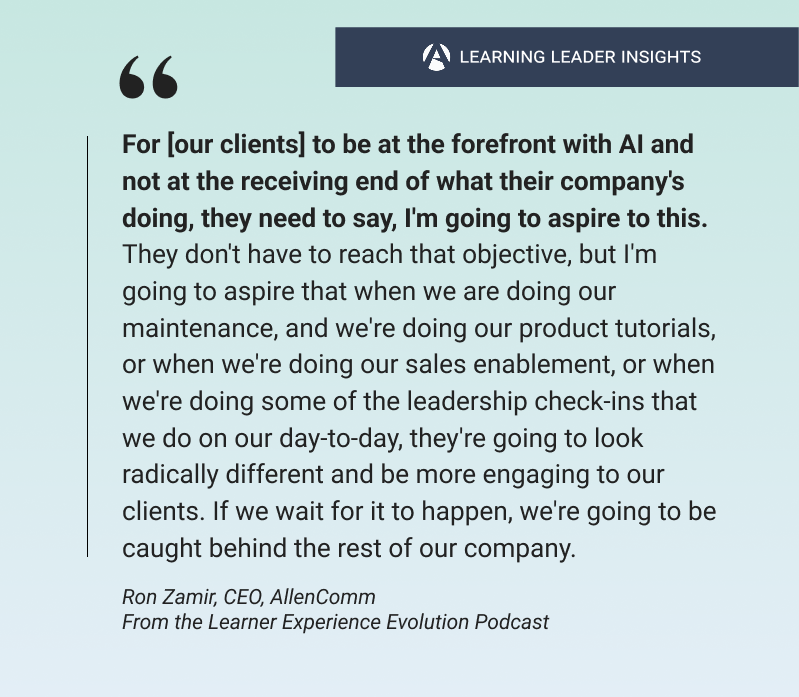
And I think our clients need to be doing that now. For them to be at the forefront and not at the receiving end of what their company’s doing, they need to say, I’m going to aspire to this. They don’t have to reach that objective, but I’m going to aspire that when we are doing our maintenance, and we’re doing our product tutorials, or when we’re doing our sales enablement, or when we’re doing some of the leadership check-ins that we do on our day-to-day, they’re going to look radically different and be more engaging to our clients. If we wait for it to happen, we’re going to be caught behind the rest of our company.
So that was that second stage. And the third stage was actually the implementation, which we’re doing now, where we’re actually delivering these really innovative learning experiences based on our going through that exploration, measurement, and check-in, let’s call it. Now we’re actually implementing and delivering.
Michael Noble
So now let’s take what you’ve explained about, especially about, well, like each phase, the exploration phase, the more planned full phase, the measurement phase, and relate that to the change journey of our clients a little bit.
Tell me a little bit, as you have talked to our clients about where they are and where they’re starting. I know it’s been different over the past couple of years. How has our experience informed the way that you guide and lead them? And what are you learning about that change journey and some of the best practices?
Ron Zamir
Yeah, and look, the only relevance of AI is how it transforms you in a positive way, right? So we had to learn what our customers could and could not do. Where was their comfort zone? Where can we stretch them? Because again, clients bring us in to help them stretch.
I’ve talked a lot about the comfort zone and the value of it and the danger of it, right? So here, I was fortunate. Sometimes luck and planning come together. The planning part is we knew we had to talk to clients and I started doing one-on-one interviews with our customers, but also with prospects that I knew through my LinkedIn network.
But then at the same time, and this is where luck comes in, we decided to form the learning leader structure, which was being done for another reason, to help anybody in industry network, to realize that we as learning leaders, are missing the boat that IT leaders know, that marketing leaders know, that they learn from each other, that they’re open to networking.
I was seeing serious people in our industry with very small LinkedIn networks, right? Or that most of their contacts were just from their existing company. So in parallel, we had started the Learning Leader Connect beginning of this year. Parallel to that, we started doing interviews mid last year.
By the time we reached our implementation phase, which was around February, March of 2025, we had done over 35 interviews where we consistently asked three important questions. I use three a lot, I apologize.
One was, tell us about the governance around AI technology. And that it was a spectrum, right? From, we’re told not to deal with it yet, somebody in the company, there is a task force working on it. And we’re talking about large companies, where the distance between the L&D team, let’s say in a call center or in a manufacturing capacity, and this task force was very, very far. But that was their limitation. We’ll talk about how to turn that into an opportunity in a minute.
The second was the opposite spectrum. I was talking to people a lot from the high-tech sector. I don’t want to mention company names because these interviews are not public. But I would say 70% of the organizations that were told, kind of what AllenComm did, you need to practice, you need to try it, you need to incorporate it, we’re in the technology space.
In the middle, we saw our finance companies kind of semi-constrained, pharmaceutical healthcare companies very constrained. And it makes sense, but I think it’s, thankfully, it’s going to be a thing of the past. When we do this podcast again in even six months, that constraint will not be because everybody’s going to be already freed up to use AI. And so we asked them about that, their governance.
The second thing we asked them, what if you try to informally explore? You know, is your team, again, I’m talking to directors, and VPs, and CLOs, is your team using it for their other stuff? Are you in ChatGPT? If your company and this is… this year I’ve incorporated Copilot, what are you doing with Copilot? What have you found? What have you not found? Their ability to think about it, not just listen to vendors or listen to even podcasts like this, was a critical aspect of their readiness of where their comfort zone was.
And the third question we asked, if you would like to implement it, where would you like to implement it first? So we left these conversations with three data points. What are your limitations? What are your experiences? And what are your aspirations? And then we took all that and started blowing up where we thought the market would start accepting AI-driven learning experiences, AI as an efficiency and creative tool.
And that really is where we are what excites us because we’re seeing our peers get as excited as our designers were months ago, and I think that’s going to be a tipping point for everybody.
Michael Noble
I’ve got two questions to follow up with what you just said. One of them relates to, and you can choose which one of these, which direction we go. One of them relates to governance, right? Because I think we’ve tended to think of governance as an obstacle and red tape and necessary evil. I was looking at some, I think it was Deloitte research that said good governance and AI can accelerate your transformation by 30% because governance equals trust equals more rapid adoption. It’s not how we’re used to thinking about governance.
And the other one is with all these research that you’ve done and you’ve mentioned some extremes to no AI, to go explore and be free, what’s that sweet spot? So we can talk about the sweet spot first, we can talk about the governance, why governance matters, but which of those makes sense for you in terms of next?
Ron Zamir
Well, I think when we get to our viewpoint, you know, let’s ignore the successes right now, and we’re pleased with our successes as well as our challenges because you don’t learn unless you have challenges.
The point of view, and I’m seeing this with other learning experts, Josh Burson and Elliot Mazze and all these people that, you know, in our industry… I’ve turned 60 here at AllenComm. We never fade away, we just stick around. So that’s a good thing or a bad thing depending, but we know how to delegate.
So we got people like you and others that are really leading the fray right now. But the viewpoint that I think we’ve developed is governance and the focus on governance has accelerated what your company is doing with AI. So the only connective tissue that you lack is being and having an understanding of where your company’s going, not for L&D, not for talent management, but for their own efficiencies, effectiveness, and enhanced customer experiences, and tap into that well of capability.
Michael Noble
Tell me, Ron, before you move on, a little on the watt, like how does governance translate to practical decision making that the leader has to make?
Ron Zamir
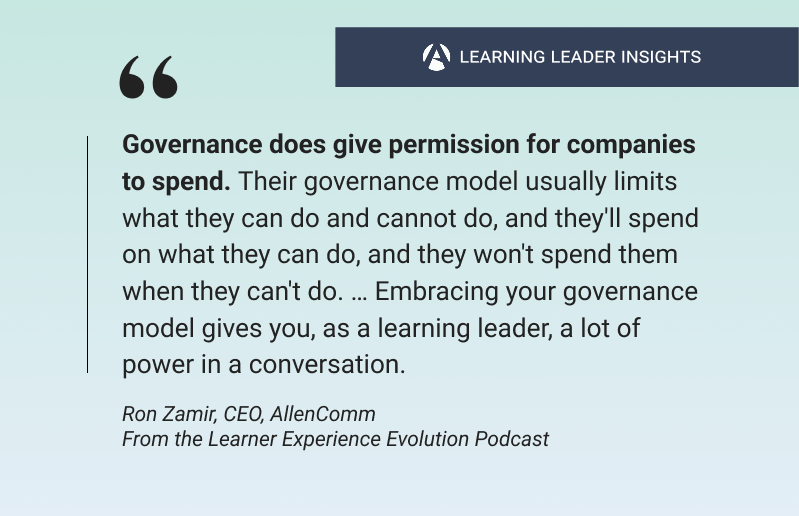
Well, first of all, governance does give permission for companies to spend. Their governance model usually limits what they can do and cannot do, and they’ll spend on what they can do, and they won’t spend them when they can’t do. So it’s clarity, right?
Also, embracing your governance model gives you, as a learning leader, a lot of power in a conversation. When you can come and say, look, this vendor that I’m interested in is asking for, and we’re going to talk about what vendors are doing.
I want to talk about ATD a bit. I just got back from ATD in DC. You know, they’re asking, I want to raise our subscription model because they’re asking for more money for to include all these great AI tools. Now, you can go into that conversation and it’s a typical conversation we all don’t like, you know, because budgets are tight. We’re asking for more. We’re probably going to have to take money away from somewhere else. And that puts us in an uncomfortable decision of having to play Solomon or something like that.
The governance models give us permission to use what other people’s money in the company has been invested in. And if we can come into that conversation and not talk about that feature, that new feature, but say, I’m going to be doing these three things, I’m going to be… Curating content better. I’m going to be outlining content better. I’m going to be localizing content better so I can enhance the engagement, the competency, and the uptick of my efforts, and I and I need those.
I’m using a Copilot example. You could be a Google shop. You could be others. I want to use the deeper level, the foundry level. Again, we can talk about that now or in a separate. And all I need is the time to send my people to get them trained on this. That gives you a lot of power.
So leaning into, and that’s going to be my theme. My theme when I get a question, so Ron, what should we or what can we be doing? I say, first of all, lean into it. In a very practical, real way. Leaning into is not attending webinars or just being knowledgeable. Leaning in is to experimentation, trying, and implementation.
And so for me, we have a governance model in AI. I mean, look, we’re not a cobbler going barefoot, right? We have very strict rules at AllenComm about getting approval from clients on the use of AI tools and what are the limitations are? Can we use them as a pre-design phase when we’re not engaging with client content? Or can we use them also when we can get engaged with client content, right? So every company has their approach.
But I think if you can lead into what has been approved and what the limitations are, you can do a lot. Governance should never be an excuse not for doing something.
Michael Noble
No, I think this takes us to where you were going. And it taps into my own curiosity about… the industry is going in a couple of different ways. This will tie into your experience at ATD. But my question is a little bit about investing in services, investing in specialized L&D AI tech. What’s the sweet spot there?
Tell us a little bit about what you saw at ATD, what your experience was, and maybe what your opinion is on these learning leaders that are looking at… Do they go find a specialized technical application? Do they partner with the enterprise tech system to engage a services firm to help them with the right agents? Talk to that.
Ron Zamir
Well, there’s always going to be opportunities and roadblocks, right? In everything in life. And like I said, you learn from the roadblocks more than you learn from the opportunities. So I’m going to talk a bit about that.
Vendors in our space are not slouches when it comes to AI. That’s the good news. I did a quick AI capability audit on the four major learning management systems that were at the show. I won’t be specific on any, but you can ask us and I’m happy to do comments when we post this video on specific systems out there.
I looked at the LMSs, the LXPs, but also some of the content players and how they were layering in AI into their subscription-based learning experiences, right? And the expert wasn’t too bad. I think most of the major players were there, not all of them.
I think what was lacking there, and I think this is one of the weaknesses of ATD, I digress, is ATD has to encourage the talent management system players to participate or collaborate because it’s always hard for me when I look at, let’s say, an industry-leading LMS and I don’t see… Oracle Learning, SuccessFactors, SAP, and some of the others there, Workday. I think we know as being industry players that these systems are very important. So I digressed a bit, but the ones I saw were very impressive in the sense that they are incorporating a lot of AI productivity into their tools, the ability to query, to outline, to even produce faster at a certain level.
I had a lot of fun at the Articulate booth, just because we are big users of Articulate. We have our own systems, but also Articulate. And I think there’s a lot to be said there as well. So that’s the good news. Where was I saying, you know, I like what I see, but I would love to have seen something a bit different. I saw a lot of Copilot cloning. And this even was on the content player.
I look at two dimensions of what we want to see in an AI technology. We want to see the productivity it gives us. We also want to see how it enhances and changes a learning experience. I saw a lot of productivity tools. I didn’t see a lot of learning experience enhancement where the learner himself… So, sadly for me, a little bit, and I think I’m not pessimistic, but this is the current balance sheet, the current stage of where we are. A lot of what you’re seeing in these platforms can be replicated easily by doing an alt tab or working within your Microsoft Suite, or if you’re using Google Suite, and stuff like that.
And I think that’s… my challenge there is, and we’re seeing it, because we have access to a lot of these tools, because our clients use them and we use them. We work with, I think, every major LMS and integrate with the backends, is that they’re never going to catch up to the big players. They’re never going to catch up to Google, to Apple.
So you’re kind of purchasing something that you’re going to have something better on your desktop at any given moment. That is an opportunity for them as well as for our learning professionals.
On the issue of the content players, what we’ve discovered through our own experimentation, through working with clients and creating AI coaches for leadership, AI tool tips for call centers and stuff like that, the barrier of entry, and this is good for us, is very low. The architecture being put out by AI companies, again, Spring and others, there’s a whole bunch of them out there in the US and Europe and so on and so forth, is you can create in a learning experience and integrate, especially if you have access to the client content, you can create an AI partner in the learning experience.
So running a simulation, running a scenario, somebody accompanying the journey pretty easily. We’ve benchmarked now the ability to implement AI coaches on a body of knowledge at a few hundred hours of effort. Which means the good news is you can do it on your own if you have access to the tools with a vendor, if you have access to a vendor, or through a subscription pretty easily. So the barrier of entry is low. You have options. That’s a good thing.
Is it still at a place where, for example, I didn’t see much adaptive options. So I think in the next few months, we’re hoping to see more examples of platforms being able to support an adaptive personalized learning journey. Again, I don’t want to talk about specific vendors here. We may do podcasts with some of those vendors down the road.
Again, we don’t compete against them. We actually want to promote the best out there for our clients. And I did see one or two that I think are thinking right, but I haven’t seen the implementations yet. And again, I would coach our clients to see you can create some of that on your own or with a consultant pretty easily. That’s the good news. So be careful to ask for that extra expense if you’re not going to really use it.
Michael Noble
So in a nutshell for our listeners, what’s the point of view, concise statement, takeaway that you would like our listeners to get at this point in time about AI and L&D?
Ron Zamir
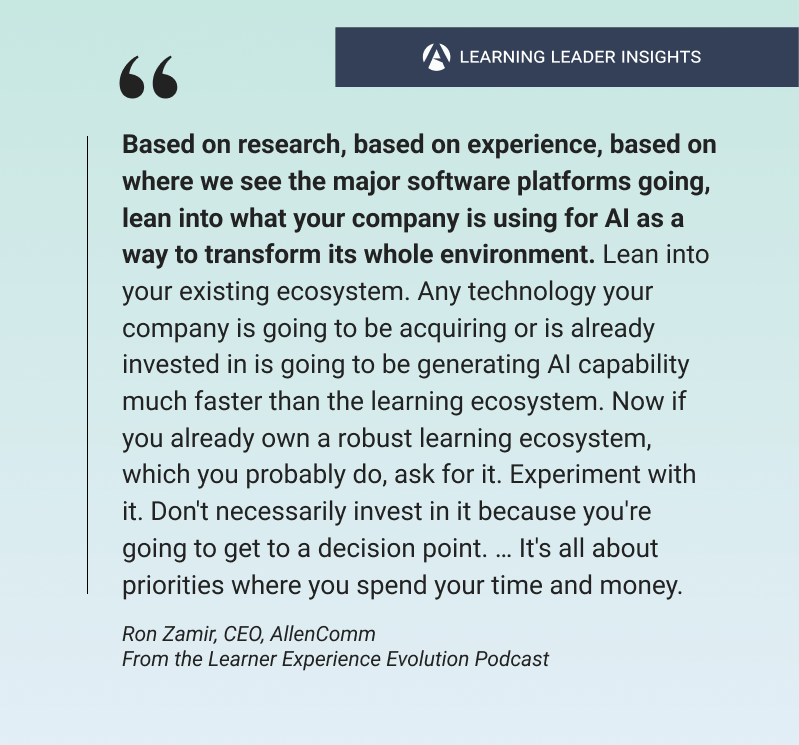
So, again, based on research, based on experience, based on where we see the major software platforms going, lean into what your company is using as a way to transform its whole environment. Lean into your existing ecosystem.
Any technology your company is going to be acquiring or is already invested in is going to be generating AI capability much faster than the learning ecosystem. Now if you already own a robust learning ecosystem, which you probably do, ask for it. Experiment with it. Don’t necessarily invest in it because you’re going to get to a decision point.
Again, it’s all about priorities where you spend your time and money. To choose between, I could alt tab almost and teach my people or hire a consultant to develop within a Copilot environment, or I could use this amazing guide and capability that I have in my LMS. And that’s a good choice to have.
So, leaning into AI, leaning into governance, that’s the first thing I want to share with viewers. The second thing is experiment with what your company has invested in. And the third, don’t be hesitant to tell your vendors, I want you to help me implement this before I buy it.
And if you could use that aggressive posture, which is the lean into approach, the curiosity of trying different things, I think you’ll be on the right roadmap. Again, we’re talking about months here. I think when we revisit this podcast—but I will tell all of our peers, it’s really a lot easier than we thought it would be.
And if you ever need a vendor like AllenComm or anybody else, don’t be afraid to be demanding. Don’t be afraid to say, hey, you know, we’ve been doing it this way with boxes and scrolling. I want to have an animation-centric experience. I want to have a video-centric experience. It’s definitely not going to be as expensive as it was. And I think there’s a great opportunity to raise the bar and move out of your comfort zone when it comes to your learning experience design.
Michael Noble
Thank you so much, Ron. We’re reaching the end of our time. I’m reminded how lucky I am to work in a services company where we get to hack the learning curve because we get to see both the broad and the really specific use cases. And thank you for sharing that.
I’m also going to put in a plug for those of you that are learning leaders that maybe are in mid-size to large companies where you’re managing a team where you’re talking about your roadmap. Shoot us an email to info@allencomm.com and we’ll see if we can connect you to our Learning Leader Connect group. We’re getting a lot of excitement there, and it’s a group for networking and collaboration.
We’ve already had some of our participants on our podcast, a couple of them. We’ve got some more scheduled. So I’ll throw in that little bit of commercial. And also if you have ideas for the podcast, we’d love to hear them. So thank you, Ron. Thank you, listeners. And we look forward to our next episode.
Resources For L&D Leaders
free guide

free guide
insights | on the blog
ALLENCOMM Press Releases
AllenComm Earns Spot on Best Mobile Learning Content Providers 2026 List
eLearning Industry honors AllenComm for its custom mobile learning solutions for enterprise, built to improve performance outcomes at scale. SALT LAKE CITY, [July 29, 2026] — AllenComm has been named to eLearning Industry’s...
ALLENCOMM Press Releases
AllenComm Named a Top Employee Engagement Training Provider by eLearning Industry
AllenComm has been recognized by eLearning Industry as a 2026 top provider for employee engagement, cited for scalable, personalized L&D that drives measurable results. SALT LAKE CITY, [June 24, 2026]...
ALLENCOMM Press Releases