

ALLENCOMM BLOG | Podcast
Episode 22: From Instruction to Innovation: A New Era in L&D
July 9, 2025
L&D has a rich history, and yet, there’s always more to learn—and new ways to innovate—each day. With a surprise role switch, Michael Noble, EVP of AllenComm Advisory, has moved from interviewer to interviewee as he discusses how leaders can prepare for the future of L&D. His conversation with Ron Zamir highlights the importance of AI, governance strategies, using existing resources more effectively for cost savings, and even the shift from instructional methods of the past to what works best today. They also cover the skills L&D leaders need to invest in to stand apart as professionals in their industry over the coming years.
Top Takeaways
- Advisory services focus on empowering clients to make informed decisions.
- Many organizations face redundancies in their tech stacks due to acquisitions.
- Governance is often misunderstood as compliance, but it can be empowering.
- AI is rapidly changing the landscape of learning technology.
- Organizations need to optimize their tech stacks to reduce costs.
- The importance of measurement and impact in L&D is crucial.
- Future L&D professionals should focus on adaptability and critical thinking.
- The shift from builder to editor reflects the evolving role of L&D professionals.
- Governance can create opportunities for innovation and growth in organizations.

Michael Noble: EVP of AllenComm Advisory
Michael Noble has been with AllenComm for over 20 years. During that time, he has held several positions, including Chief Learning Officer. Currently, Michael leads AllenComm Advisory, which encompasses three practice areas—learning technology, strategy and governance, and performance consulting.
Ron Zamir
Well, hello everybody. Welcome to our podcast. Another episode where we chart the evolution and innovation in the learning space. I’m excited for this session. I get to interview the person that has interviewed me in the past, Michael Noble. He’s going to introduce himself.
My two cents on Michael though, and I hope it’s going to make this a very interesting chat session, he’s one of the better connected people in our industry. He does a lot of interviews, a lot of talks, and right now he’s doing some exciting stuff here at AllenComm.
So with that, I’m going to kind of open up to Michael. And Michael, just as a leading question a bit, we always kind of review the person’s learning journey, what brought them into our industry, the big stages in their journey. And maybe you could share that with our listeners and viewers.
Michael Noble
You know my first job in this industry was at AllenComm, and it was in the 90s, and I took a summer job that I thought, I’ll do this and then I’ll go back to teaching Shakespeare at Westminster College or something. And you know, I came and really discovered that I had a passion for client work.
My first client was the Vanguard Group in Pennsylvania, and learning the ropes at the feet of some of the pioneers at AllenComm really just gave me a love of learning and a love of learning technology. And I had the opportunity to work with some of the companies that were doing the most innovative work in our space, and was able to kind of move through several different roles at Allen.
But most of my time was as Chief Learning Officer, and I worked closely with you after you bought the company. And we’ve kind of been side by side for almost 15 years-ish. And I did take a break, went out, had some adventures, worked for a startup in AI, worked for a few other companies in our space.
A couple of years ago, you and I were talking about some of the things that you wanted to do next. And they matched really well with some things that I wanted to do next. Namely, it was developing an advisory services practice for AllenComm. Building on expertise we’ve always provided to our more strategic clients, but figuring out how do we really productize and how do we make that kind of relevant to meet today’s market. And that’s been a lot of fun.
Ron Zamir
Yeah, and we’ve brought this up a lot with different people we’ve interviewed. It’s how do you jumpstart something, right? This podcast is about innovation. We recognize those of us that work in this industry that our L&D teams tend to be a bit reactive. We have our comfort zone. And I think one of the things I hope we can explore in the next 20 minutes or so is really how you can shake that tree, right?
And the vehicle that you’re here to do for us or with us is really advisory. What does that mean? What does it look like? But again, we’re not just here to market our services, it’s really share some of what we’ve heard from our clients. So with that, let’s talk about, not about us, let’s talk about the conversations you’ve had. And where do those conversations lead and why is that idea of partnering around advisory maybe a key to that lock?
Michael Noble
Yeah, so on that topic of conversations, it’s been a big focus since I’ve been back, right? Which is not only talking to our clients, but also talking to learning leaders across the market in a lot of different industries. And we’ve created a forum for that with our Learning Leader Connect, but we’ve also done quite a few interviews, even just apart from that.
We’re in this period of transition. And when you think about where do you start, I start by looking for where things intersect, right? It’s like, rarely is everything just so neatly organized and linear that you can just start at the start and move from milestone to milestone. It’s… this pathway is going over here, and this is going over here, and they intersect, and that becomes a starting point because you have that efficiency of being able to say, okay, I can tackle a couple of challenges here if I’ll work on this.
We’re hearing a lot about AI. We’re hearing about the need for governance. That’s where, you know, the need for leadership and governance is interacting with new technology. There’s challenges with the tech stack. We see our clients facing a lot of challenges. We’ve been in this period of tech aggregation where, we’re going to add this onto the stack, and then this LXP, and then this authoring platform. And it’s resulted in kind of a pile, not an architected, harmonized ecosystem.
And that’s a starting place with most of our clients because it ends up being a big point of need. It’s expensive. It’s not well designed, it’s not meeting their objectives. And so we have multiple intersections there. And then on top of that, we have AI as one possible need to be future ready with that tech.
Ron Zamir
Hodgepodge is the word, if I’m pronouncing it right, that comes to mind. Yeah. No, it’s crucial to understand. And I think, you know, I also love the word oxymoron, right? Advisory is not about advice, right? Advisory is about giving you tools and helping you make decisions. Not advice to make the decision, but bringing you to a point where you can make a decision. So I think, you know, in our parlance, it has a much more operational point of view.
Michael Noble
It is a hockey patch.
Ron Zamir
I think we should explore a bit because I am still amazed. I did two Learning Leader Connect interviews today. And in both cases, I usually ask, what is your learning stack? And then the question is back, what do you mean? So when we talk about learning stack, we mean your LMS, your LXP, your authoring platform, your skill-based platform. And what are some of those overlaps or those redundancies that you’ve seen in your conversations with different companies in our industry?
Michael Noble
I think most organizations have some redundancy in their tech stack. The most obvious would be, we’ve got two or three learning management systems, which I’ve seen with some large accounts where it was like, we either acquired a company that had an LMS or sales needed a very particular LMS because it had some sales enablement features that they liked.
But this group was doing analysis, and speaking of analysis, I think as instructional designers, as learners, we know how to do a needs analysis from a human performance standpoint, but we aren’t as great in looking at what are the different affordances of the technology and how do they match up, right?
And because of how we separate concerns, well, I’m going to let the learning tech team handle that versus this other team that’s more focused on program development. That gap between them ends up being both an opportunity, but it’s also an area that’s the potential where, we’ve got an LXP. We’ve got some LXP functionality here. We’ve only adopted it for this one program. Meanwhile, we’re paying licensing for this learning management system that also has those similar features. And there’s no master conductor leading the symphony of all this.
Ron Zamir
I mean, it’s almost like an audit. I think a lot of our companies that we encounter over the years, they go feature shopping. So, you know, one of the big things you mentioned is M&A, or mergers and acquisitions, that causes them to have redundancies. And that’s a very real thing. And of course, it’s not easy to decouple from a system that’s ingrained with one of the company you acquired or merged with.
But the one we’re seeing, and I know you’ve had some conversations with one of our clients on this, is they needed a specific feature. Kind like you talked about sales enablement, they needed to do more coaching and their work implementation didn’t support the coaching, so they add something to that. And then they needed to track something X, Y, Z or another, and then they added another.
And in today’s business models, everything adds license fees. And if you’re a large company or even a medium-sized company, those license fees add up. So I think that practicality of not just giving advice but helping make decisions is very clear when it comes to lowering redundancies and gaining more efficiencies in your tech stack.
Talk a bit more about what you’ve heard about governance. Where is governance empowering? Where is governance limiting? And how easy it is to fall down a governance black hole. And what can we help companies do about it?
Michael Noble
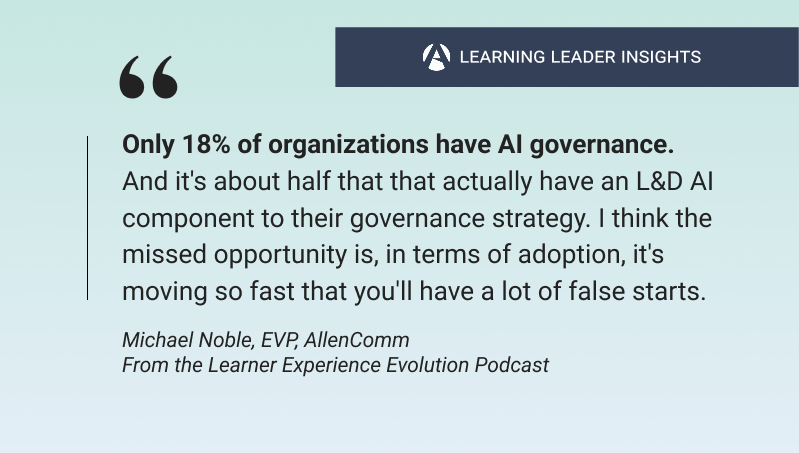
Yeah, so governance is never the most popular or accessible of topics because we think about rules and compliance and data security. All of those have become much more… we can’t avoid them in light of AI. So that’s pushed governance, I think, to the forefront. But really, I was looking at the statistic just yesterday. It was saying only 18% of organizations have AI governance. And it’s about half that that actually have an L&D AI component to their governance strategy. I think the missed opportunity is, in terms of adoption, it’s moving so fast that you’ll have a lot of false starts.
For example, if you go down this road, but you’re never going to get it through IT because IT has all these rules that you simply didn’t know about that you were going to have to go through this governance process. And that’s what I’ve seen with a lot of clients. Their model has been, which we’ve already said, I’m missing this functionality, so I’m just going to buy it and add it on.
Whereas what’s different now is AI is coming into all the technology they’ve already got in place. So they’re going to get it from different directions. They’re going to get it from the LMS. It’s already part of their work suite that they made, their office suite, whatever they might be doing, whether it’s Copilot, whether they’re in a Google environment.
There’s a couple of different decision points that could be incredibly painful or that could be made much easier through governance because this has already been approved. We can build on. We can start where we are, or I can try to start from zero. And what I’ve seen is that companies are trying to start from zero, get to a certain point, and then they hit a wall.
And I think so many of our clients are afraid of hitting the wall that they’re just not doing anything. I think that’s why despite all of the early adopters, it’s like… you often talk about this concept of a comfort zone, and people stay in their comfort zone because they don’t feel safe kind of moving out of it. Governance is actually a way to move out of your comfort zone because it builds trust.
Ron Zamir
You bring up a great topic, which we can explore as well, that for a lot of people, governance is synonymous with compliance. They see it as a limiting factor versus looking at working within their governance model to find where they can actually develop and expand. So governance could be an opportunity, right?
You mentioned one point where we see it with Copilot that, you know, we talk to clients and they talk about why they can’t do anything with AI because of governance.
Michael Noble
And we have a path.
Ron Zamir
Their companies work at a word about legal liability. They talk about it in a compliance perspective. And then when you ask them, and I’ve seen you do this, well, are you using Copilot? And suddenly you say, well, you have an opportunity to use your governance model to actually not just walk into AI-enabled services, but run.
Maybe share a bit about how you’ve seen kind of flipping the switch on governance from limiting to empowering through Copilot that we’ve had some really good insights and successes with clients?
Michael Noble
Yeah, so nothing against Copilot, but it hasn’t really been held up as the coolest or most innovative of the AI tools out there.
Ron Zamir
So marketing advice to Microsoft. I think they have a budget. They can listen to our podcast.
Michael Noble
But it has a lot of market penetration already because it’s coming through… I can get it through Teams, I can get it through my Office Suite. And they’re really smart about how they have launched it within their own ecosystem.
And that means that when I’m talking about clients, they’re in the process of finding the right AI agent that they want to buy and bring into their organization. They’re looking at a six month process to get that agent approved through their governance, but they have AI that’s already approved that uses the same large language model as the agent they would bring in. They don’t realize that because, again, we’re used to just buying the technology that we need, whereas Copilot can give us the opportunity for all kinds of sophisticated agents that they might not have thought of.
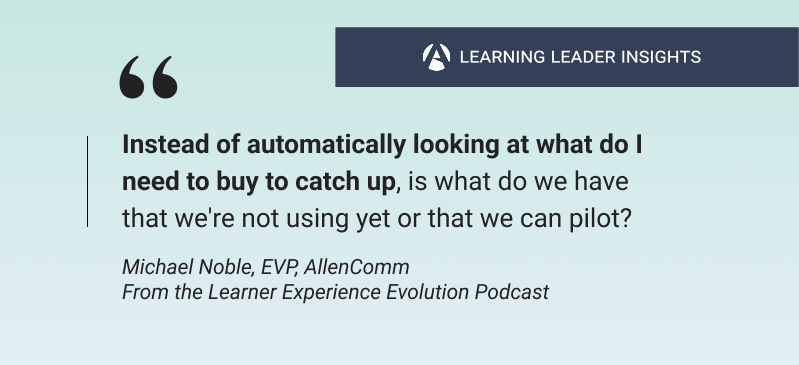
And one of the things, when you’re talking, it’s like, instead of automatically looking at what do I need to buy to catch up, is what do we have that we’re not using yet or that we can pilot? Maybe you still will need to buy something.
Ron Zamir
Yeah, or some knowledge or a consultant or, you know…
Michael Noble
Right, but it’s more likely that you need to raise your hand and get involved in the governance process, and see where that’s at, and talk to people, and build those alliances, and find out. Then you can tap into the larger ecosystem of the organization because ultimately, you’re going to want to be in the flow of work anyway. You don’t want to stay isolated in just the learning tech ecosystem. You want your solution to be part of the flow of work. And that means tapping into the larger discussion of what’s approved, what are people using, what’s built into the systems that they’re doing.
Ron Zamir
Yeah, and that’s a whole other session for the design elements that you could get from Copilot, that you can get from a third-party coach or AI-driven coach. You know, we’re seeing that a lot now. Clients are testing. And I think there’s some great product out there of people that have taken their content, created an AI mentor or AI coach for their soft skills, like if it’s Crucial Conversations or if it’s empathy, or if it’s, you know, all those things.
But then again, we’re buying the features, right? They’re not integrated with our culture. They’re not aligned with the use cases that are very specific to our organization. And your point, I’ve heard this said often enough, is you can recreate a lot of that functionality with your own content, remembering that you can point Copilot at your own knowledge versus outside knowledge, which then butts in with your governance model, right?
If it’s your content and your citations, the legal liability is easier to nail down, versus it’s somebody else’s information, who has the liability for advice that that agent may give on somebody else’s content. So those are some of the things that make governance a little more compliance, but it doesn’t have to be if you take the internal route that you’re describing.
What are some of the more obvious questions you hear when it comes to where do I start my journey, if it’s optimizing my tech stack, or if it’s going into AI, or if it’s building a new governance model, being a participant in the process? Could you share some of the questions you’re hearing from the different interviews you’re doing?
Michael Noble
The challenges are always about measurement and impact, right? How do we measure? Our data’s all over here, and that ends up becoming both an opportunity in terms of integration. We’re in this do more with less mode right now, where it’s like, okay, we need to demonstrate that we’re actually contributing to the bottom line.
We’ve always struggled with that. We’ve talked about how we measure. This is an optimization challenge and less of a philosophical, what level of Kirkpatrick analysis are we doing with our learners? We have more data at our fingertips than we realize, and we’re not leveraging it. We’re not bringing it into our business systems because of a lack of integration.
Ron Zamir
The specificity is we can use AI to ferret out the nuggets of information we need in order to create a measurement regime. But also, I think as you’re referring to it, we can use a tech optimization and AI to literally come to our bosses and say, hey, we can reduce costs, we can raise efficiencies, we can reallocate resources to do other stuff with less.
And I think we never had this opportunity that I remember. This is similar to when we started to move online, when suddenly we were reducing our classroom costs. Here, we have an ability through tech stack optimization and AI to do it in a much bigger way across multiple areas. No, I think that’s really great information.
You know, as we near the end of these short discussions, and I hope our viewers appreciate, we try to keep this very short because we can geek out on this for hours. So in that context of more technology, more governance, more AI, if you were starting off today, you started off… I first met you in 2000. So that date’s when we first met.
What would you advise somebody entering now who wants to be in learning and development, who wants to be in talent management, but they’re entering in an era of AI and of much more technology, integrated technology. What should they focus on? What skills should they have? Where should they look to create their impact?
Michael Noble
It’s interesting, when I started out, there was a kind of movement to be pretty theoretical. It’s like, well, what instructional design models do you know? What’s the theory behind instructional design? Then we went through this era where you would represent yourself based on the tools, the authoring tools that you knew how to use, and what you needed to know how to develop.
And I think… This next wave, it’s not going to be about the theory or the tools. It’s going to be more about the critical thinking, analysis, the flexible kind of mindset, that learnability of, I know how to do that human machine interface thing really, really well. And that skill of being able to adapt to new technology, to learn quickly. We’re going to have to do a lot more critical evaluation because we’re not starting from zero. And that skill set, I think, is really important.
And it’s not unique to learning where to click on an interface or the steps in a process. It’s a little bit more of a, I think, a higher level skill of synthesis, analysis, those types of things. As we look at things like… there’s an efficiency paradigm that is going to be pushed to the foreground of what everyone does, which is, I need to know how my work is valued and what I’m contributing. How do I maximize that through the use of the tools that I have available?
It’s also, I think, a higher… it’s like those executive functions of the brain. I think one of those that’s really important is being able to kind of manage where you put your focus and where you put your time.
Ron Zamir
I heard a great analogy related to that today. In the past, all of us, I started as an instructional designer myself in the 80s, to date myself. But we were very good at putting things in buckets, creating learning objectives, creating components of a journey, taking people from point A to point B. And we grew our skills to that, creating storyboards, creating outlines, writing scripts.
Then we layered in the multimedia production acumen that we needed to be able to bring it to life when we moved from CD-ROMs, and eventually to the web, and so on and so forth. With AI, with a lot of technology, we’re becoming more like editors. We’re managing the technology. We’re not using the technology.
One thing I like about editors, I was never a good editor, which means I may not be a good… a young person in today’s industry is to be able to see something and check it, optimize it, you know, look for, yes, it’s said one way, here’s a better way to say it, or here’s my prompt, I got to build the next… I got to educate the prompt so I get a better product that I would be happy with as an editor. So that builder versus editor continuum is something that I hope we can explore in further podcasts.
Michael Noble
Yeah, that brings up the whole idea of collaboration, collaborate with others and how we bring in technology into that collaboration and creativity. That part I think is exciting about what’s coming and where we are already.
Ron Zamir
I think we’re nearing our time. Look, I want to leave us all with the message that I think I want to pull out of this. Governance is not compliance. It’s actually opportunity and space. Look for that space. There’s always places to optimize. And AI is going to really enable us to be a better partner and have more room to be influential. And the last thing I’ll say…
If you’re interested in our advisory services, please hit our website. We more importantly realize advisory is not advice. Advisory is bringing you to a point where you can make better decisions. So with that, I’ll thank you, Michael, and we will see you again in our next podcast.
Michael Noble
Thank you, Ron.
Resources For L&D Leaders
free guide
free guide
insights | on the blog
ALLENCOMM Press Releases
AllenComm Earns Spot on Best Mobile Learning Content Providers 2026 List
eLearning Industry honors AllenComm for its custom mobile learning solutions for enterprise, built to improve performance outcomes at scale. SALT LAKE CITY, [July 29, 2026] — AllenComm has been named to eLearning Industry’s...
ALLENCOMM Press Releases
AllenComm Named a Top Employee Engagement Training Provider by eLearning Industry
AllenComm has been recognized by eLearning Industry as a 2026 top provider for employee engagement, cited for scalable, personalized L&D that drives measurable results. SALT LAKE CITY, [June 24, 2026]...
ALLENCOMM Press Releases