

ALLENCOMM BLOG | Podcast
Episode 24: The Evolving Role of AI in Corporate Learning & Training
August 5, 2025
How do you earn a seat at the table as a learning leader? In this episode, Ron Zamir and Lori Niles-Hofmann reveal the secret: run your L&D like a business. Their insights help leaders take a proactive stance, govern AI use for enhanced personalization, balance context and content, and create critical connections with key stakeholders to establish a strategy capable of defending decisions with data and turning any L&D challenge into an opportunity.
Top Takeaways
- Data is essential for proactive learning organizations.
- Structural challenges can be transformed into opportunities.
- Governance should focus on quality and outcomes, not control.
- Understanding the learning ecosystem is crucial for effective learning.
- Contextualizing learning is more important than just content delivery.
- Stakeholder management requires speaking their language and using data.
- AI has the potential to revolutionize learning experiences.
- Learning takes time and should be viewed as an investment.
- The current generation of learning professionals is open to innovative approaches.
Lori’s forward-thinking book, The Eight Levers of EdTech Transformation, is a valuable guide to help learning leaders implement technology that supports learning. She considers how leaders can best shift their strategies, explores a holistic approach to the tech environment, and even provides insights into aligning stakeholders, data, and other knowledge sources.
Check it out today by visiting this link!

Lori Niles-Hofmann: Senior Learning Strategist & Author
Lori is a senior learning strategist with over 20 years of L&D experience across many industries, including international banking, management consulting, and marketing. She specializes in large-scale digital learning transformations and is passionate about helping companies navigate through the ambiguity of change.
After leading and completing numerous EdTech implementations, Lori has developed data-based methodologies and frameworks to empower L&D teams to move from business support function to strategic business driver.
Lori serves on several EdTech and HRTech boards and has published two courses on LinkedIn Learning with 100K completions. She is also the author of the recently released book “The Eight Levers of EdTech Transformation”.
Ron Zamir
Welcome everybody to another episode of our podcast, and thank you to our viewers and listeners. I am joined today by Lori Niles-Hofmann. She is one of the more provocative writers and insightful people in our industry today. She’s put out a book, which we’ll have in our show notes and we may mention, but we’re going to get right into it again and talk about innovation, talk about change, and how we’re becoming a much better industry.
I’ll start with my usual first question, Lori, and it’s really about what brought you into this industry? Let’s hear a bit about your origin story or journey.
Lori Niles-Hofmann
And thank you so much, Ron, for having me on the podcast. This is a great honor. Well, I guess I would say that I didn’t choose the learning and development life. The learning and development life chose me. It might be the best way to look at it.
When I graduated from university, I did something that a lot of kids did. I went overseas to teach English, except I went to Poland instead of places where I could probably have made a much better living, like Japan or Korea. I went to rural Poland and I became a teacher. Did that for a couple of years, and it was actually… the university where I was affiliated with was actually one focused on teaching teachers. So I learned a lot of pedagogy and andragogy when I was there.
When I came back to Canada, total transparency, no money and a really dirty backpack. During the day I was a teacher at a school and at night I was working at a call center. So I was doing the two at the same time. The call center started to pick up on the fact that I knew a lot about learning, and they asked me to just start making some job aids and I did.
And then I ended up becoming an instructional designer at that bank and gradually moved my way through. I started getting more involved in EdTech systems and global implementations of learning management systems and learning experience platforms. Then I became really fascinated with the data part of things and what that could do.
I did a stint where I was actually doing customer education for a marketing automation firm. Fast forward to now, for the past eight years, I’ve been an independent consultant to chief learning officers of enterprise companies on basically how to optimize what they’re doing, what’s their strategy, how to connect it with their business, all of those meaty topics.
Ron Zamir
And again, I think coming from that varied background, we all come from varied backgrounds. Viewers know this, I came in from archeology, which that’s a whole podcast. I’m connecting the dots between archeology and instructional design. One of the topics we often discuss on this podcast, and I want to kind of start there, is the status we live in as learning organizations, even talent management organizations, between our ability to be proactive and embrace change, embrace innovation, to reactive, which sometimes curtails our ability to embrace change and innovation.
When you look at the companies you advise, what is their situation and how have you helped them go from one to the other?
Lori Niles-Hofmann
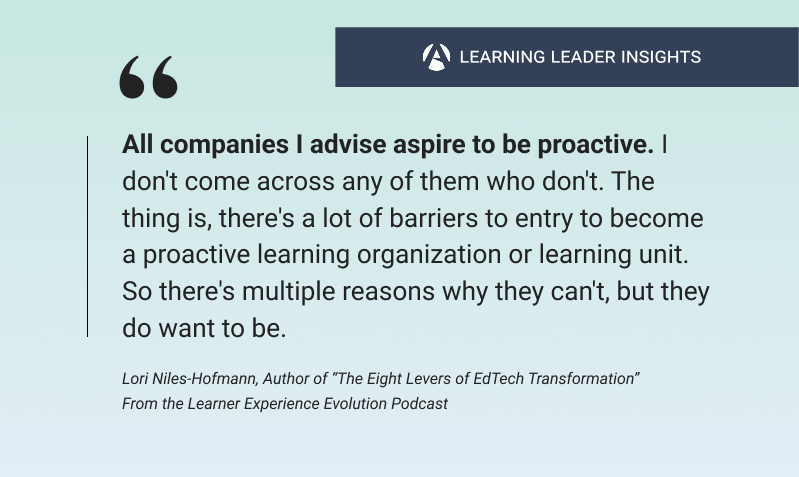
They aspire to be proactive. I don’t come across any of them who don’t. The thing is, there’s a lot of barriers to entry to become a proactive learning organization or learning unit. The first one is data. You need to have data because data is what allows you to… it’s the canary in the coal mine that you can then go out and say, hey, something is happening. What do I do with this?
I think the second one is also how they’re structured. A lot of times L&D is lower on the ladder, and they may not even have the autonomy or the authority to push back. For example, if you see a chief learning officer will have chief in their title, but they may only sit at a director or a VP level. So they don’t have the political capital in order to do the proactive things.
And I think the third one is that the way that they’re budgeted. The L&D department usually gets an annual budget and they agree that these are the things that we’re going to deliver. This is what we’re going to pay to say, consultants or vendors, and we will have X number of learning widgets by the time we reach December 31st.
And that also really becomes a rigid way of chaining you to just being in reactive mode. So there’s not a lot of incentive always to break that. So there’s multiple reasons why they can’t, but they do want to be.
Ron Zamir
Yeah, and I think, you know, I’ve always been taught every structural challenge is also a structural opportunity. And, you know, as AllenComm, we work with so many corporations. In fact, our latest podcast was one of our customers who’s taken the structure of her learning department and turned it into an opportunity.
Where do you see opportunities in that structure? And we’ll get into governance in a minute, but how do we turn some of those lemons into lemonade, so to speak?
Lori Niles-Hofmann
Of course. I love that perspective because I’m all about the fact that the juice is worth the squeeze. So we can definitely get to lemonade. I think the first one is adopting a data-driven mindset. Understanding that you may not be able to get all data, but see what you can get. And don’t take no for an answer.
So what do I mean by that? Go to IT and just say, hey, what things are you even tracking? Can you tell me what people are searching for? Can we get a summary anonymized of people’s goal setting for the year? These things give you a wealth of information. So small things like that is a really good place to start.
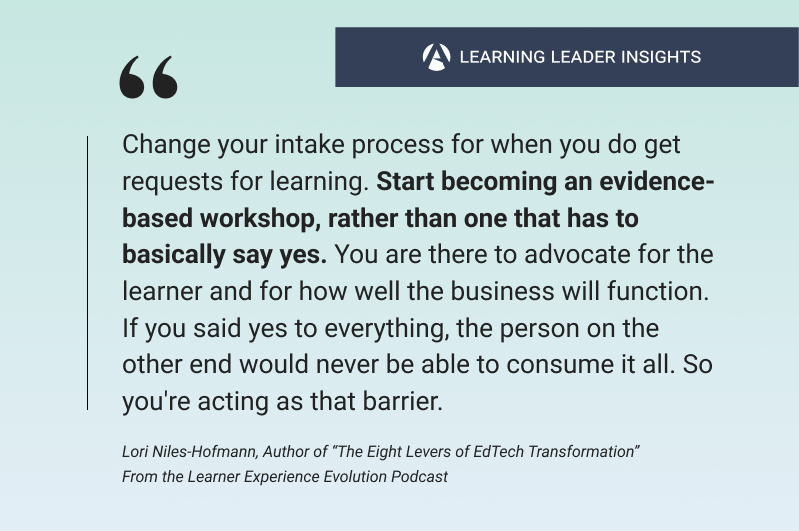
The other thing is to change your intake process for when you do get requests for learning. The first question that I always ask is, what is your evidence of need? So start becoming an evidence-based workshop, rather than one that has to basically say yes. So you’re flipping the script a bit, but it’s not because you and L&D want to make your life easier and you want to say no to things. It’s ultimately framing it and reframing yourselves to the business, which is also a marketing exercise that you are there to advocate for the learner and for how well the business will function.
If you said yes to everything, the person on the other end would never be able to consume it all. So you’re acting as that barrier. You need to have that rebranding of yourselves and what you’re advocating for and your role within the business.
I think the other thing too is finding a very senior stakeholder that you can sit down, they need ideally to be C-suite, to sit down with them and say, these are the ways that we want to change the way that we’re operating. Will you be our defense? And will you run defense for us? And typically you’ll find somebody who will because you’re going to need somebody to give you ground cover when you start to do some of these changes. And that always works out to be a good thing, because now you’ve also too changed the way that you’re perceived in the business.
Ron Zamir
Do you find that these structural opportunities or impediments are tied to industries, or tied to personalities, or tied to investments in technology? Where does it play in those three dimensions?
Lori Niles-Hofmann
It’s all different for every company, depending. So I’m a firm believer that just to do good learning is not always about good tech. I’ve seen amazing learning run on like duct tape and paper clips. So that, I think if you’re hiding behind the tech, yes, there is bad tech out there, don’t get me wrong. But if you’re saying that’s the tech, I don’t necessarily agree it’s always the impediment. I do think personality is a big one right now.
There’s a real change on what L&D actually is and means to an organization because we now are at a nexus where we have a whole generation that needs to be upskilled and fluent in AI. That’s a time for L&D to step up. But our old mindset is not going to allow us to scale in the way that we need to. So I think that personality is definitely a barrier.
I also think it’s leadership, and this is an age-old problem, is learning takes time. You’re not going to give time, you do not have learning. And that’s an equation that has always, always been there. But companies see that as a drain on revenue and it has to start to be seen as an investment.
Ron Zamir
Yeah, and I think that’s a crucial point. We all know it instinctively that learning or gaining skills, turning those skills into competencies, it’s not enough to create a taxonomy of skills. It takes time to root them and anchor them in the organization. You talk in your book about culture and how that helps or hinders. I will say, and for me a reflective statement would be that there are areas like in call centers and sales-driven learning organizations that they are able to access the data much more easily.
When you come to more general like leadership and general code of conduct, general onboarding, it’s a lot challenging. I do advise our listeners, there is a podcast before this one with Gina from UnitedHealth Group. Listen to that one. She’s one of those personalities that Lori may have been referring to, but I know her to have that personality that is able to be more proactive than reactive.
One of the things that we found at AllenComm that is a good mediator between that proactive and reactive mindset is the governance of how you govern L&D in the organization, how the organization governs in general technology. Talk to me a bit about governance models and how they can transform an organization or, again, hinder an organization.
Lori Niles-Hofmann
Yeah, governance is a funny thing because people think it’s command and control, and it’s really not about that. It is about quality and generating the outcomes that you’re looking for. Especially at times like right now, I can guarantee in every company that there is what I call “shadow learning” creeping up somewhere. Sales has bought the minimum, like they bought 49, not 50 licenses, so it won’t trigger in the budgetary review.
So there’s all sorts of things that are floating around. Now, in theory, that isn’t terrible, but it actually is because now you’re getting tons of duplication. You’re getting waste. You also get somebody within the learner in the organization who doesn’t know which way to turn because now suddenly things are all over the place.
When I’m looking for governance, I’m looking for how do we make sure we turn the faucet on and off for the learners so that they maintain a steady flow. I always say that L&D should own the keys to their learning platform. And that’s simply because you don’t want to waste a whole bunch of time.
ISIS used to happen to me perennially. If someone would come, they’ve bought some modules, they now want to put them on the platform. These learning modules that we didn’t even need, that we had or we could have built better. And now I’m left holding this baby with a really stinky diaper and nappy that someone has to change and do the QA on, go back to the vendor and fix and get it running up on our LMS.
That’s not helping anyone and it’s certainly not helping the final learner. So for me, that’s the first thing is the governance is over the learning platform. But even before that, there has to be governance on what actually gets okay to be made. And I implement a process which is akin to a triage that you would see in an A&E or in an emergency room, where you’re really prioritizing requests. And when you do that, and we’ll talk more about that in detail, but… what you say yes to actually starts to diminish. And that’s a really good thing.
In one company that I did, we probably ended up saying no. I think we counted it to about 85% of requests. And that eventually made it up to the CEO who said, what on earth are you doing as L&D? You’re saying no to these things. And we sat them down and said, well, this is why we said no. And it was like, you’re operating as a business. So governance is also about operating as a really good business. And you’re managing your assets. And you’re managing the output and the quality.
Now, one other part of governance that comes up is about user generated content and whether people in the company can use it or not. Famous story, I was part of a launch of a learning platform where they made every single user view an 11-minute video on what to say and what not to say on the platform. That was ridiculous. To me, I actually prefer when you have user-generated content because you know what people are talking about. You know what’s important. It’s not on their phones, on WhatsApp, or on some separate Slack channel. You can see it in real time.
And quite frankly, if somebody says something offensive, well, you’re going to see it and treat it like you would in any other situation. It’s not the technology’s fault. That person, unfortunately, may have said it in any environment, but now you have it and you can see it and action it. So I actually really do believe in the power of user-generated content, although some people will not. So those are some of things that I consider when it comes to governance.
Ron Zamir
Yeah, I think for a shorthand for us, when I talk to one of our clients is I try to measure their governance model. How much is it more fear and compliance-based versus low guy of control and standard-based? And I find that governance models that create more of a structure to our relationship tend to work better versus governance models that are there to limit or to elongate processes.
We all know of the governance models which drive uploading content to an LMS to months versus governance models that create an agreed upon standard on how much learning or training a certain role should get. And you have to fill that bucket, but you can’t have that bucket overflow.
I’ve seen some really smart learning leaders structure relationships with their C-level executives based on governance that meets a mutual need of this is what we want a person to know, this is how long we want them to deal with that process versus we are just here to, like you mentioned, fill a yearly contract of work.
And there’s more to be said on governance, and I really encourage our listeners to challenge as a point of departure, always challenge your governance model, align it with your company’s governance models, which are usually tied to business objectives, something that you talk about as well.
Let’s talk about the ecosystem a bit. And I know you have some great stories. And from our perspective, we see extreme inefficiency in how companies gather learning technologies. They don’t call them ecosystems. They have xLMSs, xLXPs. Now they’re buying all these AI-driven tools for leadership, for sales, for call centers. They have their SharePoint. Now it’s in behind Copilot. And it becomes an amalgamation of technology which to me is hardly ever utilized.
And we look at the money spent on licenses versus on learning experience investments, and we say to ourselves, you know, why is the tail wagging the dog? Can you talk to our viewers and listeners a bit about the ecosystem and what are some of the best practices around that?
Lori Niles-Hofmann
Sure, so when I’m talking about the ecosystem, it’s all the things, it’s just probably anchored in your, I call it learning platform because honestly the learning management system and the learning experience platform share pretty much 90% of the same DNA, right? And it becomes a search engine optimization term for audience segmentation. So to me, I just see it as a learning platform.
Then there are things that are going to plug into it that are adjacent, so some call center technology that’s specific to how they need to get their learning. If you have remote workers, that’s probably going to be something that’s mobile-based, et cetera, et cetera, all around it. Then I even go further outside of it, and you have to look at the people tech that is around it. So any of the talent marketplace, that’s where people can go to gain experience to practice the skills that they need.
They may also be a skills inference tool. So a tool that is actually scanning how you operate within an organization to see how proficient you are at particular skills. And so you can understand that within your organization. Then that rolls up to an HRIS. So your human resource information system that’s going to then know everything, you know, and understand all the patterns within your organization. So the ecosystem is quite broad and it’s a good thing. L&D doesn’t own all of it.
Of course, once it starts getting into people tech, that’s going to start moving into HR, but you have to be aware of how the data flows between them in order to really get the maximum out of it. To your point, Ron, I see all the time, you know, people… tech is bought and they say, this is going to be a shiny thing and it’s going to do this amazing stuff. They haven’t piloted it. And then it comes up with nothing, right? I don’t want to name any certain brands, but I’ve seen one that I’ll tell is I was at a company where they really were pushing an app.
And they said, you know, app-based learning is how everybody’s going to learn in the future. We beat that dead horse as much as possible to get this group to use it. We couldn’t get less than 2%. And what we found out is that just that everyone was saying, I don’t want a work app on my phone. I don’t want a work app on my personal phone. So lesson learned there.
Anyway, going back to the ecosystem, why we need ecosystem thinking is primarily based on what I call the supply chain management of skills. So it’s looking at the skills you have as an organization and thinking of them as product codes or product SKUs, and how you manage them across is not just in the growing place, which is L&D, but it could be… you buy them or you build them, or now even people are talking about bot. So what can be done by AI? So let’s look at what that ecosystem would look like and how that spiral works.
So the company has already forecasted this is how they’re going to pivot into a new market over the next three to six months. Then they have their HR system scan the skills that people have and understand what’s in their library. Then they look at what skills are predicted to be needed for that organizational shift. And it looks at the entire organization and people and their list of skills who might have adjacent skills, who might be in a position to acquire those skills.
And then that’s where learning comes in. So they say, okay, we’re going to build these skills or help you grow them. And then that information then gets fed back into say the talent marketplace where you get a chance to practice them. And now we have this relationship of these skills being created at a point of particular need. And it also comes down to being, again, that ties into being proactive because we’re actually at that point when this gets identified.
Now I’m putting it in a really reductive sense, it’s kind of like, again, supply chain management. I don’t want too many skills because they will rot. I don’t want too few skills because I may have to buy it on the market at a premium. So I need to maintain that constant level. And I can only do that when I know what’s happening in the people system. I know what skills are available on the market. I know what skills I have. And I combine them together.
Ron Zamir
I mean, two insights that I get from what you say is one, we have to relook at the artificial divide between L&D and talent management, right? That’s number one. And the second thing, which we see a lot, well, I’ll say three things.
The second thing is that content is siloed versus flowing into the, I’m going to talk about context in a minute, flowing to the learner at their point of need. And the best indication we get is when I sit in front of a learning leader, or a talent manager, or even an executive and say, so how much are you spending on your subscriptions? And it comes to that. And even getting to that number is a first important step. And then the second question we ask our customers is, do you know or have you mapped out the redundancies? Right?
And number three, do you have an idea of how much you’re using of the features and functions of the system you’ve invested in? And we find just by asking those three questions, we open a gateway to a relook at an amalgamation of technology, not an ecosystem. I really, really support what you say because I think an ecosystem is something that mutually supports the different pieces and it serves somebody and something. And if you can’t define that then you really don’t have an ecosystem. You have a series of expensive subscriptions that you’re supporting.
Lori Niles-Hofmann
Completely agree. I love the positioning and how you brought it down to the three because I think that those are super important questions to ask. In that vein, an exercise that I do run my clients through is we call it the brown paper exercise. We get craft paper, we pick a room, throw that up on the wall, and everybody puts all the interactions that you’re having with a learner. How many systems touch them? When they touch them? What happens?
And you start to map up the entire thing, and then we reframe that entire process and say, okay, let’s rethink this. Cause all of a sudden you’re thinking we’re sending 300 emails because all these systems are not talking to each other. It doesn’t make sense. How do we refine that down? And also when it comes to subscriptions, what percentage of people are actually using them? I think that’s a whole other one when it comes down to content, what are people using?
Ron Zamir
Yeah, and the idea of is content really the right metaphor? I will say we did a similar mapping for a major bank in the US, and we found that over 70% of the interaction around learning, as defined as how people access content to inform them on their jobs, was done outside the EdTech ecosystem.
It was done in SharePoint. It was done on product portals. It was done on information websites that were created internally to support different business units. And I think AI, we’re going to get to AI at end, I promise guys. I think that is going to be a game changer. So let me flow from the ecosystem to something that we alluded to is content. Remember that content that exists in every different type of LXP, LMS, cohort-based system to context. And you have some great insight on context versus content. So let’s talk about that for a minute.
Lori Niles-Hofmann
Yeah. All right, so I’m going to tell my toilet paper story because I think this is the one that illustrates this the best. Hopefully, Ron, this is palatable to your learners. I swear I was not hoarding toilet paper during the pandemic. This has a legitimate need. So like most people, I buy groceries once a week and that’s when my husband and I will do a larger shop. But we do go in between. We buy toilet paper amongst all of our other toiletries and groceries. We usually go to the same place.
Now what happened was one day as we were walking to this grocery store, I got a notification on my phone and it said, hey, would you like $3 off of the toilet paper brand that you purchased? And I’m like, yes, please. Because you know, toilet paper does not have to go on sale technically because you’re going to need it. So I said, yes, please. But it made me think of all the pieces that came together to make that meaningful and why context is so important.
For one thing, it knew my patterns. It knew when I was likely to go to the grocery store. It knew the price that I was likely to pay for toilet paper and why that would be tempting for me. It also knew the frequency at which I bought. It probably knew the size of my household based on my loyalty card. It pulled all those things together to give me a meaningful piece of information.
Okay, now. This was in a marketing context, but if we put it into a learning context, we need to think less about having, and there will always be time for very focused learning, but also learning presented in context that allows for greater practice that allows for feedback in Institute. So, and I think you have to have those three things have to be put together in order to land you in context. And that is the content, the actual, what the content is going to be. Data. And then location and background information about the person and that leads to the context.
So imagine if you are thinking about somebody who’s acquiring a language within your organization. Well, what would it mean if the next time they logged into Excel, it said, hey, do you want to change your language settings to Spanish? That’s a huge way of contextualizing learning, even though they’ve taken some content, but now you’re putting it into where actually they work. And that can be extremely important.
The idea… when we talk about, when people talk about having a chat bot or an agent or a Copilot, in a lot of ways, that’s just context based, right? But the user is actually setting the context, like I need to know this now, can you farm it from all these places? So context is incredibly important, and we need to be thinking about that more so than content. I have a whole bunch of thoughts about static content because I do see that as even eroding in favor of far more personalized experiences.
Ron Zamir
And again, to our listeners, this is not science fiction. There are companies now that we work with that are using algorithms to understand their employee journey throughout the different parts of the organization and tying into different parts from if it’s compensation, if it’s general AR, if it’s progression on their career path.
And of course, when you look at some of the new AI-driven skill based systems, we mentioned Eightfold before, Prelim, we were in our green room, so to speak. There’s a lot of things happening around there and you just have to be open to it. I will say again, the reality is we have to live within our customer silos. For AllenComm to be a good steward of our clients, we definitely try to map those out and recommend ways they can break out of those silos.
You know, onboarding has its own silo, you know, leadership training, product-based training, of course, code of conduct and compliance, and trying to break them out of those silos is, I think, not any more a holy grail of our industry, but it’s something we could progress to.
And I want to cover on two more topics before we have to finish. One is some insight, and again, it ties back to that proactive versus reactive stakeholder or… management. How do we manage up as a learning organization? I think we talked about that. We can talk a little more. And lastly, AI. I mean, for many, AI is the Aladdin’s lamp. And we get more than three wishes, we hope. Where do you see AI being the accelerator for change? Where do you see it being sometimes something to be wary of? So talk a bit about stakeholders, but let’s go right into the AI question.
Lori Niles-Hofmann
For the stakeholders, none of this is new. You have to speak the language of your stakeholders and you have to operate as if you are a business. One of the best things I ever did, when I was running a learning unit within a large bank, was I implemented a software called Workfront. Workfront is actually a project management tool used by marketers.
Okay, so it didn’t even have anything to do with learning. But what it did is it allowed me to operationalize what we were doing in learning, and I could actually turn back to them and say, hey, you know, because of these delays, look at how you impacted all these projects, or this is how much time we spent on leadership versus compliance. And I could bring that to them as a business. You need to operate as a business.
Once I turned the key on that… and you don’t even need software. There’s a lot of things you could do other than software. I’m not promoting any particular software. But once I spoke that back to them, it was like, oh, I get this now. So the stakeholder management, that’s it. You have to be there with data. You have to be there with hard facts.
The best thing I always ask with stakeholders, can you help me say no? If you really want to help me have my back when I say no. And that is a big part. Then there’s always those stakeholders in your ecosystem that you need to think deeper about. I talk about in the book, I plot them on an axis versus how much they know about learning versus how much influence they have. Don’t let anyone ever see that axis. Ask me how I know, I put it on SharePoint once, but that’s a whole other story.
But you plot your stakeholders on that. And that also gives you ways to think about how to manage them. If they really know a lot about learning and they’re high in influence, you have to pay attention to that person and make sure that you’re answering all their questions. Some might be… you can actually be a little bit more low fidelity with them. So that’s how I approach in a very broad nutshell, stakeholder management.
The other one, when you talk about AI, okay. So many things happen there. I think where L&D is stuck is in the generative phase and how do we get it to write courses faster, and how do we take a course, and get it to write quiz questions for us. And that’s all great, and it’s shorthand, and it works relatively well for what we need it to do. But really that’s just pushing out a course in the vision of what we’ve said is a course. It doesn’t actually link it to any impact. It’s not learning how people learn. It’s just a static piece of content. And sometimes, you know, that can get you through what you need to do and you can work it through that way.
But where I’m getting more excited is about agents and agentic AI. And that is where we work on something that I call the virtuous cycle. Some people call it the self-healing course, where we provide a body of knowledge. It produces a course, but then it looks at all of the data points as people go through it. And it says, that actually didn’t work quite well. That worked really well. And it constantly refines the course to iterate and make it better.
Then it can go to the personal level. So we’ll know all the things about me. So if it were a course on sales, it would know what region I’m in, who I’ve spoken to, it’s probably connected to Salesforce. It’s going to know the types of clients and types of sales I’ve actually closed, what I’ve had challenges with. Now you see that, I mean, that’s just magic. Now you have the… you have gentified it to actually personalize and customize that content. We’ve always wanted to get to that and we know personalization works, but we’ve never been able to have the technology to get there.
But to get to that type of place, and there’s so many other things that we could get agents to do within L&D just from an administrative standpoint, but to get to that state, a few things need to happen. One, we have to be willing to let go. We won’t produce courses anymore. It’ll be more of these experiences with triggers that we orchestrate.
The second thing is our data needs to be clean and our LMS data running on SCORM is not going to be sufficient. So we need to, again, look at that ecosystem that we’re in and to see where data can be pulled from those places in a meaningful way that we can enable an agent to do the things that we want it to do.
And I think the third one is some bravery. If you go now online and you look at Google, AWS, Microsoft, all of their courses to teach AI are talking heads or click next to continue. They don’t use AI themselves to build learning, which to me is utterly fascinating. So I’m like, it’s sitting right there. And when I queried one company about it, they said it’s too risky. We have to sometimes maybe take like, maybe we wouldn’t use, of course we wouldn’t use AI to maybe do a compliance course, but maybe we could use it for something that’s a little bit lower stakes and start to learn from it. Something that isn’t going to destroy the business.
And having the bravery to do some of that I think is really important. But it’s going to change the way that we do things and hopefully for the better.
Ron Zamir
I don’t disagree, and as a company that makes a lot of money from creating courses, you know, we of course have been thinking about it for over two years now, and you know, I’ll give you my personal, I do believe that any citizen, corporate citizen, private citizen, family member, will have and should have an AI support structure.
In other words, all of our jobs will be AI mediated. We’re not going to lose jobs, but they are going to change. And I think part of creating that agentic model that gives a corporate citizen the support they need to stand up to the skills and competencies an organization needs, are going to depend on a lot of other things happening.
One, you mentioned getting all that structured data out of the structured silos, right? You mentioned SCORM. We could talk about xAPI. That’s a whole other podcast that we’re going to have about SCORM and the evolution of SCORM. Never the death. I won’t compare SCORM to other animals, but they evolve. They don’t die. They don’t stay the same. But I do believe that people need structure.
And when you onboard a new employee, you can’t just tell them wing it while the AI agent helps you. So we’re seeing now AI entering agentically through part of the processes. So when you’re being onboarded to a call center, you do have some formal processes, which are content in a context, but there is still a structure around it. Then you have some areas where you collaborate or receive customization, personalization, assessment driven by the technologies which are based on an AI platform.
I’m going to end with one thought which I hope our listeners will take to heart. The potential for change is now greater than ever before. It’s not because we were smart or we were dumb, but because technology is transforming so rapidly, it creates opportunity for us to change. That’s number one.
Number two, which I think is a great positive, we’ve just brought up, and I’m an old guy, we’ve brought up a whole generation of learning professionals that are very open and flexible in doing things differently. They’re not tied to a classroom into a course, or long-form learning to micro learning. That was a transition of the old school. I think we’re entering a new school where we look at algorithms, and agents, and experiences, and we just have to make those incremental smart choices so we can get to that new state of being.
Lori, you’ve been great. I parse this session but also read your book. So thank you so much.
Resources For L&D Leaders
free guide

free guide
insights | on the blog
ALLENCOMM Press Releases
AllenComm Earns Spot on Best Mobile Learning Content Providers 2026 List
eLearning Industry honors AllenComm for its custom mobile learning solutions for enterprise, built to improve performance outcomes at scale. SALT LAKE CITY, [July 29, 2026] — AllenComm has been named to eLearning Industry’s...
ALLENCOMM Press Releases
AllenComm Named a Top Employee Engagement Training Provider by eLearning Industry
AllenComm has been recognized by eLearning Industry as a 2026 top provider for employee engagement, cited for scalable, personalized L&D that drives measurable results. SALT LAKE CITY, [June 24, 2026]...
ALLENCOMM Press Releases