
ALLENCOMM BLOG | Podcast
Episode 27: The Future of Learning: Building An Innovative L&D Culture
November 17, 2025
What does it really take to drive innovation in learning and development? And what does it mean to manage your own managers in a way that gives you more creative freedom over this innovation, as well as the opportunity to provide strategic direction for AI adoption? In this episode, Rick At Lee, SVP and Enterprise Learning Solutions Director at Truist, meets with Ron Zamir to share his journey on these topics, with practical insights and examples, to help learning leaders like you carve out space for innovation and create a long-lasting learning culture that thrives.
Top Takeaways
- Innovation in L&D Requires Intentionality
- Start Innovating in Stable, Mature Areas
- Building a Learning Culture
- Freedom and Executive Buy-In Fuel Innovation
- “Managing Up” Through Data and Storytelling
- Relationships Are a Strategic Asset
- AI Works Best with Human Expertise
- Ownership of Personal Development

Rick At Lee, SVP and Enterprise Learning Solutions Director at Truist
Rick At Lee is the Director of Enterprise Learning Solutions at Truist, bringing over 20 years of experience in learning and development. Guided by a personal purpose to inspire growth in others, Rick has built a career around creating and delivering impactful learning experiences that help individuals and teams thrive.
Rick’s work spans strategic initiatives and hands-on transformation. He led a redesign of care center training that improved performance and elevated the teammate experience. He’s contributed to enterprise-wide efforts like Teammate Growth Month and created a framework that empowers L&D practitioners across the organization ensuring they’re equipped to succeed in a rapidly evolving learning landscape.
Rick holds a Master of Education in Training & Development and is a Certified Professional in Talent Development (CPTD). His approach blends deep expertise with a collaborative spirit, always focused on making learning meaningful, accessible, and aligned with business goals.
As a speaker, Rick has shared his insights at major industry events including the ATD International Conference & Expo and the Training Industry Conference & Expo, among other engagements. His sessions are known for being thoughtful, energizing, and grounded in real-world experience.
Outside of work, Rick is an avid traveler who enjoys backpacking and camping—anything that offers a chance to explore new places and perspectives.
Ron Zamir
Hello everybody, Ron Zamir here again from AllenComm. I am thrilled to be joined today by Rick At Lee from Truist. I do want to say again, I thank all our listeners for tuning in to talk about innovation in the learning space. So Rick, I’ll let you introduce yourself, and our first question is always around your personal journey. So, happy to listen and to explore that with you.
Rick At Lee
Yeah, so I am with Truist. I’ve been with Truist for 26 years now in a variety of different things. I didn’t start in learning and development. I started in the branch network, but then this was back many moons ago. We didn’t have LinkedIn or anything like that. A job memo came out with job listings in the company at that point, and there was a corporate trainer position. I was like, oh, that sounds like fun. So I applied for it.
I didn’t get it the first time. And then the second time I applied, I did get it. And I like to say that’s when I discovered what I wanted to do when I grew up: learning and development. It was … we were very much a jack of all trades at that point. We designed our own training, we delivered our own training, all of that was … we were a small shop at that point.
And truthfully, I didn’t really know what I was doing. It was as we went along, I did a lot of facilitation and eventually decided to go back and figure out what I was doing. I went back and got my master’s degree in training and development. And that was great because I got some of the background into it.
I moved from facilitation, then started doing dabbling in some instructional design work, and then led a team of that. And then I eventually took over the area that managed our LMS, and our facilities, and everything, and then eventually kind of came back and started, you know, taking over more of the design and other areas.
And so now where I am at the moment, my official title is director of enterprise learning solutions. So basically, the enterprise, we are the center of excellence for our organization overall for learning and development. I’ve got the centralized design, content management, media, learning media team, and then centralized facilitation teams report to me. So it’s been quite a journey. I wouldn’t have guessed that’s where it ended up.
Ron Zamir
Yeah, and I think the beauty is, and I could feel for you, because a lot of the people we have on this podcast came from different parts of the organization. And I would say maybe we’re seeing that change over the past five to ten years as more and more people are graduating with bachelor’s, master’s, even PhDs in technology and education. So I’m not saying me and you are a dying breed, but we are a breed in itself. So that’s good to hear. I think it is important to bring people from other parts of the organization into the L&D fold.
Well, you know, what I would like to explore with you now, is really about what this podcast is for, is innovation. We’ve always talked about as a fait accompli that we tend to be very reactive in the learning organization. I would say even in the talent organization.
And it makes sense. We serve the corporation, we’re there to help the corporation scale. But within that context, within those maybe constraints, I would love to hear some stories about how you and your team are able to innovate and take on initiatives, and maybe shape the organization from your point of stature or view in the organization.
Rick At Lee
The metaphor I would give to this is, if you remember this story of, you know … there was a professor that had a jar on his desk, and he said it was empty jar. Then he had these buckets of large stones, and then pebbles, and then sand, and then water, and stuff like that.
And he started by filling it up with the large rocks. And he asked the class, is the jar full? And they said, yes. Said, okay. Well, then he dumped the gravel into it and it filled in the gaps and everything. He said, is it full? I’m like, yes. It took the sand, it filled in, and they started to figure out what was going on.
And quickly, the takeaway they had was that you can always fit more in. He said, no, no, no. The takeaway is if you start with the water, and the sand, you’ll never have room for the larger rocks. And that’s when it comes to innovation. That’s really a good metaphor for this because the types of things for us to move the organization forward from a learning and development capability, those are things they are never going to be looking for.
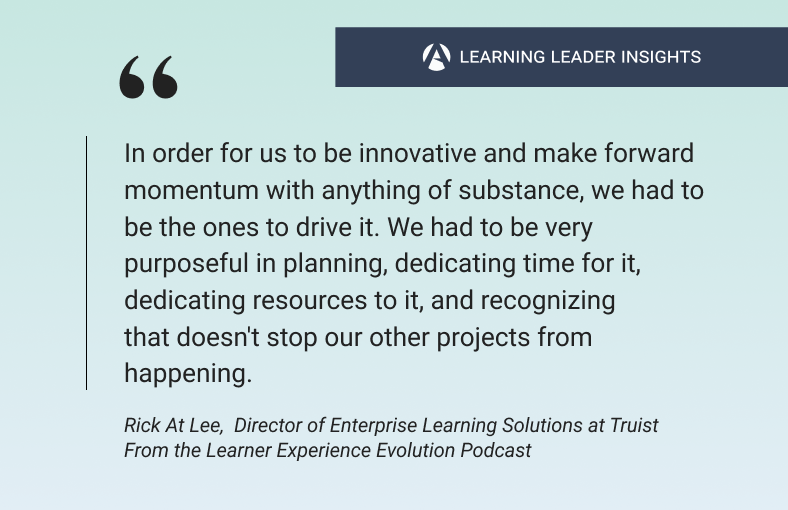
They’ve got all the other urgent things that are happening, the stuff that fills up the day. And if we didn’t plan for it, it’s not going to happen because our days will be filled up with all the fires that need to be put out. You know, dealing with just things as they are. And so for us that in order for us to make forward momentum with anything of substance, we’re really trying to drive some innovation in the learning and development space.
We had to be the ones to drive it, and we had to be very purposeful in planning to do it and dedicating time for it, dedicating resources to it, recognizing that doesn’t stop the other stuff from happening. The other stuff’s still going to have to happen. But we’ve got to protect that piece of it so we’re at least making continued movement towards it.
And then sharing that story, because when they hear about it, it’s exciting, but they’re not asking for it. And if they hear about it too early, then they’re like, well, that’s not important. We need you to do all this stuff first.
Ron Zamir
So, what would be some great examples? You’re almost carrying the organization on your back in some way or form with your programs.
Rick At Lee
Yeah. I mean, some of it is just as simple as … you know, one of the mistakes I made a number of years ago was that when we were trying to look at doing innovation, we were trying to innovate with the new projects that were coming in. And the problem with that was, as my team was, it was engaged to participate in new projects, we would say, hey, we should try this new thing or this new approach to it.
We’re well past that now, but maybe it was, you know, remote learning. This is, yeah, we’re way into that now. Maybe we should try that now and see what that looks like. And when you’re doing something with a new initiative, the stakeholders have a lot of fear and understandably of concern about failing. And when you’re innovating, there is room for failure in there.
And so what I learned is we can’t do this with those new projects. What we need to focus on is we need to find the areas that maybe even our, maybe programs or things that we’re doing, that are even somewhat mature already and lean into those, get buy-in from an appropriate stakeholder to say, hey, we’re not losing this, but let’s try something new.
Keep that going, but try it, innovate with a small group for something. Let’s try this and see how that works, because we think it might be better. And that was like, okay, okay, we’d be willing to do that. It takes some of the fear out of it, because we’re not getting rid of the old at the same time.
Now, more recently, a couple of the big rock things are … we just did, this was our second year of something we called teammate growth month. And basically it is a month long virtual and in person. It’s kind of a hybrid conference for our entire learning body. Part of our goal is to foster a learning culture across the organization.
Last year was our first year. It was an educational year. The first starting point with that, we knew we wanted to do this. Nobody was asking us to do it. They weren’t pushing for it, but we said, we feel like this is important because it will move us towards this goal of having a learning culture in our organization.
So we set that up. I was not alone in this in any way, shape, form, but the teammates I worked with got our most senior executives on board. That was key. We had to get, you’re going to support this. Maybe you can be part of it, present at it, tell the story with it. And we were able to get them on board.
And then we were able to get a month docked on the calendar for this. And then we just went to town. We threw a lot of things at the wall. And it was a challenging experience because it took of our time and our individual time. What we were able to show after the fact was the engagement of the teammates, because we opened it up to everyone. Anybody in the organization could register for these sessions or participate.
Ron Zamir
But you took the initiative, right, to get to draw people in. That’s great.
Rick At Lee
Yes, we did. Yes. And now what’s cool with that is that, you know, at that point, it was more of an intervention. It was a once in a moment, a drop in the bucket, but our goal was to make it where it was an expectation.
And so once that happened, as we turned into this year, the executives and teammates were like, when’s the next teammate growth month? Is it still going to be? It started to ramp up the interest in it and the desire to have it. And it became just something that’s expected now, which is just really cool. And this year was even better.
Ron Zamir
Well, I kind of want to unpack two insights which I find fascinating because I think they come from different ends of the innovation spectrum. One is it’s easier to innovate in areas that your organization feels pretty good about already, right? And that is contrasted with not your second point, but with something that we’ve seen through our work with so many companies, is a lot of innovation kind of comes on the coattails of a change management initiative.
But those are the ones that people are most nervous about, right? To your point. And I think a lot about how we see companies innovate currently in their call centers. And we’ll get into AI because it connects to this. But these are usually pretty standard, pretty established operations that companies have. They’re highly regulated, from what you say, the disclaimers, they’re highly distributed to different off outside of the US operations for call centers and stuff.
And we’re seeing innovation there because there the management is pretty solid. The metrics are in place, response time, escalation percentages, time on call and all that. And we’re seeing a lot of L&D teams kind of do what you just said, but I liked how you brought it up. They’re innovating there because the partnership is pretty solid and stable. There’s not a concern you’re going to go in and blow something up.
But then you have the other side of the spectrum, which you’re saying, innovation comes from building expectations, right, that don’t exist. And that takes a lot of guts. And it takes a lot of upper level management to give you that freedom. How much is freedom by the levels that manage you or that allocate funds to you? How important is that to your ability to innovate?
Rick At Lee
I’d say very important. We can try to innovate within what we’ve got. And in some cases, we’ll keep things small so that it’s not a huge drain. And so what we might do is come forward with, we think this is going to be beneficial. We’ll ask for the smaller amount to pilot it and test it.
And that’s a little bit more palatable sometime than, “We want $5 million to do something that we can’t prove to you that will work, but we feel good about.” So I’d say, you know, getting buy-in is essential there with the right leadership.
We’re going to come back around AI, but that’s very much what we’re running into with the AI implementation for us as well. Generative AI in particular, same type of thing. Starting at the top and getting that buy-in and helping them understand that before we take it down.
Ron Zamir
Sure. Yeah. Well, before I move to the next question, we’re going to talk about AI in the next segment. Talk a bit about, I call it managing up. What are some of the best practices you’ve adopted to help you deal with managing your managers in a way that gives you that leeway to lead and to innovate?
Rick At Lee
I would say I have a lot of good mentors even within my organization that have helped me learn to do this better. Honestly, Ron, I’m not sure I was great at it for the longest time. And I’ve still got opportunity to grow here as well with the things that I have found work either that I have done or I’ve watched others be very successful with.
First of all, of course, bringing the data. Here’s where we are, here’s what this looks like. Data you can’t argue with. And sometimes I think what’s funny is I think we make the mistake of thinking data has to be perfect in order to make the business case. And it oftentimes doesn’t. They’re not looking into the deep depths of it and everything, but if they see a trend and you can show them that, that’s easier to get to, then that makes the case.
Also, I’d say from my perspective, showing … I have found one of the things I love about what you’re doing. We’ve got the interacting with peers outside of our organization and seeing what they’re doing, what they’ve experienced, what they’ve been successful with, coming forward and saying, I mean, keeping it, not giving away any trade secrets or anything like that, other organizations, other organizations that we’ve talked to, this is what they’re doing. They’re seeing success here. That matters a lot.
Ron Zamir
Yeah, and that gives you lot of legitimacy, right? That’s data in itself. Hey, I was in a meeting and what you’re referring to, Rick, is our Learning Leader Connect where we bring in executives in the learning and talent space to share ideas, concerns, and best practices. And we’re members of that group. You don’t have to lead it because again, the ideas flow between the people. You know, I would say if I show up once a month, you know, I’ll plug that.
But there’ll be others, and we can put in the show notes as they say, we can put a link to that LLC page, whoever is interested or can send us questions. When I cross what you’re saying and some of our previous guests, three things come up, and I wonder if you agree with them before we move on to the next thing.
One is what you said. Data helps, even anecdotal data, even benchmarking data. The two we’ve heard a lot is trade-offs. It’s a lot easier to manage up when you come with options. And the tip is usually your middle option is the one most people pick. That’s statistically true. If you give people three options, they’ll usually grab it. It’s the middle. It’s a psychological experiment.
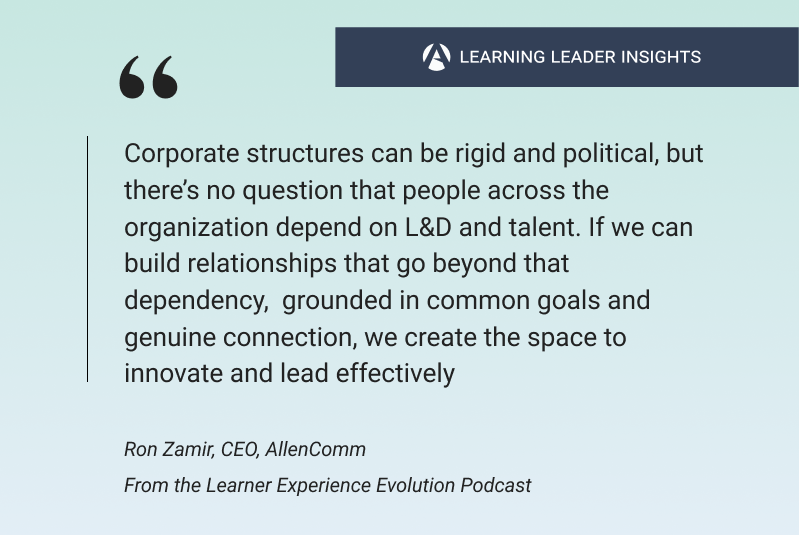
But the key, though, is I think that … are people that we have to report to like that we come in and give them options. So that’s the second one. And the third one, which sometimes I think I have the hardest time analyzing with people I talk to, but encouraging them to, is relationships. Yes, corporate structures can be rigid, corporate structures can be political, but there’s no question that L&D and talent, there are people in the organizations that depend on us.
It’s kind of that way you said about that program you’re doing. And if we can build those relationships beyond that dependency, but focus them on just commonality and friendship, it gives us a lot of space to be innovative and to manage. So those are the three things that I found most common. The last thing you want to do is turtle out. Go into your shell, because that doesn’t help anybody.
I will say one last anecdote. Sometimes the best time to ask is when they cut your budgets because then they have a feeling, okay, I’ve taken this away. What can I give? And again, that’s kind of that trade-off element, like the choices I mentioned.
Rick At Lee
Yeah. Well, and one add that, again, we didn’t do well for a long time, but we’ve been getting a lot better on is to managing up with that, is to be telling the story all along the way. You know, we have regularly … Yes, yes. Continuing not again. They don’t always ask for that. But if we are proactively telling the story about how things are going, what’s happening? Then that sets the stage.
I’ve told my team before, if we waited until we were asked, it’s too late. Because usually at that point, they’re asking because they want to cut at that point or somebody wants to try to cut.
Ron Zamir
Yeah. And again, you’re fostering a proactive culture, which I think is not as common as I wish it would be. Well, let’s move on to our next question, because a lot of people just tune in for this, is AI. It’s not just what is AI, because we all know what AI is, but how we’re adopting AI, where the challenges are, where the opportunities are. If you can share a bit about the AI journey within your centralized COE, and how is that tying to the bigger organization that’s adopting it.
Rick At Lee
Yeah, well, I’ll start by, you know, maybe this will help some folks feel a little bit better about their situation because I know I go into conferences and go into various different things. I hear all about it and like, my gosh, we are so far behind. Everybody’s ahead of us. And if anybody’s feeling that way, you may not be as far behind as you think.
Of course I work for a heavily regulated, large super regional bank. And so we’ve been very slow. They’re the larger organizations in our space, the truly national and global ones. So definitely made a lot more forward progress, but among our peers, we’ve been very purposeful in trying to make sure we are not going down the path of anything that could be dangerous for us.
Yeah, again, bank. What that means for us is, our overall framework and governance is handled by our technology team about that. We were going to naturally be slower to adopt. So we are still pretty nascent, I would say in our in our global generative AI journey.
There are certainly areas where we’ve already been dabbling in from an organization perspective. But for example, we just we just as an enterprise-wide organization got access to Microsoft Copilot like globally.
Ron Zamir
Yeah, we’re big fans, and there’s a lot to say just even talking about how you can take advantage of Copilot agents, Studio, and Foundry.
Rick At Lee
Yeah. Now, the other piece to that though, was we didn’t want, especially in the learning and development space, we didn’t want to be waiting until it was available to us in the organization to be ready to start leveraging it and see how we could do that.
And so that’s where, I mean, everybody says much the same thing with this. I was encouraging my team like, download Copilot, ChatGPT, I was like, we’re probably going to go Copilot. So you should check that out. Just start getting acclimated to it. And we’ve got LinkedIn Learning. There’s some resources there. The goal is to get comfortable with using it, and putting in the time, and seeing what’s possible so that we got that.
And then we started pulling in and experiencing with other organizations like Howard. They are leveraging it from a learning and development perspective. What capabilities are from an AI perspective already mature, like role play practice, which I would say is pretty mature at this point? And how will we be able to use that? Let’s make sure we understand that so we can then, as I talking about earlier, they’re probably not going to ask us about it. We’re going to need to bring that forward and say, this opens the door to this. Let’s try this now that we’ve got access to certain tools or let’s give this a go.
So yeah, that’s that from a global enterprise perspective. I love how our organization is, again, we’re pretty early, but we’re handling the adoption. We had a group of people, I was included doing that, that was a pilot group to test out the Copilot capabilities and start to use it.
But we very purposefully, yeah, I think. I’ve heard some organizations just kind of opening it up to the lower echelons of the organization. And what I’ve heard sometimes is that adoption actually suffers in that case. And so what we started with was we actually started with our C-suite and our senior leaders at the organization, and we started to introduce them, and get them access to it first, and push them to actually use it so that then they would be evangelists for using it and pushing it to that.
And so that’s been good.
Ron Zamir
Well, that’s true. Budgets flow up and down. They don’t flow up, down to up. Yeah.
Rick At Lee
That’s right. That’s right. So because it’s still change. And so using it is still requiring a change from, and so most people are going to naturally not change if what they’re doing is working and they don’t know what they’re missing at that point.
Ron Zamir
You know, a lot of the criticism I’ve heard about AI adoption, it stays in that play mode. What do I mean by play mode? The experimentation mode, the pilot mode, and the challenge is to find a way to scale it. And usually, when we’ve had to scale it or when we advise clients how to scale it, we gravitate towards benchmarks.
I mean, the way to analyze how an AI agent or even an agentic process which takes over like in our world, something that helps you outline content or curates content for you, right? Those are work hours. You would usually have a person doing, you know, or you would do very manually in a few steps is understanding how your organization functions and what are your benchmarks.
Like we have a lot of clients use Articulate Storyline and Rise, and they’ve launched quite a lot of, and Rise for sure, it’s AI, everything almost, but Storyline has some aspects of it that have AI assistants or agents. What is the pre-AI and what is the post-AI? And how do you use that to convince your organization that this opens up opportunities to do stuff?
We supply a lot of people to different organizations at a monthly, quarterly, or yearly basis. And we’re now looking at what is their level of AI acumen so they can bring to our partner some of that just from the outside. Have you guys benchmarked any part of your process yet to see how AI would transform or change it?
Rick At Lee
Mm-hmm. So for the learning and development space, I can speak to that. If you think about AI adoption in the learning and development space, one of the lower hanging fruit is efficiency in the design and development, and using it to create more efficiency.
And so, yeah, the benchmarks that we’ve done is that we believe that the design and build of custom learning solutions, especially the earlier phases of that design process, we are expecting that that will increase our speed by as up to 50%, potentially. Yeah.
Ron Zamir
Yeah, we’re seeing that here. So the outlining, the definition of learning objectives, maybe for some of the early script, for sure on assessments, we’re seeing over, actually I would say it’s over 100%. Just creating assessments. I mean, you get into how do you review it, how do you confirm that there’s no issues with it?
Rick At Lee
Even so the content writing, assessment writing and stuff like that. So much faster. Yeah. You still need to have a human in the mix to do that. I had a number of folks from my team attend a generative AI intensive that ATD was doing. It was like a bootcamp kind of thing. And I mean, it wasn’t capabilities that we had. So we kind of did it all through our own personal computers and stuff like that.
But we were even building agents, which is not something we’re going to be able to easily do within our organization. But to see what was possible through that was eye-opening for my team and got them really excited about what was going to be possible. It became less about the fear that it’s going to take my job. Because what they saw through that, too, is that the most impressive outcomes from using it those AI tools were when it was partnered with an expert that knew what they were looking to get out of it.
So, you had somebody that went from basically nothing to a two minute, almost video. It wasn’t perfect, but a video, and showed the process of the script, the character creation, the script writing, the outline, the script writing, and then the video creation. But the reason he was able to do that, and he did it within an hour, he could only do that because he knew what he was going for. He could prompt it well, and you could see that. And he knew what was good. The generative AI tool did not. And so it was going to be limited.
Ron Zamir
I think that brings up a good point. The only way to really use AI, affirm it, review it, optimize it, is by somebody who knows the craft of what the AI engine is doing. That doesn’t mean we won’t get to a future where, and by the way, just for our viewers and listeners, we use the word agent a lot. We found here at AllenComm, as we create multiple agents for every aspect of our design production cycle, is that it’s really about creating the structured query and how you want the results served back up to you.
So these become tool sets just like you would have when you created a macro in Excel. And that to me is the easiest way to explain it to really impact some of the fear and anxiety. Well, this guy’s now going to do the scripting for me. No, he’s a tool for you to script better and faster, and then you’re going to be fine tuning that script, and using AI to fine tune it sometimes is a way for you to now create five versions of that script for different audiences.
So now we’re getting into personalization. We’re going to see a lot of that. Are you guys using any AI simulation tools for conversation simulations yet?
Rick At Lee
Not yet. We are moving in that direction, but it’s a process for us. We talked to some even over the last couple of years, because again, that is one AI capability that feels pretty mature for, you know, there’s a lot of services that are providing it and some better than others, obviously, but it’s pretty sure. And so the ones that I’ve talked to have seen a lot of value in that capability. So I’m really excited about it.
Ron Zamir
Well, let’s move to the last segment, which I really like. It’s really about, okay, and you’re a poster child, Rick. You’ve been doing this for so long. So now, think of that guy that got that first rejection from applying to the job, and now he persisted and got that second approval. What would you tell him now that you know that would help him thrive and grow in your job?
Rick At Lee
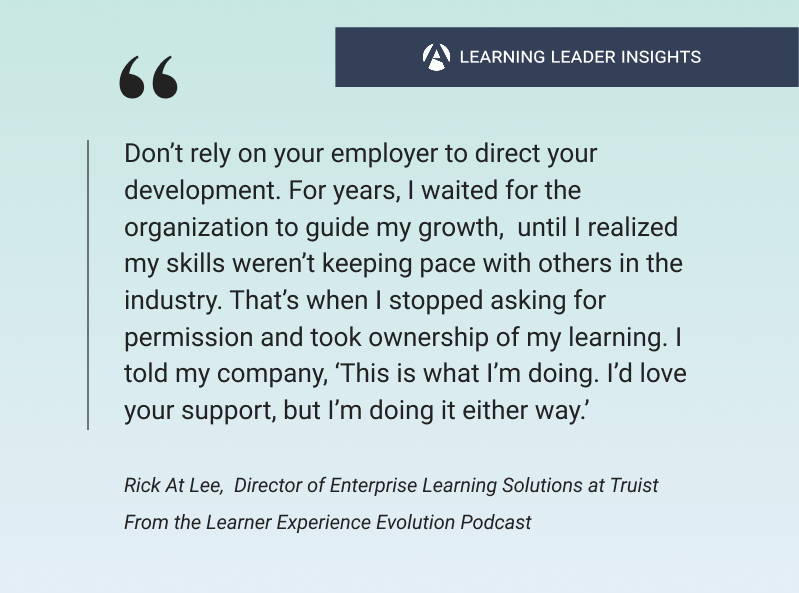
It took me far too long to learn this. But what I would tell them is that is do not rely on your employer to direct your development. Do not reply to your employer to direct your development or your personal growth and development. For the longest time, I was stuck in the learning and development knowledge and experience I had to the organization I was in because I was just looking for the organization to provide that for me.
And it was, gosh, it was probably seven, eight years ago that I finally had, yeah, there was a moment in time where I realized that I don’t think my knowledge and skills are up to snuff with people in the industry outside of my space, and I need to be able to do that. I basically changed from asking permission to “I’m going to take control of my own growth and development, and I’ll say this is what I’m doing, and I’d love for company to support me, but I’m doing this anyway, so you can support me or not.”
Thankfully I work for an organization that supports growth and development. And so that’s not been a hard push, but taking responsibility for my own growth and development has been essential because that’s not only opened my network, and my own knowledge and skills, but that’s even improved my career inside the organization for some of the reasons we’ve talked about already. So yeah, that’s what I’d tell that younger me who took far too long to figure that out.
Ron Zamir
Well, I think that’s really sound advice, and I hope that people leave this whole session we’ve just had with you with that ringing in their ears. Take responsibility. So with that, I will thank you immensely, Rick. You’ve been a good partner for AllenComm. Hopefully, we’ve been a good partner to you. But more importantly, it’s good to have you as a peer and see how we’re both developing in this pretty amazing industry.
Rick At Lee
Thanks, this was fun.
Ron Zamir
Okay, we’ll sign off now and hope you join us in our next podcast.
Resources For L&D Leaders
free guide

free guide
insights | on the blog
ALLENCOMM Press Releases
AllenComm Earns Spot on Best Mobile Learning Content Providers 2026 List
eLearning Industry honors AllenComm for its custom mobile learning solutions for enterprise, built to improve performance outcomes at scale. SALT LAKE CITY, [July 29, 2026] — AllenComm has been named to eLearning Industry’s...
ALLENCOMM Press Releases
AllenComm Named a Top Employee Engagement Training Provider by eLearning Industry
AllenComm has been recognized by eLearning Industry as a 2026 top provider for employee engagement, cited for scalable, personalized L&D that drives measurable results. SALT LAKE CITY, [June 24, 2026]...
ALLENCOMM Press Releases