

ALLENCOMM BLOG | Podcast
Episode 28: Future-Ready Learning for the Frontline to the Flightline
December 8, 2025
Innovation, evolution, and humanity in L&D: we’ve talked all about these three things on our podcast so far. But something has been missing. There was a voice waiting to be heard. And Dana Durham, Learning & Design General Manager at Delta Air Lines, is here to share it — the words of learners across the world, and what it is they feel they truly need to succeed. During her conversation with Ron, Dana dives deeper into actions leaders can take to better immerse themselves in operations, uncover what learners need to thrive, foster cultures built on support and workplace safety, and design learning pathways that lead to more impactful outcomes.
Top Takeaways
- Innovation continuously shapes modern L&D
- Training must adapt to diverse, evolving learner populations
- Short, focused content improves engagement and retention
- Hands-on practice and simulations build real-world confidence
- Benchmarking and cross-industry insights drive smarter decisions
- AI and VR enhance learning through realistic scenarios and feedback
- Listening to learners reveals true training needs
- Frontline immersion helps design training that matches real work

Dana Durham: General Manager of Learning Development & Technology at Delta Air Lines
Dana Durham is a seasoned leader in information technology, innovation, and learning, with more than 20 years of experience shaping how major industries learn and grow. For the past nine years at Delta Air Lines, Dana has championed the integration of cutting-edge technology and creative learning strategies—elevating the experience for frontline teams and leaders alike. Her background spans programming, project management, innovation strategy, and data analytics, fueling her drive to reimagine how people consume information and develop new skills. Dana’s passion is advancing the future of learning—continually pushing boundaries to deliver meaningful impact across organizations.
She lives by the credo, “Stand for something or you will fall for anything,”—a guiding principle inspired by Rosa Parks that shapes every decision and innovation she leads.
Ron Zamir
Welcome everybody to another episode of our podcast. I am thrilled beyond thrilled to have Dana Durham here joining me. She is an executive at Delta. She will share more about that.
As usual, we’re going to spend a little bit of time talking about innovation in the L&D space. We’re going to explore some personal stories and of course talk about the things that we are most interested in these days.
So with that, Dana, if you could introduce yourself and we’ll get this going.
Dana Durham
Yes, so thank you guys for having me. I really appreciate it. Dana Durham here. I am a general manager with Delta Air Lines, specifically over airport customer service. We focus on frontline employees, so Above Wing and Below Wing. So everyone who you interact with at the airport from your lobby and gate agents to your Below Wing agents, when you talk about the people who push the planes out or your baggage handlers.
And so we train any and all of them. We have about 40,000 employees that we train on a regular basis. So that’s what my area covers today.
Ron Zamir
But as a 2 million mile Delta flyer, I am very happy that your training works because it does because I’m still flying Delta. I may not get to 3 million, but I will do my best.
OK, so let’s get started. And I think, you know, all of us have come to our jobs in many different ways. That’s the beauty of L&D And I would love to hear a bit more of your personal journey. What got you to where you are today? How did you navigate your own career to get to be in charge of training 40,000 people?
Dana Durham
Great question. So I think my journey is different and maybe similar to many of you. I started off in the IT world, right? And so information technology has always been my baby. I love it. And so I really moved from programming and project management and made my way into more innovation.
And so while I’ve been in tons of consulting companies for years and years, I’ve kind of been in the IT industry for about 25 years and then made my way over to Delta about nine years ago. When I came over to Delta, I started working in the innovation and strategy space. And then as you mentioned, I was almost a million mile when I came off the road. I had traveled Monday through Friday for a long time, for almost 15 years.
I flew Delta religiously, and so one of the things I always talked about was how do I continue to create that customer experience and how do we elevate that customer experience across the board? And so when the opportunity came available for me to work at Delta, it was a no brainer.
When I came in, I was running the innovation and strategy area and helping them to understand, “How do we continue to push the envelope for our customers?” Innovation and strategy led into helping to train our employees on different things in the IT space.
And then I came over to airport customer service. In airport customer service, people think about what happens, you know, just on the front line. But if you think about everything from safety to just basic skills, and then also what technologies are we utilizing in order to create that breadth and depth of knowledge, that’s kind of where I kind of got into the learning space.
It feels like I’ve always been in the learning space, but I really started to say, we’re trying to take those technologies and bring about a new experience, especially when you think about not just our customer base, but our new employee base, right?
And so prior to COVID, Delta’s employee base was very senior. We talked 40 years and plus. That changed a little bit after COVID happened. And so now we have a newer generation of employees. And we start talking about the generations where, you know, they’re on their phones all the time. They want easy training. They want something that’s not 30 minutes anymore. They’re looking for more five minutes or less. The attention span has definitely changed and what their need is for training has changed.
And so me moving into this space has helped us to look at what are the different things that we can do differently in order to make sure that we appeal to our newer generation and our newer learners, but also how do we make sure that we’re giving them just enough information to make them successful, but also providing them that more hands-on experience.
That’s kind of my journey, and we continue to evolve, and the partnerships that we have with great companies like you all is what helps us to be able to stay on that cutting edge of technology.
Ron Zamir
Yeah. And that kind of leads into the next question. I like what you said about the changing learner population. Now the objectives don’t change. Do you want to serve your customers the best? You want to, you want everybody to be safe. You want your employees to be safe, your customers to be safe. Again, I fly in the planes. They want us all to be safe, but their audience changes.
And so how do you innovate? You know, when we look at the concept of innovation, I mentioned this a lot in this podcast. We are kind of limited in L&D or in change because we’re reacting to what our company wants. Share a bit about how you and your team have been able to drive change and innovation in circumstances where sometimes you have to make compromises and work within the platforms you’re given.
Dana Durham
Yeah, that’s a great question. One of the things I try to start off with all the time is around staying connected to my counterparts across Fortune 500 companies, right? We always talk to other organizations to see what they’re doing, how their people are handling change, and what are some of the things that they’re doing differently. That helps us to level set.
At Delta, we try to stay on the cutting edge, but fall a little bit behind the cusp of things. And it helps us to be able to be a little bit more vigilant around what others are doing and what’s really working. From an L&D perspective, right now, AI is definitely on the cutting edge and everyone’s moving towards that.
We’re a little bit behind the eight ball when it comes to the utilization of that. But we definitely want to make sure that not only are we partnering across lines with other industries, but we’re listening to our learners more. And so we formulate a lot of focus groups. We hear from them.
What did you like about our current training? What are things that we can do differently? And then what are some of the ways for us to be able to innovate more efficiently and become more efficient? And so those are things that we really focus on from an overall technology perspective.
I was going to say in addition to that, when we start talking about some of the technologies that we’re using, one of the ones that we’re recently starting to change, and you all helped us with this, is our Below Wing Ramp Up program, our onboarding program. It’s our onboarding initiative today.
Our existing ramp program is about six weeks of training, and you start thinking about literally someone sitting in the classroom for six weeks and someone talking at them. And that’s what we’ve been doing for 40 years. Our training has not changed in 40 years. And so we said, “We have to improve this, right?” Because what we were hearing from our learners was like, “I’m literally drinking out of a fire hose, right? I’ve never been up to a plane and in person with an aircraft ever besides just getting on one.”
And so being in such a dangerous environment is something that we want to take great care of, and then making sure that people feel safe when they go out there. And so what we’ve done, we partnered across with you guys looking at just industry standards and ways that we can improve learning, is really starting to listen to our frontline.
And they said, “Hey, we need more hands on. We need to be able to … before we get out into the operation, how do you get us more hands on experience? And also someone talking at me for six weeks is not helping me either.” And so we’ve incorporated more of a flipped classroom approach where you have some interaction from an eLearning perspective, and you’re going in, and you’re taking courses, and doing games, and things of that nature, simulations.
And then you have the instructor-led piece as well where they’re really starting to explain the concepts that you’ve already learned in more detail. And then we’re bringing in things from the from operation. So if they’re talking about bag tags, we’re bringing that in and we’re walking through this is, you know, a beginning destination to a destination and what that looks like. How do you properly handle bags? What happens when you go out into the operation and you’re seeing this big aircraft, right? How do you stay safe? And so we go through all of the safety tips and things that are as well.
And then before we take them out into the operation, we’re using things like VR technology where we’re putting them in the operation. From a VR perspective where they can kind of look around and see how things are fast moving, right? Not just the planes out there, but you have catering trucks, fuel trucks, you have all of these things around you. And so around staying vigilant, what are you going to see? How are you going to feel?
Working through VR in those instances, but we also have driving simulations. We put them in kind of a driving simulator where they are maneuvering around tugs. If they’re driving a baggage truck, they have to maneuver in and out of cones and things like that. So it provides them more of a hands-on experience without putting them in harm’s way right away.
So those are some of the things that we’re doing with our onboarding program. And we have quite a few more that are coming down the pipe that we’re going to continue to do those things as well.
Ron Zamir
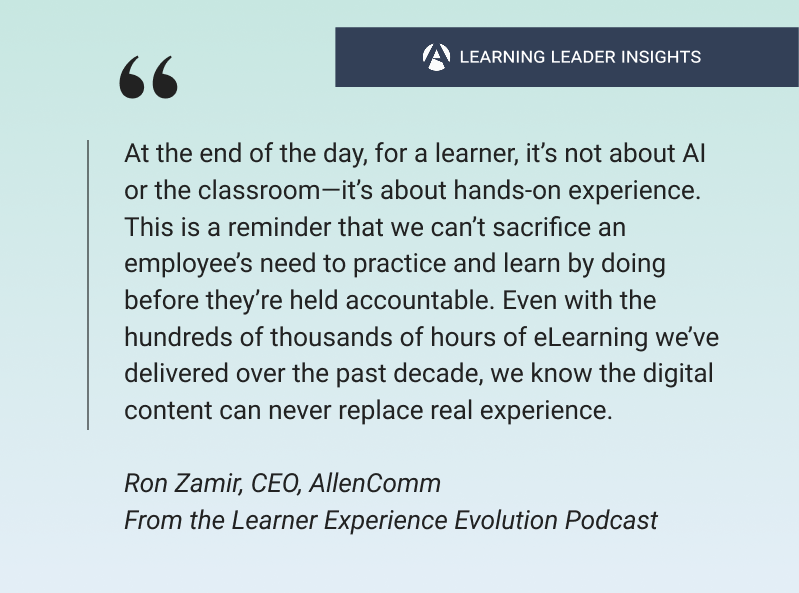
I think what fascinates me is, and we’re going to talk about AI in a minute, is that at the end of the day for a learner, it’s not about AI or classroom. It’s about that hands-on experience. And I think this is where maybe even a cautionary tale that we can’t sacrifice, the need of an employee to really experience before he’s kind of held accountable, but learn through doing.
And we’ve said as a company that does hundreds of thousands of hours of eLearning over our past 10 years, and thousands a year, is that you can’t let that take over the experience. And I think having that insight, listening and benchmarking, we talk a lot about benchmarking. We formed a group at AllenComm called Learning Leader Connect of all of our customers and others just so they can share their stories with each other.
You know, we as a vendor don’t have to be in the middle, and I think that’s where you get a lot of knowledge.
So let’s switch a bit and talk a little bit about how you’ve been able to navigate the AI world when it comes to innovation and trying to change things within your practice.
Dana Durham
So one of the things when you start talking about AI, Delta is, I say, behind the times from some companies, some companies are full-fledged and they’re really bringing those things in. I think we’re starting to really dip our toe into the AR world just to start to understand. Because we’re so heavily compliance, FAA-based, DOT regulations, there’s a lot of red tape that’s kind of wrapped into a lot of things that we’re doing.
And so we’ve recently brought in something that we call Nadia, which provides us the ability to do training more from a coaching perspective of having crucial conversations, helping you from a career perspective. That was our first step, right?
So teaching from that perspective, we just implemented something which we call Role IQ. And so Role IQ allows our frontline team members to be able to interact with this AI platform which provides them real-world scenarios without them having to be put into the real world. This is more used for our Above Wing agents when it comes to communication. We are doing things such as we call it gray sky days.
Service interruptions are happening in the operation, all flights are canceled. You have a long line and we’ve all seen this, a long line of customers that are waiting at the help counter. And you have different situations, some people are missing a cruise, or someone, you know, “My child is graduating,” or “I’m going to a funeral.”
So there’s tons of situations that that can occur, and with this Role IQ, what we’re doing is creating these scenarios that our frontline team members are put in the situation, and we’re trying to see how they respond.
We are providing three different modules or modes. So the first one is to be able to listen to an ideal conversation between a customer and the team member. The next is practice so they can go through, and we’re providing them a script where they can either read off the script or they can kind of roleplay back and forth, and they get as many times that they like.
And then the last one is an assess mode. The assess mode is your free form. You practice. Now we’re going to have you go and have a conversation with this customer. Their flight has been interrupted. How do you handle that situation? And the AI system basically scores them, right? It’ll say you passed or failed. You know you said these things incorrectly. You didn’t show empathy. You didn’t offer options. This was a Diamond Medallion member, and you didn’t provide them options to get a window seat or whatever those things are, and it provides them coaching what they can do differently and how they can continue to improve.
And so the goal of that AI system is to provide our agents more confidence when they get out into the operation to have those conversations. And then also it provides us a way to kind of gauge, right? What additional training do we need to push out there in order to provide a better learning experience for them so they feel prepared?
Ron Zamir
Yeah, and I think it’s fascinating. And by the way, I want to tell you that from somebody who meets on a weekly basis with so many different learning leaders, you are not behind the time. I mean, what you’re describing is a pretty matured implementation of learning simulation and personalization. Sorry to use some geekish words, but that is really where we see the quickest adoption.
I mean, at AllenComm, we’ve built a whole practice now around the simulation engines because really the evaluation becomes a key component of helping and identifying, and then once you start defining these as skills versus as roles, it’s really important to be able to take that evaluation and tie it to the skills you want your frontline agents to have. I have no complaints. I’ve been a Diamond Medallion since they started the program, and I’m always treated right. So the training is working.
We’ve talked about so many great things, let’s kind of bring it back to that personal side. You know you had your journey. Which to me is fascinating for through IT. We talked earlier about where you went to school, so you definitely came heavily prepared for a different type of job. But now look where you’re impacting 40,000 people.
If you can go back and say OK, when I first started this move into learning, knowing what I know now, what would you be telling yourself?
Dana Durham
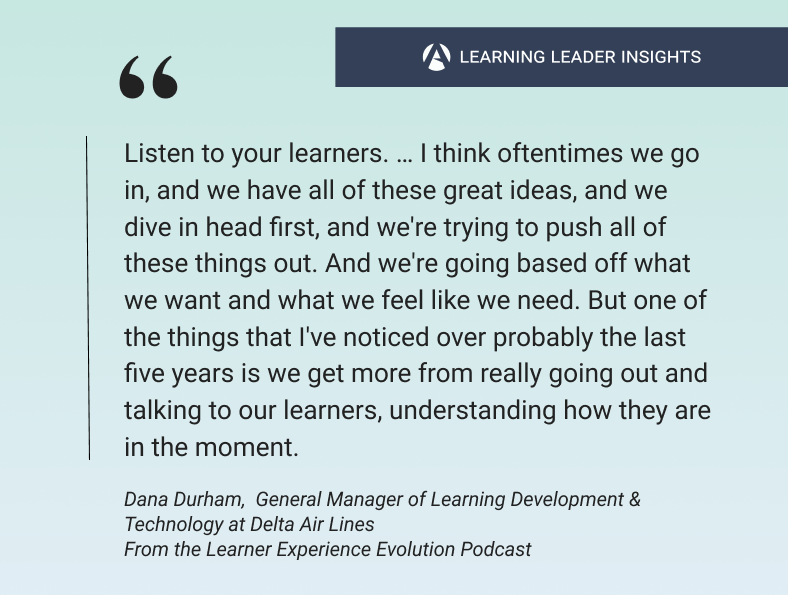
So one of the things I would have told my younger self is to listen to your learners, right? Tap into them. I think oftentimes we go in, and we have all of these great ideas, and we dive in head first, and we’re trying to push all of these things out. And we’re going based off what we want and what we feel like we need.
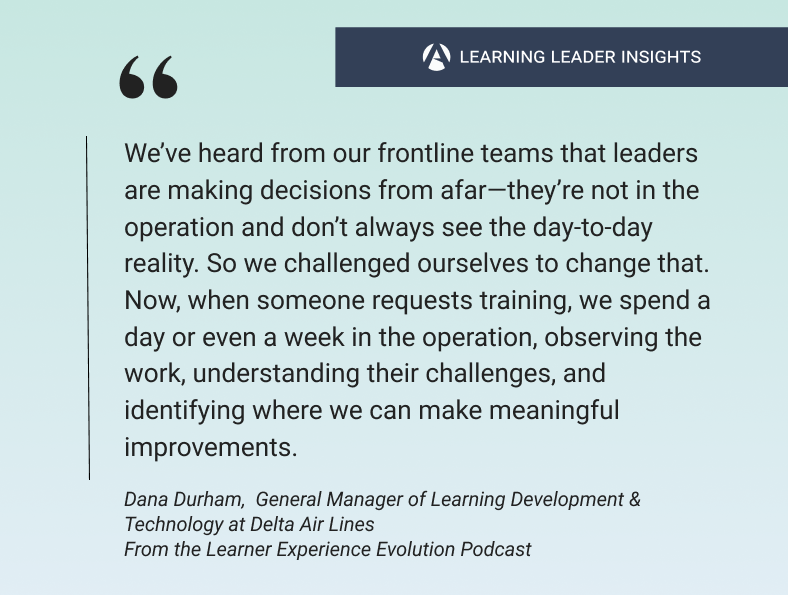
But one of the things that I’ve noticed over probably the last five years is we get more from really going out and talking to our learners, understanding how they are in the moment. We’ve heard multiple times, sometimes from some of our frontline team members, it’s like some, you know, leaders are making decisions and they’re sitting up here, right? They’re not down in the operation with us. They don’t understand the day to day. They don’t understand all the things that we’re going through.
And so one of the things that we’ve challenged ourselves with over the last several years is to go out into the operation. We do a lot of side by sides with them. If someone asks us for a training for something, we spend a day, sometimes even a week out there with them just understanding and seeing operation, seeing how it works, and seeing where we can make those improvements.
And oftentimes it is that training plus more, or maybe it’s not just pushing out of eLearning that someone can sit and take and click through. It is more of, “No, you know what, we need to really either bring them in for an IOT where we can do some more scenario-based exercises, or do we need to provide something that’s more of an OJT where they can learn things as they’re doing it?”
And so there’s multiple things that we’re learning now by really getting out there and seeing what’s happening. Because oftentimes as we sit in the office behind the closed door, and we come up with all these great ideas, oftentimes those things may not work, right?
We have people standing at a kiosk on their 15-minute break trying to take a training, but they don’t have access to headphones, right? So they can’t even … everything is in audio, so they can’t hear it. So they’re reading the closed captioning, they’re really just trying to get through to the end. Where would that training have been more effective if done or delivered in a different way?
And so those things are where we’re starting to learn more is really starting to listen to our frontline team members, and understanding the situations that they’re in, and what’s going to serve the best purpose for them is going to be the most important thing that we’ve been doing. And that I would have told myself five years ago. We would have not been able to. We were churning for a while and pushing out all the content in life. Why is this not working? But it wasn’t working because we weren’t listening.
Ron Zamir
Yeah. I’ve always heard the complaint, you know, I want to do all these great things, but I’m told what to do. My company’s reacting. I remember the post-COVID scramble to bring in employees back at the office, hire more employees. And we have to be that way.
We’re a service organization, but we have a superpower, and that superpower is that advice that you would have given yourself. Our power is that we are close to the learner, we are close to the employee. We can be their voice, and through their voice, we gain influence and then are able to innovate and say, “Hold on, corporate. Yes, this is critical, but if you want to do it, this is what we’re hearing from the learners.”
So I wish all of our listeners to take that to heart. And I really want to thank Dana Durham for spending some time with us and doing the great work she does at Delta.
Dana Durham
Yes, we look forward to the partnership across the board, not just with all, but anyone that wants to collaborate when it comes to learning and training strategies and how we continue to keep our companies at the forefront of innovation. We’re always here for great conversation around that.
Ron Zamir
Excellent. With that, thank you. And all of our listeners, we’ll see you in the next podcast.
Resources For L&D Leaders
free guide
free guide
insights | on the blog
ALLENCOMM Press Releases
AllenComm Earns Spot on Best Mobile Learning Content Providers 2026 List
eLearning Industry honors AllenComm for its custom mobile learning solutions for enterprise, built to improve performance outcomes at scale. SALT LAKE CITY, [July 29, 2026] — AllenComm has been named to eLearning Industry’s...
ALLENCOMM Press Releases
AllenComm Named a Top Employee Engagement Training Provider by eLearning Industry
AllenComm has been recognized by eLearning Industry as a 2026 top provider for employee engagement, cited for scalable, personalized L&D that drives measurable results. SALT LAKE CITY, [June 24, 2026]...
ALLENCOMM Press Releases