

ALLENCOMM BLOG | Podcast
Episode 29: How Real Problems Drive Real Learning Innovation
January 6, 2026
Successful innovation starts with real business problems — not emerging technology hype. In this episode, Ron Zamir and Adam Roesner, Director of Learning Technology and AI, dive deeper into the innovation and technology conversation, exploring how AR, VR, and AI can reduce time to competency, improve performance, and support measurable business outcomes. Even more, they share insights to help leaders looking to implement new tech in their organization get a head start on earning strong leadership buy-in, aligning learning to ROI, and positioning new tech as a tool to empower (not replace!) people.
Top Takeaways
- Innovation starts with problems
- Challenge “always done” thinking
- Clarity beats clever ideas
- Tie learning to ROI
- Leadership must co-own change
- Learner buy-in is critical
- AI augments, not replaces
- Start small with AI
- Create safe practice spaces
- Learn business before tools

Adam Rosener: Director of Learning Technology & AI at GE HealthCare
Blending a nursing background with 13+ years in Learning & Development, he designs technology‑driven learning solutions that deliver real business results. His work includes development and deployment of augmented and virtual reality training, AI‑powered learning paths, and conversational simulations that streamline capability building across complex healthcare, pharma, and medical device organizations. Adam partners closely with business leaders to connect learning to commercial and operational outcomes, with an emphasis on the practical adoption and responsible use of AI.
Ron Zamir
Welcome everybody to our podcast on innovation in L&D. For those that are joining us for the first time, we try to explore here with people in the industry how they’re able to innovate within the L&D function. We are so pleased to be joined today by Adam Roesner. He’s going to introduce himself in a minute through his personal journey.
We met through our Learning Leader Connect Forum. We’ll put a link in on the bottom. It’s a monthly or every two months meeting depending on the time of year between learning leaders, people that manage L&D functions to really discuss things like AI, like the skill-based platforms, like the tools we use, like how to manage up and manage down in this function. So if you are interested, if you do manage an L&D team, you’re welcome to join us. And again, there’ll be a link that you can follow.
So with that, Adam, my first question is always a simple one. They don’t get harder, but this is where I like to open is your personal journey. We all have our personal journey, and I would love if you could share that with our listeners and viewers.
Adam Roesner
Well, absolutely. Ron, thanks for having me on today. I actually started off in healthcare as a nurse. It was very brief, and in that time, I was fortunate enough to actually invent and patent a couple medical devices.
Yeah, and so it was a surreal experience, but in that time, once those were created, there was no way to get them out. And so, I started off at a company called, well, a medical device company. We were able to kind of push that out. And in the process of deploying that product, there was no training. And so the way that company kind of operated was, hey, Mr. 20-something, can you teach our sales forces and all our customers how to use your gadget? And that’s kind of where it all began.
That was the first step of the snowball, right? I learned every lesson the hard way. So how to approach a certain different sales team, what they care about, what they don’t care about. I made all the beginner mistakes and just jumped right into tech and spec, and I just watched the whole room of people, just … they glaze over, right? So I started there.
Eventually that product grew into a suite of products, and eventually a full-fledged learning program. And after that, that was kind of my foray into eLearning because we created an eLearning component. From there, I got picked up by a group that does eLearning exclusively, so a lot of medical research, and clinical writing, and content creation, and managing the learning system.
That evolved into … and all the content development stories under that, that turned into a larger pharma company and working with a team of several course developers and business partners and eventually a larger project of LMS consolidation, which, you know, created a lot of gray hairs.
Anyone who’s been through that process knows what that’s like. We had 13 LMSs, and came down into one. That was kind of my first dip in my toes into kind of the digital technology side of L&D that evolved into virtual reality, augmented reality, and eventually kind of where we’re at here today with AI.
I was fortunate enough to get the gamut through that whole process of commercial, inside sales, outside sales. People call it the inside corporate training component. Quality and manufacturing was in there as well. So, I’ve been fortunate or unfortunate enough to have had all the bits and pieces there.
Question 1: Driving Innovation
Ron Zamir
That’s amazing. Well, I think something is unique. We had many pretty serious people on this podcast that managed the learning function. I love your title because it’s about technology and AI. And yes, we all want AI in our title, but I know in your case, as we heard when you addressed our Learning Leader Connect Group, you put it into practice. And that’s something I would love to explore.
But before then, you know, you’ve done other great stuff. So when you look at innovation in general, if it’s VR or AR, or if it’s new ways of using eLearning, what were some of the stories that helped you or processes that helped you drive that innovation into whatever job you had at the time?
Adam Roesner
Yeah, so, you know, it’s an interesting question. I think if you were to ask anybody who I’ve worked with before, they would all tell you that Adam really hates it when people say this is the way we’ve always done it. I understand that’s a very cliche and trite thing to say, but it really makes my hair stand up on the back of my neck.
So with every team that I’ve been fortunate enough to be a part of, I’ve always said, hey, how can we do this better? How can we do this differently? I don’t just mean that as a talking point, but … those innovations that you’re asking about, they’re identified through experience, right?
I’ll give you an example. So when we first started with AR and VR, the first large launch was in a quality and manufacturing space. And one of the issues that we were facing was onboarding time and also operator re-qualifications.
The way it was always done is you would pull somebody off the line or wait for a certain time throughout the day at this particular plant to have the operator work on the machine and, you know, test, demonstrate, teach back, final test, certification, right? That took a long time. And if anybody didn’t pass their test, which happens, you’ve upset the production schedule, right? You’ve created a problem instead of fixed one.
And so one of the ways for this exercise with one my managers was how can we make this better? How do we have this not happen again? We identified a solution, which was the AR, excuse me, augmented reality and kind of a virtual reality blend where upon new hire, part of the initial, not qualification but practice for the qualification, involves in a digital twin of the machine. And before you attempt your requalification, you go through essentially an eLearning. I’m grossly underselling this, but you go through the computer game of learning how to re-qual on that piece of equipment, and you go forward from there.
Getting that deployed, it sounds great in practice, getting that deployed was a trip. There’s all kinds of NDAs and proprietary pieces of technology. There’s how do you deploy a piece of tech that your tech and governance team at your company has never seen before or has never operated before. So there’s no policies around implementing solutions like this. All of that needed to be worked out.
But having that clear vision from the beginning, clear problem statement, clear way that you want to use the solution, clear benefit, clear ROI, clear, clear, clear. That was key and that all started from that CQI process of continuous body improvement of what training is happening, how are we making this better.
Question 2: Operationalizing Innovation
Ron Zamir
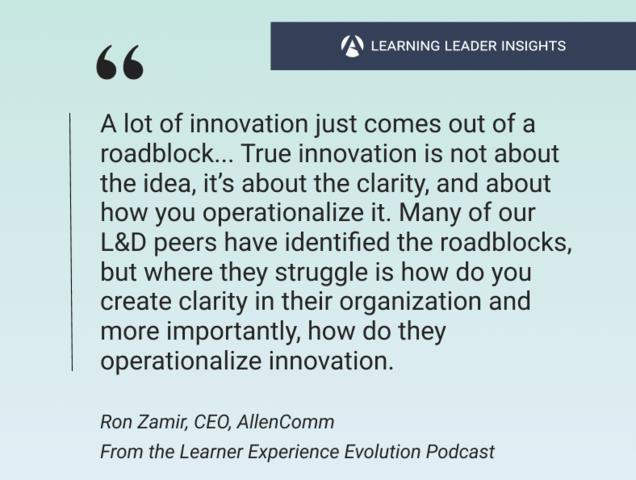
Got it. Sure. Well, let’s tease out, I mean, what excites me about … you’re saying that often we just think of innovation as disruption, right? Somebody sits and stares at a wall, stares at a screen, stares at his family and says, wow, I can do this differently, you know, or this is an unmet need, and let’s face it, we’re not all Elon Musk, we’re not all Bill Gates or Jeff Bezos. A lot of innovation just comes out of a roadblock. Your roadblock was, you know, time to competency. It was taking too long. So I think that is an amazing point, which I want our listeners to kind of ponder.
The second one, which I know we’ll get into more when you talk about AI, true innovation is not about the idea. It is about the clarity, right? But it’s also about how you operationalize it. And I think that’s what’s daunting for so many of our peers is they have the ideas. They’ve identified the roadblocks. Right? The time to competency. But where they have, where they struggle is how do you create clarity in your organization? And more importantly, how do you operationalize innovation?
And I think that’s a topic that we don’t talk about enough, so I’m so glad you brought it up. So you went through this VR process of innovation. How did you get it to stick? If it did stick?
Adam Roesner
It did stick, thankfully. Yeah, I was very, happy about that. That was also a challenge. You kind of alluded to this earlier, but change is difficult for a lot of folks, and I don’t mean to paint with too broad of a brush, but I think it’s human nature, right? We do what we did for a reason, that’s why we do it, which is why when people say that’s how we’ve always done it, that’s an aggressive term sometimes. The stickiness applied to different folks depending on their role in the scenario.
So for example, at this particular site, there were many sites, but at one particular site that I’m thinking of, site leadership was very interested in ROI, which they interpreted. Their ROI was machine uptime and that time to employee turnover. The way I made it sticky with them, and had them help me drive these changes, was if you don’t do this, we’re going to be back where we started. And by the way, we spent this money and time developing, and building, and deploying, and rolling out, and et cetera, et cetera. So help me drive this change, right?
Standard checkpoints of who is applying the technology to when and in what situations are we staying current on our training? It’s easy for me and L&D to enforce my team, making sure that we’re using it in our corner of the house, but many people run a site, right? And so my manager was only part of that.
Moving along though, even the employees who are using the technology needed to sell it. If we had built a solution which was difficult, which is uncomfortable, which didn’t make sense, which they didn’t perceive value, and by the way, the frontline employee isn’t always thinking in terms of ROI, they’re just thinking of today’s Tuesday for me. I don’t care about these abstract other things that maybe my leadership cares about … was making it comfortable, making it make sense, and also having a fun factor, which is also a bit of a loaded term, right? Fun means different things to different people, and fun isn’t always perceived as efficient. It can be both. Two things can be true at once.
And so the way that we use the augmented and the virtual reality in this particular case was not only getting to see this big complicated piece of machinery, and being able to walk around it and touch it virtually with the controllers, and take it apart and pick at it, but the machine represented … they saw in the room that we identified early that part of the reason that made the task difficult is the machines are very complicated.
It was in a pharma company, there’s a lot of, you know, banging, and pipes, and computers, and a lot of … there’s a lot of things going on in there. A new employee or a seasoned employee being able to see just what was important and have that highlighted and called out to them in their own eyes as they’re looking at the real machine, and also looking at the virtual representation, helps connect a lot of dots and come to the fun thing.
It is kind of cool to walk through the room feeling like Iron Man and feel like you have all this information at your tip.
Question 3: Getting Leadership Involved
Ron Zamir
You’re tapped into that excitement. So again, you’re teasing out some things which I don’t always hear when it comes to innovating. Again, it’s not just the idea. The clarity helps. It’s connecting to existing established ROI metrics, convincing leadership that that connection exists, but it can’t exist without their participation.
That’s what I latched on to. It’s not just, hey, I can cut down your wastage, or I can get more uptime. To do that, it’s not just a project. It’s dependent on you also helping me. But the third factor, and I’m envisioning as almost like a checkbox, the idea, the roadblock, the connection to ROI. But the fourth one, and I know that’s going to come up again, so I’m going to stress it for all of our listeners and for us, is the buy-in is not just around this really helps me, but I’m enjoying to do it. The fear and uncertainty is replaced with excitement and curiosity.
And again, this is what innovation is about. We wouldn’t be … you may like driving a Tesla because you’re saving on gas, but it’s really cool to be in. Now, by the way, I personally don’t enjoy it because I still like the noise and that oomph of a gas engine, but I’m sure I am a dinosaur in many ways.
So you got leadership involved, you got the people to help. What legitimacy, if at all, did that give you for future innovation?
Adam Roesner
Showing senior leadership the value of L&D is a fourth, I believe I’ve brought up, loaded topic, right? And what does that ROI look like? Being able to show leadership, and this is one site, we had several, it was a much larger project than the case I’m giving you, but showing them, look, here’s just a fraction of what this could be. You’ve seen this other project, you’ve seen how L&D has been a partner here.
This isn’t the only part of the business. Manufacturing quality is not only part of it. Did you know that also in your commercial organizations like L&D has identified these gaps because we see these people often, we upscale these people often, we’re on top of these trends. If I perceive you, Mr. Stakeholder, have a gap here, here’s how I would fix that. So show it.
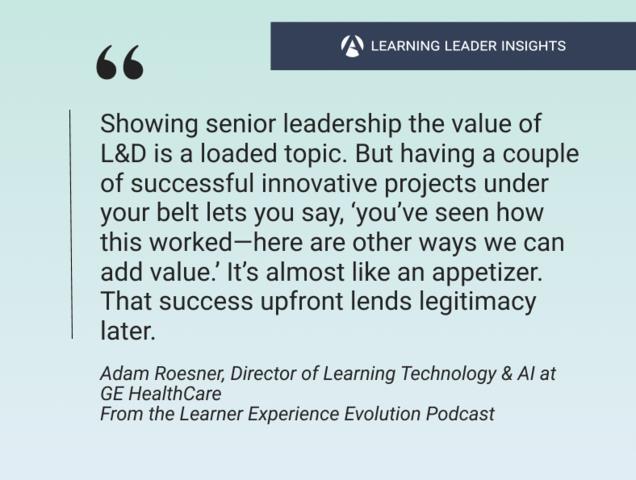
Having a couple of successful innovative projects under your belt to show value upfront lends legitimacy later because you can then come back and say, in addition to what we just did here, which has demonstrated to be a success, here’s other ways we can add value.
It’s almost like an appetizer. That’s a culture shift. And I think that’s not just in the learning culture shift. I think that’s like a wider shift. I feel like I’m perceiving throughout just the, I guess, corporate sector in general, but …
Question 4: The Journey to Adopt AI
Ron Zamir
Yeah. So, you know, when we go into these big projects, we hit these roadblocks, but we’re brought in and hoping that our stakeholder has done a lot of the work you just described. You know, we’re just, okay, we have the budget, let’s go find the vendor. And yes, let’s find a reputable vendor and all, so on and so forth.
What I always look for is what’s the client’s comfort zone? To me, in my parlance, what you described, you expanded the comfort zone by proving the vitality of this technology, by proving the buy-in and the ROI, the learner buy-in and the executive ROI. You basically changed the playing field. And now the question is, would you stretch it next?
So for me, that’s a great segue to our next kind of part of this discussion is, again, your title. It’s not just technology. It’s the plus AI. And hopefully it’s not just something that, okay, we couldn’t give you a raise, so we put AI in your title, right? There’s a lot more to it than that. So let’s talk about what it means where you work now to adopt AI into the flow of learning and some of the journey there, which I think would be extremely valuable to our listeners.
Adam Roesner
I think in a lot of ways where I’m at today has mirrored the experience of a lot of other folks who are trying to roll out AI and that we’re kind of seeing the same challenges. People are approaching it different ways. Where I have found the most success was, like I mentioned earlier, first: positioning. Here’s what I think we need to do based on what I’m seeing. Here’s our data. Here’s what we’re looking at. This is specifically how AI can help.
What I just described here specifically, how AI can help is a huge term with about 15 different offshoots and rows that can mean to different people. Generally speaking, what I find is people think you’re looking to replace, you’re looking to over perhaps automate, and we’re looking for these big giant, you know, one hit wonder like magic bullet and I’ll be all solutions. And frankly, that’s not how the world works, right?
How often do you see it like a huge disruptive piece of AI technology that just appears overnight? Looking back, it may feel like it came up overnight, but like email, for example, right? Microsoft Word, I mean, automatic car transmissions, right? Like they phase in over time. So to make it about AI… setting those expectations but alleviating fears is a big piece of adoption. So rather than how many employees can I replace with AI, right? It should be how much better can I make my team if they leverage AI? There’s a difference in those terms.
Ron Zamir
Did you see people make that mistake? I mean, are people that dense to, sorry for using that term, I don’t know anybody in your company besides you, are they that dense that they would project, we’re after your jobs? Or is it just the inexperience of how to deal with technology?
Adam Roesner
No, and thank you for asking, maybe I should clarify. It is folks feeling that the purpose of AI is to replace humans and messaging not being tailored to address that. And so those fears which are held by every employee are not being addressed by that.
Ron Zamir
So don’t ignore the fear. Yeah. Got it.
Adam Roesner
Right, so rather than positioning us as like, we need AI, if not communicated correctly, it comes off as something out of the blue. We need AI for AI’s sake. And people hear that and go, wait a minute, like, is that me? Right? Rather than, here’s how we can make all of us better to make the company better. It comes across as AI is coming for you, which is not the message you want to send.
Ron Zamir
Yeah, you know, I want to give a quick shout out to our CLO, because Anna Sargsyan, we had that concern because our people are designers, graphic artists, programmers, and the L&D function. And we knew we had to adopt AI and the positioning she took, which I was so impressed by, is AI is here to help you provide your customer with greater value.
You’re in the driver’s seat, but this opens up opportunities for you as a designer, as a writer, as a performance consultant, as a graphic artist, to deliver a product that’s so much more engaging, innovative, you know, fun. And I think topping into that personal motivation of a person to want to do better for his, you know, his teammates, for his stakeholders, for his customers, I think that that was a very powerful message. I’m excited to hear you say that.
Adam Roesner
Yeah, absolutely. And it’s not just change management. We’ve all had those change management discussions, right? But it’s more about truly being a true believer, understanding what it can actually do and also understanding what it cannot do. I’ve never encountered a person, a team or even any other companies I’ve spoken with that said, we’re out here to replace, we’re out here to do whatever.
It’s always been, at least in my eyes, efficiency. Making things cleaner, quicker, better and that self-help piece, right? It wasn’t that long ago, or if I didn’t have a certain skill, I would have to … It sounds like I’m making it so inconvenient, but Google something, look it up on YouTube, but now it’s even more accessible to me. If I don’t have something, I can talk to AI about it and start my journey there, and it can generate things on the fly.
Question 5: Identifying the Opportunity to Stretch Outside of Your Comfort Zone
Ron Zamir
So when did you have that moment like you had with the VR AI where you said you were uncomfortable suddenly, you wanted to stretch that comfort or you identified the challenge that you can solve with AI? When did that penny drop and what did you do about it?
Adam Roesner
Shortly after actually timeline wise when we were working on the AR VR project. So we didn’t just identify that problem and say, yep, this is the solution. Like that wasn’t like a five second conversation, like this is the direction we’re going. We’ve added a lot of technologies and solutions. Was it a physical training based solution? Was it like an awareness campaign? Was it an eLearning we landed on? We have a fun AR VR technology, but in that exploratory process, AI was also brought up.
And several years ago, my understanding of AI wasn’t what it is today or right now. And when I learned more about what AI could do, it seemed fairly obvious to me, like where the line of realism was, where it was like, my gosh, this could be used for … this is not just super Google. Like this isn’t just a party trick. You can use it like a party trick, but boy, this is like, that onion is like seven layers deep. We could go much further with this.
Question 6: A Real-World Example of Communicating and Managing Change
Ron Zamir
So what was the project that you feel helped you do what you did with VR? Identify an ROI, communicate it effectively to leadership, get their involvement, but also lower anxieties and co-opt the learners who were using AI. What was that like tipping point?
Adam Roesner
One of my favorite things that I’ve ever worked on actually … it sounds very simple on the surface, but it was a roleplay simulator that we deployed at some point. And the neat thing about the roleplay simulator was a lot of things.
Product training, so obvious implications there for commercial sales forces, pitch and practice and like I mentioned, product knowledge, storytelling is a big piece. These are skills that a lot of … they’re soft skills, they’re considered semi-soft skills where folks really need to practice these, but it’s awkward. If you get paired up with a person in real life, you maybe do one or two quick role plays and then you wander off topic. If you’re in front of a computer talking to yourself, it’s very awkward, it’s very unnatural. Having an AI be able talk back was game changing.
Deploying that technology, we ran into those roadblocks and those knowledge gaps that I had mentioned earlier to folks and people weren’t sure, is this being graded, is my boss saying this, is it however? So we got to build this whole fun digital dojo area for people to truly, I mean, it’s quite literally come in and like play. There are AI personas of very friendly people, very combative people, things to pick her back and forth.
Ron Zamir
Your services and products. These are buyers, people, or who are they?
Adam Roesner
Buyers, peers, manager, employee relationships, all these ways you can just come in and fire up an AI bot, and chat with it, and just get the feel of what that feels like. And then once you’re comfortable there, you can move into the, I will say the real training, the targeted, objective-driven learning scenarios. And that was a lot of fun because the biggest holdup we had was folks weren’t used to it. Folks weren’t sure what the technology did or what it meant.
But once they got to go into this experimental area, it really alleviated out of those fears. It became a really fun thing that’s very highly sought after.
In Closing: Learning from the Past
Ron Zamir
Again, one of things I want to call out because a lot of our customers, the people we service, they’ll focus, especially if they’re centralized in a large organization, on pure soft skills. There’s an initiative to make the managers better in performance reviews. There’s compliance issues that they want to get better attention to. There’s not just communication skills, leadership skills, people that would go from one level of leadership to another. We love those projects.
But you did something that I think is worth for people to pay attention to. You connected the ROI related to things that are measured like product sales, like sales cycles, like things that are real and the organization tracks already, you know, to the soft skills that AI is so attuned to. And I think again, I hear the echoes of your project in the manufacturing environment with this project as well.
Maybe I’m just doing as an outsider. You can tell me I’m full of nonsense, but I really like that. And that’s a message to anybody contemplating AI. Don’t be afraid to connect to the things your company measures. If you can show that any technology, AI is just … tomorrow will be something else, you know, that connects to the things that organizations measure, if it’s sales cycles, if it’s compliance breakdown, if it’s manufacturing waste.
We’re involved with projects now, especially in the call center space, which I know is less maybe relevant in your organization, where the length of a conversation costs the organization money. The NPS scores impact the company. How can these dojos, and that’s your copyrighted term, and nobody else I know uses, you know, AI dojos, in my opinion. So that’s really exciting.
I want to kind of move into our last segment, if I can. Okay, you have this journey, a nurse, an inventor, worker in small, medium, to very large companies. What would you today? What would you tell that either nurse, or aspiring inventor, or person who now finds himself with an L&D function? If you could go back those years and knowing what you know now, what advice would you give them?
Adam Roesner
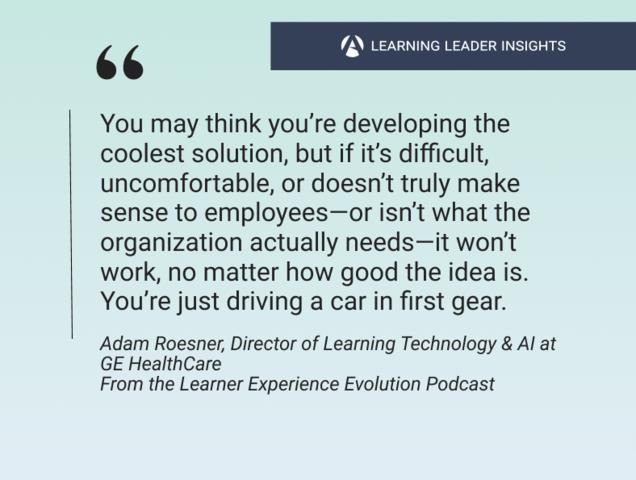
I think I would say that maybe a couple of things, but the chief amongst them would be to slow down and learn, learn the business, learn the ecosystem that you’re in. You may think that you’re developing the coolest, neatest, and greatest solution, but if it’s not exactly what the organization needs or what your stakeholder is looking for, it’s not going to be … it’s like driving a car in first gear at all times. You didn’t quite deliver them what they needed. And if it’s not what the requester of the business needs, you’re not going to have the help you need. And it’s not going to have the results you want.
The other half of that though, is in addition to not being afraid to kind of experiment with stuff, because for every success, we’ve all had like 10 failures behind it, things we don’t talk about that didn’t work out like the AR VR, or like AI, or like some of the devices we patented. The newest shiniest solution is not always the best one, which I know is contradictory to the way we’ve always done it statement I made earlier.
There’s a lot of folks who will come to you with like, this is going to solve all your problems. I would strongly encourage you to take a long hard look. Make sure you understand your problem before you going down the road of shiny, new, cool, we’re doing this from now on.
Ron Zamir
I like that. mean, I always bemoan the fact that we mostly celebrate success. We don’t often encourage failure. And I’m not sure we can do that openly, but I look back at my own career path and it grew from failure. It didn’t always grow from success. It grew from being a bit more, not cynical, but questioning, not accepting, but still being optimistic that you can make a change as a person.
So with that, Adam, I really want to thank you for talking about these things. I love your title. I want to see more of those titles, Director of Learning Technology and AI in our industry. And I’m sure this just opens up a conversation. And again, I encourage people to reach out to you on LinkedIn, join LLC and be part of the conversation.
So thanks a lot, Adam. And with that, we’ll sign off for another podcast on innovation in L&D. Thanks a lot.
Resources For L&D Leaders
free guide

free guide
insights | on the blog

ALLENCOMM Press Releases
AllenComm Earns Spot on Best Mobile Learning Content Providers 2026 List
eLearning Industry honors AllenComm for its custom mobile learning solutions for enterprise, built to improve performance outcomes at scale. SALT LAKE CITY, [July 29, 2026] — AllenComm has been named to eLearning Industry’s...
ALLENCOMM Press Releases
AllenComm Named a Top Employee Engagement Training Provider by eLearning Industry
AllenComm has been recognized by eLearning Industry as a 2026 top provider for employee engagement, cited for scalable, personalized L&D that drives measurable results. SALT LAKE CITY, [June 24, 2026]...
ALLENCOMM Press Releases