

ALLENCOMM BLOG | Podcast
Episode 30: How to Turn Learning Data Into Measurable Business Results
February 10, 2026
This year, L&D is reaching even greater heights — and it’s an exciting shift! Follow along with Ron Zamir and Paul Core, Global Partner Development at Siemens, as they discuss this velocity of change (and what leaders like you can do to get ahead of the curve). They cover it all: L&D partnership opportunities, improving sales effectiveness, embracing AI to drive market intelligence and anticipate skill needs, and more. So … are you prepared to keep pace with the rapid business change ahead? Paul’s rare dual perspective and experienced advice may just give you the inspiration you need to take that next step.
Top Takeaways
- L&D success depends on business success
- Let data guide learning decisions
- AI drives speed and personalization
- Mobile microlearning is essential
- Measure behavior, not completion
- Personalization boosts results
- Connect learning and business data
- Treat partner enablement like employee training
- Agility is a core L&D skill
- AI users will outperform others
- Design for outcomes, not roles
- Experimentation drives innovation

Paul Core: Director, Global Partner Development at Siemens
Passionate about learning, emerging technologies, and driving results, [Name] is currently the Director of Global Partner Development at Siemens, where he focuses on building scalable, high-impact programs that enable partner and customer success worldwide. With over 15 years of experience in support and consulting leadership across both private and public sectors, he brings a proven ability to lead complex, global initiatives from concept to full execution. Recently, he led a complete transformation of the Customer Success Manager onboarding experience by designing a scalable, agile LMS program driven by customer user stories, which exceeded user adoption and monthly active user targets. Known for strong partnership, analytical, and communication skills, he is a goal-driven leader who thrives on tackling challenges, inspiring teams, and delivering meaningful business and learning outcomes.
Ron Zamir
Hello, everybody. Welcome again to another podcast about innovation in the L&D space. Today is a really interesting episode. We were kind of going out of our own comfort zone and inviting somebody that works with L&D on the business side of a large company. I’m going to welcome Paul. He’s even going to introduce himself.
But I want to stress again for all of our viewers, listeners. There are two sides to the equation. L&D is only as successful as the business units they work with. So we’re excited to do more of these types of podcasts going into the future.
With that, I welcome Paul Core and wanted you to start us off. Talk about yourself a little bit, your journey, and what brought you into this intersection between L&D and business.
Paul Core
Yeah, sounds good. We could go pretty far back in my career. And there’s always been that intersection all the way along through all the jobs I’ve had.
Currently, I work for Siemens Digital Industry Software based here in the DFW area in Texas. And I sit inside of the partner ecosystem. So part of my role is focusing on system integrators and our services partners, but across all motion, sell, service, and build that our partners do. I’m on the business side, but I leverage very, very heavily the learning and development capabilities that we have within the company and essentially external vendors like yourself at AllenComm to achieve the outcomes that we’re looking for from a partner enablement standpoint.
It started though, a long, long time ago when I was in high school in Los Angeles, kind of going way back, but I was actually hired to teach teachers how to use the Scantron machines, because the school that I was at, Garfield High School in East Los Angeles, it was the first time they were rolling out Scantron machines. I remember that because one of the key lessons that I learned that stayed with me all these years is that different people learn in different ways.
And so teaching school teachers how to go from grading paper exams to Scantron forms using the computer … Some teachers, you could just give them the concepts and in five minutes they understood, and they’re good to go, and they move on. And there’s other teachers on the other end of the spectrum where you actually had to sit down with them and give them that verbal example of instruction and how to do it, give them the tactile, hold it in your hand, now push it into the machine and do all that. And learning styles all the way in between.
You kind of had to adapt what we do, or I had to adapt what I do, in order to be able to get that message across. And that’s something that’s carried through with me through the Army as a training officer in the Corps of Engineers all the way through to what I was doing at NASA, and Boeing, and of course today at Siemens.
Different people learn in different ways. And if you are going to be effective, the training that you produce, regardless of who produces it, the training that you produce has to be effective for the audience that you’re targeting. That’s kind of stuck with me all these years.
Ron Zamir
Yeah, and I think we’re going to get into it in some of the later questions coming up on how technology is helping us create that personalization, or that adaptation to different learning approaches.
So you’re in the business unit, you’re responsible for the results or some of the data related to the actual partners, or I guess you’d call them resellers in some way or form or supporters. What are some of the opportunities you’ve seen in working with L&D? Where has that been an accelerator for the business? And I know we like talking about data, so feel free to give us a cool example. You just say that and you smile. I mean, it’s obvious, right?
Paul Core
I love data. I look at data and trends and exactly data. It’s really interesting. Like you mentioned, I sit on the business side. So I’m constantly looking at … me and my team, my leadership. We’re constantly looking at trends, which way the industry is going. What does the buyer journey look like? Not just today, but in the future, you know, which direction do we need to go to be ahead of the curve?
And the thing is, is that it all boils down to making sure that the partners inside of our ecosystem, and even our employees, because it’s the same process.
Ron Zamir
A great question that comes to mind, knowing how you straddle both the business and the L&D is where have you identified opportunities where the business uses L&D in very specific ways, very data-driven ways that help the business? So we’d love to hear your journey in that area and some examples for our listeners.
Paul Core
Yeah, absolutely. Absolutely. It’s really a convergence of multiple things. One is just the intelligence about where our ecosystem is going and how we can anticipate the skills and capabilities that are needed for them to be successful in the future.
The second part of that is just constantly looking at data. We measure everything. We’re looking at the consumption trends. We’re looking at how people consume it, what devices they’re consuming it on, what they find valuable, the ratings that we get back.
We analyze all the data to make sure that whatever we produce in the future through the learning development organizations and contractors like yourself, that we’re basically tuned to the way that our audience is going to consume that training in a meaningful way. The business side of it, we’re going to determine where we want people to be from a skill and knowledge standpoint to make sure that they can thrive, you know, 12, 24, 36 months from now.
We’re going anticipate that. And that’s part of the intelligence gathering. For what it’s worth, we use AI now every day as a part of our jobs to understand the direction of the industry, basically look across, instead of reading trade journals and reading transcripts of industry reviews and things, we’re having AI help us in that and try to hone out what the trends are, the directions, and anticipate where the buyer’s journey is shifting now and in the future, what are the hyperscalers play in there and how are the trends actually affecting the software business today and in the future.
So we’re using AI as a part of that, we’re measuring everything, and then all that creates the requirement that we have for training and enablement that L&D helps us build. So we’re trying to stay ahead of the curve, we’re trying to anticipate where we need to be, and that training is innovative enough to leverage how it’s being consumed and deliver a message that people need to know in the future.
Ron Zamir
So you bring up a critical point here, I think, that the velocity of change is weighing what we ever believed it would be. I mean, for those of us who’ve been in the industry for a long enough time, we thought that electronic-based learning would create more velocity, right? We were able to do stuff quicker. We had software platforms to do it. And now with AI, the business units are pushing for change more rapidly.
So the question becomes, you know, from our industry, we’re not just giving heads up, hey, we have this requirement, we’ll get back to you in a few weeks, we want a proposal on how you would address this. Now that’s zipping in a lot quicker because you’re getting the data quicker and the data is being processed. So, in that world of more velocity, more change, how have you set up yourself to be successful and how have your demands of L&D stayed the same or changed?
Paul Core
Well, I mean, our entire team is pretty agile and that we’re able to respond to changes very, very quickly. It’s the culture that we’re in inside of our company here just to be agile, to be responsive, and to be able to pivot. And we just consider it an entrepreneurial spirit within the company. We’re a small team supporting a very large, multi-billion dollar ecosystem.
Yet we’re agile enough where if we see a trend or there’s an indication of a trend in the buyer’s journey, or requirements around training, that we can pivot, and shift, and work very quickly to close that gap or deliver on that training.
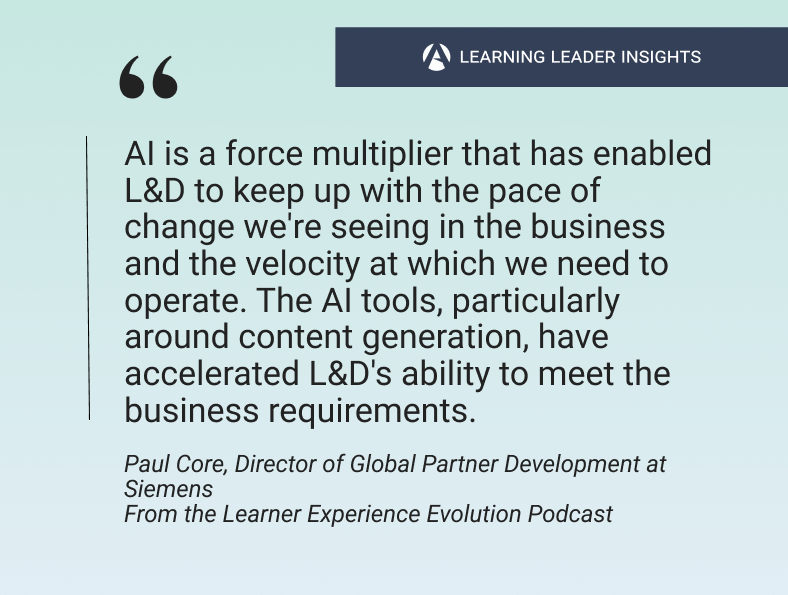
The interesting thing though is that L&D has not traditionally been able to keep up with the demands of the business. And AI has really been a force multiplier there where now L&D is able to keep up with the amount of change that we’re seeing in the business and the direction that we want to go with the velocity that we want to operate at. And it’s been the AI tools on content generation and things like that that have accelerated the ability of L&D to match what the business requirements are and what we have.
I will say that our in-house delivery on that has been, how should I put it? We’ve had the ability to reach outside the company to look for innovation in the L&D space, and get some examples of how companies like you do it. I mean, we’re partnered with you right now on a few really, really interesting courses and curriculum that is really challenging the way that we’ve done L&D in the past. And we’re pretty excited about it.
It’s actually infusing AI into that learning experience in a way that you can make decisions and change the content on the fly based on the interactions with the individual learner. And we just don’t have that capability yet in-house. So we appreciate that we as a company have the flexibility to reach out and leverage that innovation where we can find it.
Ron Zamir
Yeah. I mean, it’s obvious we all in our personal lives as well as our business lives look for experts. I picked up on something which I would love your opinion. It’s almost like there’s a tale of two cities, to quote a famous author. You know, have all these stories that AI is going to replace L&D, it’s going to replace the creative component in a company, marketing, L&D, you name it. That’s the dark city, right? That you’re going to be replaced, you’re going to be too slow, technology could do better.
But then there’s the … I would call it the golden city, right? Which is now using these tool sets to be a better partner, to react quicker, right? To be lot more integrated into the data flow of the business, right? To personalize. And I think that’s where at AllenComm we’re coming at this, it’s not that, you know, it’s harder to find a partnership, it’s that you could bring more to the partnership. And I would say that’s an area you’re describing as an important message, both to a lot of the people in our industry that are worried, to the people in our industry that are saying, I now as an individual can do a lot more for my business partner because I have access to the data streams on one hand and the creative tools on the other in order to create the right learning and training opportunities as the market changes.
Let’s talk a bit more about data. You looked at, hey, these are five new data points I’ve collected over the past few weeks. And you don’t have to be too specific because of commercial interests, if there is once something that, wow, that is really different, what would you pick up on?
Paul Core
Well, not necessarily in the last few weeks, but maybe the last few, you know, six months or so. It’s how the enablement is being consumed. The trends that we’re seeing right now because of the data that we’re collecting, because we’re just trying to measure everything. We’re seeing more and more done on the mobile devices. And I’m not talking about tablets or laptops. I’m talking about, you know, cell phones. Sales rep walking into a meeting, has about 30 minutes while they’re sitting outside the office.
And what we’re seeing is within an iPhone or an Android device, they’re actually pulling up some very specific content that we’ve created for them that teaches them about, here’s how you have this conversation, or here’s how you have that conversation. Here’s how you position this or that. And it’s not technical in nature. It’s actually the soft skills stuff that we’ve created the L&D content for.
That’s been the first thing, because it’s been interesting. Not just the fact that it’s on a mobile device, but the amount of time that they have available to consume it. And it’s really kind of driven our thinking around how we want to add more modularity into our training, make the training smaller. And I know that this is a trend of adult learning, but make it smaller, make it more compact, make it easily digestible on the fly on a mobile device, specifically on an iPhone or an Android device so that somebody can literally take 5 minutes or 10 minutes before a meeting or on a subway train or whatever, and just start consuming that content in bite-sized chunks.
Traditionally, we have looked at anywhere from 30 minutes to an hour as being a sweet spot and assume that a person’s going to be on a laptop or a desktop, maybe a tablet device. It’s just not that way anymore. And it’s really the latest trends and looking at the analytics and data that have led us to that conclusion.
Ron Zamir
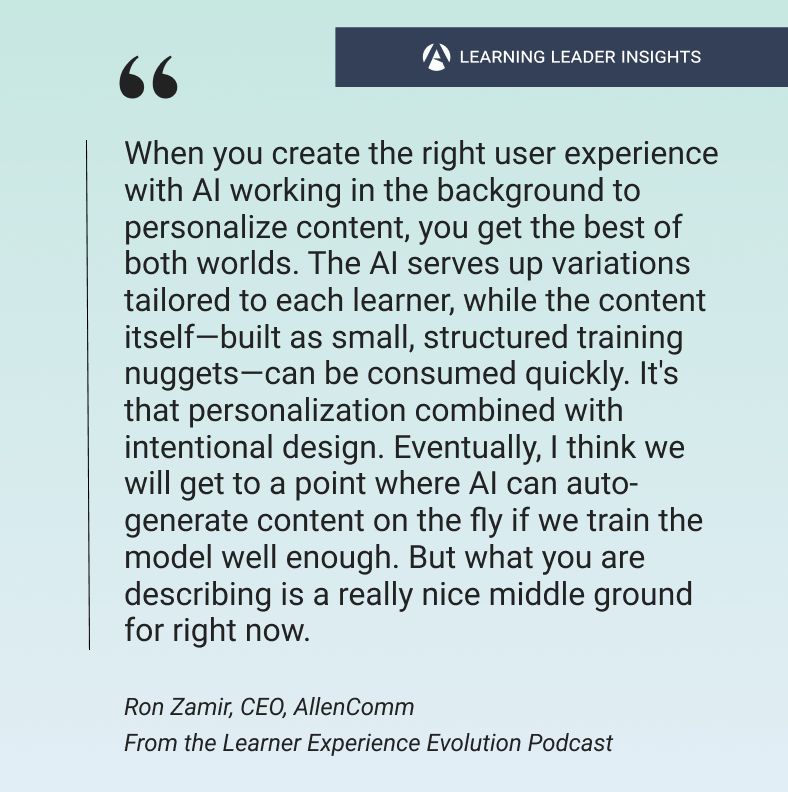
Yeah, and I know we’re to talk a bit about the potential of AI more, we’ve been fascinated to see, and again, I’m taking the user’s perspective like you just did versus the designer’s perspective, that when you create the right UX design, the right interface, and you may have a partial AI backend to help you navigate or personalize the experience, you can have the best of both worlds. The AI capability gives you the ability to serve up variations of content, which are very personalized to the learner.
But the content itself, which you’ve built into small chunk size training nuggets, which have a structure, can actually be consumed very quickly. So it’s that personalization plus a more designed approach versus the other option. And I think we’ll get there, by the way, is where if we can educate the model enough around your content, we can auto-generate some level of content on the fly.
So I think what you’re describing is a really nice middle ground right now. And I would love when I talk to you, maybe even in six months, to see where have we progressed, are you able to see the data on, OK, this has made me the actual results of that better prepared? What have you seen in that part of the equation?
Paul Core
Yeah, there’s lead indicators and lag indicators, right? I mean, obviously the lag indicators are, we’re looking for big change in revenue, we’re looking for big change in new logos and the typical things that a business is looking for. But the lead indicators are, are those intermediate milestones of the demand generation, creating enough leads, creating enough things inside of that pipeline, they’re going to lead to the opportunities that we have.
When we’re looking at creating new training to get ahead of the changes in the customer’s buying cycle, we’re specifically looking at how do we influence the behaviors in this particular area? And we do that very specifically with the measurements that you’re asking about. We need to be able to say, if we’re going to create this training, the expected outcome is, and here’s how we’re going to measure that inside of the ecosystem to determine whether or not we made a good investment or a bad investment.
And by answering those questions upfront and anticipating how we’re going to measure that to drive success, we’ve been pretty successful at driving the change in the influence that we’re looking for.
Ron Zamir
Yeah, you’re seeing the behaviors you want, and you know that that’s another layer of the cake. A lot of a lot of organizations, and I’m sure including in some areas your global organization of Siemens, are trying to design words based on skills. These are the skills the organization needs, and then a lot of the requirements come from what skills do my employees have? What skills do the jobs need? And how do I match those two things together?
But what you described, I think, is even a more exciting transformation of how we impact change is the ability in using AI analytics, not AI concentration, is to look at behaviors, is to extrapolate from different activities, not just the learning that the employee did or the reseller did, but actually there was leading indicators that you described and extrapolate a behavior matrix.
We’re pretty excited here at AllenComm about that. We see that a lot in projects where we can put the learner through a conversational simulation, an activity simulation of one sort, and the AI background is able to not just collect and rank what they said, how they said it, how long they took to say it. It’s that, but also extrapolate from other data being pulled in from data lakes around, okay, this employee or this team has had this much impact in different indicators.
And while I think that some of the systems out there are not there yet, some of the BI systems, we are looking and hoping a lot more connectivity between those worlds, the observational world in the learning process, and the analytical world in the business measurement process. So I think those are going to be exciting days for all of us.
Paul Core
It’s funny that you mentioned it because we kind of learned that lesson the hard way. We had invested a bunch of money with actually one of your competitors. It wasn’t their fault. It was our fault. We didn’t know specifically what to ask for. We built out this entire training package around how to establish customer success as a part of the SaaS transformation in the software partner business.
And what we learned is that the consumption was extremely low. People were fixated on the role. And they were basically throwing up a blocker because we didn’t position, we didn’t market it right. We developed it for the wrong audience. But getting to exactly what you just mentioned, which is the behaviors, the motions, the skills, the individual micro skills that an individual needs in order to be successful to do those customer success things.
Once we pivoted over to that and had the micro learning, and taught skills, and outcome-based training that resonated with the things, the tasks, the activities they needed to do to be successful in the SaaS world, then it changed the dynamic. And we saw a huge uptake, and we could actually measure the impact that that training had, where before we had almost zero adoption, even after a pretty healthy investment.
So you’re right, that’s the trend that we’re seeing. And we appreciate that AI kind of takes that to a whole nother level in the way we describe it.
Ron Zamir
Yeah, and that’s a good segue. I don’t want to be cliché, but we’re all either active in how AI is changing our jobs and our ability to influence the environment we’re in, or we’re talking about it, or we’re reading about it. And sometimes every conversation has two letters in them, AI somewhere. We’re changing our job titles. I get resumes now, you know, AllenComm has been blessed that we’re hiring right now. And it seems that everybody has AI in their job title. And when you get down to it, of course, it’s not as obvious.
But let’s talk about AI in the context of how you see your resellers working and where you see AI playing a role, not just to train them, but also to enable them to be more successful.
Paul Core
Yeah, we’re an AI-first organization. We’ve embraced it as a company. Big Siemens has embraced it as a company. We have a lot of massive investments in leveraging AI. For the partner ecosystem, we even built out a multi-LLM interface, and we give that to our partners at no cost, and we preload it with a lot of our sales capability and our marketing capability to help them do demand gen and go out there and do selling.
So it’s exactly what you just mentioned. Our expectation is that our partner ecosystem is going to use the AI tools to be faster and more effective at the processes that they’re assigned. So a sales rep is going to use that to figure out where they should spend their energy from a prospecting standpoint, and where they should spend their energy inside of that organization. Who do they need to talk to, and how do they get to that person inside of the organization who makes the decisions?
They can do that the old way, which is a lot of research, and LinkedIn, and contacts, and phone calls, and emails. But in reality, we built out some training with our L&D. I think you guys even helped with a couple of the modules. And we’re teaching them how to use AI as a part of their job every single day. And not just using the LLMs that we give them access to, but we’re constantly updating it with the available tools because it’s AI out there every day, there’s something new.
And if we can leverage that in a positive way to get to revenue faster and to expand the footprint, or the penetration, or the size of the portfolio that we have with our existing accounts, then we need to leverage all we can to do that.
I subscribe to the … Geoff Woods, he wrote the book on AI and leadership. And you mentioned Tale of Two Cities, best of times, worst of times. I honestly think that, you know, Geoff Woods describes it as there’s two groups of people that are going to be here in the future. There’s those that do AI and use AI as a part of their job every day. And those are the ones that are going to thrive. And then there’s going to be those that don’t.
And AI is not necessarily going to replace people, although job trends might tell you otherwise. The reality is that it’s AI, or people that use AI, are the ones who are going to replace the people that don’t use AI. And I subscribe to that. So anything that we can do today to infuse AI into the daily lives of our partners and even our employees, then we’re trying to leverage that and bring that capability in there.
Ron Zamir
Yeah, the example you gave on a person doing it through LinkedIn or doing it more manually versus now having access to a tool. Again, we’re all worried about the replacement, and history has shown that when new technology comes in, some jobs are replaced. But when you look at it, when you go up a level and you look at employment and what people are doing or enjoying, it’s how they’ve been able to reallocate their efforts in new ways using technology, right?
I think we’ll still be seeing doctors and maybe lawyers will be accessed differently and maybe even doctors, but for sure Siemens as a software company is going to take a lot of advantage of this. I do want to mention, because I know that we work together on this with your team, is sometimes the most powerful way AI can be deployed is helping orient the person on where their gaps are, where their strengths are, where their weaknesses are, and enable them then to build their own journey on what they want to learn and pull from what the company offers them.
So that issue of self-assessment and evaluation is something that, especially when it doesn’t have to be tracked, right? The idea is that when I want to learn a new skill and apply it to a new job, because I think there is a hierarchy here. There are tools I can access that will help tell me where I need to focus my efforts. And I think that actually touches on personalization, right? When I first was told about some of the stuff your team is doing, I latched onto that, that understanding that we can use technology to help people be more efficient and learning a way.
Okay, so we’re going back to your teacher example, right? Of learning in their way. Any other examples you want to bring on the AI front? You know, I think we’ve talked a lot about it, but I’m always keen to know what excites the people I invite to the podcast. So where are you most excited about AI?
Paul Core
Well, your team has actually helped us bring a new level of experience in our training and enablement. It’s what you described about gather a little bit of data during that training experience to frame what it needs to look like, and then tailor that training to close the gaps on things that they don’t necessarily know.
For us, that’s basically just cracking the door open of what the potential is for creating an entirely different learning experience that’s going to be customized and tailored. But it’s not just from an L&D perspective, and it’s not just looking at the individual learner that gets us excited. When we can bring the convergence of what the capabilities are of the organization, what their business plan looks like, what do they intend to do in the next 12 to 24 months with their customer base? What new markets are they going after? What new logos are they going after? How are they going to expand their portfolio?
And then we bring that into the learning and development experience so that we can tune and customize and say, hey, these are the skills that you have. You’ve demonstrated this. This is the capability that we can see. But through AI, I think that we can accelerate that, bring in all these other data points and create a very bespoke, very customized learning experience that’s tuned not just to what the capabilities are that we need within the business, but also what the learning style is of the individual who needs to consume that.
So we converge all that together, and AI is at the crux of all of that happening. I think that we’re going to create a much more effective learning and development experience, and I’m pretty excited about it.
Ron Zamir
You hit on that other layer. It’s not just about velocity, AI learning us to do stuff quicker, better. It’s not just about personalization, which we talked about a lot. It’s actually a nexus for converges of different data sources that are now at the palm of the hand, you know, of the individual needed to deliver whatever activity they do for themselves or for a company.
I’m going to ponder that a bit. That convergence message is something that we don’t hear enough about. We assume it, but that AI layer that will enable us to pull in not just the data sources, but also the experiences that that individual needs is pretty exciting.
Let’s get to kind of one of my favorite questions, which we tend to ask at the end of the podcast. And it’s really about, you know, we’re going through amazing times. But beyond those times, there’s things we’ve learned along the way. And if you had to now had a chance to talk to that same young guy who just joined NASA, I mean, you have such an interesting resume, or just joined Boeing, what advice would you give them?
Paul Core
Honestly, I would just go back and say, don’t be afraid to take chances. Just have good ideas, be creative, think outside of the norms that you see around you all the time and take chances. Don’t be afraid of failure. Don’t dwell on failure, but don’t be afraid of taking chances. And it gets back to that entrepreneurial spirit. Just see what an opportunity is and be very creative about how to do something that’s going to be a unique position within the industry, or unique position to solve that problem that’s in front of you at the time.
And I took a long time to learn that lesson, but it is threaded in my DNA today. I’m always looking for ways, and data is a huge part of that, but I’m always looking for ways to be creative, to solve problems. It’s kind of what leads us to some of the trends and what we’re trying to do with AI in learning and development today.
That’s what I would tell my younger self is don’t learn that lesson the hard way. Take advice from others. Take chances. Be creative. Be experimental. Entrepreneurial spirit. And do that early and fast.
Ron Zamir
Yeah. We hear that a lot. I always wonder, how do we train for that? How do we train people to not avoid risk? How do we train them to embrace failure as a learning experience? Maybe there’s an AI agent for that as well. Who knows?
With that, I want to thank you so much for joining us, Paul. I think you brought a new voice into our usual conversation and I really, really appreciate that. I want to thank you a lot for joining us, and hopefully you got something out of it as well, because we sure did.
Paul Core
I did, and I really appreciate the opportunity to come in today and have this conversation with you. So again, thanks for the opportunity.
Ron Zamir
Thanks a lot. Well. that’s a wrap guys, and we will see you all in our next episode.
Resources For L&D Leaders
free guide
free guide
insights | on the blog
ALLENCOMM Press Releases
AllenComm Earns Spot on Best Mobile Learning Content Providers 2026 List
eLearning Industry honors AllenComm for its custom mobile learning solutions for enterprise, built to improve performance outcomes at scale. SALT LAKE CITY, [July 29, 2026] — AllenComm has been named to eLearning Industry’s...
ALLENCOMM Press Releases
AllenComm Named a Top Employee Engagement Training Provider by eLearning Industry
AllenComm has been recognized by eLearning Industry as a 2026 top provider for employee engagement, cited for scalable, personalized L&D that drives measurable results. SALT LAKE CITY, [June 24, 2026]...
ALLENCOMM Press Releases