

ALLENCOMM BLOG | Podcast
Episode 31: Building a Resilient Workforce in the AI Era
March 17, 2026
Here’s a new question that’s taking L&D by storm: How do leaders effectively transition their organization from an old capabilities framework to a new, meaningful skills-based approach in today’s market? Well, this podcast episode has the answer! Follow along with the discussion as Ron Zamir and Dr. Shveta Miglani cover common challenges—and how to overcome them—when adopting a skills-based L&D strategy. When done right, you can improve employee performance, introduce cost savings by amplifying internal talent, accelerate AI adoption for better (more efficient) outcomes, and become a future-ready business.
Top Takeaways
- Skills frameworks replacing traditional competency models
- Skills link talent strategy to business decisions
- Start planning with Build Borrow Buy or Bot
- Most companies lack reliable skills data
- Poor skills data drives reactive workforce planning
- Self-reported skills data is often unreliable
- AI simulations improve real-world skills assessment
- Skills frameworks require clear governance
- Assign ownership for skills data management
- Continuous learning enables workforce adaptability
- Employees want learning opportunities
- Leaders must protect time for learning

Dr. Shveta Miglani: Author and former Sr. Director of Global Learning, Development & Skilling at Micron Technology
Dr. Shveta Miglani is a distinguished leader in organizational development, talent management, and career coaching. With over two decades of experience, she has held pivotal roles at industry giants such as Micron Technology, GlobalFoundries, SanDisk, Palo Alto Networks, Google, and Salesforce.
She is a passionate advocate for empowering professionals through personalized coaching and strategic initiatives. Her expertise has made her a sought-after consultant and speaker at leadership panels and key events, including those with Josh Bersin, USC Marshall School of Business, and several global Chief Learning Officer events.
She has also been featured on Times Square New York, Fox News Chicago, Forbes, CEO World Magazine, Fast Company, Yahoo Finance and several industry podcasts.
Her best seller book Navigate Your Career – Strategies for Success in New Roles Promotions, is an essential guide for anyone stepping into a new role, offering practical advice and actionable strategies to ensure a smooth and successful transition. The book is a culmination of Dr. Miglani’s extensive experience in coaching and mentoring professionals, providing readers with a comprehensive toolkit to navigate the challenges of a new job with confidence.
Ron Zamir
I’m excited today to be joined by Dr. Shveta Miglani. Dr. Miglani is part of our Learning Leader Connect network, a group of people that meet every other month to talk about innovation and how to do better both in the talent and in the L&D space. I won’t take a long time on any of this, but I do want to introduce Dr. Miglani, and she’s going to talk about herself a bit, and then we’re going to dive right into it.
So I’ll call you Shveta if that’s okay for the podcast. Okay, so why don’t you talk a little bit about your journey into talent, and then we’ll take on some of the great topics we want to talk about.
Dr. Shveta Miglani
Well, thanks Ron for inviting me for this amazing podcast. My journey has been a little unplanned. I was supposed to be a journalist when I came to the US to actually do my master’s, and then decided, well, I’m much better as a designer, as a people person. And I moved, and I did my master’s then not in journalism, but rather in instructional technology. And that’s how my journey really started. It’s been 25 years.
In that journey, I’ve had the pleasure of working in amazing tech companies like Google, Salesforce, Sandisk, and more recently, just Micron. And it’s just been an amazing journey of learning from how cognitively people actually understand what they have to learn for their current roles, how we as organizations can help them to get better, and then what role do we play. So it’s just amazing, and continuous learning has been the key for my growth.
Ron Zamir
Yeah. I’ll also mention that you are a published author, and we’ll talk about that later in the podcast. And what I like, and I’ve always said that between talent and L&D the lines are blurred, that you’ve made kind of that transition from L&D to talent, and maybe back and forth. And that’s a great place for insights. I hope we can tease out some of what you’ve learned along that journey for these amazing companies.
Let’s get into some of that journey, specifically a big issue that’s preoccupied our space now, and I think that is bringing talent and L&D together, is the move to the skill-based taxonomy or platform. There’s a lot of technologies involved, but it’s really a basic relook in how we define our workforce and how those definitions drive our growth and our success.
Let’s talk about that a bit. What was your first engagement with the skill-based taxonomy, and where have you taken it throughout some of the jobs you’ve done?
Dr. Shveta Miglani
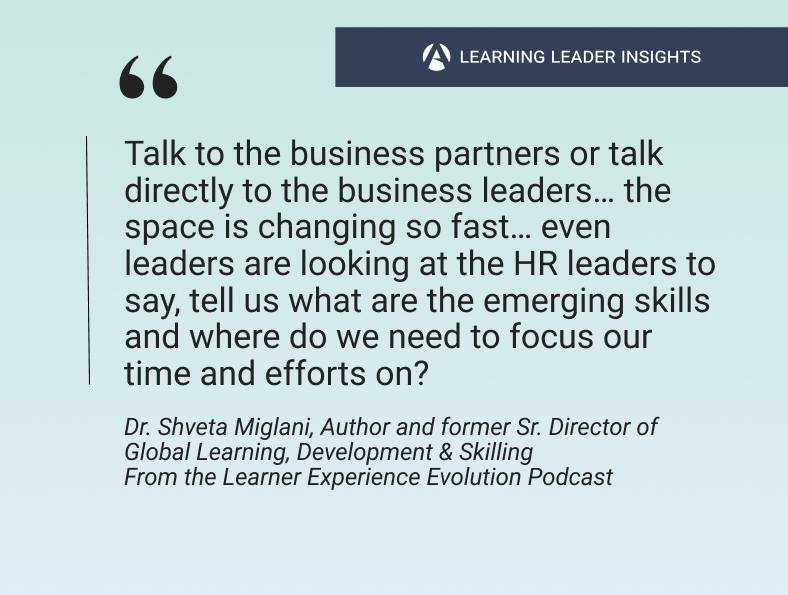
Yeah, I’ll take a step back when we think from an L&D perspective, I’ve always seen companies talk about, what should we design for the business? Well, the easy answer is talk to the business partners or talk directly to the business leaders.
And in the last few years, one of the things we were noticing that the space is changing so fast in the tech industry at least, and I’ve heard the same in healthcare, heard the same thing in finance, that even leaders are looking at the HR leaders to say, tell us what are the emerging skills and where do we need to focus our time and efforts on?
And that’s when I have always seen either sometimes people end up getting a template and saying, let’s focus on these three skills that you’re seeing other companies do, or something that they are pulling out from their old playbook.
But the reality is the best way to actually design a roadmap for your businesses, for your companies, is actually understanding not just what the business wants, but also working with the best benchmarking systems in the industry. For instance, you have systems like Lightcast, or so many other vendors that provide emerging skills in front of you. Taking that, working with the recruiting team to understand where we are, doing workforce planning with the organization, and then coming up with the idea, do we build, borrow, buy, or bot?
Those are the four areas that people are working on. And I think that’s where skills really plays such a strong role is because it helps you to see the gap. It helps you to then create a roadmap and a strategy, not just from an L&D perspective, but even from a talent management perspective. And honestly, from a whole HR perspective to say, where do we hire? Where do we place our bets? Where can we actually build those skills internally? And what do we do internally when we have larger companies?
So for instance, my last company, we were a manufacturing company, and we had a lot of knowledge in Asia because as we all know, in the US, manufacturing had left for the longest time. But now with manufacturing coming back, one of the best things we did was we actually did a lot of assignments for our Asia region leaders, the borrow piece, right? And that build, buy, borrow to come here and set up the teams for the next two to three years because that’s the fastest way we would get that knowledge in.
I think that’s one of the best ways to utilize skills. That’s where I have actually, I was introduced, and that’s when it helps you to create those next steps and those next roadmaps.
Ron Zamir
So to be a little of a devil’s advocate for the sake of this conversation, those of us that have been doing this for a long time, AllenComm started, you know, in more knowledge-based activities, competencies became very popular. We’re doing a lot of manufacturing training because of all the manufacturing that’s supposed to come back to the US.
Where have skills given us better resolution than, let’s say, a competency-based framework or a knowledge-based framework? Things we’ve used in the past. What is the innovation you believe will come out of this newer approach around skills?
Dr. Shveta Miglani
A couple of things. One is easy, ease of understanding the whole approach. I have been part of the competency—I would say “journey”—myself, getting certified in that, trying to educate leaders. I think for our own, I would say negative part in HR, we over complicated it. We made it very hard for people to understand. And when I say we, I mean, within organizations.
I’m sure the founders of competency, I don’t know who they were, but whoever came up with that brilliant idea, really good thought on paper, but the application of it was getting tough. And that’s where people love the idea, but they got lost in the circles. Skills, on the other hand, has been much more easier to not just access, but also to understand and to actually deploy within the systems that we have.
So for instance, during the competency journey, we still didn’t have systems that helped us to plug and play fast. We still use Excel sheets. That’s what my memory is. We didn’t have systems that talk to our SAP data of understanding. For instance, if Shveta is with the organization recently, what competencies is she bringing from the outside, and what competencies does she need to grow in her current role and obviously her aspiration?
Well, since we have taken that narrative, and we’ve put that in the skills journey in a much more easy manner by not just giving a blueprint, but also giving systems … and kudos to the industry for doing this, so that you can plug and play and you can actually start showcasing the data. You can start showcasing dashboards and you can help leaders to make decisions faster.
Ron Zamir
So for our listeners, it’s two aspects which you mentioned, which I want to highlight because I think they are the core of a deeper discussion. Let’s say between skills, competencies, and knowledge is that unified language. And one of the reasons we’re excited here at AllenComm about the skills transformation because it enables talent and L&D to work better together.
And as you said, it really enables us to communicate across the organization in a way that a stakeholder could understand. Here, what are the skills you need for this job? And again, jobs also confuse things, right? Because is it a competency? It’s a job? It’s a skill. So the agreed upon nomenclature is better. But the other thing you said is the resolution.
Are skills more transportable from an organizational perspective than competencies? And I get very excited when I look at resilience in an organization, a term that corporations don’t use, but the military uses them, first responders use them. It enables us to get to that point of, are we ready for the future? Are we resilient?
And from your experience, if you look at the companies you worked for, how did moving to skills make them better, stronger, more nimble? Can you? Kind of pinpoint some examples.
Dr. Shveta Miglani
I think the jury’s still out on that one because we have not really come to that, even the first milestone to say, yes, skills have really helped so-and-so organization at a large or at a scalable level. Now, at a smaller level, I’ve seen a lot of changes. So for instance, one of the companies I worked for, wanted to … same thing when we were doing workforce planning, looking at what the business needs, there was a lot of discussion about data analytics, and the company needed more analysts around data.
And that’s when we sat down with the leaders to make a decision on build, buy, borrow, or automated through bot, right? And then once we decided that they want to invest in building a workforce around that, we actually went back and we worked with a lot of our partners like Udemy, Udacity, all these organizations in the industry to say, what do you have already pre-packaged?
What can you customize for our organization? And what can we actually get ready in a faster manner? So that was one thing that I think the results were very fast within a year’s time. And I say fast, a year sounds a little late, but when you’re building skills internally, you need that much time to look at, well, not just getting certified, but are they applying it for the job instantly?
That instant gratification of application of their skills, not just by the individual for their growth, but also for the organization to say, yes, it’s worth spending that money. I think that’s the key. That’s where the results are absolutely important.
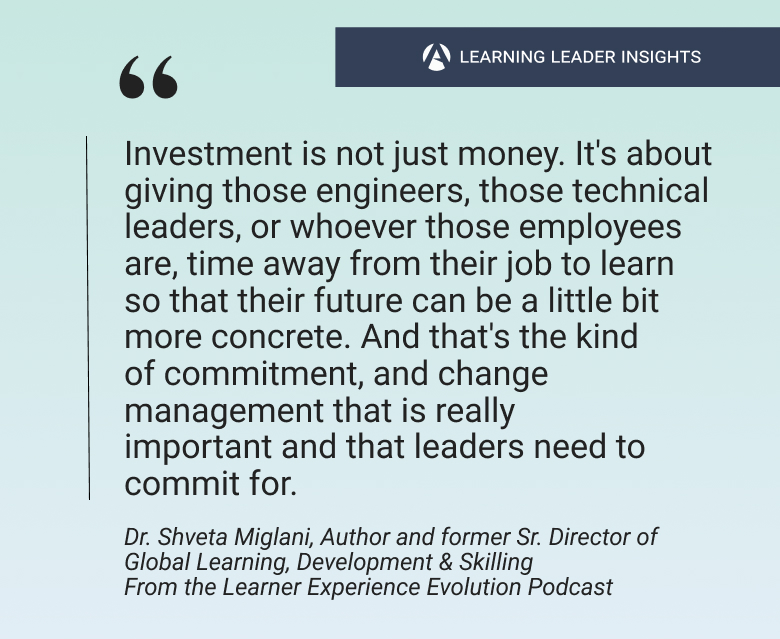
And that then feeds back to the rest of the organization to say, great, if this function could do it, maybe we need to put that investment too. And investment is not just money. It’s about giving those engineers, those technical leaders, or whoever those employees are, time away from their job to learn so that their future can be a little bit more concrete. And that’s the kind of commitment, and change management that is really important and that leaders need to commit for.
Ron Zamir
Yeah. You got me thinking about a lot of stuff, so I hope our listeners are enjoying this as much as I am. One of the areas I have a concern about is that the longevity of a skill. We’re now in the quickest, fastest transformation I think business processes and roles have ever been. So what is the job today versus the job next week? It’s not even next month, next year is moving so quickly.
How do we build stability into our skill taxonomies? You know, the concerns we’re having when we meet with clients, we’re doing so many new, what we used to call needs analysis. Now it’s really helping them define their skill taxonomy. Some, as you mentioned, they get from outside. We’re even looking at how JD Powers and some really traditional benchmarking organizations. And then we also have all the data coming out of LinkedIn, which they’ve mined for years.
How do we inject more stability into the skill taxonomy when the jobs are changing so quickly? That’s my first interesting question. And my second is … how do we control our leadership inside the organization from thinking that a skill is really basic and stationary versus how business constraints can change how they define even what a skill should be?
So let’s talk a bit about how do we build resiliency into our skill taxonomy?
Dr. Shveta Miglani
So Ron, I think both the questions are interrelated, especially the second question that you had there, because at the end of the day, the stability or resilience, as you said, they both come from the organization giving space to the employees in making time in building those skills.
So when I talk to mid-level professionals in companies where they have been there for six plus years and are going all the way to maybe even 20 years, the biggest problem that they face is yes, they’re doing their job. Maybe they had some talent mobility within organizations, but they don’t get the time to go beyond what they can. And the organization sometimes take very swift decisions to say, great, so and so is not going to be part of the future or the new org. Let’s let go of this team or this person. And mainly it’s the teams that we are seeing getting rid of.
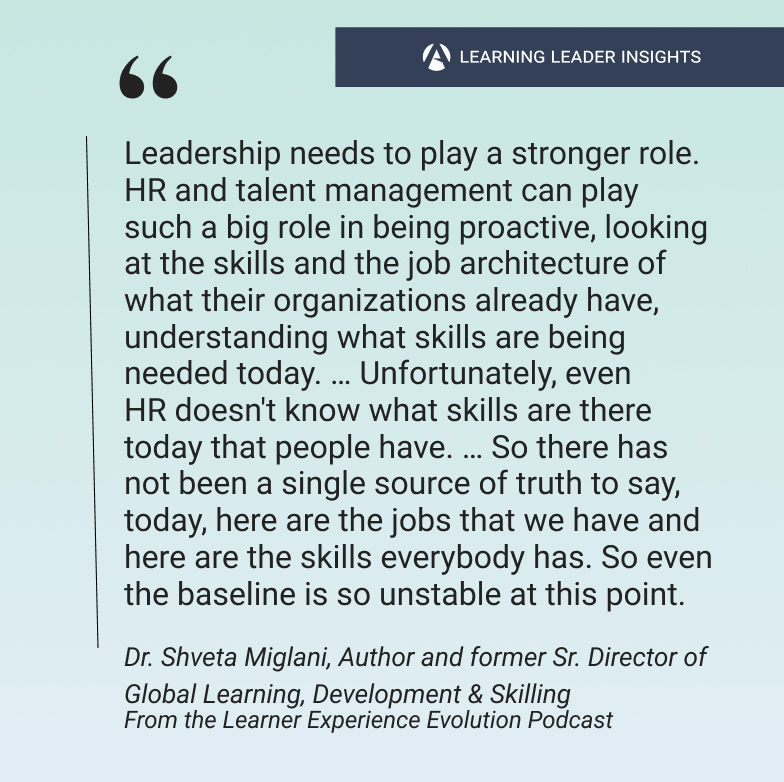
And that’s where the leadership needs to play a stronger role. And I think HR, talent management can play such a big role in this, in being proactive, looking at the skills and the job architecture of what their organizations already have, understanding what skills are being needed today. And I’ll just pause there for a second before I talk about, you know, the whole summary of this question, which is … Unfortunately, even HR doesn’t know what skills are there today that people have.
The only reason is because a lot of work has been done on Excel sheets. Those Excel sheets, maybe they were sitting on people’s laptops. If they left, that knowledge has gone out from the organization. So there has not been a single source of truth to say, today, here are the jobs that we have and here are the skills everybody has. So even the baseline is so unstable at this point.
The companies who have had that data, for instance, Microsoft or the larger companies, they’ve been proactive in making sure that they’re looking at their job architecture and saying, okay, these are the job descriptions. These are the skills that we have inside our company. And this is where we can help them to create a roadmap for the future. And stability comes from constantly giving the opportunity to learn.
Those companies, so I do a lot of consulting also. I talked to a company, but they said, we’ve not even done any management fundamentals training for a long time. So that is where I get a little bit scared because I know those organizations have not given any learning opportunity to their employees. So when the time comes to shift or to actually learn a new skill, they’re going to have a hard time.
I give this example of going to the gym. If somebody tells me, go and lift this much weight in the gym suddenly one day, I won’t be able to do it because I’ve not built that muscle. Learning and cognitive learning is the same thing. You need to build that muscle on a regular basis.
So I’ll give you a fantastic example. A country like Singapore does these five to 10 year roadmaps and they actually give their people money to learn. They don’t tell you what to learn. They say, just keep on learning. You can learn to garden, you can learn to cook, you can learn to any Python, you name it. But as long as you’re continuously learning, you’re building that muscle. And today, they actually have a centralization within the government that looks at all the skills that their people have, which is, I think, a fantastic approach in the long run.
So to answer your question coming back to the summary is … It comes back to the leaders in the organization to be able to be proactive, give commitment, time, and effort to the skills strategy. And then it’s upon the employees to adopt it. I think employees are hungry, but they are scared sometimes that if I take time away from my day job, will my manager get angry? Right. But if you build a culture where learning is the most important piece, that’s where the stability will come.
Ron Zamir
Yeah, you know, it’s again, when I talk to some of our clients who are using a lot of the platforms that are out there, the ROI or what sells the project is, “I could do a better job hiring faster, but more importantly, I could find the needs of my organization within my organization,” right? There’s a high cost of hiring from outside.
So the ROI just by shifting the outside to inside, my challenge is I find that very tactical because when I talk about resilience, it’s more about into the future, kind of what you mentioned about Singapore. And this is where, as an organization like AllenComm that tries to advise clients on setting this up better for the future and then support those processes, we’re seeing that the value chain can break.
So the value chain, okay, I’ve just adopted Workday skills framework, and maybe I even have Eightfold to give me more AI into how I’m going to project it, or maybe I will be an early adopter of Asana so I can actually take those skills and create some learning interventions around those skills and do better measurement, is that they’re relying a lot on self-reporting.
So talk to me a bit about the assessment side, because one of the ways to ensure, when we were doing competencies, it had inside a very assessment-based format. While skills are more about, hey, here’s a job we need, we have a technology-based app to see who had those skills, who says they have those skills. How do we interject more assessment? More checking into the whole skill framework?
Dr. Shveta Miglani
So that’s such a great question. In fact, we had an example in my previous company where the company was so large and every organization had their own way of assessing where somebody wanted a rating scale of five, versus somebody wanted something simple as basic, intermediate, and advanced. So when we were building the blueprint within Workday to identify the assessment pieces, that’s where something that we ran into.
And I’ll go back to change management that we as leaders had to work on to get agreement on what is the right way to move forward. So once we agreed on it, then came the part like you mentioned, how do we make sure the assessment is accurate or fair? Does the individual go in and actually just put in, I am advanced at this level, and then what do we do for a second level of assessment? So we actually, as a technical company, wanted to make sure that the leaders had a say in it, and the leaders felt that they were part of the process, not just the employees.
So we did it in phases where we didn’t do an immediate leader assessment, which was if Shveta goes in and she puts in she’s advanced in communication, my manager won’t see it immediately. We let it sit for six months. And we actually encouraged our employees to have those conversations with their managers before the managers gave their assessment confirmation within the system.
The reason being is, for most of us who have gone through performance management in our lifetimes, a lot of what gets documented stays, it sticks. And that creates a fear, a peace within the organization and the people. And then they don’t want to give accurate assessments or they don’t even want to fill up because they go like, I’ll do it later. So they found procrastination as a way of getting away from it.
And lastly, I would say the industry was also not helping with so much news about layoffs, right? So when you go to somebody who’s been with the company six, seven years above, 10, 20 years, and you ask them, hi, Ron, here’s a system, go in and put in your skills that you think you’re good at, suddenly they’re thinking, wow, why do they need my skills now? So there was a lot of pre-work that we had to do to make sure they understood that. And so that’s how we tackle that is defining what that level of assessment looked like and that what approval looked like.
Now, one difference we had was at the VP level, reporting directly under the executive management, that we had a third level of assessment there where we had the business partners also provide some input. And we just did a pilot for that. We didn’t put that at scale because we wanted to see, we getting a triangulation of accurate skills for this high level business leaders?
So I think that was a good approach. It might work for some companies, it might not for the others. But I think it goes back to understanding the culture of your company and saying, what is the right way to govern this in the long run? Because more people touch the system, like job architecture. When we went into our job architecture data, we realized it was completely all over the space because more than 200 people had touched it in the last few years.
The governance piece then becomes so important as part of attaching to the assessment. How do we do it? How do we audit it? And how do we make sure it’s updated on a regular basis?
Ron Zamir
I think you bring up an important takeaway, you know, we could spend hours just discussing this, is that the easy part, which in itself takes time, is to set the threshold. These are the skills I need and connect them to jobs or connect them to any other structures, roles or jobs in my organization. The hard part is how to govern it, the governance.
And governance is not just assessment, it’s also what data is collected, how is it brought in, you know, if you’re using AI, how are you policing those AI assumptions that are created on the fly? So what guardrails are you putting in? There’s a lot of issues that I think will come around, gender discrimination, other things that have to be guardrailed into the system, right?
We still have jobs that are predominantly tied to one sex or another, and I think that there’s biases into that need to be dealt with. On the assessment side, I think that’s the real Achilles heel. Our current assessment strategy is based on 180, 360 assessments, certification-based, test-based assessments, very low-level self-reporting type assessments, and I think that we’re using old world paradigms for a new world approach.
And this is where we get excited at AllenComm because we’re starting to use AI-driven activities in our learning design to pull out observations tied to behaviors. So any simulation that you’re asked, we do this a lot for call centers, leadership and sales. It’s scary how easy it is to do it now where you can build a lot of stepping stones within your engagement process with an employee where they get a chance to exhibit activities or behaviors that then can be assessed for certain skills that go into those behaviors.
You know, we’ve always worked in one direction. We’ve tried to influence behaviors through learning. I think we can now do a better job in analyzing current behaviors, create that benchmark to really assess what skills or what ranking and what skills does an employee have?
Now there’s a lot of governance around that as well, stuff I mentioned. Where do you think the assessment world will go in the next few years? Or let’s take a future looking approach. If you were now three years, we had the same podcast in the world of AI, maybe even next month, where would we be in the whole skills-based idea or concept?
Dr. Shveta Miglani
I think because the systems are connecting so well these days, for instance, we were a Microsoft shop in my last company. So even the generative AI used was from Microsoft with all the firewalls and everything nicely done. So for instance, when I did my assessment of my team, I had 45 people reporting to me. I would just go into the system and say, what was my last conversation with XYZ? And what have they done in their development goals? Bring it all together.
For me as a leader, it made things much easier to put everything under one space rather than me looking at a Word document, or Excel sheet, or my own written notes. So for me, that’s the same idea that I think in the next few years, not even few years, like you said, in the next few months, we’ll start seeing the adoption of to seeing how organizations can use the data in a more comprehensive manner.
And that’s the assessment pieces can be built in to say how quickly is Shveta responding to her emails. The service level agreements, I know how many times internal service level agreements never work when let’s say IT is supporting HR for a project, or HR is supporting a business for a project, and those SLAs go out the window because nobody’s keeping a track of it.
So by interconnecting the systems internally, having one truth of data, which is a data warehouse. I know in my last company, we were putting everything under Snowflake, which was a really big undertaking. But those are the things that we have to do as organizations because we can have the best laid ideas to say, let’s get in this system. Let’s put this philosophy in place. But if they don’t talk to each other in the backend, it’s still going to be so much manual work for that individual, for that leader to actually get results.
Automated decisions and assessments are going to play a big part under that umbrella, right? And so the philosophy and the framework can still be the same fundamentals, but how we use it within a system is something that I think is going to be adopted much faster.
Ron Zamir
I would love our listeners to suggest terminology because I am, my core belief is that the whole word assessment is going out the window. When you are recording conversations, when everything you do is being collected, the ability of AI-driven systems to create a picture of what a person does well, not well, where he’s at level one, level two, level three, can be an interesting future, even though it’s scary for us because it’s a black box.
But we’re talking about the future now. I can tell you that the interim approach, at least that we’re taking with our clients, is we are encouraging to use more a type of simulation-based activities within a learning journey so they can not only give feedback in the journey itself, but that data can be collected later to … let’s call it certified again.
I think these terms all have to change to certify a person on, you know, within the levels of the skill set. We use this internally at AllenComm to onboard our team members to use of AI, but that’s a very micro case. We’re 50 to 75 people having to go through that. But now scale that up to a recent project we did with 30,000 call center personnel.
You know, how do we, if they have skills around, soft skills around, you know, empathy, they have hard skills around being able to use the right nomenclature, the right language, connect people to the right systems or procedures, how do we interject simulations into the process that we provide our customer with new data, which helps them understand, even if it’s not communicated to the learner, understand where they’re at now and where the gaps they have to close into the future?
You’ve been in this industry quite a few years, from when you came over to do your master’s, as you said, to where you have done leadership positions, some pretty big companies. If you could give advice to yourself then, when you are just getting your first job out of your masters, what would you tell yourself, knowing what you know now?
Dr. Shveta Miglani
That does take me many, many years back, but no, no, all good, all good. Continuous learning is something that’s helped me, and that’s why I was able to make these changes. I wish I had expedited a lot of that, moved faster, just rolled up my sleeves and jumped into the, you know, into the actual ditch to actually learn. And sometimes your work keeps you away from it.
So my advice to people in this journey is continuous learning is important. Don’t get frustrated with AI. Use AI as your partner. And I think that’s where you’ll find the answers. That’s where you’ll find satisfaction. And you’ll find you’re more productive as you use these tools in a faster way.
So the tools have changed. Earlier, we used to have all those editing tools from Adobe, right? That you all jumped in and we learned. And those rendering tools, you imagine how many times our systems used to fail. If you didn’t have a Mac, things would not get resulted in the right way. But all said and done, patience is very, important and understanding how to use that when you’re learning is really important. That would be my example is patience, continuous learning and expedited. Don’t wait for tomorrow.
Ron Zamir
So I’ll add one more and that’s going to intro to my last thing I want you to talk about is I would add curiosity. I think that’s the underlying factor in all those things. So I’m curious about the book you just published. Can you give us a one minute synopsis, if you can do that, into what drove you? You can show us the book cover, your career, navigate your career. So let’s talk about that for a minute.
Dr. Shveta Miglani
Thanks, Ron. So Navigate Your Careers, just as the book says. I wish somebody had given me this playbook many, many years ago when I was in my professional career, but it’s never too late. It talks about what are the seven skills you need to actually make sure you’re successful in your current role, and what can you do to aspire for that next role.
And it is like a playbook giving you step-by-step advice, giving you examples. I have actually interviewed people from Adobe, MasterCard, Zapier, you name it, large companies, small companies, even from a global perspective. So no matter where you are in the world today, pick up the book. It’s there in Amazon. It’ll give you a real good advice on what you can work on today because things don’t happen by chance. You need to plan for it.
Ron Zamir
Well, that is amazing. Again, the book link will be in our show notes. Thank you again, Dr. Miglani—Shveta, which I prefer to call you. This has been great. Thank you, Shveta, and we’ll see you all this format in our next podcast.
Dr. Shveta Miglani
Thanks, Ron.
Resources For L&D Leaders
free guide
free guide
insights | on the blog
ALLENCOMM Press Releases
AllenComm Earns Spot on Best Mobile Learning Content Providers 2026 List
eLearning Industry honors AllenComm for its custom mobile learning solutions for enterprise, built to improve performance outcomes at scale. SALT LAKE CITY, [July 29, 2026] — AllenComm has been named to eLearning Industry’s...
ALLENCOMM Press Releases
AllenComm Named a Top Employee Engagement Training Provider by eLearning Industry
AllenComm has been recognized by eLearning Industry as a 2026 top provider for employee engagement, cited for scalable, personalized L&D that drives measurable results. SALT LAKE CITY, [June 24, 2026]...
ALLENCOMM Press Releases